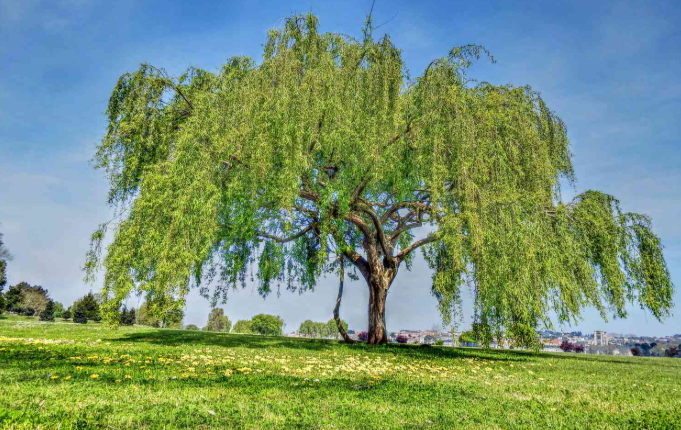
If you want shade quickly, choosing a tree that can put on several feet of growth each year can make a noticeable difference. USDA Zone 7 offers a particularly broad selection because its relatively moderate winters allow gardeners to grow both northern and southern shade-tree species. From enormous tulip poplars and hybrid poplars to river birches, maples, oaks, and bald cypresses, there are plenty of possibilities for creating a useful canopy.
However, fast growth should not be the only consideration. A tree that grows 5 feet a year can quickly become much larger than expected. Extension specialists repeatedly recommend considering mature height, canopy spread, soil conditions, root characteristics, and proximity to buildings before choosing a shade tree. Fast-growing trees can also have weaker wood or shorter lifespans than slower-growing species.
The growth rates below are approximate annual height growth once trees are established under favorable conditions. Actual growth in your Zone 7 garden may be slower or faster depending on moisture, soil fertility, sunlight, cultivar, pruning, and other site conditions.
1. Hybrid Poplar
Growth rate: 4–6 feet per year
Hybrid poplars are among the fastest-growing shade trees available to gardeners in Zone 7. Under favorable conditions, poplars can put on approximately 4–6 feet of height in a year, and some selected clones can grow exceptionally rapidly. USDA Forest Service research has documented hybrid poplar clones averaging 4–6 feet of annual height growth at test sites in Pennsylvania and Maryland.
The rapid growth is impressive when quick shade is the goal, but hybrid poplars need plenty of room. Their vigorous root systems and susceptibility to storm damage make them a poor choice for planting immediately beside a house, driveway, septic system, or underground utilities. They are better suited to large properties where their mature size and rapid growth can be accommodated.
2. Eastern Cottonwood
Growth rate: 3–6 feet per year
Eastern cottonwood is another exceptionally fast-growing native tree. Young cottonwoods can put on several feet of height annually under favorable conditions, making them capable of producing a large canopy surprisingly quickly. Related cottonwood data from the USDA Forest Service show young trees growing roughly 6–12 feet per year in especially favorable conditions.
Cottonwoods are best suited to spacious properties with deep, moist soil. Their enormous mature size, aggressive roots, brittle branches, and abundant cottony seeds make them unsuitable for many residential yards. If you have a large acreage and need rapid shade away from buildings, however, their growth rate is difficult to beat.
3. Tulip Poplar
Growth rate: 2–4 feet per year
Tulip poplar, also called yellow-poplar, is one of the fastest-growing large native hardwoods for Zone 7. It eventually develops a tall, straight trunk and broad canopy, while its distinctive tulip-shaped flowers add ornamental interest in late spring. USDA Forest Service research has recorded young yellow-poplar growth of roughly 2–3 feet per year on good sites, with particularly vigorous sprouts capable of growing even faster.
This is a magnificent tree for a large landscape, but it should not be mistaken for a small-yard shade tree. Tulip poplars can become extremely tall, so give them plenty of room from the beginning. In a large Zone 7 property, few trees combine rapid growth, height, flowers, and a substantial shade canopy quite as effectively.
4. Silver Maple
Growth rate: 2–3 feet per year
Silver maple has long been popular with homeowners who want a tree that produces shade quickly. Young trees can grow rapidly when they receive adequate moisture and have little competition. USDA Forest Service research describes silver maple as a rapid-growing species and records young trees reaching about 12.5 feet after five growing seasons under intensively managed plantation conditions.
Despite its impressive growth rate, silver maple requires careful placement. Its shallow, extensive root system can interfere with drainage and underground infrastructure, and its branches can be prone to breakage. For these reasons, it is generally better planted well away from structures and paved areas rather than directly beside a house.
5. Weeping Willow
Growth rate: 2–4 feet per year
Weeping willow is one of the classic fast-growing trees for creating shade near water. Its long, cascading branches create an instantly recognizable silhouette, and a healthy tree can develop a substantial canopy relatively quickly. UGA Cooperative Extension classifies weeping willow as a fast-growing tree suitable for Zones 6 through 9.
The biggest limitation is its need for moisture and space. Weeping willows perform best in moist soils and are particularly appropriate near ponds and other water features. Their extensive root systems mean they should be kept well away from septic systems, water lines, foundations, and underground utilities.
6. River Birch
Growth rate: 1.5–3 feet per year
River birch is one of the more versatile fast-growing shade trees for Zone 7. It develops an attractive rounded to oval canopy and has exfoliating bark that provides winter interest after the leaves have fallen. Several cultivars are available, allowing gardeners to select forms with different habits and mature dimensions.
It is especially useful where the soil remains consistently moist. UGA lists cultivars such as ‘Dura-Heat’ and ‘Heritage’ as fast-growing trees, with mature heights commonly reaching around 40–50 feet. River birch is generally a more practical residential choice than some of the extremely fast-growing poplars, although it still needs adequate room.
7. Autumn Blaze Maple
Growth rate: 2–3 feet per year
Autumn Blaze maple is a popular hybrid maple selected for rapid growth, attractive form, and brilliant fall color. Its leaves can turn vivid shades of orange and red in autumn, giving the tree ornamental value beyond its shade-producing ability.
The tree can eventually reach approximately 45–55 feet tall with a canopy around 30–40 feet wide. UGA Cooperative Extension lists Autumn Blaze maple for Zones 6 and 7 and describes it as a desirable shade-tree choice. Give it full sun and sufficient space for the mature canopy.
8. Red Maple
Growth rate: 1.5–3 feet per year
Red maple is one of the most adaptable shade trees for eastern North America. Its relatively quick growth is accompanied by attractive foliage that can turn brilliant red, orange, or yellow in autumn depending on the cultivar and growing conditions.
Zone 7 gardeners have a wide selection of red maple cultivars, including forms chosen for stronger branching, improved fall color, and more predictable shape. Unlike some extremely fast-growing shade trees, red maple can provide a useful combination of reasonably quick growth and ornamental value.
9. Pin Oak
Growth rate: 1.5–3 feet per year
Pin oak is a tall, pyramidal oak that can develop into a substantial shade tree. Its lower branches often droop toward the ground while the upper branches grow upward, producing a distinctive layered silhouette. UGA lists pin oak as a suitable shade tree for Zones 6b and 7.
Pin oak prefers moist, acidic soils and performs particularly well in landscapes where soil moisture is reliable. Because it can eventually become a large tree, it is best suited to spacious yards rather than narrow planting beds.
10. Willow Oak
Growth rate: 1.5–3 feet per year
Willow oak is an excellent large shade tree for warmer parts of Zone 7. Its narrow, willow-like leaves give the tree a finer texture than many other oaks, while its broad mature canopy can provide extensive summer shade.
UGA Cooperative Extension lists willow oak as a shade-tree species for Zones 6, 7, and 8 and describes it as a medium-growing tree that can reach approximately 40–60 feet tall. It prefers moist, fertile soil but can adapt to a range of conditions.
11. Nuttall Oak
Growth rate: 2–3 feet per year
Nuttall oak is a fast-growing oak that is particularly useful when you want the durability and long-term presence of an oak without waiting as long for a canopy to develop. It produces a rounded crown and can eventually become a substantial shade tree.
UGA Cooperative Extension describes Nuttall oak as a fast-growing shade tree reaching approximately 40–60 feet tall. It is particularly well suited to moist soils, although established trees can tolerate a wider range of conditions.
12. Sweetgum
Growth rate: 2–3 feet per year
Sweetgum is a vigorous-growing shade tree recognized for its star-shaped leaves and spectacular autumn color. In favorable locations, it can develop a large canopy relatively quickly, making it useful for homeowners who want substantial shade.
The main drawback is its spiny, spherical seed capsules, which can accumulate beneath the tree. Seedless cultivars are therefore preferable in many residential landscapes. Purdue Extension also identifies sweetgum as a fast-growing shade tree while noting the nuisance created by its spiny fruit.
13. American Elm
Growth rate: 2–3 feet per year
American elm was once one of America’s most important street and shade trees because of its graceful, high-arching canopy. Disease-resistant cultivars have renewed interest in the species, allowing homeowners to obtain the classic vase-shaped form with better protection against Dutch elm disease.
Modern selections can make excellent shade trees when planted where they have adequate room. NDSU Extension specifically highlights disease-resistant American elm selections such as ‘Jefferson’ and ‘St. Croix’ among fast-growing shade-tree choices.
14. Thornless Honeylocust
Growth rate: 2–3 feet per year
Thornless honeylocust is a useful shade tree for gardeners who want a broad canopy without the large thorns found on wild forms. Its fine-textured foliage allows filtered sunlight to reach the ground, creating lighter shade than trees with very dense leaves.
The tree can tolerate a surprisingly wide range of urban conditions. Purdue Extension recommends thornless honeylocust as a fast-growing landscape tree, while CSU Extension describes it as a shade tree adaptable to a variety of sites. Cultivars vary considerably in mature size and form, so choose one appropriate for your property.
15. Bald Cypress
Growth rate: 1.5–2.5 feet per year
Bald cypress is one of the best choices for wet or periodically saturated areas in Zone 7. It develops a broad, attractive canopy and has soft, feathery foliage that turns rusty orange to reddish-brown in autumn before falling.
Although it is commonly associated with swamps and southern wetlands, bald cypress is surprisingly adaptable and can grow in ordinary landscape soils as well. UGA lists it as a desirable shade tree for Zones 6, 7, and 8 and notes its tolerance of both wet and dry conditions.
16. Dawn Redwood
Growth rate: 2–3 feet per year
Dawn redwood is a spectacular deciduous conifer that combines rapid growth with an unusual appearance. Its soft, bright-green needles create a lush canopy during the growing season before turning bronze in autumn.
It can eventually become a very large tree, so it belongs on larger properties. UGA lists dawn redwood as suitable for Zones 6, 7, and 8, with mature trees potentially reaching 70–90 feet tall. Its relatively narrow form can make it more manageable than some equally tall shade trees.
17. Boxelder
Growth rate: 2–3 feet per year
Boxelder is one of the fastest-growing native maples and can produce substantial shade in a relatively short time. Its compound leaves distinguish it from most other maples, while its ability to tolerate difficult conditions makes it useful in naturalized landscapes.
CSU Extension specifically describes boxelder as a fast-growing shade tree suitable for harsh sites. However, boxelder can be messy and is not always the best choice for a highly manicured residential landscape. Use it where toughness and rapid establishment are more important than refined appearance.
18. Water Oak
Growth rate: 2–3 feet per year
Water oak is a fast-growing southern oak that can develop a rounded crown and provide considerable shade. It is particularly suited to the warmer portions of Zone 7 and performs well in moist soils.
UGA Cooperative Extension describes water oak as a medium-to-fast-growing shade tree and lists it as suitable throughout Georgia, including Zone 7. Because it becomes a large tree, allow substantial clearance from buildings, power lines, and other structures.
19. Green Ash
Growth rate: 2–3 feet per year
Green ash was historically planted extensively as a street and shade tree because of its attractive form and relatively rapid growth. USDA Forest Service data show young green ash averaging about 1.3 feet of annual height growth during the first several years in shelterbelt conditions, although growth can be substantially faster on favorable sites.
The major issue today is emerald ash borer, which has devastated ash populations across much of North America. For that reason, green ash is generally not the first choice for a new residential planting. If you are considering an ash, check current local pest conditions and recommendations before planting.
20. Hackberry
Growth rate: 1.5–2.5 feet per year
Hackberry is an underappreciated shade tree that can tolerate a wide range of difficult urban conditions. It develops a rounded crown and distinctive warty bark as it matures, while its small fruits can provide food for birds.
Although it may not grow as explosively as a hybrid poplar, hackberry offers a useful balance between reasonably quick growth, toughness, and longevity. Extension recommendations frequently include hackberry among alternatives to more fragile fast-growing trees.
21. Japanese Zelkova
Growth rate: 1.5–2.5 feet per year
Japanese zelkova is a more moderate choice for gardeners who want relatively quick shade without relying on one of the notoriously brittle fast-growing trees. It develops a graceful vase-shaped canopy and attractive bark, while the leaves provide good summer shade and colorful autumn interest.
UGA Cooperative Extension lists zelkova as a Zone 6–8 tree capable of reaching approximately 45–55 feet tall and 35–45 feet wide. Its mature size means it still requires adequate space, but its combination of form, durability, and moderate-fast growth makes it worth considering for larger Zone 7 landscapes.
Fastest Shade Trees for Zone 7 at a Glance
| Tree | Approx. annual growth | Mature size | Best feature |
|---|---|---|---|
| Hybrid Poplar | 4–6 ft | Very large | Extremely fast shade |
| Eastern Cottonwood | 3–6 ft | Very large | Exceptional growth |
| Tulip Poplar | 2–4 ft | Very large | Height and flowers |
| Silver Maple | 2–3 ft | Very large | Rapid canopy |
| Weeping Willow | 2–4 ft | Large | Fast growth near water |
| River Birch | 1.5–3 ft | Large | Bark and adaptability |
| Autumn Blaze Maple | 2–3 ft | Large | Fall color |
| Red Maple | 1.5–3 ft | Large | Adaptability and color |
| Pin Oak | 1.5–3 ft | Large | Classic oak form |
| Willow Oak | 1.5–3 ft | Large | Fine-textured shade |
| Nuttall Oak | 2–3 ft | Large | Fast-growing oak |
| Sweetgum | 2–3 ft | Large | Brilliant fall color |
| American Elm | 2–3 ft | Large | Vase-shaped canopy |
| Thornless Honeylocust | 2–3 ft | Large | Filtered shade |
| Bald Cypress | 1.5–2.5 ft | Very large | Wet-soil tolerance |
| Dawn Redwood | 2–3 ft | Very large | Unique deciduous conifer |
| Boxelder | 2–3 ft | Large | Tough conditions |
| Water Oak | 2–3 ft | Large | Fast southern shade |
| Green Ash | 2–3 ft | Large | Rapid growth |
| Hackberry | 1.5–2.5 ft | Large | Toughness |
| Japanese Zelkova | 1.5–2.5 ft | Large | Attractive form |
What Is Considered a Fast Growth Rate for a Shade Tree?
There is no single universal definition of “fast-growing.” In practical gardening terms, a tree capable of adding around 2 feet or more of height per year under good conditions is generally considered fast, while trees capable of 3–6 feet annually are exceptionally vigorous.
Growth rates should always be interpreted in context. USDA Natural Resources Conservation Service materials, for example, commonly categorize 2–4 feet per year as fast growth in their planting guidance, while also emphasizing that rates depend on weather, weed control, soil quality, and other site conditions.
A newly planted tree may also grow slowly during its first few years as it establishes its root system. Once established, growth can accelerate considerably. This is why nursery descriptions should be treated as a general indication rather than a promise of how many feet your particular tree will grow every year.
Which Fast-Growing Shade Tree Is Best for a Backyard?
For a large backyard, tulip poplar, river birch, red maple, Autumn Blaze maple, Nuttall oak, willow oak, thornless honeylocust, and hackberry are among the more useful choices to investigate.
If your property contains consistently moist soil, river birch, bald cypress, pin oak, willow oak, and weeping willow deserve particular consideration. For a drier site, species such as honeylocust, hackberry, red maple, and some oak selections may be more appropriate.
The most important consideration is mature size. UGA Extension warns that fast-growing trees can quickly overwhelm smaller landscapes when their eventual dimensions are ignored. A tree that provides wonderful shade 30 feet from the house may become a serious maintenance problem if planted only 8 feet away.
Are Fast-Growing Trees Safe to Plant Near a House?
Not always. This is one of the most important points to consider before choosing a tree based solely on its growth rate.
Some extremely fast-growing trees have relatively weak wood, aggressive roots, or branches that are more susceptible to storm damage. Extension specialists specifically caution that fast-growing trees can be more prone to breakage during high winds, thunderstorms, or ice events.
For planting close to a home, it is usually better to select a tree with a moderate-to-fast growth rate and good structural characteristics rather than choosing the fastest-growing tree available. Also consider the mature canopy width, root zone, overhead wires, underground utilities, septic systems, driveways, and foundations before planting.
How to Make a Shade Tree Grow Faster
The best way to encourage rapid, healthy growth is not excessive fertilizer. Start with the right tree in the right location.
Plant the tree where it receives the amount of sunlight it needs, prepare the soil appropriately, and water consistently while the root system becomes established. Keep competing grass and weeds away from the trunk and use a suitable organic mulch layer to conserve moisture. Avoid piling mulch directly against the trunk.
Adequate moisture is particularly important during the establishment period. A tree experiencing drought stress cannot reach its potential growth rate, even if it is naturally considered a fast-growing species.
Things to Remember
Zone 7 is an excellent climate for growing a wide variety of fast-growing shade trees. If your priority is maximum speed, hybrid poplar, eastern cottonwood, tulip poplar, and weeping willow can produce shade remarkably quickly under favorable conditions. If you want a better balance between growth, appearance, and long-term landscape value, river birch, red maple, Autumn Blaze maple, Nuttall oak, thornless honeylocust, hackberry, and Japanese zelkova are worth serious consideration.
Remember that the fastest-growing tree is not necessarily the best tree. A shade tree is a long-term investment, and choosing a species that fits the available space, soil, moisture, and climate will usually produce a healthier and more useful landscape than simply choosing the tree with the highest number of feet per year. As the University of Georgia Extension emphasizes, “right plant – right place” should guide the decision.
Further References
- USDA — Plant Hardiness Zone Map — Useful for confirming which tree species are suitable for Zone 7 growing conditions.
- University of Georgia Extension — Landscape Plants for Georgia — Provides information on tree selection, growth characteristics, and landscape suitability.
- Ohio State University Extension — Fast-Growing Shade Trees — Covers several fast-growing trees commonly used to provide shade in residential landscapes.
- University of Maryland Extension — Choosing Trees for Zone 7b — Helpful for identifying trees that perform well in Zone 7 conditions and different landscape settings.
- Oklahoma State University Extension — Fastest Growing Trees — Discusses fast-growing shade trees and factors affecting their growth and long-term performance.