The Akebono cherry tree is one of the most widely planted flowering cherries in the United States, prized for the soft pink blossoms that blanket its branches every spring before a single leaf appears. Its name comes from the Japanese word for “daybreak,” a reference to the way its pale pink petals fade to nearly white as they fully open, echoing the soft light of early morning. Despite its Japanese name, this particular tree was never bred in Japan at all; it was discovered and introduced entirely in California, a detail that surprises many gardeners who assume every ornamental cherry with a Japanese name originated overseas.
Origin and History
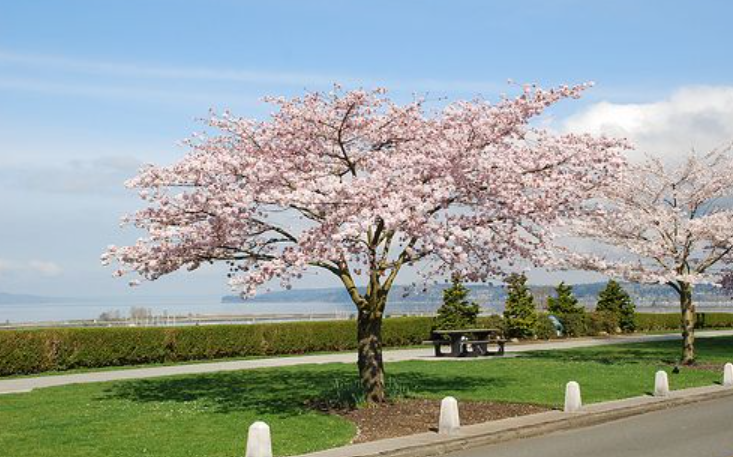
The Akebono cherry tree originated as a chance seedling selection made by the W.B. Clarke Nursery in San Jose, California, and was introduced to the nursery trade in 1925. It arose from the Yoshino cherry, the same widely planted ornamental species that dominates Washington, D.C.’s Tidal Basin, and it was selected specifically for its slightly earlier bloom time and its pink-tinted petals, which stand out against the purer white flowers of standard Yoshino trees. According to the Virginia Tech Dendrology fact sheet on Yoshino cherry, the parent species itself is a hybrid whose exact wild origins remain somewhat unclear, believed to descend from a cross between two other Japanese cherry species.
In the 1930s, seedlings of the Akebono selection were donated for planting around Washington, D.C.’s Tidal Basin, where they were mixed in among the original Yoshino cherries gifted by Japan in 1912. Today, Akebono trees make up a small but consistent percentage of the Tidal Basin’s cherry population, valued specifically for extending the visual variety of the annual bloom. Oregon has since become the country’s leading commercial grower of flowering cherry trees, and the Oregon State University Department of Horticulture’s Landscape Plants database notes that the cultivar remains one of the most commonly propagated flowering cherries shipped out of Pacific Northwest nurseries today.
Botanical Classification
The Akebono cherry belongs to the rose family, the same large plant family that includes apples, pears, and dozens of other stone fruit and ornamental species. It’s classified as a cultivar of the Yoshino cherry group rather than a distinct species in its own right, meaning every Akebono tree in cultivation today is propagated by grafting or cuttings from the original 1925 selection rather than grown from seed. The North Carolina Extension Gardener Plant Toolbox lists several alternate names still used for the cultivar, including Daybreak Yoshino cherry and, within Japan itself, a name that translates roughly to “America cherry,” a nod to its California origin.
Akebono vs. Yoshino Cherry: Key Differences
Because the Akebono cherry is a direct selection from the Yoshino cherry, the two are frequently confused, and many nurseries even mislabel one for the other. The clearest distinction is flower color: Yoshino blossoms open nearly pure white with only the faintest pink blush, while Akebono flowers open a more noticeable soft pink before gradually fading toward white, giving the tree a warmer overall tone during peak bloom. Flower structure also differs somewhat, since Akebono more commonly produces semi-double blooms with extra petals, whereas standard Yoshino trees tend toward simpler, single flowers.
The two cultivars generally bloom within days of one another each spring, which is why they’re planted together at the Tidal Basin to extend and enrich the color of the display rather than to stagger it. According to the National Park Service’s own breakdown of the Tidal Basin planting, Akebono trees make up only around 3% of the total cherry population there, compared to the Yoshino cherry’s roughly 70% share, making Akebono very much the supporting color rather than the headline variety. Disease resistance tips in Akebono’s favor as well, with several university extension sources noting it holds up better against common flowering cherry ailments than straight Yoshino seedling stock.
Identifying Characteristics
A mature Akebono cherry tree typically reaches 25 to 35 feet in height with a similar or slightly wider spread, developing a rounded, spreading crown as it ages after starting out more upright while young. Its flowers emerge in early spring before the leaves, arriving in clusters of 2 to 5 blooms that are soft pink in bud and fade to nearly white as they open fully, with individual flowers ranging from single to semi-double depending on the specific tree.
The Cal Poly SelecTree database, maintained by California Polytechnic State University’s urban forestry program, catalogs the tree’s growth rate as moderate to fast, faster than many other ornamental cherries while still producing wood that resists breakage better than typical fast-growing trees.
Its leaves are glossy and dark green through spring and summer, elliptical in shape and 2 to 4 inches long with finely serrated edges, before turning shades of yellow and orange in autumn. The bark is smooth and gray with prominent horizontal lenticels, small pore-like markings that become more pronounced as the trunk ages, adding a distinct textural feature even in winter when the tree is bare. Small black fruit follows the spring bloom, typically around half an inch across, and while it holds little culinary value for people, it’s readily eaten by a wide range of songbirds.
Wildlife and Pollinator Value
Because it flowers so early in spring, often before many other nectar sources have opened up, the Akebono cherry tree provides an important early-season feeding stop for bees and other pollinators emerging from winter dormancy. Its dense clusters of blooms, sometimes numbering in the hundreds on a single mature tree during peak bloom, make a single specimen a meaningfully concentrated food source for a short but critical window each year. Honeybees and native solitary bees are both regularly observed working Akebono flowers on warm early-spring days when few other blooming trees are available to them.
Once the small black fruit ripens in early summer, the tree shifts from a pollinator resource to a bird magnet, drawing species such as robins, cedar waxwings, and mockingbirds, which strip the fruit clean within a matter of days in most years. The fruit’s small size and lack of appeal to humans works in its favor here, since none of it typically goes to waste as litter the way larger ornamental fruit sometimes does. Between its early nectar and its midyear fruit, the Akebono cherry effectively supports two distinct waves of wildlife activity in a single growing season.
Landscape Uses
Because of its broad, arching canopy, the Akebono cherry tree is most often planted as a specimen tree in open lawns, along walkways, or over patios where its spreading form has room to develop without crowding structures or other plants. The University of Florida IFAS Extension fact sheet on the cultivar recommends it specifically for locations where its horizontal branching pattern can be appreciated from below, such as along a path or seating area, and notes that its relatively short lifespan compared to shade trees makes it better suited to ornamental rather than structural landscape roles. Its dense spring bloom also makes it a popular choice for street tree plantings in municipalities looking to replicate the visual effect of Washington’s Tidal Basin on a smaller scale.
The tree’s fall color and winter bark provide two additional seasons of visual interest beyond its spring flowering, which has made it a common addition to college and municipal campus plantings. The California State University, Stanislaus campus tree program includes the Akebono cherry among its catalogued specimen trees, describing it as a reliable, low-litter option for high-traffic pedestrian areas since its small fruit doesn’t create the mess associated with larger-fruited ornamental trees.
Cultural Significance and Notable Plantings
Beyond its supporting role at the Tidal Basin, the Akebono cherry has become something of a fixture at American college campuses, where its manageable size and reliable spring display make it a popular choice for quads, walkways, and building entrances. Its status as a California discovery rather than a Japanese import has also made it something of a quiet symbol of American horticultural innovation within the broader story of flowering cherries in the United States, even though its Japanese name and heritage species keep that origin easy to overlook. Interestingly, the National Park Service has noted that Akebono has gradually lost ground in the commercial nursery trade in recent years, with growers increasingly favoring a newer cultivar called Afterglow, which offers a deeper, more saturated pink bloom while retaining much of Akebono’s growth habit.
Regional cherry blossom festivals outside Washington, D.C. have also picked up the cultivar as plantings have expanded across warmer parts of the country where straight Yoshino cherries sometimes struggle to get adequate winter chill. Its slightly greater heat tolerance compared to some other flowering cherry cultivars has allowed festival organizers in more temperate regions to extend the recognizable pink-and-white spring display beyond the narrow band of climates where the classic Yoshino thrives.
Growing Considerations
The Akebono cherry tree is hardy across USDA zones 5 through 8, tolerating winter lows down to roughly -10°F while still requiring enough winter chill to trigger reliable spring flowering. It performs best in full sun with moist, well-drained soil, though it tolerates a range of soil types including both sandy and clay-heavy conditions as long as drainage is adequate. Its typical lifespan runs 15 to 25 years, notably shorter than many shade trees, a trade-off that comes with its fast growth rate and its susceptibility to a range of pests and diseases including borers, scale, aphids, and canker.
Despite that susceptibility, the Clemson Cooperative Extension’s guide to ornamental cherry, plum, apricot, and almond trees and the Utah State University Extension TreeBrowser database both list the Akebono cultivar among the more disease-resistant flowering cherries available, particularly in comparison to older Yoshino seedling stock.
Pruning and Seasonal Care
Structural pruning matters more for the Akebono cherry than for many other ornamental trees, since its branches tend to form narrow, weak crotch angles while young that can split under the weight of heavy snow, ice, or wind if left uncorrected. Formative pruning during the first 3 to 5 years, aimed at establishing well-spaced, wide-angled scaffold branches, pays off later by reducing the odds of storm damage on a mature canopy that can span 30 feet or more. Once the framework is established, maintenance pruning mostly involves thinning crossing or crowded interior branches to keep air moving through the canopy, which lowers the risk of the fungal and bacterial issues the tree is otherwise prone to.
Timing matters as much as technique. Pruning cuts made during wet weather are considerably more likely to introduce canker and other fungal infections, so most extension guides recommend pruning during a dry stretch in late winter while the tree is still dormant, well before the flower buds begin to swell. Avoiding pruning right after flowering, when the tree is investing energy into leafing out, also helps minimize stress and keeps the following year’s bloom from being noticeably diminished.
Further References
- North Carolina State University Extension — Prunus × yedoensis ‘Akebono’.
NC State Extension — Akebono Yoshino Cherry
A comprehensive source for identifying characteristics, mature height and spread, flowers, foliage, bark, USDA hardiness zones, sunlight, soil preferences, landscape uses, and common pests and diseases. - U.S. National Arboretum — Prunus × yedoensis ‘Akebono’.
U.S. National Arboretum — Akebono Cherry
Particularly useful for the tree’s history and flowers. It explains that ‘Akebono’ is a Yoshino cherry cultivar, has pink flower buds that open white with a trace of pink, and was selected in California despite its Japanese name. - Oregon State University — Prunus × yedoensis ‘Akebono’.
Oregon State University — Akebono Yoshino Cherry
Provides botanical classification, mature size, leaf and flower characteristics, hardiness, cultivar history, and information about its relationship to the broader Yoshino cherry group. - Oregon State University — Prunus × yedoensis (Yoshino Cherry).
Oregon State University — Yoshino Cherry
Useful for background information on Prunus × yedoensis, including its history, naming, and related cultivars such as ‘Akebono’, ‘Afterglow’, and ‘Shidare Yoshino’.