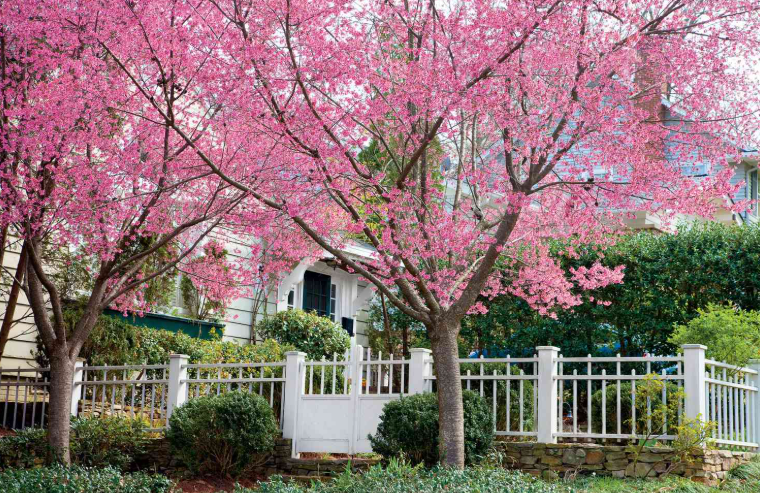
Cherry trees that do not bear fruit exist because of a genetic trade-off centuries of Japanese breeding built directly into their flowers. Many ornamental cherry cultivars carry doubled blossoms with 20 to 50 petals per flower, and those extra petals typically develop by converting the tree’s own reproductive parts, its stamens and pistils, into more petal tissue. Without functioning reproductive structures, these trees cannot be pollinated in the normal way, so no fruit ever follows the spring bloom no matter how heavy the flowering display becomes.
This sterility is not a flaw; it is precisely why these varieties dominate ornamental plantings along city streets, in parks, and around landmarks like Washington D.C.’s Tidal Basin. A fruitless cherry tree never drops sticky, staining fruit onto sidewalks, driveways, or parked cars, which makes it dramatically easier to maintain in high-traffic public and residential settings. Roughly 13 percent of the cherry trees in Washington’s famous cherry blossom display belong to a single sterile cultivar, and sterile double-flowered varieties collectively represent some of the most widely propagated ornamental trees sold in nurseries across the country each spring.
The 15 varieties below are all genuinely fruitless, prized purely for their spring flower display, fall foliage color, or distinctive growth habit rather than any harvest that follows.
Kwanzan
Kwanzan is the most widely planted fruitless cherry in the world, instantly recognizable by its dense clusters of double pink blossoms carrying 20 to 30 petals each. The tree grows 25 to 30 feet tall in an upright, vase-shaped form that gradually rounds out with age, and its doubled flowers are entirely sterile, meaning no fruit ever forms after the bloom fades. Beyond its spring display, Kwanzan offers reddish-bronze new growth in spring and vivid orange-to-bronze fall color, giving it multiple seasons of interest.
Amanogawa
Amanogawa is prized for an unusually narrow, columnar growth habit that makes it one of the few flowering cherries genuinely suited to tight urban planting strips and small gardens. Its semi-double, pale pink flowers bloom in dense clusters in mid to late spring, and like most doubled Japanese cherry cultivars, it produces no significant fruit afterward. Mature trees typically stay under 20 to 25 feet tall while remaining just 6 to 8 feet wide, an unusually tall-and-narrow profile among ornamental cherries.
Shirofugen
Shirofugen produces some of the largest flowers of any ornamental cherry, with fragrant double blooms that open pink from the bud, shift to white with a pink blush on the reverse petals, and finally deepen to pink again as they age. The tree grows in a distinctive vase shape with pendulous flower clusters draping along the branches in late spring, later than most other cherry varieties. Its coppery-red new growth matures to bronze-green through summer before turning orange in fall, and no fruit follows its elaborate, multi-stage bloom.
Shirotae
Shirotae, also known as Mount Fuji cherry, produces large semi-double to double white flowers with a light fragrance, held in horizontal, spreading branches that give the tree a distinctive tiered silhouette. It typically stays a modest 15 to 20 feet tall but can spread significantly wider, making it a popular choice where a low, broad canopy is preferred over height. The doubled flower structure leaves it with essentially no fruit production, keeping the tree’s spreading branches clean through summer and fall.
Ukon
Ukon stands apart from nearly every other ornamental cherry for its unusual greenish-yellow double blossoms, a color rarely seen elsewhere in the genus. The flowers age to a pale creamy white as they mature, and the tree’s doubled structure means it does not set fruit at any point in the season. Ukon typically reaches 20 to 25 feet with a broad, spreading crown and coppery new leaf growth that adds contrast to its pale flowers.
Shogetsu
Shogetsu produces exceptionally large, frilly double flowers, sometimes stretching over 2 inches across, that open pink in bud and fade to nearly white as they fully unfurl. The tree grows in a wide, spreading, umbrella-like form that typically reaches only 15 to 20 feet tall while spreading considerably wider, making it a popular specimen tree for smaller landscapes. Its heavily doubled blossoms leave no viable reproductive structures behind, so the tree remains completely fruitless through the growing season.
Fugenzo
Fugenzo holds a notable place in American cherry tree history as the first ornamental cherry variety ever planted in Washington, D.C., installed along the Potomac in 1909, three years ahead of the famous 1912 Japanese gift. Its double, rose-pink flowers carry around 30 petals each and hang in pendulous clusters of four to six blooms. As one of the oldest cultivated cherry varieties in Japan, Fugenzo has been grown specifically for its sterile, fruitless flowers for centuries.
Pink Perfection
Pink Perfection lives up to its name with densely packed, deep pink double flowers that open from darker pink buds, creating a two-tone effect as the blossoms mature on the branch. The tree typically grows 20 to 25 feet tall with an upright, rounded form well suited to smaller residential yards. Like its Kwanzan and Shogetsu relatives, its fully doubled flower structure prevents any fruit from developing after bloom.
Royal Burgundy
Royal Burgundy combines the sterile double pink flowers of a Kwanzan-type cherry with striking reddish-purple foliage that holds its color from spring through fall, a rare combination among flowering cherries. The tree typically reaches 15 to 20 feet, somewhat smaller than standard Kwanzan, making it easier to fit into compact garden spaces. Its dark foliage provides season-long visual interest that continues well after the fruitless spring bloom has finished.
Snow Fountains
Snow Fountains is a dwarf weeping cherry that rarely exceeds 8 to 12 feet tall, with branches that cascade dramatically to the ground and are covered in pure white spring flowers. Its compact, mounding form makes it one of the most popular ornamental cherries for small yards, entryways, and container planting. The tree produces essentially no significant fruit, keeping its weeping branches clean and mess-free through summer.
Hokusai
Hokusai produces large, semi-double pink flowers that open from deeper pink buds and fade to a soft blush as they mature, typically blooming in mid-spring alongside the tree’s emerging bronze-green foliage. The tree grows to a rounded, spreading form reaching about 20 to 25 feet at maturity. Its partially doubled flower structure results in negligible fruit production, keeping the ornamental display clean from bloom through fall color.
Shimidsu Sakura
Shimidsu Sakura produces long-stalked, double white flowers that emerge from distinctly pink buds, creating a striking contrast as the blossoms open in mid to late spring. The tree grows in a wide, spreading, umbrella-shaped canopy that typically reaches 15 to 20 feet tall while spreading considerably wider. Its heavily doubled blossoms, much like its close relative Shogetsu, leave the tree entirely fruitless through the growing season.
Horinji
Horinji is a lesser-known double-flowered cultivar valued for its soft pink blossoms and dense, rounded growth habit, typically reaching 20 to 25 feet at maturity. Its flowers open in mid-spring in clusters similar to other Sato-zakura group cherries, the historic Japanese group of cultivated ornamental cherries known for elaborate doubled blooms. As with its relatives in this group, Horinji’s doubled flower structure prevents meaningful fruit development.
Ichiyo
Ichiyo produces pale pink, double flowers with a distinctive frilled or ruffled petal structure, often described as resembling small pom-poms held in loose clusters. The tree typically grows 20 to 25 feet tall with an upright, somewhat vase-shaped form similar to Kwanzan, though generally less vigorous. Its doubled blossoms are sterile, meaning the tree’s ornamental value comes entirely from its spring flower display and fall foliage rather than any fruit.
Kiku-Shidare-Zakura
Kiku-shidare-zakura, commonly sold under the name Cheal’s Weeping Cherry, combines a graceful weeping growth habit with dense, chrysanthemum-like double pink flowers, a pairing that has made it one of the most popular small weeping ornamentals in cultivation. The tree typically stays under 15 feet tall, with branches cascading nearly to the ground in a soft, mounded silhouette. Its fully doubled flowers leave no functional reproductive structures behind, so like its upright double-flowered relatives, it produces no fruit at all.