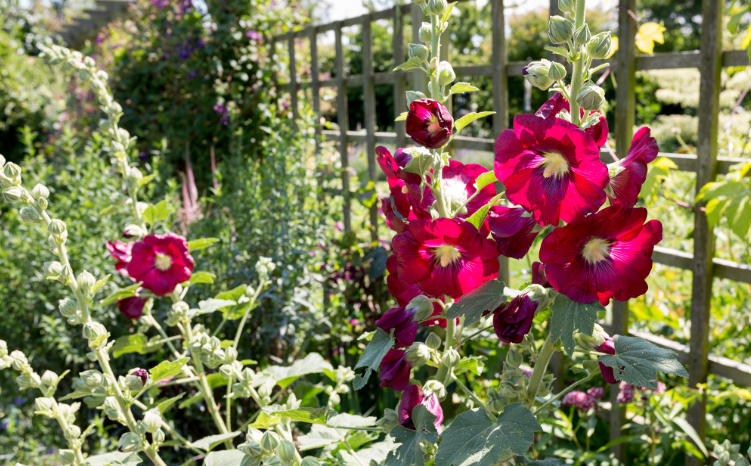
Hollyhocks are among the most recognizable flowers in traditional cottage gardens. Their tall stems, large saucer-shaped flowers, and wide range of colors make them especially noticeable when planted along fences, walls, pathways, and the back of flower borders. Although they are often associated with old-fashioned gardens, hollyhocks remain popular today because they combine striking vertical growth with relatively simple cultivation.
The name hollyhock generally refers to plants in the genus Alcea, particularly Alcea rosea, which is the species most commonly associated with the traditional garden hollyhock. These plants belong to the mallow family, Malvaceae, a large botanical family that also includes familiar plants such as hibiscus, okra, and cotton. Hollyhocks are valued not only for their ornamental flowers but also for their long history in gardens and their importance to pollinating insects.
Botanical Classification of Hollyhocks
The botanical classification of the common garden hollyhock is as follows:
- Kingdom: Plantae
- Clade: Angiosperms
- Clade: Eudicots
- Order: Malvales
- Family: Malvaceae
- Genus: Alcea
- Species: Alcea rosea
The genus Alcea contains several species of flowering plants commonly known as hollyhocks. Alcea rosea is the species most widely cultivated as an ornamental garden plant.
Hollyhocks are herbaceous plants, meaning their stems are not permanently woody like those of shrubs or trees. Depending on the species, cultivar, and growing conditions, they may behave as biennials, short-lived perennials, or sometimes annuals.
Their relationship with other members of the Malvaceae family is easy to recognize when looking closely at their flowers. Like many plants in this family, hollyhocks have distinctive flower structures and leaves that help identify them botanically.
Also Read: How To Grow And Care For Hollyhocks
History and Origin of Hollyhocks
Hollyhocks have a long association with gardens, particularly in Europe and other regions where they became established as ornamental plants. Their exact origins have been debated because Alcea rosea has been cultivated for centuries and has naturalized in many parts of the world.
The species is generally associated with Europe and parts of Asia, while its extensive cultivation has helped spread it far beyond its original range. Historical records and illustrations show that hollyhocks became valued garden plants in Europe several centuries ago.
Their tall, upright growth made them particularly useful around the edges of gardens and against buildings, where they could provide color without taking up large amounts of horizontal space.
Hollyhocks eventually became strongly associated with cottage gardens and traditional country landscapes. Their ability to self-seed also contributed to their popularity. Once established, plants can produce seeds that fall around the parent plant and produce new seedlings in subsequent seasons.
Today, hollyhocks are cultivated in gardens throughout many temperate regions of the world.
Identifying Characteristics of Hollyhock Flowers
Hollyhocks are relatively easy to recognize because of their combination of height, foliage, and large flowers.
Tall Upright Stems
Perhaps the most obvious characteristic is the plant’s height. Hollyhocks develop strong vertical stems that can rise several feet above the surrounding vegetation.
Depending on the cultivar and growing conditions, plants can reach approximately 5 to 8 feet tall, with some growing even higher under favorable conditions.
This exceptional height gives hollyhocks their characteristic architectural appearance. In a flower border, they can create a vertical layer above shorter annuals and perennials.
Large, Showy Flowers
The flowers are another defining characteristic. Hollyhock blooms are generally large and open-faced, with petals arranged around a central column of reproductive structures.
Flower colors vary considerably. Common shades include:
- Pink
- Red
- White
- Yellow
- Purple
- Burgundy
- Peach
- Lavender
Some cultivated varieties have single flowers, while others produce semi-double or fully double blooms with considerably more petals.
Flowers Along the Stem
Rather than producing all their flowers at one level, hollyhocks develop blooms along the length of their tall flower stalks.
This creates a vertical succession of flowers that can make a mature plant appear almost covered in blooms.
The lower flowers generally open before those farther up the stalk, allowing the flowering display to develop progressively.
Hollyhock Leaves
The foliage provides another useful identification feature. Hollyhock leaves are generally large, rounded to heart-shaped, and somewhat lobed.
The leaves are typically green and have a somewhat rough or hairy texture. Their broad surface allows them to capture considerable sunlight during the plant’s vegetative growth.
Leaves near the base of the plant can be considerably larger than those higher on the flowering stem.
Flowering Stems
The flowering stalks emerge from the foliage and become increasingly prominent as the plant matures. The stems are generally upright but may require support in exposed locations because their height makes them vulnerable to strong winds.
When several hollyhocks are grown together, their tall flower stalks can form an impressive wall of color.
Hollyhock Flower Structure
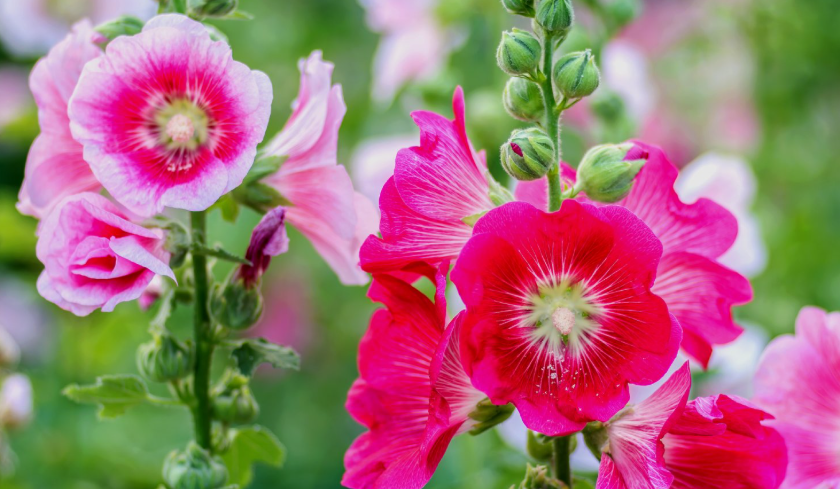
A closer look at a hollyhock flower reveals several features typical of the mallow family.
The flowers have five basic petals in single-flowered forms, although cultivated double varieties may have many additional petals. At the center is a prominent reproductive column formed by the stamens surrounding the style.
This central structure is one reason hollyhock flowers can be attractive to bees and other flower-visiting insects.
The petals may have a smooth appearance or a slightly ruffled texture depending on the variety. Double cultivars often have a more rounded, rose-like appearance, while single forms have a simpler and more open structure.
Hollyhock Seeds and Seed Pods
After pollination, hollyhocks produce distinctive seed structures. The seeds develop within flattened, disk-like arrangements often described as cheese-wheel-shaped seed pods.
As these structures mature, they gradually dry and turn brown. Mature seeds can eventually fall near the parent plant or be collected for propagation.
This natural seed production is important because hollyhocks can readily reproduce without gardeners having to divide the plants.
However, seedlings produced from saved seed may not always look exactly like the parent plant, particularly when different varieties are growing nearby. Cross-pollination can result in new combinations of flower colors and forms.
Are Hollyhocks Annuals, Biennials, or Perennials?
One of the most confusing aspects of hollyhocks is their life cycle.
Traditional Alcea rosea plants are commonly described as biennials or short-lived perennials. A biennial plant generally spends its first growing season developing roots and foliage, then flowers and produces seed during its second season.
However, individual plants can behave differently depending on climate, variety, and growing conditions. Some may flower during their first year when started early, while others may survive and flower for several years.
Hollyhocks can also appear to be permanent garden plants because they often self-seed. When older plants disappear, new seedlings may emerge nearby and take their place.
Hollyhocks in Cottage Gardens
Few flowers are as strongly associated with the traditional cottage-garden style as hollyhocks.
Their height makes them particularly useful for creating layers in a flower bed. Shorter plants can be positioned in front while hollyhocks rise behind them.
They are especially effective when planted:
- Along fences
- Beside walls
- At the back of borders
- Around garden entrances
- Along pathways
- Near old buildings
- In informal flower beds
Their informal growth and ability to self-seed fit naturally into gardens designed to look abundant rather than highly structured.
Hollyhocks and Pollinators
Hollyhock flowers can provide food for flower-visiting insects, particularly bees and other pollinators.
Single-flowered varieties are generally more accessible to insects than heavily double varieties because their reproductive structures are less obstructed by layers of petals.
The large, colorful flowers also make hollyhocks visually prominent in a pollinator-friendly garden.
For gardeners interested in supporting pollinators, combining hollyhocks with other flowering plants that bloom at different times can provide a more continuous supply of floral resources throughout the growing season.
Common Hollyhock Flower Colors
One reason hollyhocks remain popular is their impressive color range.
Pink hollyhocks are among the classic forms and work particularly well in cottage-style gardens.
Red and burgundy hollyhocks provide stronger visual contrast and can become focal points in large borders.
White hollyhocks have a clean appearance and are particularly attractive against darker backgrounds.
Yellow and peach varieties introduce warmer tones and can complement other summer flowers.
Purple and lavender cultivars provide cooler colors that work well alongside blue, white, and pink flowers.
Some modern varieties combine unusual shades or produce flowers with contrasting centers.
Single and Double Hollyhocks
Hollyhocks are available in several flower forms, but single and double types are particularly common.
Single hollyhocks have a relatively simple flower with a visible central reproductive structure. Their open form can make it easier for pollinators to reach the flower’s resources.
Double hollyhocks have additional layers of petals and often resemble large, ruffled flowers. They are especially popular when the primary goal is ornamental impact.
Neither form is universally better. The choice depends on the appearance desired and the gardener’s interest in supporting pollinating insects.
Hollyhocks in Modern Gardens
Although hollyhocks have a distinctly traditional reputation, they can fit into many contemporary landscape designs.
Their vertical growth can add height to a garden that otherwise contains mostly low-growing plants. They can also be used to soften fences, disguise unattractive walls, or create a colorful background behind ornamental grasses and other perennials.
Compact cultivars are increasingly useful for smaller gardens and containers, while tall traditional forms remain excellent choices for larger landscapes.
Hollyhock Symbolism
Hollyhocks have accumulated various symbolic associations over the centuries. In flower traditions, they have sometimes been associated with ambition, fertility, abundance, and the cycle of life.
Such symbolism varies between cultures and historical periods, so it is better understood as part of the plant’s cultural history rather than a fixed botanical characteristic.
Their towering growth and abundant flowers naturally lend themselves to associations with height, aspiration, and flourishing.
Why Hollyhocks Remain Popular
Hollyhocks have survived changing gardening fashions because they offer several qualities that are difficult to overlook. They are tall without being woody, produce large and colorful flowers, attract flower-visiting insects, and can reproduce naturally through seed.
Their ability to fit into both formal and informal landscapes also adds to their versatility.
For gardeners who want a strong vertical element, few traditional flowers provide the same combination of height and abundant blooms. Even a small group of hollyhocks can transform the appearance of a border by creating a backdrop of flowers above shorter plants.
Final Thoughts
Hollyhocks are much more than old-fashioned garden flowers. Botanically, they belong to the genus Alcea within the Malvaceae family, and the familiar garden hollyhock is most commonly associated with Alcea rosea. Their history stretches back centuries, while their distinctive appearance has made them recognizable in gardens around the world.
Their tall flowering stems, large lobed leaves, colorful saucer-shaped blooms, and unusual seed pods provide some of the easiest ways to identify them. Whether grown as part of a traditional cottage garden, a pollinator-friendly landscape, or a modern flower border, hollyhocks remain valuable ornamental plants.
Their combination of history, height, color, and relatively straightforward growth explains why these spectacular flowers continue to occupy a special place in gardens today.