Turkeys are large, distinctive birds native to North America, recognized by their broad, fan-shaped tails, fleshy facial wattles, and characteristic strutting displays during courtship. Their unique combination of size, plumage, and behavior has made them one of the most recognizable birds in the world, yet their general body shape and features are shared, to varying degrees, by a surprising number of other bird species found across different continents. Many of these turkey-like birds belong to entirely different families and have no direct evolutionary relationship to true turkeys, instead having developed similar appearances through convergent evolution or simply sharing certain ancestral traits common to large ground-dwelling birds.
The resemblance between turkeys and other birds often comes down to a combination of shared characteristics — a heavy, rounded body, relatively short wings adapted more for brief bursts of flight than sustained soaring, strong legs suited for walking and foraging on the ground, and in many cases, areas of bare, often colorful skin on the head and neck. These features tend to develop in birds that have adopted a largely terrestrial lifestyle, spending much of their time foraging for food on the forest floor or in grasslands rather than in the air, making the turkey-like body plan a recurring solution to similar ecological pressures across different bird lineages.
Many of the birds that resemble turkeys belong to the broader group known as galliformes, which includes not only turkeys themselves but also chickens, pheasants, grouse, and guineafowl, all of which share certain anatomical and behavioral characteristics inherited from a common ancestor. Other turkey-like birds, however, belong to entirely unrelated groups, including certain large game birds found in South America and various species that have simply converged on a similar appearance despite vastly different evolutionary histories. This diversity makes the category of birds that look like turkeys a fascinating window into both the close relatives of true turkeys and the broader phenomenon of convergent evolution in the bird world.
Exploring the different birds that bear a resemblance to turkeys reveals the rich diversity of large ground-dwelling birds found around the world, from the dense forests of South America to the open landscapes of Africa and the woodlands of North America itself. The following overview introduces a range of bird species that, for various reasons, are often compared to or mistaken for turkeys.
Wild Turkey
The wild turkey is the original species from which all domestic turkeys are descended, native to forests and woodlands across much of North America and serving as the natural benchmark against which turkey-like birds are often compared. Its iridescent bronze and copper plumage distinguishes it from the white feathers typical of domestic varieties.
Male wild turkeys display the iconic fan-shaped tail and inflate the bare, colorful skin of their head and neck during courtship displays, behaviors that have become deeply associated with the turkey’s cultural significance in North America. Wild turkey populations have rebounded significantly in many areas after facing severe declines in the early twentieth century, becoming a notable conservation success story.
Ocellated Turkey
The ocellated turkey is a close relative of the wild turkey found in the Yucatan Peninsula and surrounding areas of Mexico, Belize, and Guatemala, distinguished by its strikingly iridescent blue-green plumage and the distinctive eye-like spots on its tail feathers from which it takes its name. Its smaller size and more vibrant coloration set it apart from its northern relative.
Unlike the wild turkey’s bronze tones, the ocellated turkey displays brilliant iridescent colors across much of its body, with males developing a bright blue and orange head during the breeding season that makes this species one of the most visually striking members of the turkey family. Its restricted range and habitat dependence on tropical forests have made the ocellated turkey a species of conservation concern.
Helmeted Guineafowl
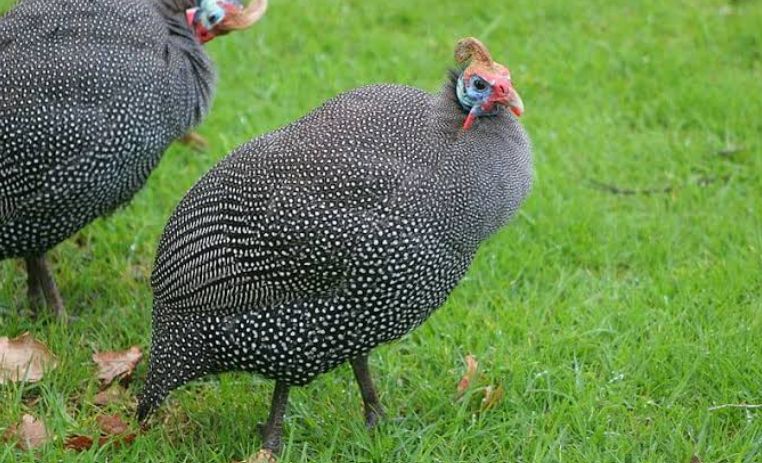
The helmeted guineafowl is a distinctive African bird recognized by its rounded body, dark plumage covered in white spots, and the bony, helmet-like protrusion on top of its head, giving it a turkey-like silhouette despite belonging to an entirely different family. Its bare, brightly colored facial skin adds to its turkey-like appearance.
This species has been domesticated and is now raised for food and ornamental purposes in many parts of the world beyond its native African range, with its meat considered a delicacy in various culinary traditions. The helmeted guineafowl’s social, flocking behavior and ground-foraging habits parallel those of turkeys, contributing to the visual and behavioral similarities between the two species despite their distant evolutionary relationship.
Vulturine Guineafowl
The vulturine guineafowl is the largest species of guineafowl, found in arid regions of East Africa, and is named for the bare, vulture-like skin on its head and neck that contrasts dramatically with its richly patterned blue and black plumage. Its overall body shape bears a notable resemblance to that of a turkey.
This striking bird forms large, cohesive flocks that move together across the savanna in search of food, displaying social behaviors that, combined with its size and ground-dwelling habits, contribute to comparisons with turkeys despite the considerable evolutionary distance between the two groups. The vulturine guineafowl’s vivid cobalt blue breast feathers make it one of the most visually distinctive members of the guineafowl family.
Sage Grouse
The sage grouse is a large, ground-dwelling bird native to the sagebrush habitats of western North America, sharing with turkeys a heavy body, relatively short wings, and elaborate courtship displays performed by males. Its mottled brown and gray plumage provides effective camouflage within its sagebrush habitat.
During courtship, male sage grouse inflate prominent air sacs on their chest and fan out their spiky tail feathers in a display that, while distinct from the turkey’s fan-tailed strut, shares the general theme of dramatic visual display used to attract mates. Sage grouse populations have declined significantly due to habitat loss, making this species a focus of significant conservation attention across its range.
Capercaillie
The capercaillie is the largest species of grouse, found in the coniferous forests of Europe and parts of Asia, with males displaying a heavy, dark body and a fan-shaped tail that can be raised during courtship displays in a manner reminiscent of a turkey’s strut. Its size and overall shape contribute to frequent comparisons with turkeys.
Male capercaillies perform elaborate courtship displays at traditional display grounds, fanning their tails, drooping their wings, and producing distinctive vocalizations to attract females in a ritual that has fascinated naturalists for centuries. This species has experienced significant population declines in many parts of its range due to habitat loss and fragmentation of the forests it depends upon.
Razor-Billed Curassow
The razor-billed curassow is a large, turkey-sized bird found in the forests of South America, characterized by its glossy black plumage, curled crest of feathers atop its head, and the distinctive laterally compressed bill that gives the species its common name. Its overall size and shape readily invite comparison to turkeys.
This species belongs to a family of birds found exclusively in the Americas that occupies an ecological niche broadly similar to that filled by turkeys, pheasants, and other large galliformes in other parts of the world, despite having evolved independently in South America. Curassows are generally shy, forest-dwelling birds that forage on the ground for fruit and other food items, much like the foraging behavior typical of turkeys.
Great Curassow
The great curassow is one of the largest members of the curassow family, found in the forests of Central America and parts of South America, with males displaying glossy black plumage, a curled crest, and a distinctive yellow knob at the base of the bill. Its substantial size places it among the largest forest birds in its range.
The great curassow’s combination of large body size, ground-foraging habits, and overall robust build contributes to its frequent comparison with turkeys, even though the two groups represent entirely separate branches of bird evolution that developed on different continents. This species has faced significant pressure from hunting and habitat loss throughout much of its range, leading to population declines in many areas where it was once common.
Bare-Faced Curassow
The bare-faced curassow is found in the forests of South America, distinguished by the area of bare, pale skin on its face that contrasts with its otherwise dark plumage, along with the curled crest typical of curassow species. Its size and general body shape again invite comparisons with turkeys.
This species inhabits forest environments where it forages on the ground for fruits, seeds, and small animals, exhibiting foraging behaviors broadly similar to those of turkeys despite the different evolutionary paths that led to similar body plans in both groups. Like other curassow species, the bare-faced curassow has faced pressure from habitat loss and hunting in parts of its range.
Ring-Necked Pheasant
The ring-necked pheasant, while generally smaller and more slender than a turkey, shares with turkeys certain features including a ground-dwelling lifestyle, strong legs adapted for running, and in males, dramatic plumage used in courtship displays. Its long, pointed tail distinguishes it from the turkey’s fan-shaped tail.
Originally native to Asia but introduced widely across North America, Europe, and other regions for hunting purposes, the ring-necked pheasant has become one of the most familiar game birds in many parts of the world. While its overall proportions differ from those of a turkey, the bright, iridescent plumage of male pheasants and their preference for foraging in fields and woodland edges create some behavioral parallels with turkey ecology.
Malleefowl
The malleefowl is an unusual ground-dwelling bird found in parts of Australia, notable for its mottled brown, gray, and black plumage that provides excellent camouflage, along with a turkey-like body shape and ground-foraging habits. Its remarkable nesting behavior sets it apart from most other birds.
Unlike turkeys, malleefowl construct elaborate mound nests in which they carefully regulate temperature by adding or removing material to control the heat generated by decomposing vegetation, using this heat to incubate their eggs rather than sitting on them directly. Despite this dramatically different reproductive strategy, the malleefowl’s overall body shape and ground-dwelling lifestyle contribute to occasional comparisons with turkeys by observers unfamiliar with Australian wildlife.
Brush Turkey
The Australian brush turkey is a large, dark-plumaged bird found along the eastern coast of Australia, possessing a bare red head and neck along with a prominent yellow collar that, combined with its overall heavy build, makes its turkey-like appearance unmistakable despite belonging to a completely different family from true turkeys. Its name directly reflects this resemblance.
Like the malleefowl, the brush turkey builds large mound nests of leaf litter and soil in which it buries its eggs, relying on the heat generated by decomposing vegetation rather than body heat for incubation. This species has adapted remarkably well to suburban environments in parts of Australia, where its mound-building activities in gardens are a familiar, if sometimes unwelcome, sight to local residents.
Horned Guan
The horned guan is a striking bird found in the cloud forests of Mexico and Guatemala, distinguished by a bright red, horn-like protrusion on top of its head along with glossy black plumage and a white-tipped tail. Its large size and overall body shape contribute to comparisons with turkeys, particularly given its similarly ground- and tree-foraging habits.
This rare and endangered species inhabits high-altitude cloud forest environments, where it forages for fruit, leaves, and seeds in a manner broadly similar to other large galliform-like birds despite belonging to a distinct lineage found only in Central America. Habitat loss within its limited range has made the horned guan one of the more threatened birds bearing a turkey-like resemblance.
Black Francolin
The black francolin is a medium to large game bird found across parts of Asia and the Middle East, with males displaying a striking pattern of black plumage marked with white spots and a chestnut collar that creates a visually rich appearance somewhat reminiscent of smaller turkey relatives. Its rounded body and ground-dwelling habits add to this resemblance.
This species has been introduced to various regions outside its native range for hunting purposes, establishing populations in parts of North America and elsewhere. Like turkeys, black francolins are primarily ground foragers that prefer to run rather than fly when disturbed, taking to the air only when necessary and generally for short distances.