The tulip is one of the most iconic flower forms in the world — an elegant, upright cup of smooth, overlapping petals that has captivated gardeners, artists, and traders for centuries. Originally native to Central Asia and the mountainous regions of Turkey and Iran, tulips were introduced to Europe in the 16th century and sparked one of history’s most extraordinary economic events: Tulip Mania of the 1630s, during which single bulbs sold for prices equivalent to a Amsterdam canal house.
Today, the Netherlands produces approximately 2.2 billion tulip bulbs annually, accounting for nearly 80% of the world’s total tulip production. But the tulip’s iconic silhouette — that smooth, rounded cup held upright on a clean, straight stem — is not exclusive to the genus Tulipa. Dozens of other flowering plants produce blooms strikingly similar in form, creating the same sense of elegant simplicity that has made the tulip so universally admired.
These tulip-like flowers span a remarkable range of plant families, climates, and growth habits. Some are fellow bulb plants that share the tulip’s underground storage structure and spring-flowering rhythm. Others are tropical perennials, climbing vines, shrubs, or woodland wildflowers that have arrived at the same graceful flower shape through entirely different evolutionary paths.
Whether you are extending your tulip season, finding tulip alternatives for warmer climates, or simply drawn to the beauty of this classic floral form, there is a remarkable variety of options to explore. Many of these flowers are easier to grow, longer-blooming, or more heat-tolerant than true tulips, making them outstanding garden plants in their own right.
Daffodil (Narcissus pseudonarcissus)
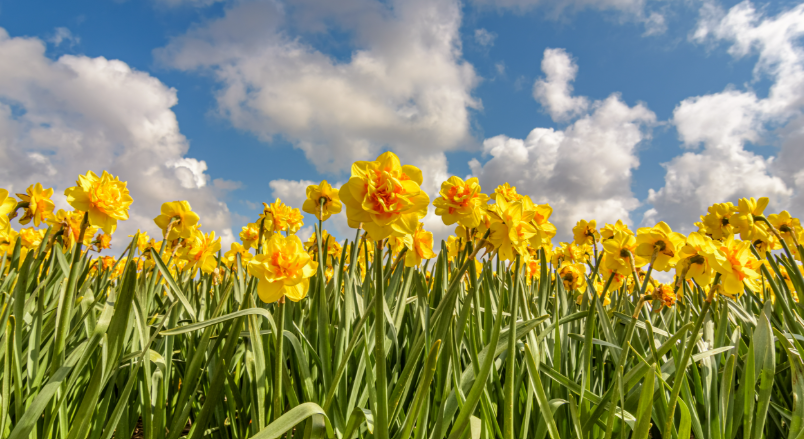
While most daffodils are immediately recognizable by their central trumpet, the single-cup varieties bear a strong overall resemblance to tulips in their upright posture and smooth, rounded petals. They grow 12 to 18 inches tall and are among the most reliable and long-lived of all spring bulbs, with some established clumps known to flower for 50 years or more without division. Like tulips, they emerge in early spring and naturalize beautifully in lawns and borders.
Also Read: Flowers That Look Like Daisies
Lily (Lilium asiatic hybrids)
Asiatic and Oriental lilies produce upward-facing, cup-shaped blooms that closely echo the tulip’s classic silhouette, especially in the single-flowered, upright varieties. They grow 2 to 4 feet tall and bloom in an extraordinary range of colors — red, orange, yellow, pink, white, and bicolor — from early to midsummer. There are over 9,000 registered lily cultivars worldwide, making them one of the most diverse flowering bulb genera available.
Lisianthus (Eustoma grandiflorum)
Lisianthus produces upright, cup-shaped blooms in shades of purple, lavender, white, pink, and bicolor that bear a striking resemblance to tulips when in bud and early bloom. It grows 18 to 36 inches tall and is one of the most prized cut flowers in the floral industry, with a vase life of up to 21 days — significantly longer than a cut tulip. It is native to the warm grasslands of the American Southwest and Mexico.
Ranunculus (Ranunculus asiaticus)
Persian Buttercup produces tightly layered, cup-shaped flowers in vivid shades of red, orange, yellow, pink, white, and bicolor that resemble elegant tulips when partially open. Each corm can produce 4 to 7 flowers per season, and the flowers are among the most popular in the wedding and floral industry worldwide. They grow 12 to 18 inches tall and prefer cool growing conditions with excellent drainage.
Fritillary (Fritillaria imperialis)
Crown Imperial produces large, pendant, bell-shaped flowers in rich shades of red, orange, and yellow, hanging in a crown-like cluster beneath a topknot of leafy bracts. The individual flowers share the smooth, waxy quality and overall form of tulips, though they nod downward rather than facing upward. It grows an impressive 3 to 4 feet tall, making it one of the most dramatic spring bulbs available.
Anemone (Anemone coronaria)
Poppy Anemone produces upright, cup-shaped blooms in jewel-bright shades of red, blue, purple, pink, and white, often with a striking black central boss of stamens. When fully open, they closely resemble single tulips in form and posture, growing on stems 12 to 18 inches tall. They are widely grown as cut flowers, particularly in the De Caen and St Brigid series, and have a cheerful, vivid quality few other spring flowers can match.
Magnolia (Magnolia x soulangeana)
Saucer Magnolia produces large, goblet-shaped flowers in shades of white, pink, and deep rose-purple that are strikingly similar to oversized tulips, particularly when the blooms are in their early, upright cup stage before fully opening. Individual flowers can measure 5 to 10 inches across, and the tree blooms spectacularly in early spring before its leaves emerge. It is one of the most widely planted ornamental flowering trees in temperate gardens worldwide.
Also Read: Perennial Flowers That Bloom All Summer
Hellebore (Helleborus orientalis)
Lenten Rose produces nodding, cup-shaped flowers in shades of cream, white, pink, deep purple, near-black, and spotted combinations that bear a graceful resemblance to downward-facing tulips. They grow 12 to 18 inches tall and bloom remarkably early — often from January through April — filling the garden with color when little else is in flower. Hellebores are exceptionally long-lived plants, with established clumps known to persist for 20 years or more.
Camellia (Camellia japonica)
Single and semi-double camellia varieties produce smooth, rounded, cup-shaped blooms in shades of red, pink, white, and striped bicolor that closely mirror the tulip’s elegant silhouette. Camellias are evergreen shrubs that can grow 6 to 15 feet tall and bloom in late winter to spring, providing tulip-like flowers during the months when few other shrubs are in bloom. Japan alone recognizes over 2,000 named camellia cultivars.
Also Read: Flowers That Look Like Roses
Peonies (Paeonia lactiflora)
Single-flowered peony varieties produce large, upright, cup-shaped blooms in shades of white, cream, pink, red, and coral that bear a striking resemblance to oversized tulips in their early bloom stage. They are extraordinarily long-lived garden plants — a well-sited peony can bloom reliably for 50 to 100 years without needing to be lifted or divided. Peonies are also among the most fragrant of all tulip-like flowers.
Poppy (Papaver orientale)
Oriental Poppies produce large, silky, cup-shaped flowers in shades of red, orange, pink, white, and salmon, often with dramatic dark blotches at the petal bases. When the buds split open, the emerging flowers bear a beautiful resemblance to opening tulips, with the same smooth, rounded petals and upright posture. They grow 2 to 3 feet tall and make one of the most vivid displays of any early-summer perennial.
Brodiaea (Brodiaea elegans)
Harvest Brodiaea is a California native bulb plant that produces clusters of upright, funnel-shaped flowers in shades of violet-blue and lavender on slender stems 12 to 18 inches tall. The individual flowers closely resemble small tulips in both form and posture, and they bloom in late spring and early summer when true tulips have faded. They are exceptionally drought-tolerant once established, thriving in dry summer conditions that would stress many other bulbs.
Ipheion (Ipheion uniflorum)
Spring Starflower produces solitary, upright, star-shaped to cup-shaped flowers in pale lavender-blue to white on slender stems just 6 to 8 inches tall. While smaller than a tulip, the single flower held upright on its clean stem is strongly reminiscent of a miniature tulip in its overall presentation. It naturalizes freely and can produce carpets of bloom across a lawn or border in just a few years.
Calochortus (Calochortus venustus)
Mariposa Lily is a beautiful North American native bulb with three broad, rounded petals forming a perfect upright cup in shades of white, yellow, pink, purple, and red, often with intricate markings near the base. The resemblance to a tulip is remarkably close, and in many cases the two are nearly indistinguishable at a glance. There are approximately 70 species of Calochortus native to western North America, many of which are rare and sought after by specialist bulb growers.
Iris (Iris tulipana / Dutch Iris)
Dutch Irises produce upright, elegantly formed flowers in shades of blue, purple, yellow, white, and bicolor that share the tulip’s clean, upright posture and smooth petals before the falls and standards fully open. They grow 18 to 24 inches tall and are major commercial cut flowers, widely sold in florists alongside tulips. The Netherlands exports over 1.3 billion Dutch iris bulbs annually to markets around the world.
Gentian (Gentiana acaulis)
Trumpet Gentian produces solitary, upright, deep blue trumpet-to-cup-shaped flowers of extraordinary intensity that closely resemble small tulips in their upright posture and smooth, rounded form. It grows just 4 to 6 inches tall and is a jewel of the rock garden, producing some of the most brilliantly blue flowers in the entire plant kingdom. Few other flowers can rival its vivid, almost electric shade of pure blue.
Sternbergia (Sternbergia lutea)
Winter Daffodil produces bright, glossy, golden-yellow flowers with smooth, overlapping petals in a perfect upright cup — making it one of the most convincing tulip lookalikes among autumn-flowering bulbs. It grows just 6 to 8 inches tall and blooms in September and October, when true tulips are still dormant. It is native to the Mediterranean and Middle East, where it grows on rocky hillsides in full sun.
Tulbaghia (Tulbaghia violacea)
Society Garlic produces clusters of small, tubular to cup-shaped flowers in soft lilac-purple on upright stems 18 to 24 inches tall. While individual flowers are smaller than tulips, the overall upright presentation and smooth, overlapping petals of each bloom share the same elegant simplicity. It is an exceptionally tough and adaptable plant, tolerating drought, coastal conditions, and light frost with remarkable ease.
Also Read: Perennials With Yellow Flowers
Trillium (Trillium grandiflorum)
Great White Trillium is a woodland wildflower that produces a single, upright, three-petaled flower in pure white or soft pink above a whorl of three broad leaves. The large, smooth petals held in an upright cup form a strong visual echo of the tulip, particularly in its early bloom stage. It is a slow-growing but exceptionally long-lived plant, with established colonies known to persist in woodland gardens for decades.
Oxalis (Oxalis versicolor)
Candy Cane Sorrel produces small, upright, cup-shaped flowers in pure white with vivid red spiral stripes on the petal reverses, creating a striking tulip-like silhouette when the buds are closed or partially open. It grows just 6 to 8 inches tall and is one of the most visually distinctive of all small bulbous plants. The striking red-and-white striped buds are arguably even more beautiful than the open flowers.
Sparaxis (Sparaxis tricolor)
Harlequin Flower produces upright, open cup-shaped blooms in bold combinations of red, orange, yellow, and white with a contrasting yellow throat bordered by dark markings, closely resembling brightly colored tulips in form. It grows 12 to 18 inches tall from corms and blooms in spring, thriving in sunny, well-drained positions. It is native to the Cape region of South Africa, which is home to an extraordinary concentration of bulbous plant diversity.
Tulip Magnolia (Magnolia liliiflora)
Lily Magnolia produces deep rose-purple to red-purple goblet-shaped flowers that are among the most convincingly tulip-like of any tree blossom, particularly in bud and early bloom when the flowers are still upright and cup-shaped. It grows as a large shrub or small tree to 10 to 12 feet and blooms in mid to late spring, often producing a second flush of flowers in early summer. It is one of the parent species of the popular Saucer Magnolia hybrid.
Puschkinia (Puschkinia scilloides)
Striped Squill is a small, delicate spring bulb that produces clusters of pale blue-white flowers, each petal marked with a darker blue central stripe, on stems just 4 to 6 inches tall. The individual flowers have a neat, upright cup form reminiscent of a miniature tulip, and they naturalize freely to form expanding colonies under deciduous trees and shrubs. It is native to the Caucasus, Turkey, and Lebanon, sharing much of its natural range with wild tulip species.
Geranium (Pelargonium x hortorum — Tulip-flowered types)
Tulip-flowered pelargoniums are a distinct group within the zonal geranium family, producing small, semi-double flowers that remain in a tight, inward-curving cup shape and never fully open — a form remarkably close to a half-open tulip. They grow 12 to 18 inches tall and are outstanding container plants for sunny patios and balconies. Their perpetually half-open flowers give them a uniquely neat, refined appearance compared to standard pelargoniums.
Nierembergia (Nierembergia hippomanica)
Cup Flower produces delicate, upright, cup-shaped blooms in shades of white, lilac, and violet-blue with a contrasting yellow throat on low-growing plants 6 to 12 inches tall. The smooth, rounded petals forming a neat cup echo the tulip’s fundamental form on a much smaller scale. It is a prolific bloomer in cool weather and an excellent edging and container plant for spring and autumn displays in temperate gardens.
Zephyranthes (Zephyranthes grandiflora)
Rain Lily produces solitary, upright, funnel-to-cup-shaped flowers in pink, white, or yellow on slender stems 8 to 12 inches tall, blooming in flushes triggered by rainfall. The single flower held upright on its clean stem bears a very close resemblance to a small, graceful tulip, particularly in the pink and white varieties. It is native to the Americas and thrives in warm, humid climates where true tulips often struggle.
Also Read: Perennials With Large Flowers
Allium (Allium karataviense)
While most alliums are known for their spherical flower heads, the species Allium karataviense produces its star-shaped blooms in a much more compact, rounded cluster close to the ground with broad, ornamental grey-green leaves — and some species like Allium unifolium produce small, upright, cup-shaped flowers with a distinctly tulip-like character. Alliums are exceptionally easy to grow and are remarkably deer and rodent-resistant, a significant advantage over true tulips.
Hyacinth (Hyacinthus orientalis)
While hyacinths are best known for their dense flower spikes, individual florets are perfectly formed upright bells with smooth, reflexed petals that closely mimic the tulip’s fundamental shape on a miniature scale. They grow 8 to 12 inches tall and are among the most intensely fragrant of all spring bulbs — a single potted hyacinth can fill an entire room with its sweet perfume. They have been cultivated in gardens for over 400 years since their introduction from the Eastern Mediterranean.
Crocus (Crocus vernus)
Large-flowered Dutch crocuses produce upright, goblet-shaped blooms in shades of purple, lavender, white, yellow, and striped bicolor that are essentially miniature tulips in form. They grow just 4 to 6 inches tall and are among the first bulbs to flower in spring, often pushing through the last snow of the season. A well-planted crocus display can include thousands of flowers per square meter, creating one of the most spectacular mass plantings possible in a small space.
Protea (Protea cynaroides)
King Protea produces enormous, goblet-shaped flower heads in shades of pink, red, and cream with a striking arrangement of stiff, pointed bracts surrounding a central dome — creating a flower head that, when young and partially open, bears a remarkable resemblance to a giant tulip. It can grow 3 to 5 feet tall and produces flowers up to 12 inches across, making it one of the largest tulip-like blooms in the plant world. It is the national flower of South Africa.
Colchicum (Colchicum autumnale)
Autumn Crocus produces large, smooth, goblet-shaped flowers in shades of lilac-pink, purple, and white that emerge directly from the ground in autumn without any foliage — a phenomenon sometimes called “naked ladies.” The flowers are strikingly tulip-like in form, growing 4 to 6 inches tall, and their autumn timing makes them a fascinating and unexpected addition to the garden. Despite its common name, Colchicum is not a true crocus and is actually more closely related to lilies.