There is something undeniably compelling about a large flower. Where small blooms create texture and mood, a large flower commands attention — stopping the eye, drawing the visitor closer, and making a statement in the border that smaller plants simply cannot replicate. The perennials that produce truly large flowers are among the most celebrated and sought-after plants in horticulture, and for good reason.
Large-flowered perennials serve a specific and important role in garden design. They provide focal points and anchor beds, creating moments of drama that prevent a planting from becoming visually monotonous. A single well-placed peony, a towering echinacea, or a bold rudbeckia can transform the character of an entire border, giving it a sense of scale and intention that collections of smaller-flowered plants alone rarely achieve.
The range of large-flowered perennials available to the modern gardener is extraordinary. The selection spans continents and climates — North American prairie natives, European woodland plants, South African rarities, and Asian garden classics — and covers every season from the earliest spring to the last days of autumn. Some are architectural and stately, others romantic and billowing, and others wild and naturalistic in character.
Peony (Paeonia)
The peony is one of the great large-flowered perennials — a plant whose blooms are so extravagantly full, so richly colored, and so intensely fragrant that they have been celebrated in art, poetry, and garden design for centuries across both Europe and Asia.
The flowers can reach eight to ten inches across in the finest double varieties, with layer upon layer of silky petals in shades of white, cream, blush, pink, coral, red, and deep burgundy. Single and semi-double forms have a simpler, more elegant character, each flower showing prominent golden stamens at the center.
Peonies are exceptionally long-lived — a well-sited plant can outlast the gardener who planted it by decades — and they ask very little once established beyond a sunny position and good drainage. The foliage is handsome through summer and turns attractive shades of red in autumn.
Oriental Poppy (Papaver orientale)
The oriental poppy produces flowers of extraordinary size and impact — tissue-paper-thin petals of vivid scarlet, orange, salmon, pink, or white surrounding a dramatic boss of dark stamens, the whole flower often measuring six inches or more across and carried on tall, hairy stems above deeply cut, bristly foliage.
The flowering season is brief — typically two to three weeks in late spring and early summer — but the impact during that period is so intense that the plant earns its border space many times over. After flowering, the foliage dies back completely, which is best managed by planting neighboring perennials that will fill the gap as the season progresses.
Varieties such as Beauty of Livermere (deep red), Patty’s Plum (smoky mauve-purple), and the white Checkers are among the finest.
Echinacea (Coneflower)
Echinacea — the coneflower — has been transformed from a relatively simple, pink-petaled prairie native into one of the most dazzling and diverse large-flowered perennials in modern horticulture, with contemporary breeding producing varieties in extraordinary shades of orange, red, yellow, magenta, white, and bicolor forms.
The flowers are large — typically three to four inches across — with prominent, domed central cones of rich orange-brown surrounded by reflexed petals that give the flower a distinctive, shuttlecock-like silhouette instantly recognizable across the summer border. They are excellent for cutting and the dried seed heads provide ornamental value through autumn and winter.
Echinaceas thrive in full sun with well-drained soil and are remarkably drought-tolerant once established.
Also Read: Perennial Flowers that Bloom All Summer Long
Rudbeckia (Black-eyed Susan)
Rudbeckia produces some of the most cheerful and luminous large flowers of the late summer and autumn garden — vivid golden-yellow to deep orange daisies with dark, velvet-brown to black central cones that give the flowers a warm, richly contrasted character perfectly suited to the golden light of late summer.
The flowers are large — three to five inches across in the finest varieties — and produced in great abundance on bushy, upright plants that bloom from late summer through to first frost. Rudbeckia fulgida Goldsturm is the classic variety, consistently excellent and widely regarded as one of the finest late-season perennials. Rudbeckia laciniata produces even larger flowers on very tall stems and creates an impressive back-of-border display.
Delphinium
Delphiniums produce tall, majestic spires of densely packed flowers — individually small but collectively creating a bloom structure of extraordinary scale and visual power — in a color range dominated by the most intense and saturated blues available in any garden plant.
The individual florets are typically one to two inches across, but the towering spikes can reach five or six feet in height, making the overall scale of the floral display among the largest of any perennial in the garden. Pacific Giant varieties produce the most spectacular spires, while the Belladonna group offers a more slender, graceful, branching habit.
Delphiniums need staking, prefer a sheltered position, and repay careful cultivation with a display that is among the most dramatic in the summer border.
Hibiscus (Hardy Hibiscus)
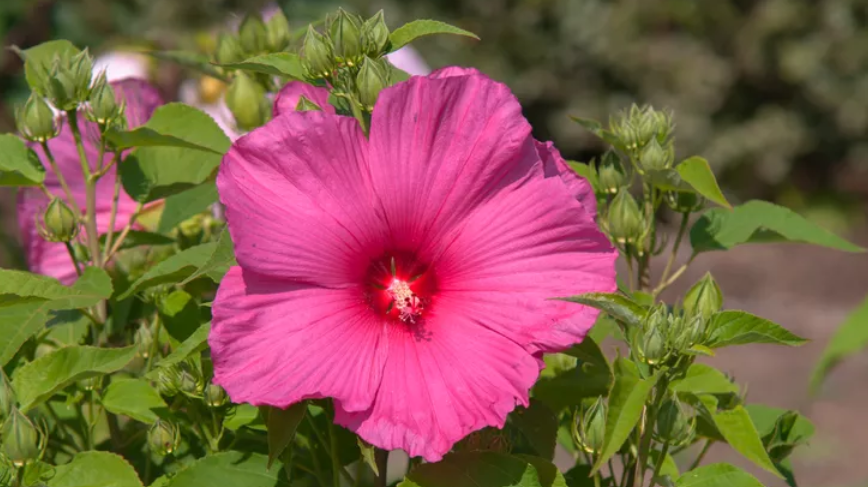
Hardy hibiscus — the perennial, cold-hardy species rather than the tropical houseplant — produces flowers of almost tropical extravagance on fully winter-hardy plants that die back to the ground each autumn and return reliably each spring.
The flowers are enormous — often eight to twelve inches across — in vivid shades of white, pink, red, and bicolor forms, with a bold, open, plate-like form and a prominent central column of stamens that gives them an unmistakable tropical character. They appear in late summer and continue through autumn, often well into September and October, extending the large-flowered season further than almost any other hardy perennial.
Varieties such as Summerific Evening Rose, Cranberry Crush, and Midnight Marvel are among the finest modern selections.
Helenium (Sneezeweed)
Helenium produces large, daisy-like flowers with reflexed petals surrounding prominent, domed central cones in a warm palette of yellow, orange, copper, and deep mahogany-red — often with bicolor petals that graduate in intensity from the pale petal tips to the rich, dark central zones.
The flowers are typically two to three inches across and are produced in extraordinary abundance on bushy plants that bloom from midsummer through to early autumn. The combination of flower size, quantity, and warm color range makes helenium one of the most visually rich and rewarding of all late-summer perennials.
Varieties such as Moerheim Beauty (deep copper-red), Sahin’s Early Flowerer (orange and yellow), and Waltraut (golden orange) are among the finest.
Agapanthus
Agapanthus produces large, spherical or hemispherical flower heads — each head composed of dozens of individual trumpet-shaped florets — carried on tall, smooth, leafless scapes above strap-like basal foliage. The overall flower head can measure four to eight inches across in the finest varieties.
The color range runs from pure white through the palest sky-blue to deep, vibrant violet-blue — a color range of particular value in the summer garden where truly strong blues are relatively uncommon among large-flowered perennials. Deciduous varieties such as Headbourne Hybrids are hardier than evergreen types and better suited to gardens with cold winters.
They are outstanding plants for containers, borders, and coastal gardens where their bold, architectural flower heads create a striking midsummer display.
Hemerocallis (Daylily — Large-flowered)
While daylilies as a genus range from small and delicate to large and extravagant, the large-flowered modern hybrid varieties produce individual blooms of considerable size — four to six inches across — in a color range that spans virtually the entire spectrum except pure blue and pure white.
Each flower lasts only a single day, but well-budded scapes produce a succession of blooms over a period of several weeks, and reblooming varieties extend the display further with additional flushes through summer. The large-flowered varieties have ruffled petals of great substance and elegance, and modern breeding has produced forms with extraordinary color combinations, patterns, and petal forms.
Varieties such as Gentle Shepherd (white), Red Volunteer (red), and Frans Hals (bicolor) represent the impressive breadth of the large-flowered daylily palette.
Crocosmia (Large-flowered)
The large-flowered crocosmia varieties — particularly Lucifer, the most famous and widely grown — produce arching sprays of vivid, trumpet-shaped flowers of considerable size and impact, carried in late summer on bold, sword-like foliage that is ornamental in its own right throughout the growing season.
Lucifer produces flowers of a particularly intense, fire-engine red in late July and August that are among the most vivid and eye-catching of any summer perennial. The flower heads are dramatic and architectural, with the arching spray carrying multiple open blooms simultaneously.
Other large-flowered varieties include George Davidson (deep yellow), Emily McKenzie (orange with mahogany markings), and Hellfire (deep red), each bringing its own vivid color to the late-summer border.
Phlox (Border Phlox)
Border phlox produces large, domed flower heads — each individual flower half an inch to an inch across, but collectively forming flower trusses four to six inches wide — in a color range that includes white, pink, lilac, purple, red, and striking bicolor forms with contrasting central eyes.
The fragrance is one of the finest of any summer perennial — sweet, warm, and distinctly phlox-like — and the scent intensifies in the evening, making it a perfect plant for a border near a seating area or outdoor dining space. Tall varieties reach four feet and need staking in exposed positions; compact forms such as the short-growing Intensia series are more self-supporting.
Mildew resistance should be a priority when selecting varieties — resistant forms such as David (white) and Blue Paradise (violet-blue) perform far better through the late-summer season.
Baptisia (False Indigo)
Baptisia is a bold, long-lived North American prairie native that produces tall, upright spikes of large, pea-shaped flowers — typically one to one and a half inches across — in vivid indigo blue, white, or yellow, followed by attractive inflated seed pods that rattle in the autumn wind.
It takes a few years to establish fully but becomes an increasingly impressive and self-sufficient plant over time, forming large, shrubby clumps that need no staking and die back cleanly each autumn. The blue-flowered species produces one of the truest and most saturated blues available in a spring-flowering perennial, and its bold, bushy structure makes it one of the most architecturally valuable plants in the early-summer border.
Also Read: Dark Purple Perennial Flowers
Inula magnifica
Inula magnifica is a towering, bold-spirited perennial that produces some of the largest and most dramatically ray-petalled daisy flowers of any hardy garden plant — the vivid yellow flower heads can reach four to six inches across, with finely divided, thread-like ray petals radiating from a prominent central disc.
The plant itself is enormous in scale, reaching six feet or more in height on thick, upright stems with large, heart-shaped basal leaves, making it a commanding back-of-border or specimen plant. It blooms in midsummer and the combination of flower size, stem height, and vivid yellow color creates one of the most dramatic large-scale floral displays the perennial garden can produce.
It is particularly effective as a bold statement plant at the back of a large border or beside water.
Rodgersia
Rodgersia is grown for the combination of its bold, architectural foliage and its large, plume-like flower heads — tall, branching panicles of tiny flowers that collectively form a floral structure of considerable scale and elegance, in white or pink, carried high above the dramatic, palmate or pinnate leaves.
The leaves are the dominant ornamental feature — deeply veined, bronze-tinged in spring, and often taking on reddish tints again in autumn — but the flower plumes, which can reach twelve to eighteen inches in length, add a further dimension of summer interest that makes rodgersia one of the most complete and multi-season perennials for damp, shaded positions.
It thrives beside water, in moist woodland shade, and in boggy ground where its large, moisture-demanding foliage can develop to its fullest and most impressive scale.
Gunnera manicata
Gunnera is the most architecturally dramatic of all hardy perennials — a plant of genuinely extraordinary scale, with leaves that can reach ten to fifteen feet across on thick, bristly stems, creating a prehistoric, jungle-like presence beside water that is utterly unique in the temperate garden.
The flower heads — large, cone-like structures of greenish-red that emerge from the base of the plant in early summer — are in themselves impressive, reaching three to four feet in height, but the scale of the leaves makes them the more remarkable feature. This is a plant that requires a large garden and a permanently moist position, but in the right setting it creates an impact that no other hardy perennial can approach.
It needs its own crowns protected in winter with a covering of its own dead leaves in cold climates.
Iris (Tall Bearded)
The tall bearded iris produces flowers of exceptional beauty and complexity — the three upright standards and three downward-falling falls creating a sculptural, architectural form that is unique among large-flowered perennials — in a color range broader than virtually any other garden plant.
Individual flowers can reach four to five inches across and are often intensely fragrant, with a sweet, violet-like scent carried on the warm early-summer air. Modern tall bearded varieties have been bred to an extraordinary level of refinement, with ruffled petals, bicolor forms, contrasting beards, and a color palette that includes black, near-orange, pure white, and every shade in between.
They need excellent drainage and a baking, sunny position to perform at their best — conditions that suit them perfectly at the front of a hot, south-facing border.
Trollius (Globeflower)
Trollius produces flowers of unusual and distinctive form — tightly cupped or open globe shapes in clear, luminous shades of yellow, gold, and orange that glow with a particular intensity in the soft light of late spring and early summer.
The individual flowers are large — two to three inches across — and are held singly on upright stems above attractive, deeply divided foliage. They are one of the best large-flowered perennials for damp, partially shaded conditions, thriving in moist borders and at the water’s edge where they produce their cheerful, buttercup-like display in May and June.
Varieties such as Superbus (pale yellow), Earliest of All (deep yellow), and Orange Princess (rich orange) are among the most widely grown and reliable.
Lychnis coronaria (Rose Campion)
Lychnis coronaria produces flowers of startling, almost shocking intensity — the vivid magenta-crimson blooms are small individually but carried in such abundance on branching silver-white stems above woolly, grey-white foliage that the overall effect is one of vivid, luminous color that carries across the garden with unusual power.
The contrast between the brilliant flower color and the soft, silvery foliage and stems is one of the finest natural color combinations in the perennial border. The white form, Alba, and the bicolor Oculata, with white petals and a pink eye, are more restrained alternatives that work beautifully in softer color schemes.
It self-seeds freely, which means that an initial planting quickly establishes a self-sustaining colony that regenerates reliably from year to year.
Heliopsis helianthoides (False Sunflower)
Heliopsis produces large, vivid yellow daisy flowers of considerable substance and quantity from midsummer through to autumn — flowers very similar in character to the true sunflower but on a reliably perennial plant that returns each year with increasing vigor.
The flowers are typically three to four inches across, with rich golden-yellow ray petals surrounding a raised, golden-brown central cone. They are produced prolifically on bushy, upright plants that require no staking and remain in flower for an exceptionally long period. The double and semi-double varieties — such as Loraine Sunshine, with its dramatic variegated foliage, and Summer Nights, with deep-toned flowers and dark stems — add further ornamental interest.
It is one of the most reliably long-blooming large-flowered perennials of the late summer border.
Kniphofia (Red Hot Poker)
Kniphofia produces tall, dramatic torches of densely packed, tubular flowers — the individual florets small but collectively creating flower heads of considerable scale and visual impact, in vivid combinations of red, orange, and yellow that give the plant its evocative common name.
Modern breeding has expanded the color range considerably to include cream, white, pale yellow, apricot, and coral forms that integrate more easily into a wider range of color schemes than the classic hot-toned varieties. The flowers are carried on thick, leafless scapes above arching, strap-like foliage and reach three to four feet in height in the mid-range varieties, with taller forms reaching five feet or more.
They are exceptional plants for providing bold vertical accent and vivid late-summer and autumn color in a sunny, well-drained border.
Also Read: Best Perennial Flowers for USDA Zone 13
Acanthus mollis (Bear’s Breeches)
Acanthus mollis is one of the most architecturally dramatic of all large-flowered perennials — a bold, sculptural plant with deeply lobed, glossy, dark green leaves of impressive size and flower spikes of extraordinary architectural quality that have influenced decorative design since ancient Greek and Roman times.
The flower spikes can reach four to five feet in height, each carrying dozens of large, hooded flowers in white and soft mauve-purple enclosed in spiny, rich green to purple bracts. The overall effect is one of bold, spiny, upright drama that is quite unlike any other large-flowered perennial.
The foliage alone — wide, deeply cut, and gleaming — would justify growing acanthus in the garden, and the combination of extraordinary leaves and dramatic flower spikes makes it one of the most complete and impressive of all large-flowered perennial plants.