Container gardening has undergone a remarkable transformation in recent decades, evolving from a collection of annual bedding plants in terracotta pots to a sophisticated and dynamic design discipline that rivals in-ground planting for visual impact, seasonal interest, and design ambition. At the heart of this transformation has been the increasing use of ornamental grasses — plants that bring movement, texture, architectural presence, and four-season interest to container arrangements in ways that no other plant group can quite replicate.
The appeal of ornamental grasses in containers is multifaceted. Their vertical or arching forms provide the height and structure that anchor container compositions and create a visual framework around which flowering and trailing plants can be arranged. Their movement in the breeze — the gentle swaying and rustling that is one of the most distinctive and calming qualities of any grass — brings a living dynamism to patios, terraces, and balconies that static plants cannot provide. And their remarkable seasonal range — from the vivid new growth of spring through the flower plumes of summer and the fiery autumn colors to the architectural winter silhouettes — means that a well-chosen container grass earns its space through all four seasons.
The global container plant market is substantial. In the United States alone, container plant sales exceed $4 billion annually, and ornamental grasses have been among the fastest-growing categories within that market over the past decade — with sales growth consistently outperforming the broader container plant sector by 15 to 20 percent year on year. This growth reflects an increasing appreciation among gardeners and landscape designers for the combination of low maintenance, high ornamental value, and ecological benefit that ornamental grasses bring to container planting.
Not all ornamental grasses are equally suited to container cultivation. The most successful container grasses share certain qualities — a clump-forming rather than aggressively spreading habit, a manageable root system that tolerates the confined space of a pot, a tolerance of the variable moisture conditions that containers naturally produce, and an ornamental character that justifies the prominent position that container planting typically demands. The 30 grasses in this guide represent the finest and most rewarding choices for container growing, chosen for their ornamental excellence, their container adaptability, and their all-round garden performance.
1. Japanese Forest Grass ‘Aureola’
Japanese forest grass Aureola is widely considered the finest ornamental grass for container cultivation — its cascading mounds of brilliantly variegated, gold-striped leaves creating a luminous, glowing effect in even the darkest container positions that is unmatched by any other shade-tolerant grass.
It reaches twelve to eighteen inches in height and spreads gracefully to fill its container with a waterfall of golden-yellow and green-striped foliage that is at its most vivid in partial shade — one of the few ornamental grasses that actually performs better away from full sun. The foliage turns warm copper and buff in autumn before dying back.
It is consistently rated among the top three ornamental grasses for container use in professional landscape designer surveys across both North America and the United Kingdom.
2. Blue Fescue
Blue fescue is one of the most popular and widely grown container grasses in the world — a compact, tufted, cool-season grass forming neat, rounded mounds of intensely blue-grey, narrow leaves that provide vivid color contrast in container arrangements throughout the spring and early summer growing season.
Its compact size — typically six to twelve inches in height — makes it ideal for smaller containers, window boxes, and combination planting where it provides a clean, precise color accent alongside flowering companions. The straw-colored flower stems add further texture in early summer.
It is estimated to be the most widely sold ornamental grass for container and rock garden use in European nurseries, where its reliable blue color and compact, tidy habit have made it a staple of both amateur and professional container planting for decades.
3. Karl Foerster Feather Reed Grass
Karl Foerster is the most important tall ornamental grass for container use — its narrow, strongly upright form providing clean vertical structure in large containers without the sprawling footprint of wider-spreading grasses, and its early summer flower plumes extending the container display across multiple seasons.
The feathery, pink-tinged plumes emerge in June — earlier than most large ornamental grasses — and mature through golden wheat-buff to pale straw, providing months of changing color and texture. In a large container on a terrace or by an entrance, a single well-grown Karl Foerster makes an immediate architectural statement.
It was named Perennial Plant of the Year in 2001 — the first grass to receive that distinction — and its outstanding all-round performance in both container and ground planting has made it the benchmark against which other tall container grasses are measured.
4. Purple Fountain Grass
Purple fountain grass is one of the most spectacular and widely used container grasses in warm-climate and summer annual planting — its burgundy-purple arching foliage and distinctive, bottlebrush-like flower plumes of deep burgundy to rose-pink creating one of the most vivid and immediately impressive container displays available from any ornamental grass.
It grows to three to five feet in a single season, making it ideal as a tall accent in large summer container arrangements where its rich purple color provides a dramatic backdrop for orange, yellow, and pink flowering companions. In containers it can be moved to a frost-free location for winter storage in cooler climates.
It is consistently one of the top five best-selling ornamental container grasses in American garden centers, with annual sales reflecting its exceptional color impact in the summer container market.
5. Sedge ‘Evergold’
Evergold is a compact, evergreen Japanese sedge with a broad, creamy-yellow central stripe edged in deep green on each arching leaf — forming a neat, luminous mound of year-round color that is among the most reliable and versatile evergreen container grasses available for shaded and partially shaded situations.
It grows to about twelve inches in height and spread — an ideal size for medium containers, window boxes, and combination plantings where its vivid variegation illuminates positions too shaded for most flowering container plants. The bright central stripe catches available light with a reflective quality disproportionate to the plant’s modest size.
It is one of the most popular sedges in the British nursery trade, where its year-round performance in shaded container situations has made it a consistent bestseller across multiple growing regions.
6. Mexican Feather Grass
Mexican feather grass produces fine, hair-like, arching leaves and an almost continuous display of long, silky, shimmering awns from late spring through autumn that give the plant a luminous, mist-like quality in any sunlight or breeze — a quality that makes it one of the most elegant and visually distinctive container grasses for sunny positions.
In a container, the fine texture of Mexican feather grass provides an outstanding contrast to bold-leaved flowering companions such as dahlias, salvias, and agapanthus — the delicate, transparent quality of the grass making neighboring plants appear bolder and more vivid by contrast. It is particularly beautiful in the low light of morning and evening.
It has become naturalized and is considered invasive in parts of California and Australia, and locally appropriate sterile or alternative varieties should always be verified before purchase.
7. Maiden Grass ‘Morning Light’
Morning Light is the most refined and container-appropriate of all the maiden grass varieties — its very finely striped, silver-margined leaves creating a misty, silvery-green overall effect that is quite unique among large ornamental grasses and that provides a graceful, luminous backdrop in large patio and entrance containers.
It grows to four to five feet — slightly smaller than most miscanthus varieties — and forms a neat, rounded, vase-shaped mound of exceptional elegance. In large containers it develops the graceful, fountain-like form that showcases the characteristic silver sheen to maximum effect.
Morning Light is consistently rated among the top five ornamental grasses in professional landscape designer surveys for its refined, year-round ornamental quality in both container and ground planting.
8. Leatherleaf Sedge
Leatherleaf sedge is one of the most striking and dramatic container sedges available — a New Zealand native producing wide, arching, copper-bronze to reddish-brown leaves of considerable visual impact that provide warm, autumnal color throughout the entire year in a container with no seasonal downtime.
The rich, warm tones of the leatherleaf sedge leaves combine exceptionally well with orange, gold, and burgundy flowering companions in autumn container arrangements, and they provide year-round color consistency that most flowering container plants cannot match. It grows to two feet with leaves broader and more substantial than most container sedges.
It is one of the most popular container sedges in New Zealand and Australian nurseries, where its warm coloration and year-round performance have made it a standard component of professional container planting palettes.
9. Black Mondo Grass
Black mondo grass provides one of the most dramatic color contrasts available in any container planting — its low, slowly spreading mounds of strap-like leaves in near-black to deep purple-black creating a striking, unusual, and highly effective dark accent in container compositions alongside silver, gold, and vivid flowering companions.
It grows to six to eight inches and spreads slowly — ideal proportions for medium containers, window boxes, and combination bowls where its dark foliage provides a sophisticated contrast without overwhelming smaller companions. The small pink to white summer flowers and glossy black autumn berries add further seasonal interest.
It has become one of the most popular and widely purchased ornamental grass-like plants in contemporary garden design globally, consistently appearing in award-winning container arrangements at international horticultural shows.
10. Switchgrass ‘Shenandoah’
Shenandoah switchgrass is one of the finest tall container grasses for autumn interest — a native prairie grass that develops vivid, early, intense red coloration in the foliage from midsummer onwards, turning a deeper, richer burgundy-red through autumn before fading to warm buff through winter.
In a large container it provides bold vertical structure of three to four feet with the added bonus of one of the earliest and most vivid autumn color displays of any ornamental grass. The airy, cloud-like seed heads catch low autumn light with a translucent, glowing quality.
The early red coloration — beginning as early as July in some climates — is Shenandoah’s greatest distinction and has made it the most sought-after switchgrass variety for container and border planting alike.
11. Calamagrostis ‘Overdam’
Overdam is a variegated form of feather reed grass with cream-and-green striped foliage that provides attractive foliar interest throughout the growing season alongside the characteristic early-season feathery plumes that make the feather reed grass family so valuable in the container garden.
The variegation brightens shaded container positions considerably, and the narrow, upright form — reaching three to four feet — provides strong vertical structure in large containers without a sprawling footprint. The plumes appear in early summer, adding a further dimension of seasonal interest above the attractive striped foliage.
It performs well in containers with consistently moist growing medium and is one of the most consistently recommended variegated tall grasses for large-scale patio and terrace container planting.
12. Blue Oat Grass
Blue oat grass is prized for its striking metallic blue-grey foliage — one of the most intense and sustained blue colors available from any container plant — that provides vivid color contrast in container arrangements throughout spring and early summer, the cool blue-toned leaves complementing warm-toned flowering companions with exceptional effectiveness.
It grows to eighteen to twenty-four inches with strongly upright, narrow leaves and produces straw-colored, oat-like flower heads in early summer. In containers it provides a clean, architectural blue accent that works particularly well alongside orange, yellow, and bronze companions.
It is a cool-season plant that looks best in spring and early summer before going somewhat dormant in heat, making it most effective in containers in cool-climate gardens or in combination with summer companions that can carry the display through the warmest months.
13. Sedge ‘Ice Dance’
Ice Dance is a vigorous, spreading, evergreen Japanese sedge with deep green and bold white-margined leaves that provides one of the most effective and dynamic white-variegated groundcovers for shaded container situations, brightening dark window boxes and shaded patio containers with its clean, crisp coloring throughout the year.
It spreads more vigorously than many other ornamental sedges — a quality that makes it one of the fastest-filling container grasses for situations where rapid coverage is required. The bold, clean variegation maintains its brightness even in moderate to relatively deep shade.
It is widely used in commercial container planting programs where its reliability, year-round performance, and shade tolerance make it one of the most cost-effective and consistent container sedge choices available.
14. Pennisetum ‘Hameln’ (Dwarf Fountain Grass)
Hameln is the finest dwarf fountain grass for container cultivation — a compact, well-behaved variety producing bottlebrush-shaped, creamy-white to pinkish flower plumes in summer and autumn on a tidy, mounding plant of ideal proportions for medium to large containers.
It reaches eighteen to twenty-four inches in height — significantly more compact than standard fountain grass — and the dense, rounded mound with arching leaves and attractive flower plumes provides a complete and self-contained ornamental display without the vigorous spreading that can become problematic in containers. The foliage turns warm gold in autumn.
It is one of the top-selling ornamental container grasses in American garden centers, valued for the combination of compact size, early flowering, and outstanding flower plume display that makes it one of the most complete container grasses available.
15. Lemongrass
Ornamental lemongrass is a bold, tropical-looking grass with broad, arching, blue-green to grey-green leaves that produces a dramatic, fountain-like mound in a large container — simultaneously providing architectural ornamental presence and the aromatic culinary lemongrass of Southeast Asian cooking.
In a container on a sunny terrace or patio, lemongrass creates an immediate tropical statement, reaching three to four feet in height and spread with leaves that release an intensely fresh, citrusy fragrance when touched. In cooler climates the container can be moved indoors for winter, where it continues to provide attractive foliage and culinary value.
It grows rapidly in warm conditions — adding significant size in a single season — and the dual ornamental-culinary value makes it one of the most practically useful large container grasses available.
16. Carex ‘Eversheen’
Eversheen is a bright, golden-yellow, wide-leaved sedge that forms a low, spreading mound of vivid, luminous foliage in containers — one of the most consistently golden and brightest of all the container sedge varieties, providing a persistent warm glow of color that justifies its prominent position in container arrangements throughout the growing season.
The wide, golden leaves are effective in both sun and partial shade — brightening shaded container positions with their warm yellow tone and providing vivid contrast to blue-flowered companions in sunnier situations. It is semi-evergreen and retains its golden color well into winter in mild climates.
It is increasingly used in commercial patio container schemes where its consistent color and low maintenance requirements make it one of the most reliable year-round container sedge choices available to professional landscapers.
17. Fiber Optic Grass
Fiber optic grass is a distinctive, eye-catching rush-like plant that produces tufts of slender, arching green stems each tipped with a tiny pale flower head at the very tip — giving it the evocative appearance of a cluster of illuminated fiber optic cables that makes it one of the most conversation-stopping plants in any container arrangement.
It grows to around twelve inches and requires consistently moist growing medium — it does not tolerate drought — but in appropriately watered containers it is a charming and unusual addition to shaded and partially shaded patio and terrace planting. The fine, delicate stems move with great sensitivity in any air movement.
It is particularly effective in water feature surrounds, moisture-retentive container gardens, and as an unusual textural companion to broad-leaved shade container plants where its fine, animated form provides maximum contrast.
18. Carex ‘Prairie Fire’
Prairie Fire is a vivid, upright-leaved container sedge with striking red to bronze-red foliage that provides some of the most intense warm color available from any container grass-like plant — a bold and striking contrast to the cool greens and blues that dominate most container schemes.
It grows to twelve to fifteen inches with narrow, upright leaves that hold their rich color throughout the growing season, and it performs well in partial to moderate shade — making it one of the most vivid warm-color container plants available for less sunny positions. It combines particularly effectively with blue-green hostas and the golden foliage of Japanese forest grass.
It is one of the most popular colored-foliage sedges for container planting in the current North American nursery market, with sales reflecting the growing preference for warm-toned, foliage-led container planting designs.
19. Spiky Fountain Grass ‘Burgundy Bunny’
Burgundy Bunny is the most compact of all the red-leaved fountain grasses — a dwarf variety reaching only twelve to eighteen inches that combines vivid burgundy-red foliage with the characteristic soft, fluffy flower plumes of the pennisetum family in a plant of ideal proportions for smaller containers, window boxes, and combination plantings.
The rich burgundy foliage provides intense color throughout the growing season, and the soft, silky flower plumes that appear in late summer add a further dimension of textural interest. It is one of the finest choices for smaller container situations where the standard purple fountain grass would be too large.
Its combination of compact size, vivid color, and ornamental flower plumes makes Burgundy Bunny one of the most versatile and widely recommended small ornamental container grasses currently available.
20. Golden Creeping Jenny
Golden creeping Jenny is a low, spreading, ground-cover perennial with vivid chartreuse-yellow leaves that provides a continuous carpet of bright golden color at the edges and base of container arrangements, its trailing stems spilling elegantly over container rims to soften the transition between container and surface.
It thrives in moist, partially shaded container situations and provides one of the most vivid and sustained yellow-green foliage effects of any trailing container plant — brightening the base of tall container grasses and filling the lower level of mixed container arrangements with a warm, luminous ground layer. Small yellow flowers appear in summer as a bonus.
It is one of the most widely used trailing companion plants for ornamental grass containers in professional and amateur planting alike — its vivid, year-round color and easy-going character making it one of the most reliable and practical container-edge plants available.
21. New Zealand Wind Grass
New Zealand wind grass is a fine-leaved, graceful, clump-forming grass that produces arching mounds of narrow, shining, olive-green to bronze-green leaves of exceptional elegance in containers — the leaves moving in the lightest breeze with a fluidity and animation that gives the plant a quality of perpetual gentle motion.
It reaches eighteen to twenty-four inches in a container and produces fine, airy flower spikes in summer that add a delicate, shimmering texture above the attractive foliage. The bronze-green leaf color darkens and enriches through the season, providing year-round interest that improves as the container plant matures.
It is one of the most widely used container grasses in contemporary New Zealand and Australian landscape design, where its natural origin and refined appearance make it a culturally appropriate and ecologically recognized container grass choice.
22. Festuca ‘Beyond Blue’
Beyond Blue is one of the most intensely blue-colored of all the ornamental fescues — a compact, tufted, cool-season grass with strikingly vivid, powder-blue leaves that maintain their color more consistently through summer heat than most other blue fescue varieties.
It forms neat, rounded mounds of six to ten inches — ideal for smaller containers, alpine bowl plantings, and as compact accent plants in combination container arrangements where the vivid blue provides a precise and striking color note. The improved heat tolerance means it retains its characteristic blue color longer into summer than standard blue fescue.
It is one of the most recommended compact blue container grasses for extending the ornamental season of blue-foliaged container grasses into the warmer months when other varieties begin to fade.
23. Pampas Grass (Dwarf)
Dwarf pampas grass varieties — reaching only three to four feet in containers rather than the full ten to thirteen feet of standard forms — bring the spectacular, creamy-white plumes of pampas grass into practical container territory, providing an impressive large-scale plume display from a plant of manageable container proportions.
In a large container on a terrace or by an entrance, a well-grown dwarf pampas grass in full plume is one of the most immediately impressive container grass displays available — the feathery, silky plumes appearing in late summer and persisting through winter providing months of dramatic ornamental value.
Dwarf varieties such as Pumila and Tiny Pampa have made pampas grass accessible to container gardeners for the first time, bringing its extraordinary plume display to gardens and patios that could not accommodate the standard large-scale plant.
24. Carex ‘Toffee Twist’
Toffee Twist is a warm-toned, bronze-brown sedge with attractively twisted, curling leaf tips that create a distinctive, slightly disheveled texture in containers — a plant of considerable character and year-round interest whose warm, coffee-brown to toffee-orange coloration provides one of the most unusual and effective foliage tones available in container planting.
It grows to twelve to eighteen inches and tolerates partial shade, making it a versatile container grass for a range of light conditions. The twisted leaf tips catch light in interesting ways through the day and the warm, earthy color palette suits both contemporary and traditional container design styles.
It is increasingly popular in professional container planting schemes where its unusual color and texture provide a distinctive alternative to the more familiar green and gold container sedge varieties.
25. Miscanthus ‘Little Kitten’
Little Kitten is the most compact miscanthus variety available — reaching only eighteen to twenty-four inches in height — bringing the ornamental qualities of the maiden grass family into appropriate proportions for medium to large container cultivation where standard miscanthus varieties would be far too vigorous.
It produces fine, silvery-green foliage and small but attractive flower plumes in late summer and autumn, and the plant develops an appealing, miniature version of the fountain-like form that characterizes the larger maiden grasses. In a medium container it provides the graceful, arching habit of miscanthus at a manageable container scale.
It is one of the most important developments in container-appropriate miscanthus breeding and has opened up the ornamental qualities of the maiden grass family to a much wider range of container planting situations than was previously possible.
26. Variegated Purple Moor Grass
Variegated purple moor grass is a medium-sized, cool-season grass whose leaves are striped lengthwise with creamy-white and green, and which produces attractive, purple-tinged, arching flower heads in early summer — a combination of year-round foliage interest and seasonal flowering charm that makes it one of the most complete ornamental container grasses for partially shaded situations.
It grows to two feet in a container and produces its best color and flowering performance in cool, moist growing conditions — partial shade with consistent moisture suits it perfectly. The creamy variegation illuminates shaded containers while the purple flower heads add a seasonal color note of considerable elegance.
It is one of the most recommended variegated container grasses for cool, moist garden situations in the British Isles and similar maritime climates where cool, moist conditions suit its preferences.
27. Soft Rush (Corkscrew Form)
The corkscrew rush is one of the most architecturally distinctive plants available for container cultivation — its continuously twisted and spiraled stems creating a sculptural, animated effect quite unlike any other container plant, providing a talking point and a visual curiosity that generates comment in virtually every garden where it is grown.
It grows to around two feet and requires consistently moist growing medium — it thrives in water garden containers and moist, partially shaded situations where regular watering is easily managed. The twisted stems provide interest throughout the year, including the golden winter tones of the faded stems.
It is one of the most popular specialist container grasses for contemporary minimalist garden design, where its precise sculptural form and unusual structure suit the clean, architectural aesthetic that characterizes contemporary outdoor living spaces.
28. Carex ‘Feather Falls’
Feather Falls is a graceful, weeping, cream-and-green variegated sedge whose long, cascading leaves fall in a distinctive, waterfall-like curtain over the sides of containers — one of the most elegant and effective trailing container grasses available, providing year-round structural interest in large pots, urns, and raised planters where the cascading habit can be fully displayed.
It grows to eighteen to twenty-four inches with cascading leaves that can extend considerably further down the sides of a tall container, and the cream variegation catches light beautifully throughout the year. The weeping habit is more pronounced and consistent than most other variegated trailing sedges.
It is increasingly specified in professional patio and terrace container schemes where its graceful, cascading habit provides the flowing, soft textural counterpoint to more upright and architectural container companions.
29. Hakonechloa ‘Beni-Kaze’
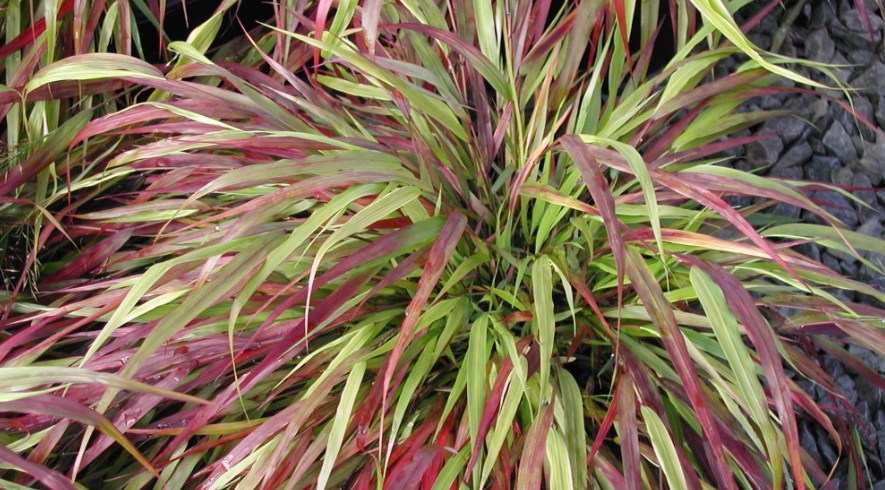
Beni-Kaze — meaning “red wind” in Japanese — is a green-leaved form of Japanese forest grass that develops vivid red and scarlet tints through the foliage in autumn, creating one of the most spectacular seasonal color displays available from any container grass at a time when the autumn container garden needs it most.
It grows to twelve to eighteen inches with the characteristic arching, cascading habit of all Japanese forest grass varieties, and through spring and summer it provides an attractive, fine-textured green grass of good ornamental quality. The autumn transformation — from green through orange to vivid, burning red — is one of the most dramatic seasonal performances of any container grass.
In containers it earns its space through two distinct seasons — the refined green texture of summer followed by the extraordinary autumn color display — making it one of the most seasonally complete container grasses available.
30. Striped Bulrush
Striped bulrush is a bold, upright, aquatic or semi-aquatic rush whose cylindrical, dark green stems are horizontally banded with creamy-white variegation at irregular intervals — creating one of the most visually striking and unusual variegation patterns of any container grass-like plant for water features and moisture-retentive containers.
It grows to two to three feet in height and is particularly effective in water garden containers, large ceramic glazed pots with a water reservoir, and consistently moist patio planters where its bold, upright stems create a strong architectural vertical accent. The striking horizontal banding provides maximum visual interest when viewed against a simple, uncluttered background.
It spreads by rhizomes and may need dividing every two to three years in containers — but the regular division also provides new plants that can be used to expand the container planting scheme or shared with other gardeners.