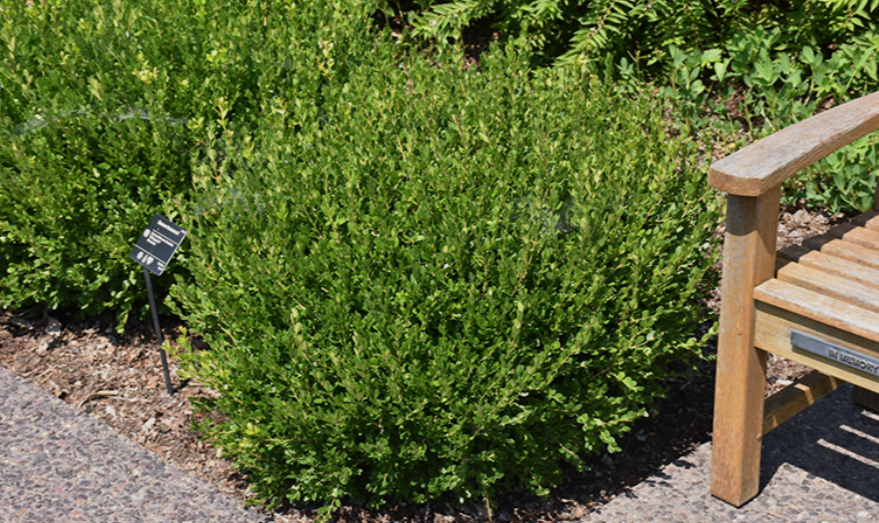
Wintergreen boxwood is a hardy, compact evergreen shrub prized for staying green through cold winters. Many boxwoods turn bronze, yellow or brown when temperatures drop, but Wintergreen keeps much of its fresh color, which is exactly how it earned its name. It is one of the most popular boxwoods for hedges and edging in the northern United States and Canada.
This tough little shrub combines cold hardiness with good resistance to boxwood blight and boxwood leafminer, two of the biggest threats to boxwoods today. Its small leaves, dense growth and easy care make it a dependable choice for homeowners who want a classic boxwood look with fewer problems.
Botanical Classification
Wintergreen belongs to the box family, a small group of evergreen shrubs that also includes pachysandra and sweet box. It is a cultivar of Korean boxwood, a small-leaved Asian boxwood known for surviving harsh winters. Korean boxwood was once grouped with littleleaf boxwood, so Wintergreen is sometimes labeled as a littleleaf boxwood in nurseries.
There is also some variation in plants sold under this name. Nurseries sometimes offer both a larger-leaved and a smaller-leaved form of Wintergreen. Both share the same cold hardiness and good winter color, but they differ slightly in leaf size and density.
Brief History
Korean boxwood grows wild on mountain slopes and islands in Korea and eastern China. It was introduced to North America in the early 1900s, when gardeners in colder regions were searching for boxwoods that could survive harsh winters.
Wintergreen was selected from Korean boxwood for its ability to hold green color through winter. It was introduced in Ohio in the mid-1900s and quickly became popular across the Midwest, Northeast and Canada. Today, it remains one of the most widely planted cold-hardy boxwoods.
Identifying Characteristics
Wintergreen has small, oval leaves about a quarter to half an inch long. They are bright to medium green and slightly glossy. The leaves grow in pairs on opposite sides of the stem and are closely packed, giving the plant a fine, dense texture.
It grows into a compact, rounded shrub about 3 to 4 feet tall and 3 to 4 feet wide when mature. It grows slowly, often a few inches a year, so it holds its size and shape for many years with little pruning.
Its biggest strength is its winter color. While many Korean boxwoods turn bronze or brown in winter, Wintergreen keeps a fresher green color in most sites. Some light yellowing may occur in very exposed, sunny or windy spots.
Like other boxwoods, it produces tiny, fragrant, pale yellow-green flowers in early spring. They attract bees but are easy to miss among the leaves.
Landscape Uses
Wintergreen is an excellent choice for low hedges and borders in cold climates. Its dense, rounded form creates a neat green edge along walkways, driveways, patios and garden beds. It is especially useful where other boxwoods look tired or brown in winter.
It works well in foundation plantings, where its compact size fits under windows and along the front of houses. Single plants make attractive accents near steps and entrances. It can also be clipped into simple shapes such as balls and low cubes.
It grows well in containers, though potted plants need extra protection in very cold winters. Like other boxwoods, it is deer-resistant. All parts of the plant are toxic if eaten, so it should be kept away from pets and livestock.
Growing Considerations
Wintergreen is generally hardy from about USDA zone 4 to zone 8. It performs especially well in the Upper Midwest, New England, the northern Plains and southern Canada, where many boxwoods struggle in winter.
It grows in full sun to partial shade. In very cold areas, a spot sheltered from strong winter wind and late-afternoon winter sun helps keep it looking its best. In warmer regions, afternoon shade helps protect it during hot summers.
Good drainage is essential. Like all boxwoods, Wintergreen can develop root rot in soggy soil. It grows best in loose, well-drained soil enriched with compost, with a slightly acidic to neutral pH of about 6.5 to 7.0.
Its roots are shallow, so a thin layer of mulch, about 1 to 2 inches, helps protect them. Keep mulch away from the stems. Water young plants regularly, and give established plants a deep watering in fall before the ground freezes.
Pruning and Care
Wintergreen needs only light pruning because of its slow growth and naturally rounded shape. Trim it in late spring after new growth hardens to keep it neat. Formal hedges may need a second light trim in early summer.
Avoid pruning in late summer or fall. Late cuts can trigger soft new growth that is damaged by early frost. Thinning a few interior branches each year lets in light and air and helps reduce disease.
Light fertilizer in spring is helpful if growth is weak or leaves look pale. In very cold or exposed sites, young plants can be wrapped in burlap during winter to reduce wind damage and protect against heavy snow.
Pests and Diseases
Wintergreen is one of the more disease- and pest-resistant boxwoods. It shows good tolerance to boxwood blight, a fungal disease first found in the United States in 2011 that causes leaf spots, black stem streaks and rapid leaf drop. While no boxwood is completely immune, Wintergreen performs better than many common hedge boxwoods.
It also has good resistance to the boxwood leafminer, a tiny fly whose larvae tunnel inside leaves and cause yellow or brown blisters. This gives it an advantage over popular hybrids such as Green Velvet and Green Mountain, which are more susceptible to leafminer.
Other possible problems include spider mites, boxwood psyllids and root rot in poorly drained soils. The invasive box tree moth, whose caterpillars can strip boxwoods of their leaves, has spread across Europe and into parts of North America. Gardeners should watch for webbing and chewed leaves in late spring and summer.
Wintergreen vs. Winter Gem
Wintergreen and Winter Gem have similar names and are often confused. Wintergreen is a Korean boxwood with smaller leaves and slower growth. It is very cold-hardy and well suited to the coldest northern gardens.
Winter Gem grows faster and has slightly larger, glossier leaves. It fills in hedges more quickly and handles warmer summers well. Both offer good winter color and resistance to leafminer, so the best choice depends mainly on climate and how quickly a hedge needs to fill in.
Wintergreen vs. Green Velvet
Green Velvet is another popular cold-hardy boxwood. It is a hybrid of Korean and common boxwood, with a fuller, softer look and slightly larger leaves. It also holds its color well in winter.
Wintergreen has better resistance to boxwood leafminer and better tolerance of boxwood blight. For gardeners concerned about pests and disease, Wintergreen is often the more reliable choice.
Frequently Asked Questions
How big does Wintergreen boxwood get? Wintergreen usually grows about 3 to 4 feet tall and 3 to 4 feet wide. It reaches this size slowly over many years. Regular light trimming can keep it smaller if needed.
Does Wintergreen boxwood really stay green in winter? Yes, it holds its green color better than most Korean boxwoods. In very exposed, sunny or windy sites, the leaves may yellow or bronze slightly. They usually return to full green in spring.
How fast does Wintergreen boxwood grow? It grows slowly, often only a few inches a year. Its slow growth helps it keep a neat shape with very little pruning. Young plants grow fastest in rich, well-drained soil with steady moisture.
How far apart should Wintergreen boxwoods be planted for a hedge? For a solid hedge, plants are usually spaced about 2 to 3 feet apart. Closer spacing fills in sooner, while wider spacing improves airflow. Good airflow helps reduce the risk of disease.
Is Wintergreen boxwood deer resistant? Yes, deer rarely eat boxwoods because of their bitter, toxic leaves. This makes Wintergreen a good choice for areas with heavy deer pressure. It is also generally avoided by rabbits.
Can Wintergreen boxwood grow in full sun? Yes, it can grow in full sun, especially in northern climates. In hot southern areas, some afternoon shade helps prevent leaf scorch. In very cold areas, protection from winter sun and wind reduces winter bronzing.
Sources
Cornell University, “Woody Plants Database: Boxwood”
Virginia Tech, “Boxwood Blight Resistant and Susceptible Cultivars”
Virginia Tech, “Boxwood (Buxus species)”
North Carolina State University, “Susceptibility of Commercial Boxwood Cultivars to Boxwood Blight”