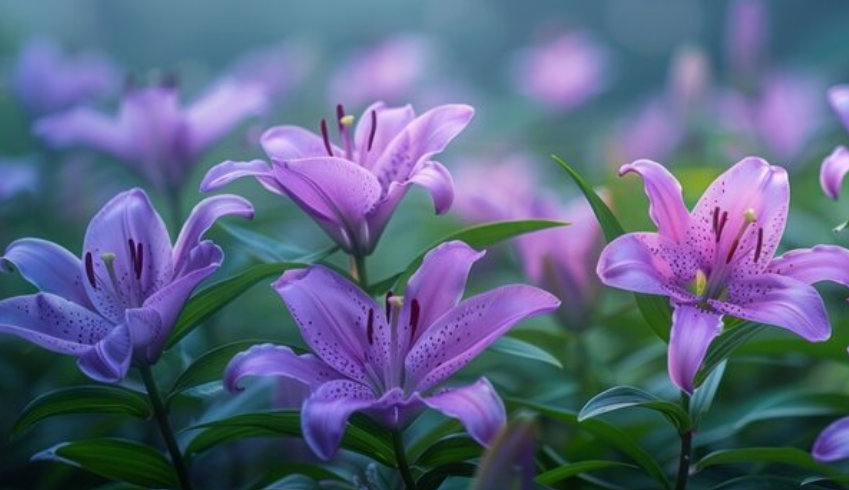
Purple lilies bring a rich, regal presence to the garden, ranging from the softest pale lavender to deep, saturated eggplant and near-black plum tones. Purple is genuinely one of the rarer colors in the lily world, and most true purple-toned types are members of the Asiatic or Oriental divisions, or hybrids derived from crossing the two. Most purple lily types grow from bulbs planted 6 to 10 inches deep and send up a single upright stem reaching anywhere from 1 to 8 feet tall depending on the division, with individual blooms measuring 3 to 10 inches across in the largest Oriental-Trumpet hybrids.
The purple coloring found in lilies comes primarily from anthocyanin pigments, the same class of compounds responsible for pink and red-purple tones in Oriental hybrids, while Asiatic types often display purple in combination with chocolate brown or burgundy shading rather than as a pure, solid hue. A single mature stem can produce anywhere from 5 to over 30 blooms depending on the cultivar, with the largest Oriental-Trumpet types capable of producing the most prolific and dramatic flower counts. Fragrance varies by division, with most Asiatic hybrids bred to be unscented while Oriental and Trumpet-influenced purple types often carry a strong, sweet perfume.
Purple lily bulbs are generally long-lived, multiplying readily into clumps that benefit from division every few years once established, with most types hardy across USDA zones 3 through 10 depending on the specific cultivar and division. As cut flowers, purple lilies typically hold up for 7 to 14 days in water, and their bold, moody coloring has made them a favorite for dramatic floral arrangements and formal garden displays that call for a strong visual anchor. Purple lilies require 6 to 8 hours of direct sunlight daily for the best bloom color and quality, and environmental factors like soil pH can noticeably shift the intensity of their purple tones.
Purple has been associated with nobility, wealth, and royalty for thousands of years, and purple lilies in particular are said to symbolize dignity, pride, admiration, and accomplishment. Beyond the true lily genus, several other well-loved garden plants carry the common name “lily” and produce genuinely purple flowers, offering gardeners an even broader palette to work with when building a purple-themed planting. Whether used as a dramatic focal point, massed for a formal landscape display, or grown for cutting, purple lilies remain one of the most striking and symbolically rich flowering bulbs available to gardeners.
Types of Purple Lilies
Souvenir
Souvenir is an Oriental cultivar with enormous, bowl-shaped blooms reaching up to 6 inches wide, featuring snow-white petal bases that blend gradually into soft lavender at the tips. Its yellow throat produces reddish-orange stamens that add a warm contrast to the cool purple tones above. Thanks to its relatively diminutive size, Souvenir works especially well as a border plant or in a container garden setting.
Netty’s Pride
Netty’s Pride is one of the most famous bicolor Asiatic cultivars in cultivation, featuring dark plum petals with contrasting white tips and centers, an unusual pattern since most bicolor lilies show the opposite arrangement of light centers and dark edges. Chartreuse green anthers reach upward to create striking contrast, and its stems are lined with soft, fringy leaves that radiate outward. Netty’s Pride blooms in late spring to early summer on stems reaching 3 to 4 feet tall.
Purple Prince
Purple Prince is a massive Oriental-Trumpet hybrid, one of the largest lily cultivars available, with upward-facing blooms measuring 8 inches wide in a rich grape color accented by yellow anthers and prominent black stamens. It can grow 3 to 4 feet tall in its first year but reaches an impressive 6 to 8 feet at full maturity, with each mature plant capable of producing 20 to 30 blossoms. Given its imposing height and heavy bloom load, staking is recommended in windy locations.
Purple Dream
Purple Dream is an Asiatic cultivar with a deep blackish-purple center that fades gently into a striking reddish-purple toward the petal edges, an unusual color arrangement for a bicolor lily. Its star-shaped, single-form blooms face upward with orange-tipped anthers, and a single plant typically produces 5 to 9 flowers on stems reaching 32 to 40 inches. Purple Dream is hardy across USDA zones 3 through 9 and blooms in mid to late summer.
Purple Marble
Purple Marble produces solid burgundy-purple petals with a silky, velvety finish, facing outward to slightly downward on stems that resist browning as they age, unlike many other Asiatic cultivars. It attracts pollinators including bees and, occasionally, hummingbirds, and pairs particularly well in a mixed bed with strong yellow companions. Once established, it spreads readily by clump and returns reliably for many years.
Purple Lady
Purple Lady is a towering Oriental-Trumpet hybrid capable of reaching up to 8 feet tall by its third year, with massive 8-inch blooms in a stunning purple-pink shade accented by a cream midrib and a chartreuse green center. Its powerful fragrance and bushy garden presence make it a striking choice for mass plantings or the rear of a mixed border, though its lance-shaped foliage and sturdy stems still benefit from staking in heavy wind.
Night Rider
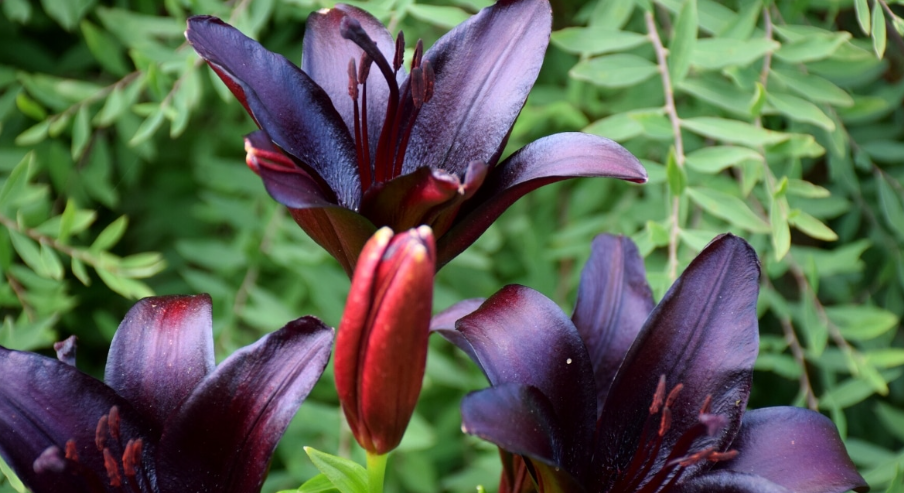
Night Rider is an Asiatic-Trumpet hybrid with 6-inch blooms in a deep, dark burgundy-purple so intense it can resemble chocolate in low light, with satin-textured petals that bend backward on upward-facing, trumpet-shaped flowers. Dark anthers and stamens enhance its moody, dramatic effect, making Night Rider a striking choice when planted alongside orange or pink companion lilies for maximum contrast.
Tom Pouce
Tom Pouce, named after a Dutch pastry, is an Oriental cultivar producing fragrant, star-shaped blooms over 8 inches wide in shades of soft purple and pink with yellow ribbing and dark brown stamens. It blooms in mid to late summer, later than most other divisions, and its long-lasting flowers make it a popular choice for both garden borders and cut arrangements, where its sweet fragrance and vase performance are especially valued.
Purple Eye
Purple Eye is a rare bicolor Asiatic cultivar with a deep, blackish-purple center that fades gently into a reddish-purple toward the petal tips, closely related to the famous Netty’s Pride line. Plants typically reach 32 to 40 inches tall and are hardy across USDA zones 3 through 9, producing the same unusual dark-center, light-edge pattern that distinguishes this small family of related cultivars.
Easy Dance
Easy Dance is another Asiatic cultivar closely related to Netty’s Pride, sharing the same distinctive dark-centered, lighter-edged bicolor pattern uncommon among most bloom types in the lily world. It flowers in late spring to early summer on stems similar in height to its relatives, offering the same bold, high-contrast presence in the garden with slightly different shading and petal proportions.
Dark Secret
Dark Secret is considered the darkest cultivar among the Asiatic Longiflorum group, with deep plum to dark red petals contrasted by bright orange pistils and vivid green foliage. It is one of the earliest lilies to bloom each summer and, being unscented, makes an excellent addition to cut arrangements without competing against other fragrant flowers.
Cappuccino
Cappuccino is a popular purple-toned Asiatic cultivar known for its rich, warm-toned blooms that blend deep plum shades with hints of brown, evoking the coffee drink that gives it its name. It performs well in mixed borders and containers, flowering in early to midsummer alongside other Asiatic types, and requires the same minimal care typical of the division.
Tiny Poems
Tiny Poems is a dwarf Asiatic cultivar with rich, aubergine-toned petals that can appear nearly black or dark brown in dim light, brightened by delicate pink tips, on blooms measuring about 4 inches across. Specially bred for container growing, its petite stature and spiky foliage make it well suited to border fronts, and it produces a gentle, pleasant fragrance uncommon for its division.
Nodding Lily
Nodding Lily is a species type with a strongly downward-drooping habit, its delicate lilac petals arching upward into a distinctive cap-like shape flecked with orange. Hanging anthers with rustic orange-purple heads sit at the center of each bloom, and its strong fragrance combined with tolerance for partial shade makes it an excellent choice for woodland edges and beneath tree canopies.
Black Beauty
Black Beauty is a dramatic Oriental hybrid with deep, dark purple to near-black recurved petals, unique green centers, and prominent stamens that add further contrast to its moody coloring. It can reach 5 to 7 feet tall once established and carries a strong fragrance, with its compact-for-its-height growth habit making it a fitting choice even for gardens with somewhat limited space.
Marco Polo
Marco Polo is an elegant Oriental cultivar producing 5 to 10 upward-facing blooms per stem, each averaging 8 inches wide with lavender-purple petals accented by pale yellow midribs. Freckling can appear in yellow or rust tones to match the unique coloring of its anther tips, and its sweet, light fragrance combined with a long vase life makes Marco Polo a popular choice for the cutting garden.
Purple Heart
Purple Heart is a striking Asiatic bicolor cultivar combining deep violet tones with lighter accents, part of a small group of purple-toned Asiatic types bred specifically to expand the color range within this typically unscented, early-blooming division. It reaches 3 to 4 feet tall and flowers in early summer, providing bold purple color well ahead of the later Oriental and Trumpet divisions.
African Lily
African Lily, more formally known by its genus name Agapanthus and sometimes called Lily of the Nile, is not a true lily but shares the common name thanks to its tall, elegant flower stalks topped with rounded clusters of trumpet-shaped violet-blue blooms. Native to South Africa, it typically reaches 2 to 4 feet tall and flowers in mid to late summer, offering a long-lasting, low-maintenance addition to a purple-themed border.
Peruvian Lily
Peruvian Lily, botanically known as Alstroemeria, is another popular “lily” that is not a true member of the Lilium genus but produces abundant, long-lasting purple and lavender blooms marked with darker streaking on the inner petals. It typically grows 1 to 3 feet tall and is a favorite in the cut flower trade thanks to its exceptionally long vase life, often lasting 2 weeks or more.
Plantain Lily
Plantain Lily, the common name for many Hosta varieties, produces tall, slender flower spikes topped with clusters of lavender to deep purple, trumpet-shaped blooms rising above the plant’s signature broad, textured foliage. While primarily grown for its leaves, the purple flower spikes appear in mid to late summer and add a vertical accent to shaded borders where true lilies often struggle to thrive.
Toad Lily
Toad Lily, the common name for Tricyrtis, produces small but intricately patterned purple blooms speckled with darker maroon spotting, giving each flower a delicate, orchid-like appearance despite the plant’s unassuming name. It typically reaches 1 to 3 feet tall and flowers in late summer into fall, thriving in shaded, woodland-style plantings where its unusual coloring can be appreciated up close.
Camas Lily
Camas Lily, more formally known as Camassia, produces tall spikes of star-shaped, bluish-purple blooms that echo the lavender tones of true lilies despite belonging to a different plant family entirely. Common in well-hydrated meadows across parts of North America, this bulb typically reaches 1 to 2 feet tall and has a long history of use by Indigenous peoples, who harvested and cooked its edible roots.
Purple Tree Lily
Purple Tree Lily refers to the tallest class of Orienpet hybrids bred specifically for extreme height and dramatic violet-purple coloring, with mature specimens capable of reaching 6 to 8 feet in a single season. These towering hybrids typically produce dozens of large, fragrant blooms per stem and are prized for creating an unmistakable architectural presence at the back of a mixed perennial border.
Côte d’Azur
Côte d’Azur is an Asiatic cultivar with cool, violet-blue toned blooms that bring an unusually crisp, almost icy quality to the purple lily palette, distinct from the warmer plum and burgundy shades found in many other Asiatic types. It shares the general early-summer bloom time and unscented flowers typical of its division, reaching a moderate 24 to 30 inches tall.
Common Martagon Lily
Common Martagon Lily is the classic wild species behind the entire Martagon, or Turk’s Cap, division, producing small, strongly recurved blooms in shades of dusky purple-pink speckled with darker spotting. It tolerates more shade than most true lilies, spreading gradually into an increasingly full clump over several growing seasons, and typically reaches 3 to 4 feet tall.
Carolina Lily
Carolina Lily is a native North American species producing nodding, strongly recurved blooms in soft purple-lavender tones blending into orange near the throat, closely resembling other native Turk’s Cap-type lilies found across the southeastern United States. It typically grows 2 to 3 feet tall and flowers in mid to late summer, favoring dry, acidic woodland soil.
Purple Trumpet Lily
Purple Trumpet Lily describes a category of Trumpet and Aurelian hybrids bred to introduce violet and plum tones into the otherwise typically white, yellow, and pink Trumpet color range. These hybrids typically reach 4 to 6 feet tall with large, fragrant, outward-facing blooms in mid to late summer, bringing the height and heavy scent characteristic of the Trumpet division to an unusual purple palette.
Chocolate Lily
Chocolate Lily, the common name for a Fritillaria species, produces small, nodding, bell-shaped blooms in a deep purple-brown that closely resembles the color of dark chocolate, quite different from the bright, upright blooms of most true lilies. It typically grows 1 to 2 feet tall and flowers in spring, favoring moist meadows and coastal habitats where its unusual coloring and mild, sometimes unpleasant scent attract specific pollinators like flies.
Forever Susan
Forever Susan is a striking Asiatic cultivar combining bright magenta, deep purple, and orange in a single bloom, with a yellow-orange throat freckled in purple that adds even more visual complexity. It flowers in early summer on compact, unscented stems typical of the Asiatic division, and its bold, multi-toned coloring makes it one of the most visually complex cultivars in the entire purple lily category.
Purple Star Lily
Purple Star Lily describes a group of upward-facing Asiatic hybrids bred for deep, saturated violet coloring in a classic star-shaped bloom form, generally reaching 24 to 30 inches tall and flowering in early summer. Like most Asiatic types, these hybrids are unscented and low maintenance, offering reliable, vivid purple color early in the lily season before the Oriental and Trumpet divisions take over.