Insects are the most diverse group of animals on Earth, with scientists having described more than 1 million species so far, and estimates suggesting anywhere from 2 million to 30 million species may exist in total once undiscovered species are accounted for. They make up roughly 80% of all known animal species on the planet, outnumbering mammals, birds, reptiles, and fish combined by an enormous margin. This staggering diversity spans every continent except Antarctica and nearly every habitat imaginable, from deep caves to high mountain peaks.
Despite their small size, insects play an outsized role in the health of ecosystems. Around 75% of the world’s flowering plants rely on insect pollinators like bees, butterflies, and beetles to reproduce, and roughly one out of every three bites of food humans eat depends on that pollination. Insects also serve as a critical food source for countless birds, amphibians, and small mammals, and they help recycle nutrients by breaking down dead plant and animal matter far faster than it would decompose on its own.
Insects are also remarkably ancient and resilient. Fossil evidence shows insects have existed for more than 400 million years, meaning they predate dinosaurs by roughly 170 million years. Their basic body plan of three segmented body regions, six legs, and often two pairs of wings has proven so successful that it has barely changed at the structural level despite hundreds of millions of years of evolution, even as they diversified into everything from flightless soil-dwellers to insects capable of flying over 30 miles per hour.
Unfortunately, insect populations face growing pressure in the modern era. Long-term studies have recorded declines in flying insect biomass of over 75% in some regions over the past few decades, largely attributed to habitat loss, pesticide use, and climate change. Because insects sit at the base of so many food webs and pollination systems, researchers warn that continued declines could have ripple effects across entire ecosystems, making insect conservation an increasingly urgent area of scientific study.
Types of Green Insects
Green Grasshopper
One of the most familiar green insects, the green grasshopper uses its coloring as camouflage among grass and leaves, blending in so effectively that predators often miss them entirely. Adults typically grow between 1 and 2.5 inches long and are capable of jumping over 20 times their own body length in a single leap. Some species can also fly short distances of up to several hundred feet when startled.
Praying Mantis
The praying mantis is prized for both its vivid green camouflage and its distinctive front legs, which fold in a prayer-like posture while it waits motionless for prey. Adults typically measure 2 to 5 inches long, and their triangular heads can rotate nearly 180 degrees to track movement without shifting their body. A single mantis can consume dozens of insects per week, making it a popular natural pest-control agent in gardens.
Katydid
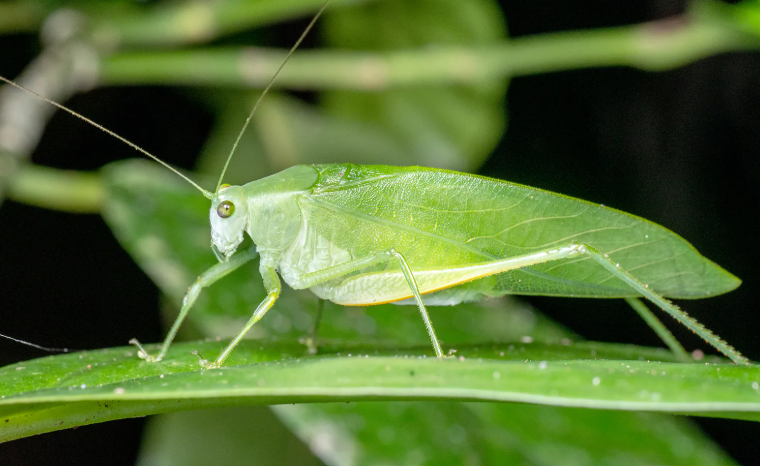
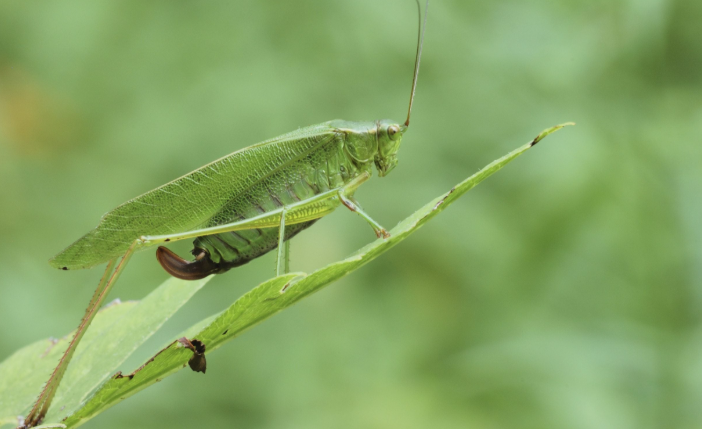
Katydids are known for their leaf-like green wings, which mimic real foliage so closely that some species even display fake leaf veins and blemishes. They range from 1 to 2.5 inches in length and are famous for their loud nighttime calls, produced by rubbing their wings together at a rate that can exceed 100 times per second. There are more than 6,400 known katydid species worldwide.
Green Lacewing
This delicate insect has translucent, lace-patterned green wings spanning about 0.6 to 0.8 inches, giving it its name. Green lacewing larvae are voracious predators, with a single larva capable of eating more than 200 aphids during its two- to three-week development period. Because of this, they are widely sold commercially as a natural pest-control solution for gardens and greenhouses.
Luna Moth
While best known for its pale green color rather than a bright shade, the luna moth is one of the largest moths in North America, with a wingspan reaching up to 4.5 inches. Adults live for only about one week, since they lack functional mouthparts and cannot eat once they emerge from their cocoon. Its long, trailing hindwing tails are thought to help confuse the sonar of bats hunting at night.
Green Stink Bug
Named for the unpleasant odor it releases when disturbed or threatened, the green stink bug has a shield-shaped body about 0.5 to 0.7 inches long. It feeds on a wide range of crops, including tomatoes, soybeans, and fruit trees, making it a notable agricultural pest in many regions. A single female can lay over 100 eggs across several clusters in a single season.
Green Tiger Beetle
This fast-moving beetle has a metallic green sheen and is considered one of the fastest insects relative to its size, capable of running at speeds equivalent to a human sprinting over 200 miles per hour. Adults measure about 0.5 to 0.6 inches long and are aggressive predators of smaller insects. Their large eyes and long legs make them highly effective hunters in sandy, open habitats.
Green June Beetle
Recognized by its metallic green, velvety body, the green June beetle grows to about 0.75 to 1 inch long and is most active during the summer months. Its larvae, known as white grubs, live underground and can damage lawns by feeding on grass roots. Adult beetles are strong fliers and are often seen buzzing loudly around gardens and orchards in swarms.
Emerald Ash Borer
This small, metallic green beetle measures only about 0.3 to 0.5 inches long but has caused devastating damage to ash tree populations across North America since its accidental introduction. A single infested tree can host hundreds of larvae tunneling beneath the bark, often killing the tree within 2 to 4 years. It has been responsible for the death of tens of millions of ash trees.
Green Shield Bug
Also called the green stink bug in some regions, this insect has a broad, shield-shaped body around 0.5 inches long, colored bright green for camouflage among leaves. It undergoes several color changes throughout its life cycle, often appearing brown before turning green as an adult. It feeds primarily on plant sap and can be found on a wide range of garden crops.
Green Aphid
Among the smallest insects on this list, green aphids typically measure just 0.06 to 0.1 inches long but can reproduce at an extraordinary rate, with a single female capable of producing up to 80 offspring in her lifetime without mating. Large aphid colonies can number in the thousands on a single plant. Their rapid reproduction makes them one of the most common garden pests worldwide.
Green Leafhopper
This small, wedge-shaped insect measures about 0.1 to 0.4 inches long and uses its green coloring to blend seamlessly with the leaves it feeds on. Leafhoppers are known for their powerful jumping ability, propelling themselves many times their body length to escape predators. Some species also transmit plant diseases, making them a concern for crop growers.
Green Darner Dragonfly
One of the largest and most common dragonflies in North America, the green darner has a green thorax and can grow up to 3 inches long with a wingspan of about 4.5 inches. It is capable of flying at speeds up to 30 miles per hour and can travel long distances during seasonal migrations, with some populations migrating hundreds of miles. Its large compound eyes contain up to 30,000 individual lenses.
Green Weevil
This small beetle has a distinctive elongated snout and a body covered in tiny, green, scale-like structures that create its coloring rather than pigment alone. Adults typically measure 0.2 to 0.4 inches long. Many green weevil species feed on specific host plants and can cause significant damage to crops like citrus and cotton when populations grow large.
Walking Stick Insect
While most walking sticks are brown, several green species exist that mimic fresh green plant stems rather than dry twigs. They can grow remarkably long, with some species reaching over 12 inches, among the longest insects in the world. Their slow, swaying movement mimics a twig blowing in the wind, helping them avoid predators.
Green Cicada
Certain cicada species display a bright green body, often measuring 1 to 2 inches long, and are known for producing some of the loudest sounds in the insect world, with calls reaching up to 100 decibels. Some species spend the majority of their lives underground as nymphs, with certain periodical cicadas emerging only once every 13 or 17 years. Adults typically live for only a few weeks above ground.
Green Bottle Fly
This fly is known for its shiny, metallic green body, typically about 0.4 inches long, caused by structural coloration rather than pigment. It is attracted to decaying matter and can detect the scent of a suitable food source from over a mile away. A single female can lay up to 2,000 eggs in her lifetime, contributing to its rapid population growth.
Green Assassin Bug
This predatory insect uses a green body for camouflage while ambushing prey, growing to about 0.5 to 0.8 inches long. It injects venomous saliva through its sharp mouthpart to immobilize and liquefy the internal tissue of its prey before feeding. Some species can deliver a painful bite to humans if handled carelessly.
Green Orchid Mantis
Native to Southeast Asia, this striking insect mimics the shape and color of orchid petals, growing to about 2.5 to 3 inches long as an adult female. Its camouflage is so effective that it attracts pollinating insects directly to itself as prey rather than simply hiding from predators. Some studies suggest it may attract more pollinators than the actual flowers it resembles.
Green Sawfly
Resembling a small wasp, the green sawfly has a stout green body about 0.3 to 0.6 inches long and uses a saw-like egg-laying organ to cut slits into plant tissue. Its larvae resemble caterpillars and can strip entire branches of leaves when populations are high. Certain species are considered significant pests of rose bushes and conifer trees.
Green Leaf Beetle
This small, oval beetle displays a bright, often iridescent green shell and typically measures 0.2 to 0.4 inches long. Both adults and larvae feed on leaves, sometimes skeletonizing entire plants when present in large numbers. Some species can produce more than one generation per year in warm climates, accelerating plant damage.
Green Shieldback Katydid
A relative of common katydids, this species has a broad, shield-like green back and measures about 1 to 1.5 inches long. Unlike many katydids, some shieldback species have reduced wings and cannot fly, relying entirely on camouflage and jumping to escape predators. They are most active at night, feeding on a variety of plant material.
Emerald Cockroach Wasp
Known for its brilliant, metallic emerald-green body, this wasp measures about 0.5 to 0.8 inches long and has an unusual reproductive strategy: it stings cockroaches to precisely control their nervous system, then leads them like a leash to a burrow where its larva will feed on the still-living host. A single sting can incapacitate a cockroach for over a week. Its iridescent coloring comes from microscopic surface structures rather than pigment.
Green Bush Cricket
This green-bodied insect resembles a grasshopper but has much longer antennae, sometimes exceeding its own body length of 1 to 2 inches. Males produce chirping sounds by rubbing specialized structures on their wings together, a behavior called stridulation. They are most commonly found in shrubs and tall grass, relying on their coloring to stay hidden.
Green Fig Beetle
Also called the fig eater beetle, this large, metallic green beetle measures about 0.8 to 1.4 inches long and is often seen feeding on ripe or overripe fruit. Its heavy, noisy flight makes it easy to identify as it buzzes around gardens in the late summer. Larvae develop in compost and rich organic soil, sometimes taking up to a year to mature.
Green Peach Aphid
A major agricultural pest, the green peach aphid measures only about 0.08 inches long but can reproduce extremely quickly, with populations capable of doubling in as little as one week under warm conditions. It is known to transmit more than 100 different plant viruses, making it one of the most economically damaging aphid species worldwide. It feeds on hundreds of different plant species.
Green Metallic Bee
This solitary bee displays a shining, metallic green body, typically measuring 0.3 to 0.6 inches long, caused by microscopic surface structures rather than pigment. Unlike honeybees, it does not live in large colonies, with females instead digging individual nesting burrows in the ground. It is considered an important pollinator, visiting a wide range of wildflowers and crops.
Green Broad-Winged Katydid
This large katydid species has broad, leaf-shaped green wings that can span up to 3 inches, among the most convincing leaf mimics in the insect world. It is almost entirely nocturnal, spending daylight hours motionless to avoid detection. Its calls, produced at night, can be heard from over 100 feet away in quiet conditions.
Green Shield Beetle
A member of the stink bug family, this beetle-like insect has a rounded, shield-shaped green body about 0.4 to 0.6 inches long. It feeds primarily on plant sap and releases a defensive odor when threatened, similar to related species. Females can lay clusters of over 20 eggs at a time on the underside of leaves.
Green Hawker Dragonfly
This large dragonfly species displays a bright green thorax and can grow to nearly 3 inches long with a wingspan of up to 4 inches. It is an agile flier, capable of hovering in place and reversing direction almost instantly while hunting smaller flying insects. A single dragonfly can eat dozens of mosquitoes and other pests in a single day, making it a valuable natural pest controller.
Green Planthopper
This small, wedge-shaped insect grows to about 0.3 to 0.5 inches long and holds its wings in a tent-like shape over its body, giving it a leaf-like silhouette when at rest. Green planthoppers are strong jumpers, able to launch themselves more than 50 times their own body length to escape predators. Several species are known to feed on rice crops, sometimes transmitting plant viruses in the process.
Green Stinkhorn Beetle
Also known as the green tortoise beetle in some regions, this small beetle has a rounded, dome-shaped shell measuring only about 0.2 to 0.3 inches long. Its shell is translucent and can shift between shades of green and gold depending on moisture and stress levels, a rare trait among insects. Larvae often carry a shield of shed skin and feces on their backs as camouflage against predators.
Green Bird Grasshopper
One of the larger grasshopper species, the green bird grasshopper can reach 2 to 2.75 inches in length, making it one of the biggest grasshoppers found in North America. It is a strong, sustained flier, capable of traveling several hundred feet in a single flight when disturbed. Its bright green coloring provides effective camouflage among broad-leafed garden and field plants.
Green Sphinx Moth
Certain sphinx moth species display a soft green coloring across their wings and body, with wingspans that can reach up to 3.5 inches. Adults are powerful fliers capable of hovering in place while feeding on nectar, beating their wings up to 70 times per second, a rate comparable to hummingbirds. Their caterpillars, often called hornworms, can grow up to 4 inches long before pupating.
Green Leaf Insect
Among the most convincing plant mimics in the insect world, the green leaf insect has flattened, vein-patterned wings that closely resemble real leaves, including irregular edges that mimic insect-eaten damage. Adults typically measure 2 to 4 inches long. They even sway gently while walking to imitate a leaf moving in the breeze, a behavior scientists believe helps them avoid detection by predators.
Green Shield Mantis
A lesser-known relative of the common praying mantis, this species has a broad, shield-shaped green thorax and grows to about 2 to 3 inches long. Like other mantises, it relies on stillness and camouflage to ambush prey, striking with its forelegs in as little as 50 to 100 milliseconds. Its diet consists mainly of smaller insects such as flies, moths, and crickets.
Green Longhorn Beetle
Named for its unusually long antennae, which can exceed the length of its own body, this beetle displays a metallic green sheen and typically measures 0.5 to 1 inch long. Larvae bore into wood, sometimes taking one to three years to fully develop before emerging as adults. Some species are considered pests of forestry and orchard trees due to this wood-boring behavior.
Green Damselfly
Closely related to dragonflies but slimmer and more delicate, the green damselfly has a narrow green body typically 1 to 1.5 inches long and holds its wings folded along its body at rest, unlike dragonflies. It is an agile predator of small flying insects like gnats and mosquitoes, catching prey mid-flight. Their aquatic larvae can spend up to a year developing underwater before emerging as adults.
Green Stag Beetle
This beetle displays a glossy green sheen across its body and is named for the large, antler-like mandibles found on males, used primarily in combat with rival males over mates. Adults can grow to 1 to 2 inches long, with the mandibles sometimes accounting for nearly a third of that length. Larvae develop in decaying wood and can take several years to mature into adults.
Green Shield Bug Nymph
While adult shield bugs are typically discussed on their own, the nymph stage deserves separate mention for its distinct bright green, rounded body lacking fully developed wings, usually measuring just 0.1 to 0.3 inches long. Nymphs molt through five separate stages before reaching adulthood, with their coloring and pattern shifting slightly at each stage. This gradual transformation can take anywhere from 4 to 8 weeks depending on temperature and food availability.