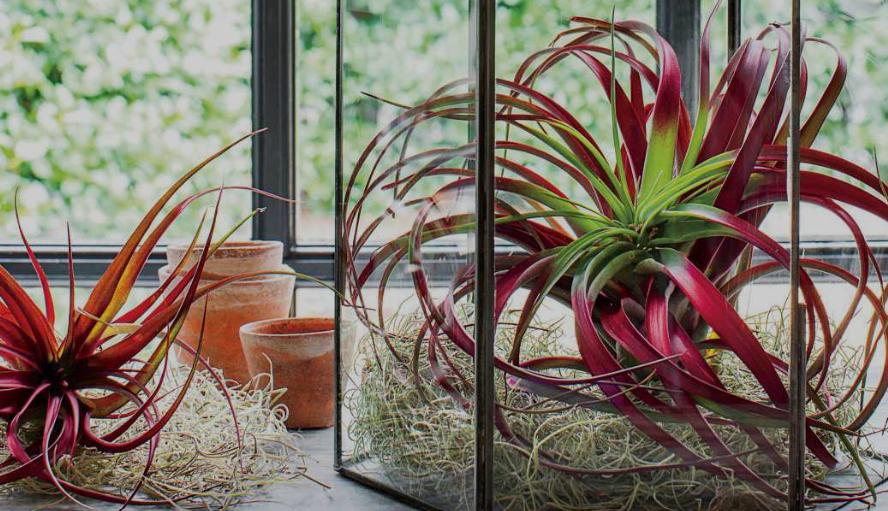
There are hundreds of types of air plants, and they’re some of the easiest houseplants you can grow. They don’t need soil or pots, and many of them fit in the palm of your hand. Some stay as small as a thumbnail. Others grow into silver giants 3 feet wide.
All true air plants belong to one plant group called Tillandsia. It has about 660 species, which makes it the largest group in the bromeliad family. That means the pineapple is a distant cousin of the little plant on your shelf. In the wild, air plants grow from the southern United States down to Argentina.
Air plants drink through their leaves instead of their roots. Their leaves are covered in tiny scales that pull in water and food from rain, fog, and damp air. The roots only hold the plant in place on a tree or rock. That’s why you can grow one on a piece of driftwood or in a glass globe.
Color is the easiest care clue. Silvery, fuzzy air plants come from dry, sunny places, so they need more light and less water. Smooth green air plants come from humid forests, so they need more water and gentler light. Indoors, most of them are happy between 50°F and 90°F with bright, indirect light.
Most air plants bloom only once in their lives. After flowering, the mother plant grows baby plants called pups and then slowly fades. Several air plants that grow wild in Florida are now rare because of an invasive weevil and illegal collecting, so always buy plants that were grown in a nursery.
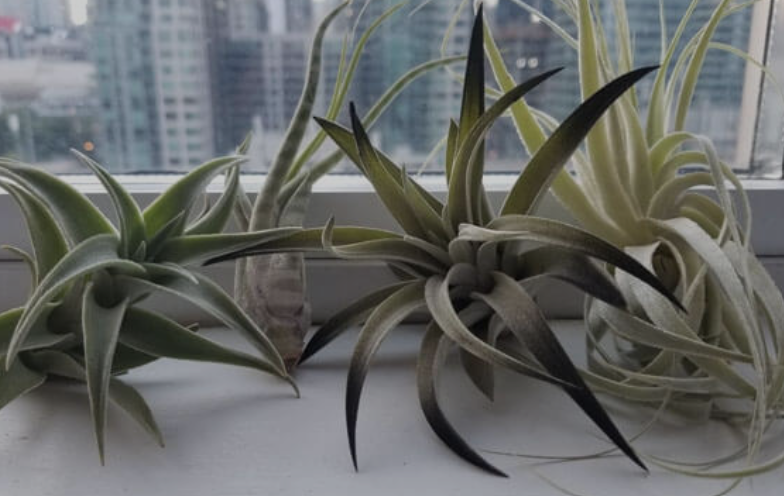
1. Spanish Moss
Spanish moss is the gray, stringy plant that hangs from oak trees across the American South. It isn’t really a moss, and it doesn’t come from Spain. It’s an air plant with no roots at all. Its strands can grow up to 20 feet long.
It grows from Virginia down to Florida and west to Texas, and it continues south into South America. It spreads when wind or birds carry broken pieces to new trees. It doesn’t harm the trees it hangs from. Indoors, it needs lots of misting and a spot where it can hang freely.
2. Ball Moss
Ball moss grows in small, round gray clumps on tree branches, fences, and power lines. It’s common in Texas, Florida, and along the Gulf Coast. Most clumps measure 2 to 10 inches across. Like Spanish moss, it’s an air plant, not a moss.
Many homeowners think ball moss is killing their trees, but it doesn’t feed on them. It usually shows up on shady inner branches that were already weak. It’s very tough and can survive long dry spells. A fallen clump will often keep living on a porch rail for years.
3. Sky Plant
The sky plant is the air plant most people buy first. It comes from Mexico and Central America. Most plants stay just 2 to 4 inches tall. The leaves are stiff and silvery green.
Right before it blooms, the center of the plant turns bright red or pink. Then purple flowers pop out of the middle. It grows pups easily and can form a thick clump over time. It’s cheap, tough, and very forgiving of beginner mistakes.
4. King of Air Plants
This plant earns its royal name with its size. Its silver, curling leaves can spread up to 3 feet wide. It comes from dry forests in Mexico, Guatemala, and El Salvador. It grows slowly, so large plants can be expensive.
When it finally blooms, it sends up a tall pink and green flower stalk with purple flowers. The bloom can last for months. Because wild plants were overcollected, its trade is now protected, so buy only nursery-grown plants. Give it bright light and a quick dunk in water once a week.
5. Medusa’s Head
Medusa’s head has twisting, snake-like leaves that curl out from a round base. It grows wild in Mexico and Central America. Most plants are 6 to 10 inches tall. The leaves are gray-green with a soft, fuzzy coating.
It blooms with bright red, finger-like stalks and blue-violet flowers. The round base is hollow, so water can get trapped inside. After watering, turn the plant upside down to dry. It looks great hanging or mounted on wood.
6. Pink Quill
The pink quill is often sold in a small pot, unlike most air plants. It comes from humid forests in Ecuador and Peru. Its leaves are thin, green, and grassy. The plant grows about a foot wide.
Its big attraction is a flat, hot pink flower spike shaped like a paddle. The pink can last up to 3 months, with small violet flowers opening along its edges. It likes more water than silver air plants. Keep it out of harsh afternoon sun.
7. Bulbous Air Plant
This air plant has a fat, round base and long, wavy leaves that look like octopus arms. It grows in Mexico, Central America, the Caribbean, and parts of South America. Most plants are 4 to 8 inches tall. In the wild, ants often live inside its hollow base.
When it’s ready to bloom, its center turns red and purple flowers appear. The hollow base can trap water and rot. Water it quickly, then shake it out and dry it upside down. Its fun shape makes it popular for hanging displays.
8. Snowball Air Plant
The snowball air plant is so fuzzy it looks covered in white felt. It comes from the mountains of Ecuador and Peru. There, it grows on rocks and cliffs in strong sun and wind. Most plants are 3 to 6 inches across.
Its thick fuzz protects it from sun and helps it catch water from fog. It’s easy to overwater, so a light misting a couple of times a week is usually enough. Give it the brightest spot you have. Its pink and lavender blooms look striking against the white leaves.
9. Cardinal Air Plant
The cardinal air plant is named for its bright red flower spikes. It grows in Florida, the Caribbean, Mexico, and Central and South America. Its stiff, gray-green leaves can grow up to 28 inches long. The flower stalk stands up to 2 feet tall.
Red is the classic color, but some plants bloom yellow, green, or rose. It was once common in Florida’s forests and swamps. Today, it’s endangered in the state because of the invasive Mexican bromeliad weevil. Nursery-grown plants do well outdoors in frost-free areas.
10. Giant Air Plant
The giant air plant is the biggest air plant native to the United States. It can reach 6.5 feet tall when it blooms. Its broad leaves grow up to 31 inches long. It grows wild in central and south Florida.
This plant can live up to 20 years before it blooms once and dies. It makes very few pups, so it depends on seeds to survive. That left it badly exposed to the invasive weevil, and it’s now endangered in Florida. Conservation groups are working to bring it back.
11. Twisted Air Plant
The twisted air plant has stiff leaves that spiral around like a corkscrew. Its silvery leaves often have pale stripes. That’s why it’s also called the banded or striped airplant. It grows in Florida, the Caribbean, and parts of Central and South America.
It likes sunny spots near the coast. Its flower stalk rises high above the leaves with pink bracts and violet flowers. It’s listed as threatened in Florida. Indoors, give it a very bright window and quick waterings.
12. Southern Needleleaf
The southern needleleaf grows in thick tufts of very thin, needle-like leaves. A clump can look like a bird’s nest sitting on a branch. It’s one of Florida’s more common native air plants. It often grows on cypress and oak trees.
In shade, it stays green, but in strong sun it turns bronze or reddish. It blooms with slim pink spikes and violet flowers. Its thin leaves dry out quickly, so mist it often indoors. It grows well mounted on wood.
13. Northern Needleleaf
Despite its name, the northern needleleaf looks nothing like its thin-leaved cousin. It has a swollen base and long, twisting leaf tips. Some people call it the coke bottle airplant because of its shape. It can grow up to 28 inches tall.
It grows in Florida, the Caribbean, Mexico, and Central America. In spring, it sends up a branched spike with bright red bracts and violet flowers. It’s listed as threatened in Florida. Mount it at an angle so water drains out of its base.
14. Broad Needleleaf
The broad needleleaf grows nowhere in the world except Florida. It reaches 8 to 16 inches tall with pointed, gray, leathery leaves. Its leaves are wider than those of the southern needleleaf. It’s still fairly common in central Florida’s wet forests.
It blooms in spring and summer with reddish bracts and up to 30 violet flowers. It’s often mixed up with Bartram’s air plant because they look so alike. It’s a great native choice for Florida gardeners. Just make sure your plant comes from a nursery.
15. Fuzzywuzzy Air Plant
The fuzzywuzzy air plant gets its silly name from its soft, silvery-white fuzz. It’s a small plant that grows up to 10 inches tall. It usually has only 5 to 10 leaves. Its leaves grow out of a small bulb-shaped base.
It blooms mostly in spring with pink bracts and violet flowers. It grows in Florida’s shady, humid forests, as well as in the Caribbean and Central and South America. In Florida, it’s rare and endangered. Indoors, it likes humidity but needs to dry fully after watering.
16. Potbelly Air Plant
The potbelly air plant is named for its round, swollen base. It has only a few curved leaves that grow from the top of the “belly.” It’s a small plant, usually just a few inches tall. It grows in Florida, the Caribbean, and Mexico.
Like other bulb-shaped air plants, it often hosts ants in the wild. It blooms with a short spike of violet flowers. Its odd shape makes it a fun conversation piece. Dry it upside down after watering so the base doesn’t rot.
17. Leatherleaf Air Plant
The leatherleaf air plant has soft, leathery leaves in shades of green and silver. Some plants have a rosy or purple tint. It grows 12 to 20 inches tall. It’s found in moist, shady forests and swamps in south Florida.
It blooms from spring to fall with reddish or purple bracts and violet flowers. It’s listed as threatened in Florida. It likes more shade and humidity than most air plants. That makes it a good fit for a bathroom with a bright window.
18. Bartram’s Air Plant
Bartram’s air plant is named after William Bartram, an 18th-century naturalist who explored the American South. It has narrow, gray leaves that form an upright clump. It grows in Florida’s swamps and forests. It’s one of the state’s more common native air plants.
It blooms with red bracts and violet flowers. In the wild, it sometimes crosses with the cardinal air plant to create a natural hybrid. It’s often confused with the broad needleleaf. It does well mounted in a shady garden tree in warm areas.
19. Shirley Temple Air Plant
The Shirley Temple air plant has leaves that curl into tight ringlets, like the famous child star’s hair. It comes from Mexico and Central America. Mature plants can grow a foot or more across. The leaves are silvery green.
The curls tell you when it needs water. When the plant is dry, the leaves curl tighter, and after watering, they loosen up. It blooms with pink bracts and purple flowers. It’s a tough plant that handles dry air well.
20. Carnation of the Air
This air plant gets its name from its bright, carnation-like blooms. It comes from Brazil, Argentina, Uruguay, and Paraguay. Its stiff, spiky leaves grow along a short stem. It forms clumps quickly.
It blooms with pink bracts and deep purple-blue flowers. It’s one of the hardiest air plants and handles cooler temperatures better than most. That makes it a good choice for beginners. It also does well outdoors in mild climates.
21. Blue-Flowered Torch
The blue-flowered torch looks a lot like the pink quill, but it’s larger. It comes from Ecuador and Peru. Its flower spike is a wide, flat pink paddle. The flowers are deep blue, often with a white center.
The blue flowers are much bigger and showier than the pink quill’s. It has thin green leaves and likes humidity. It’s often grown in a pot with loose bark. Give it bright, filtered light and regular water.
22. Rush-Leaved Air Plant
The rush-leaved air plant has thin, stiff, upright leaves that look like a bundle of grass. It grows from Mexico down into South America. Plants can reach about a foot tall. The leaves are gray-green.
It blooms with reddish bracts and violet flowers. It’s easy to grow and handles bright light well. Its tall, tidy shape works well in modern displays. Water it once a week and let it dry fully.
23. Silver Air Plant
The silver air plant has thin, wiry leaves that spray out from a small base. It comes from Mexico, Guatemala, and the Caribbean. It’s a small plant, usually 3 to 5 inches tall. The leaves shine silver in the light.
It blooms with red bracts and violet flowers. Its fine leaves give it a delicate, airy look. It likes bright light and good airflow. Avoid long soaks, since its thin leaves dry slowly in still air.
24. Velvet Air Plant
The velvet air plant has soft leaves that feel like velvet to the touch. It comes from Guatemala. Plants are usually 4 to 6 inches tall. The leaves are pale green with a light silver coating.
Before blooming, the whole plant blushes pink or rosy red. Then it produces purple flowers. That color change makes it one of the prettiest small air plants. It likes bright, indirect light and weekly watering.
25. Pom Pom Air Plant
The pom pom air plant grows into a round ball of thin, needle-like leaves. It comes from Colombia. It’s a small plant, but it can form a full clump over time. It’s harder to find than most air plants.
Unlike most air plants with purple flowers, this one blooms bright red-orange. It likes more water than silver types. Mist it often, especially in dry homes. Its ball shape looks great on a small stand or in a terrarium.
26. Harris’s Air Plant
Harris’s air plant has wide, silver leaves that curve gently outward. It comes from Guatemala, where it grows on rocks and trees. Plants usually grow 6 to 8 inches across. The silver leaves look almost frosted.
It blooms with red bracts and purple flowers. Its trade is protected because wild plants were overcollected. Nursery-grown plants are widely available and easy to care for. Give it bright light and let it dry well between waterings.
27. Thread-Leaf Air Plant
The thread-leaf air plant has very fine, hair-like leaves. It comes from Mexico and Central America. It’s small, usually 3 to 6 inches tall. The leaves are soft and green.
It blooms with a branched stalk of pale lavender flowers. Its thin leaves dry out fast, so it needs more frequent water than most. It loves humid rooms like bathrooms and kitchens. It looks lovely in an open glass globe.
28. Tricolor Air Plant
The tricolor air plant is named for its three-colored flower spike. The bracts are red, yellow, and green, with purple flowers on top. It grows from Mexico to Costa Rica. The plant can reach about a foot tall.
Its leaves are stiff, narrow, and green. It likes humidity and more water than silver air plants. The bloom can stay colorful for weeks. It’s a great choice if you want lots of color.
29. Cotton Candy Air Plant
Cotton Candy is a hybrid air plant bred for its pretty colors. It has soft, silvery-green leaves with a frosted look. It grows a few inches tall and forms neat clumps. It’s one of the most popular hybrids sold.
Its bloom is a soft pink spike with purple flowers. It produces pups easily, so one plant can become many. It’s tough and easy for beginners. Water it weekly and give it bright, indirect light.
30. Curly Slim Air Plant
Curly Slim is a hybrid air plant with long, curling leaves. It grows upright and can reach a foot or more tall. Its curls look a lot like the Shirley Temple air plant’s, but on a taller frame. The leaves are silvery green.
It blooms with pink bracts and purple flowers. It grows fast and handles a range of conditions. It’s a great pick if you want a tall air plant with personality. Let it dry fully after each watering to keep it healthy.
Sources
- Penn State Extension, “Tillandsias as Houseplants”
- University of Florida IFAS Gardening Solutions, “Air Plant – Tillandsia”
- University of Florida, “Save Florida’s Bromeliads: Cardinal Airplant”
- University of Vermont Extension, “Tillandsia: The Captivating World of Soil-less Air Plants”
- Clemson University HGIC, “Air Plants”