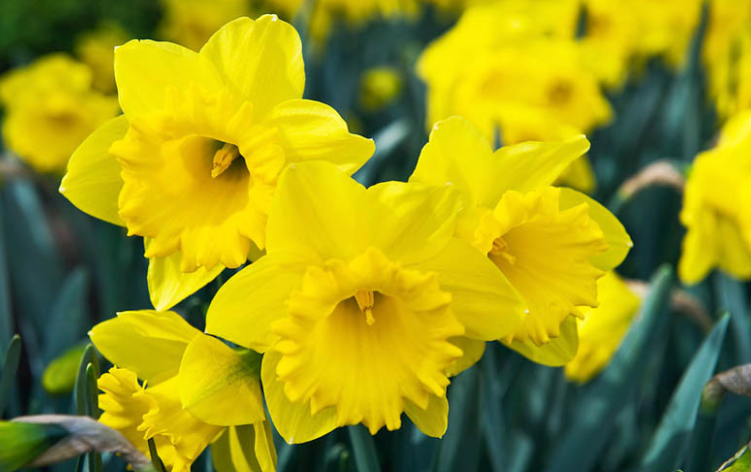
There is something especially satisfying about seeing trumpet daffodils open in early spring. I have always thought they have a little more presence than many of the smaller daffodils. The flowers seem to stand up and announce themselves, with broad petals surrounding a long central trumpet that catches the light even from a distance. When planted in groups, they can turn an otherwise quiet spring border into a bright, cheerful display almost overnight.
What makes trumpet daffodils particularly interesting is that the name refers to a specific flower form rather than simply any daffodil with a trumpet-shaped center. According to the Royal Horticultural Society, Trumpet Daffodils are Division 1 and have one flower per stem, with the corona, or trumpet, at least as long as the surrounding perianth segments. Daffodils are classified into 13 horticultural divisions, and the enormous diversity of Narcissus includes tens of thousands of named cultivars.
After growing and comparing different forms, I find trumpet daffodils particularly useful when I want a traditional spring display without creating a high-maintenance garden. They work beautifully in flower borders, informal plantings, lawns and containers, and many are excellent for bringing that classic golden-yellow spring color into the garden. There are also white, cream, bicolored and softer-colored trumpet forms, so you are not limited to the familiar all-yellow flowers. In this guide, I’ll look at some of the most interesting trumpet daffodils and explain what makes each one worth growing.
What Are Trumpet Daffodils?
Trumpet daffodils are the cultivars placed in Division 1 of the official daffodil classification system. Their defining feature is the large central corona, which is equal to or longer than the surrounding petals. Each stem normally carries a single flower, giving the plant a clean, upright appearance.
That long corona is what gives these daffodils their unmistakable trumpet-like appearance. Depending on the cultivar, the trumpet may be smooth, flared, ruffled, frilled or gently wavy. Flower colors range from traditional golden yellow to combinations of white, yellow, cream, orange and pinkish tones.
For gardeners, trumpet daffodils also offer considerable versatility. Daffodils generally perform well in containers, borders and lawns, and prefer fertile, well-drained soil with good light. The RHS recommends planting bulbs at roughly three times their own height, while allowing the foliage to die back naturally after flowering rather than cutting it down while it is still green.
Also Read: Different Types of Daffodils
15 Trumpet Daffodils Worth Growing
1. King Alfred
Few trumpet daffodils are as closely associated with the classic spring garden as ‘King Alfred’. Its large golden-yellow flowers have broad petals surrounding a prominent trumpet, creating the traditional daffodil appearance that many gardeners picture when they hear the word daffodil. It has a strong, substantial look and works especially well when several bulbs are planted together rather than scattered individually.
I particularly like this type for informal spring displays because it has the kind of presence that can be appreciated from across the garden. Plant it among shrubs, along a pathway or through a lawn, and the flowers provide an unmistakable burst of yellow. It is also one of those varieties that works well when you want your garden to have a timeless rather than fashionable appearance.
2. Mount Hood
‘Mount Hood’ is a beautiful choice when you want something quieter than the traditional yellow trumpet. The flowers open with a pale yellow appearance and mature toward white, producing a much softer display. Its long trumpet remains the dominant feature, but the overall effect is elegant rather than bright and flashy.
This is one of the trumpet daffodils I would consider for a garden with white, silver or pastel planting schemes. The flowers look particularly attractive against darker shrubs and evergreen foliage, where the pale blooms stand out without overwhelming their surroundings. It can also be useful for gardeners who want the recognizable shape of a trumpet daffodil without relying on strong yellow color.
3. Goldfinger
If you want a trumpet daffodil with plenty of impact, ‘Goldfinger’ is worth considering. The RHS describes it as having flowers up to about 9 cm across, with light-yellow pointed perianth segments surrounding a rich yellow trumpet with a flared mouth.
The contrast between the paler petals and deeper trumpet gives the flower more dimension than an entirely yellow bloom. I would use a variety like this where individual flowers need to stand out, such as beside a path or at the front of a shrub border. Its classic coloring also makes it an easy companion for other spring bulbs.
4. Rosy Trumpet
‘Rosy Trumpet’ shows just how far trumpet daffodils can move away from the traditional yellow form. It has white flowers with a long, wavy trumpet that develops a creamy apricot-pink coloring. The result is much more delicate and unusual than the standard golden daffodil.
This is the sort of trumpet daffodil I would choose when I want spring bulbs to feel a little more distinctive. The warm tones in the trumpet pair nicely with soft pinks, whites and early spring perennials. It can also make a lovely cut flower, particularly when arranged with other pale spring flowers.
5. Abenaki
‘Abenaki’ is a taller trumpet daffodil with broad white outer petals and a white corona with a flared rim. The RHS lists it as reaching around 60 cm and notes that its flowers are strongly scented.
The combination of height, white flowers and fragrance makes it particularly useful in a border where you want spring flowers to rise above lower-growing plants. I would place it toward the middle or back of a border, especially near a walkway or seating area where its fragrance can be appreciated.
6. Mando
‘Mando’ is an early-flowering trumpet daffodil with bright yellow petals and a golden-yellow corona. Its trumpet has a deeply frilled rim, giving the flower a slightly more elaborate appearance than the smooth trumpets found on some classic varieties. The RHS describes flowers around 9 cm across and plants reaching approximately 45 cm.
I like frilled trumpet forms because they give a familiar daffodil shape a little extra character. ‘Mando’ would work well in a mass planting, where the repeated golden flowers create a strong block of spring color, but a smaller group can also be effective in a mixed border.
7. Sagitta
For a really impressive flower, ‘Sagitta’ deserves attention. It can reach around 65 cm and produces large flowers, up to approximately 12 cm across, with pale yellow petals and an orange-pink corona with a flared, ruffled edge.
This is not the variety I would hide among dozens of competing flowers. Its large blooms deserve enough room to be appreciated, making it a good candidate for a focal area in a spring border. The orange-pink coloring also gives it a warmer, more sophisticated appearance than the standard yellow trumpet.
8. Cedric Morris
At the other end of the scale is ‘Cedric Morris’, a dwarf trumpet daffodil that reaches only around 25 cm. It produces lemon-yellow flowers with narrow, pointed petals and a relatively narrow trumpet with a flared, notched mouth. Its flowers appear from late winter into early spring.
Its compact size makes it especially interesting for smaller gardens, rock gardens and containers. I would also use it toward the front of a border where taller trumpet daffodils might hide shorter plants. A few groups planted close together can create a surprisingly strong display without taking up much space.
9. Standard Value
Despite its rather unglamorous name, ‘Standard Value’ produces a very attractive trumpet flower. It has bright yellow outer petals and a golden-yellow corona with a widely flared, ruffled rim. It is also listed by the RHS as a late-flowering trumpet daffodil.
That later flowering period can be useful when you are trying to stretch the daffodil season. Rather than having the entire display arrive and disappear at once, combining early, midseason and late varieties can keep the garden looking colorful for longer.
10. Royal Armour
‘Royal Armour’ belongs to Division 1, making it a true trumpet daffodil under the horticultural classification system. Like other trumpet cultivars, it produces a solitary flower with a corona at least as long as the surrounding perianth segments.
I would think of varieties such as this as useful additions to a broader collection of trumpet daffodils rather than relying on a single cultivar. Mixing different trumpet forms, heights and flowering periods can make a planting look much more natural and give you a succession of flowers instead of one short burst.
11. Fort Knox
‘Fort Knox’ is another Division 1 trumpet daffodil. Its classification comes from the characteristic relationship between its corona and petals, which places it firmly within the trumpet group.
For gardeners building a collection around traditional daffodil forms, it is worth exploring named cultivars beyond the handful that appear in ordinary garden-center displays. Specialist bulb suppliers often provide a much wider selection, allowing you to experiment with flower color, trumpet shape and flowering period.
12. Yellow Trumpet Types
Traditional yellow trumpet daffodils remain among the easiest choices for creating a strong spring display. Their combination of yellow petals and yellow trumpets gives them an especially sunny appearance, and planting them in groups can make even a relatively small garden feel brighter.
Rather than spacing every bulb evenly, I prefer planting bulbs in loose groups or drifts. The resulting display looks more natural, especially when the bulbs are allowed to multiply over time. Daffodils are generally long-lived and can return for many years when planted in suitable conditions.
13. White Trumpet Daffodils
White trumpet daffodils provide a completely different mood. Instead of the strong contrast created by yellow flowers, white cultivars can give a spring garden a cooler, more refined appearance. They look particularly good against green foliage and can be combined with blue, purple or pale pink spring flowers.
‘Mount Hood’ is a good example of this style, while cultivars such as ‘Abenaki’ demonstrate how white trumpet flowers can also bring fragrance and height into the garden.
14. Bicolored Trumpet Daffodils
Bicolored trumpet daffodils are some of the most interesting choices if you enjoy flowers with noticeable contrast. Instead of petals and corona blending into one color, the two parts may differ considerably, creating a stronger visual focal point.
‘Goldfinger’ illustrates this beautifully with its light-yellow petals and richer yellow trumpet, while ‘Sagitta’ moves into warmer territory with pale yellow petals and an orange-pink corona.
15. Frilled and Ruffled Trumpet Daffodils
Not all trumpet daffodils have perfectly smooth trumpets. Some have ruffled, frilled or wavy edges that make the central corona look almost decorative. These varieties are especially appealing when you want a familiar spring flower with a little more personality.
‘Mando’, for example, has a deeply frilled trumpet rim, while ‘Rosy Trumpet’ has a long, wavy corona with creamy apricot-pink coloring. These are excellent choices for gardeners who enjoy collecting unusual bulbs or adding a little variation to a traditional daffodil planting.
How to Grow Trumpet Daffodils
Trumpet daffodils are generally straightforward to grow, which is one reason they remain such dependable spring bulbs. Choose a location with good sunlight and soil that drains well. They can tolerate some partial shade, but flowering is usually strongest where plants receive plenty of light. The RHS recommends fertile, well-drained conditions and warns against waterlogged soil.
Plant the bulbs in autumn while they are dormant. A useful general rule is to plant them at around three times the height of the bulb, although planting recommendations can vary somewhat by bulb size and growing situation. Water them after planting and allow the foliage to develop naturally in spring.
One of the most important lessons with daffodils is to leave the leaves alone after flowering. It can be tempting to cut the foliage down as soon as the flowers fade, but the leaves are still producing energy that the bulb needs for the following year’s growth. Deadhead faded flowers if you wish, but allow the foliage to yellow and die back naturally.
Where to Plant Trumpet Daffodils
Flower Borders
Trumpet daffodils are excellent in mixed borders because their upright stems and large flowers provide an early-season focal point. Taller cultivars can be positioned behind lower-growing bulbs and perennials, while dwarf trumpet types can be planted toward the front.
Lawns and Naturalized Areas
For a more relaxed look, plant trumpet daffodils through grass or informal areas. Avoid mowing the foliage immediately after flowering; wait until it has naturally yellowed and begun to die back.
Containers
Compact trumpet daffodils can perform particularly well in containers. This is a useful option if you have limited garden space or want to place the flowers somewhere highly visible, such as beside an entrance or on a patio.
Cut-Flower Gardens
The large, strongly defined flowers of trumpet daffodils make them attractive for cutting. If you grow them specifically for arrangements, consider planting several varieties with different colors and flowering periods so that you have more than one style of flower available.
When Do Trumpet Daffodils Bloom?
Trumpet daffodils generally flower in spring, but the exact timing varies considerably between cultivars and growing conditions. Some varieties begin flowering in late winter, while others flower later in the season. For example, the RHS describes ‘Mando’ as early flowering, ‘Cedric Morris’ as flowering from late winter to early spring, and ‘Standard Value’ as late flowering.
This variation gives gardeners an opportunity to extend the display. Instead of planting one trumpet cultivar throughout the garden, combine early, midseason and late varieties. The result can be a succession of trumpet flowers rather than a single short-lived show.
Are Trumpet Daffodils Perennials?
Yes. Daffodils are bulbous perennial plants, meaning the bulbs can remain in the ground and return year after year under suitable conditions. Many are long-lived and relatively low maintenance, which makes them particularly valuable for gardeners who want dependable spring color without replanting every season.
Over time, healthy bulbs may produce offsets and form larger clumps. If a planting becomes overcrowded and flowering declines, the bulbs can be lifted and divided after the foliage has faded.
Do Trumpet Daffodils Come Back Every Year?
Trumpet daffodils can return every year, and established clumps can become one of the most dependable parts of a spring garden. Good drainage, suitable planting depth and allowing the foliage to die back naturally all help the bulbs replenish their energy after flowering.
I have found that the best approach is often to leave a successful planting alone rather than constantly disturbing it. Once the bulbs are established and flowering well, they can provide a remarkably reliable spring display with very little attention.
Final Thoughts
Trumpet daffodils are worth growing if you want spring flowers with a strong architectural shape and unmistakable character. Their defining feature—the long central corona—gives them a presence that works equally well in traditional borders, informal plantings, lawns and containers.
What I enjoy most about this group is the range available within a single flower form. You can grow the familiar golden-yellow types, choose elegant white flowers, experiment with bicolored trumpets, or seek out unusual frilled and ruffled forms. With 13 official daffodil divisions and thousands of named cultivars documented around the world, there is plenty of room to explore beyond the standard varieties found in local garden centers.
If you are planting trumpet daffodils for the first time, I would start with several cultivars rather than just one. Choose different heights, colors and flowering periods, plant them in generous groups, and then give the bulbs time to establish. After a few seasons, the garden can develop that wonderful early-spring quality where the daffodils seem to appear almost by themselves, returning each year with a little more confidence.
References
- Royal Horticultural Society — Horticultural Classification of Daffodils
The most important reference for this article. The RHS defines Division 1 Trumpet Daffodils as having one flower per stem, with the corona (trumpet) as long as or longer than the petals. - Royal Horticultural Society — Daffodils Growing Guide
Useful for information about planting, soil, sunlight, bulb selection, flowering, cultivation, and the distinction between botanical varieties and named cultivars. - Royal Horticultural Society — International Daffodil Register
Particularly valuable when checking the names and classifications of individual trumpet cultivars. The RHS is the International Registration Authority for the genus Narcissus and maintains the official daffodil register. - Royal Horticultural Society — ‘W.P. Milner’ Daffodil
A useful example of an individual Division 1 trumpet daffodil, with information about its classification, cultivation, propagation, garden uses, and characteristics. - Royal Horticultural Society — ‘Rijnveld’s Early Sensation’
Excellent for supporting descriptions of one of the notably early-flowering trumpet daffodils, including its flower color, trumpet form, size, flowering characteristics, and official Division 1 classification. - Missouri Botanical Garden — Daffodils
A strong horticultural reference for the diversity of cultivated daffodils. The garden maintains nearly 700 unique daffodil varieties, representing 12 of the 13 recognized divisions, making it particularly useful for comparing different forms and cultivars.