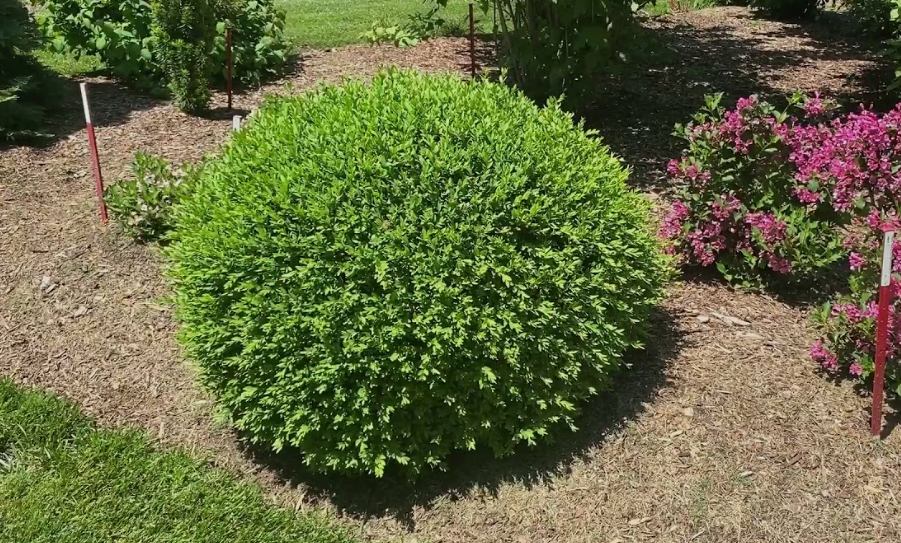
North Star boxwood is a compact, globe-shaped evergreen that forms a naturally round ball of dark green leaves. Its tidy shape and slow growth mean it looks neatly clipped with very little effort. For gardeners who love the classic look of round boxwoods, it offers a simple, low-maintenance way to get that polished style.
What makes North Star especially appealing is its disease resistance. While many forms of common boxwood are highly susceptible to boxwood blight, North Star has shown good resistance to the disease. That makes it a strong choice for gardeners who want a traditional-looking boxwood with fewer worries.
Botanical Classification
North Star belongs to the box family, a small group of evergreen shrubs that also includes pachysandra and sweet box. It is a cultivar of common boxwood, the species native to southern and western Europe, North Africa and western Asia.
It is sometimes sold under the cultivar name Katerberg, with North Star as its trade name. Both names refer to the same plant. Its common boxwood heritage gives it the deep green color and fine texture that many gardeners prefer.
Brief History
Common boxwood has been grown in gardens for more than 2,000 years, and gardeners have selected hundreds of cultivars with different shapes and sizes. Round, compact forms have always been popular for edging, parterres and formal accents.
North Star was selected for its dense, globe-shaped habit and good garden performance. As boxwood blight spread through North America and Europe in the 2010s, its resistance to the disease helped it gain popularity. Today, it is widely sold as a reliable alternative to more disease-prone round boxwoods.
Identifying Characteristics
North Star has small, oval leaves about half an inch to an inch long. They are dark green and glossy, with a slightly leathery feel. The leaves grow in pairs on opposite sides of the stem and are densely packed, giving the plant a full, solid appearance.
Its most distinctive feature is its naturally round shape. It forms a tight globe about 2 to 3 feet tall and wide. It grows slowly, often only a few inches a year, so it keeps its shape for many years.
Its leaves hold their deep green color well through winter in most sites. Like other common boxwoods, its leaves have a musky scent, especially in warm weather. In early spring, it produces tiny, fragrant, pale yellow-green flowers that attract bees.
Landscape Uses
North Star is ideal for low hedges and edging. Planted in a row, its round forms create a neat, rhythmic border along walkways, driveways and garden beds. It fits well in both formal and modern garden designs.
It also makes an excellent accent plant. Single globes or groups of three add structure to foundation plantings, mixed borders and entryways. Its tidy shape pairs well with flowering perennials and ornamental grasses.
It grows well in containers and planters, where its round form looks clean and polished. It is a natural choice for gardeners who want the look of boxwood balls without constant trimming. Like other boxwoods, it is deer-resistant, and all parts of the plant are toxic if eaten.
Also Read: Different Types of Boxwood Shrubs
Growing Considerations
North Star is generally hardy from about USDA zone 5 to zone 9. It grows well across much of the United States, from the Northeast and Midwest to the Mid-Atlantic, Southeast and Pacific Northwest.
It grows in full sun to partial shade. In hot southern regions, afternoon shade helps prevent leaf scorch. In colder areas, protection from strong winter wind helps keep its leaves green.
Good drainage is essential. Like all boxwoods, North Star can develop root rot in waterlogged soil. It grows best in loose, well-drained soil enriched with compost, with a slightly acidic to neutral pH of about 6.5 to 7.0.
Its roots are shallow, so a thin layer of mulch, about 1 to 2 inches, helps keep them cool and moist. Keep mulch away from the stems. Water young plants regularly, and give established plants a deep watering during dry spells and in fall before the ground freezes.
Pruning and Care
North Star needs very little pruning because it naturally grows into a round shape. A light trim in late spring, after new growth hardens, is usually enough to keep it neat. Formal designs may benefit from a second light trim in early summer.
Avoid pruning in late summer or fall. Late cuts can trigger tender growth that is damaged by frost. Thinning a few interior branches each year lets in light and air and helps keep the plant healthy.
Light fertilizer in spring can help if growth is weak or leaves look pale. Avoid heavy feeding, which can encourage soft growth that is more prone to pests.
Pests and Diseases
North Star has shown good resistance to boxwood blight, a fungal disease first found in the United States in 2011. Blight causes dark leaf spots, black streaks on stems and rapid leaf drop. North Star’s resistance makes it a better choice than many other common boxwoods, such as English boxwood, in areas where blight is a concern.
It is not completely immune, so good care still matters. Spacing plants for airflow, watering at the base of the plant and buying from reputable nurseries all help reduce disease risk.
Other possible problems include the boxwood leafminer, boxwood psyllids, spider mites and root rot in poorly drained soils. The invasive box tree moth, whose caterpillars can strip boxwoods of their leaves, has spread across Europe and into parts of North America and should be watched for in late spring and summer.
North Star vs. Other Round Boxwoods
North Star is often compared with other compact, rounded boxwoods. Green Gem forms a similar globe about 2 feet tall and wide, is very cold-hardy and is rated moderately resistant to boxwood blight. Green Mound grows into a slightly larger mound about 3 feet tall and is moderately susceptible to blight.
English boxwood forms soft, billowy mounds but grows much more slowly and is highly susceptible to blight. For gardeners who want a classic, round common boxwood with better disease resistance, North Star is one of the best options available.
Frequently Asked Questions
How big does North Star boxwood get? North Star usually grows about 2 to 3 feet tall and 2 to 3 feet wide. It reaches this size slowly over several years. Its compact form makes it ideal for small spaces.
Does North Star boxwood keep its round shape naturally? Yes, it naturally grows into a dense globe. It needs only light trimming to stay neat. This makes it a low-maintenance choice for formal designs.
Is North Star boxwood resistant to boxwood blight? Yes, it has shown good resistance to boxwood blight compared with most common boxwoods. It is not completely immune, so good spacing and careful watering still help. It is a strong alternative to blight-prone English boxwood.
How far apart should North Star boxwoods be planted for a hedge? For a low hedge, plants are usually spaced about 2 feet apart. Closer spacing creates a continuous hedge, while wider spacing lets each globe stand out. Good airflow between plants helps reduce disease.
Can North Star boxwood grow in containers? Yes, it grows well in containers and planters. Its round shape makes it a striking accent near entrances. Containers need good drainage and regular watering.
Is North Star the same as Katerberg boxwood? Yes, North Star is the trade name, and Katerberg is the cultivar name. Both refer to the same plant. Plant labels may use either name.
Sources
Cornell University, “Woody Plants Database: Boxwood”
North Carolina State University, “Susceptibility of Commercial Boxwood Cultivars to Boxwood Blight”