Run your hand down the trunk of a royal palm and it feels like polished concrete: cool, hard, and almost perfectly even. Plenty of palms have shaggy, fibrous, or spiny trunks. Palm trees with smooth trunks have a clean, sculptural look instead, like living columns in a garden. They are popular for driveways, entrances, and formal landscapes, where neat lines matter.
A palm’s trunk becomes smooth when its old leaf bases fall away on their own. Many of these palms also have a crownshaft, a smooth green sleeve at the top of the trunk where new fronds form. When an old frond dies, the whole leaf base drops off cleanly. All that remains is a faint ring on the trunk.
Smooth trunks also make palms easier to care for. Because the old fronds shed by themselves, these palms need less trimming. Their trunks don’t trap debris or give pests as many places to hide.
Most smooth-trunked palms are tropical or subtropical. In the United States they grow outdoors mainly in South and Central Florida, coastal Southern California, Hawaii, and the warmest parts of Texas. A few, like the Chilean wine palm, tolerate colder winters and grow farther north along the Pacific Coast.
1. Royal Palm
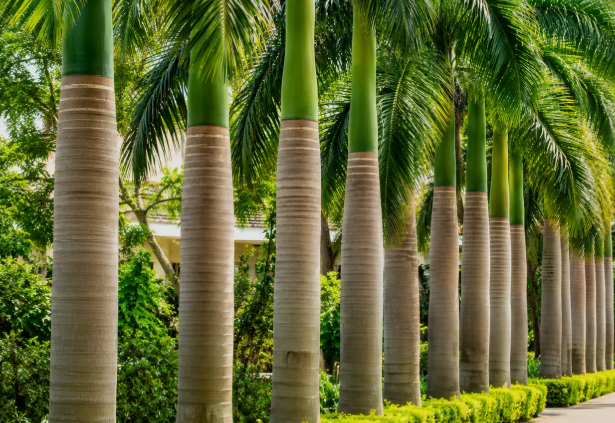
The royal palm has one of the most impressive smooth trunks of any palm. The trunk is light gray, can reach 2 feet across, and looks so even that it is often compared to poured concrete. A tall, glossy green crownshaft rises from the top, and above it sits a crown of long, arching fronds. Mature trees often reach 50 to 70 feet.
The Florida royal palm is native to South Florida, Cuba, and other Caribbean islands, where it grows in wet hammocks and swamps. It is widely planted along streets, boulevards, and large properties in South and Central Florida. It grows best in zones 10a through 11 and needs plenty of water and fertilizer. Its size makes it better suited to parks and wide avenues than to small yards.
2. Queen Palm
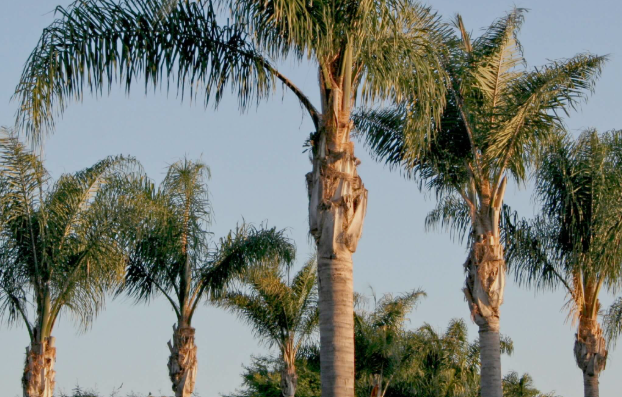
The queen palm has a straight, smooth gray trunk usually 8 to 15 inches across, marked with faint rings left by fallen fronds. It can grow up to 50 feet tall and has a full, drooping crown of soft, feathery fronds. Clusters of small orange fruits hang below the crown in summer and fall. It grows quickly, so it gives a tropical look within just a few years.
The queen palm is native to Brazil, Paraguay, Argentina, and Uruguay. It is one of the most commonly planted palms in Florida, Southern California, and along the Texas Gulf Coast. It handles brief cold down to the mid-20s°F, and it grows in zones 9b through 11. It does best in acidic soil, because alkaline soil often turns its fronds yellow from nutrient deficiencies.
3. Foxtail Palm
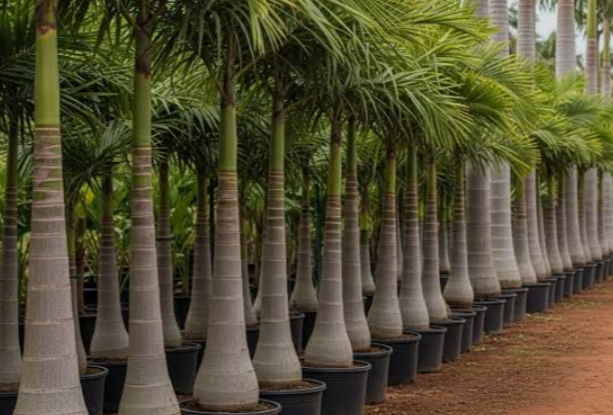
The foxtail palm has a smooth, light gray trunk ringed with narrow leaf scars and topped by a bright green crownshaft. It gets its name from its fronds, whose leaflets grow in all directions around the stem, so they look bushy, like a fox’s tail. The trunk is often slightly thicker at the base and tapers gently upward. Mature trees usually grow 20 to 30 feet tall.
The foxtail palm is native to a small area of northeastern Queensland, Australia, and Western botanists didn’t describe it until the 1980s. It has quickly become a favorite in South Florida, Southern California, and Hawaii. It grows best in zones 10 and 11, in full sun and well-drained soil. It tolerates salt spray and drought fairly well once established.
4. Bottle Palm
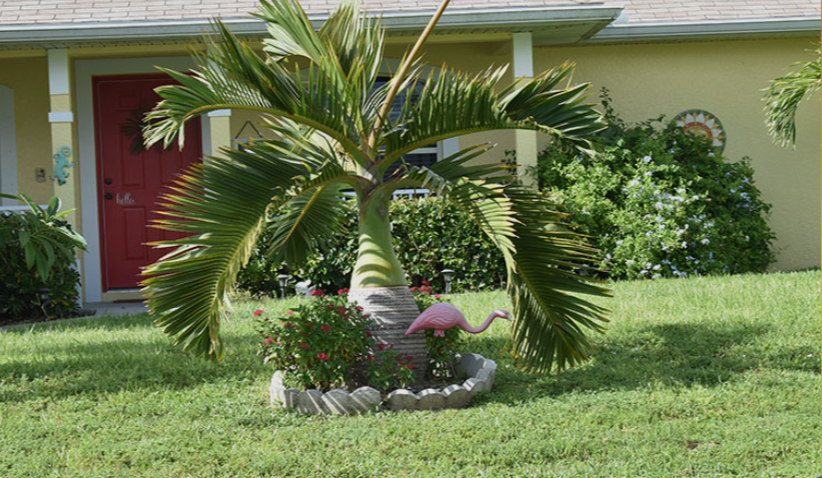
The bottle palm has a smooth gray trunk that swells dramatically at the base, so it looks like an old glass bottle. The swollen base can reach about 2 feet across, and the trunk then narrows sharply just below the crownshaft. Only four to six stiff, arching fronds grow at a time. Mature palms rarely grow taller than 10 to 12 feet, which makes the odd shape stand out even more.
The bottle palm is native to Round Island near Mauritius in the Indian Ocean, where very few wild trees survive. In the United States it is grown mainly in South Florida, the Florida Keys, and Hawaii. It is very sensitive to cold and grows only in zones 10b and 11. It does well in sandy soil, full sun, and salty coastal air.
5. Spindle Palm
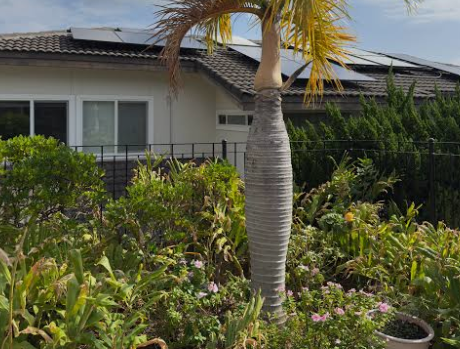
The spindle palm is a close relative of the bottle palm, but its smooth gray trunk swells near the middle instead of at the base. This gives the trunk a spindle shape, like an old wooden thread spool. It grows 20 to 25 feet tall and carries a short, light green crownshaft and a crown of arching, feathery fronds. Young trees often have reddish or orange tints on their leaf stalks.
The spindle palm also comes from the Mascarene Islands near Mauritius in the Indian Ocean. In the United States it is grown mainly in South Florida and Hawaii, where it is valued as an unusual accent tree. It grows in zones 10b and 11, tolerates salt well, and adapts to sandy and limestone soils. It is a good choice for small yards and coastal gardens.
6. Alexandra Palm
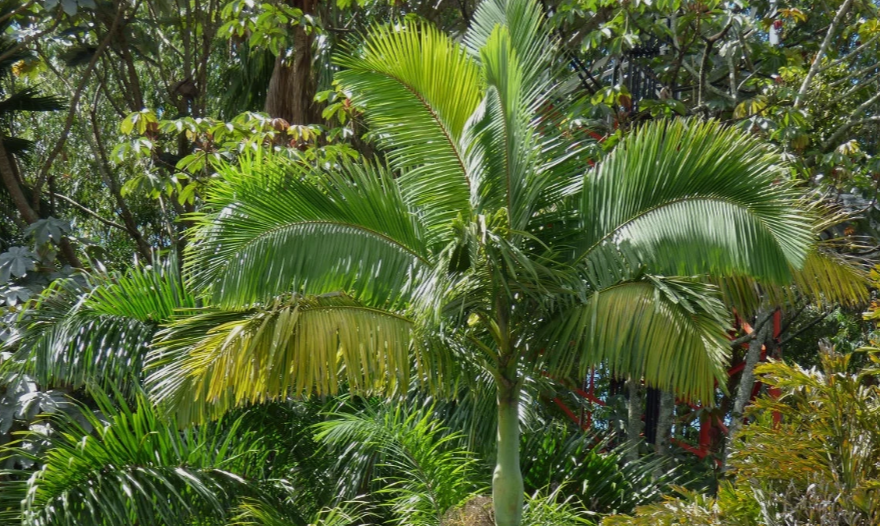
The Alexandra palm, sometimes sold as the king palm, has a tall, smooth gray trunk with neat, evenly spaced rings. The trunk is usually less than a foot across and often swells slightly at the base. A smooth green crownshaft supports a crown of long, graceful fronds whose leaflets are silvery underneath. Outdoors it can reach 40 to 60 feet.
The Alexandra palm is native to the rainforests of eastern Queensland, Australia. In the United States it is planted widely in South Florida, Southern California, and Hawaii. It grows quickly in moist, rich soil and tolerates partial shade when young. It does best in zones 10 and 11 and needs regular water during dry spells.
7. Coconut Palm
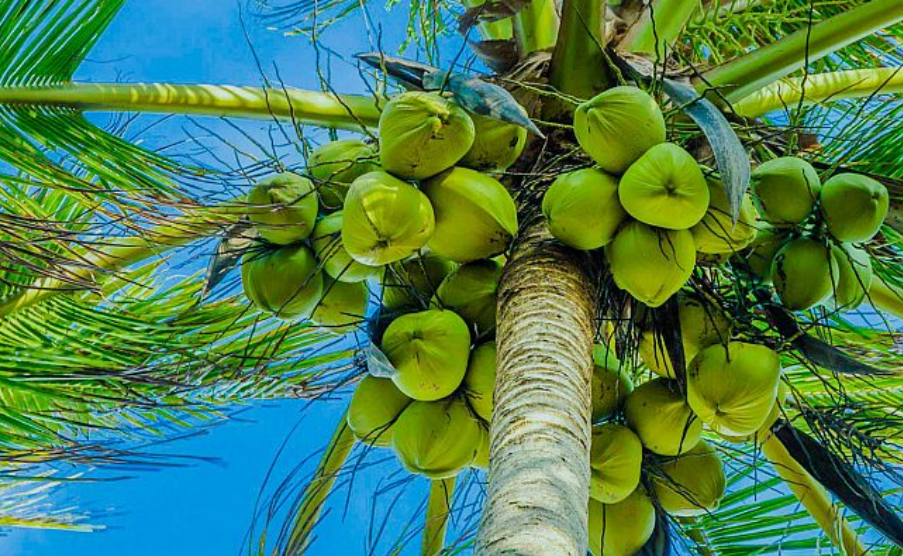
The coconut palm has a gray, fairly smooth trunk ringed with faint leaf scars, and it often curves or leans gracefully toward the light. It can grow 60 to 100 feet tall and carries a large crown of long, feathery fronds. Clusters of coconuts hang beneath the crown, with green or orange husks that turn brown as they ripen. Dwarf varieties have narrower, straighter trunks and stay much shorter.
The coconut palm probably originated in the Indo-Pacific region, and today it grows along tropical coastlines around the world. In the United States it grows outdoors mainly in South Florida, the Florida Keys, and Hawaii, in zones 10b and 11. It thrives in sandy soil, salt air, and full sun. Lethal yellowing has killed many coconut palms in Florida, so disease-resistant varieties are often recommended.
8. Chilean Wine Palm
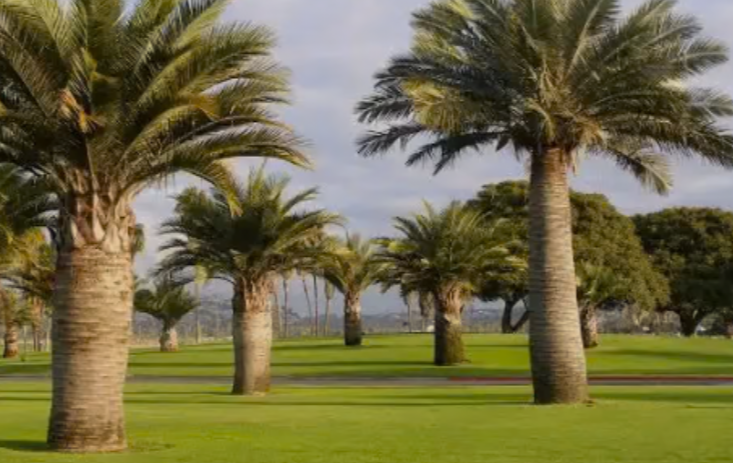
The Chilean wine palm has the thickest trunk of any palm, often 3 to 5 feet across, with smooth gray bark that looks like elephant skin. Its trunk is marked with faint diamond-shaped leaf scars and supports a dense crown of feathery fronds. It grows slowly and can eventually reach 50 to 80 feet tall. Its name comes from its sweet sap, which is traditionally boiled into syrup or fermented into palm wine.
The Chilean wine palm is native to central Chile. It is one of the most cold-hardy feather palms and survives temperatures down to about 15°F. In the United States it is grown mainly in California, especially in the San Francisco Bay Area and other mild coastal regions. It grows well in zones 8b through 11 and handles drought once established.
9. Buccaneer Palm
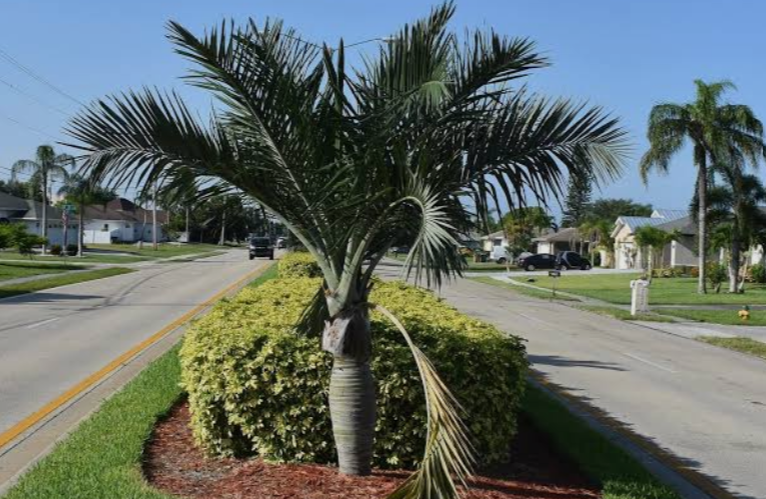
The buccaneer palm has a smooth, gray-green trunk 4 to 10 inches across, marked with brown leaf scars that fade to gray as the tree ages. Many trunks develop a gentle bulge, and its shape varies from tree to tree. It usually grows about 20 feet tall and carries a compact crown of stiff, blue-green fronds. Bright red, cherry-sized fruits give it another common name, cherry palm.
The buccaneer palm is native to a few islands in the Florida Keys, as well as the Bahamas and parts of the Caribbean. It is endangered in Florida, so landscape plants should come from licensed nurseries. It grows in zones 10b and 11 and tolerates salt, drought, and alkaline soil very well. Gardeners in South Florida value it as a tough native palm for coastal yards.
10. Carpentaria Palm
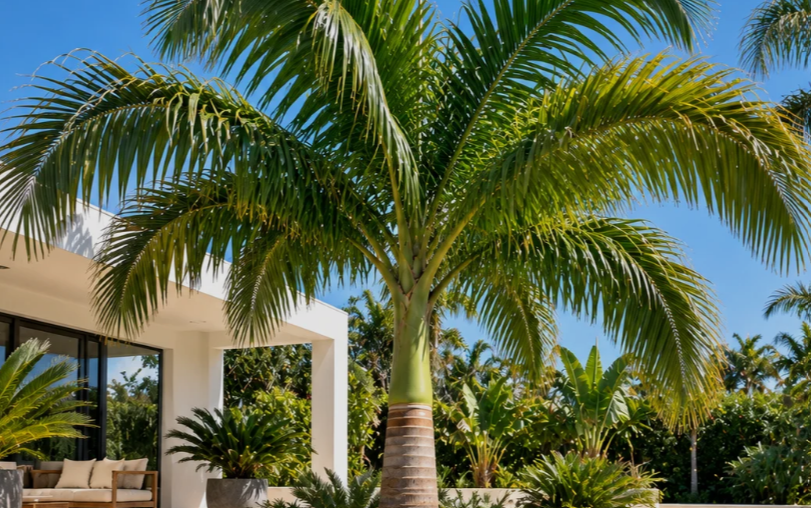
The Carpentaria palm has a straight, smooth gray trunk with neat rings, topped by a slender green crownshaft. The trunk is usually 6 to 8 inches across, so it looks tall and graceful. Its arching fronds have long, slightly drooping leaflets, and clusters of bright red fruits hang below the crown. Mature trees usually grow 30 to 40 feet tall.
The Carpentaria palm is native to the tropical north of Australia, including the Northern Territory and the Gulf of Carpentaria region. In the United States it is planted mostly in South Florida and Hawaii. It grows fast and likes moist, fertile soil in full sun to partial shade. It is very sensitive to cold and grows reliably only in zones 10b and 11.
Sources
- University of Florida IFAS Extension, “Royal Palm”
- University of Florida IFAS Extension, “Queen Palm”
- University of Florida IFAS Extension, “Buccaneer Palm”
- University of Florida IFAS Extension, “Coconut Palm Growing in the Florida Home Landscape”
- University of Florida IFAS Extension, “Palms for Central Florida”