White Birch Tree Identification: Telling the True White Birches Apart
White birch tree identification gets confusing because the name “white birch” is used for more than one tree. In North America it usually means the native paper birch, which is also called canoe birch. Nurseries also use “white birch” for the European white birch, sometimes sold as silver birch or weeping birch, and the native gray birch gets mistaken for both. All three have pale trunks and doubly toothed leaves, so to tell them apart you need to look at how the bark peels, what the dark markings on the trunk look like, how the leaves are shaped, and how the branches hang.
Paper birch is the tree most people mean. It grows across the northern part of the continent from Alaska to Newfoundland and south into the Great Lakes, New England, and the northern Rockies. It is a medium-sized tree that can reach about 70 feet, often with several trunks growing from one base. In the wild it tends to come up in pure stands after fire or logging, since it is a fast-growing pioneer that needs full sun.
Bark
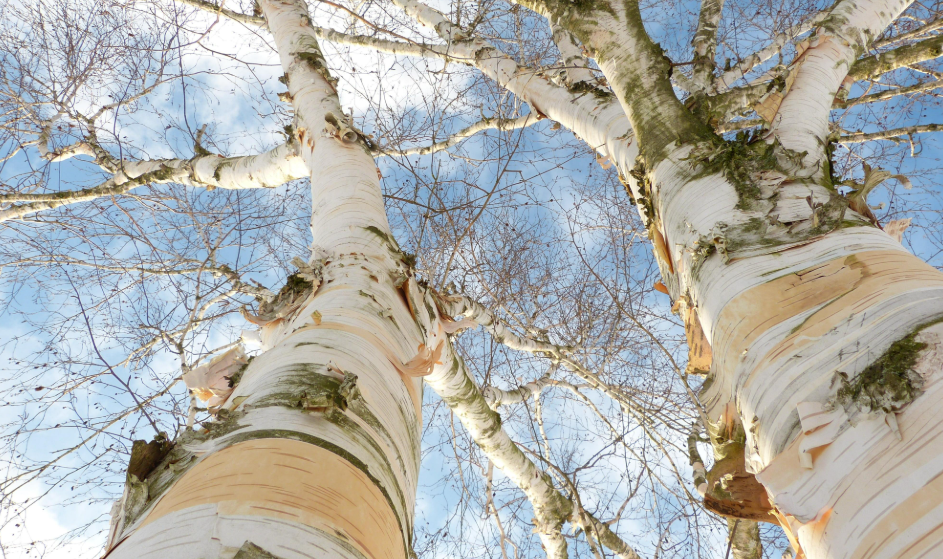
On a paper birch, the bark peels in wide, thin, curling sheets, much like paper coming off a roll. The outer surface is a clean chalky white, while freshly exposed inner layers can be cream, pinkish, or orange. Dark horizontal lenticels mark the trunk, and on very old trees the base turns black and furrowed. Young saplings don’t look like this at all. They start with smooth reddish-brown bark and only turn white after several years.
European white birch has bark that is creamy to silvery white, but it doesn’t peel as freely as paper birch, and when it does shed, it comes off in long, narrow strips instead of broad sheets. Its most telling mark is the scattering of black, diamond-shaped patches where branches meet the trunk. As the tree ages, the lower trunk turns black and deeply fissured, with only small amounts of white showing through. Gray birch bark barely peels at all. It is a duller, dingier white with dark triangular “chevron” marks beneath each branch.
Leaves
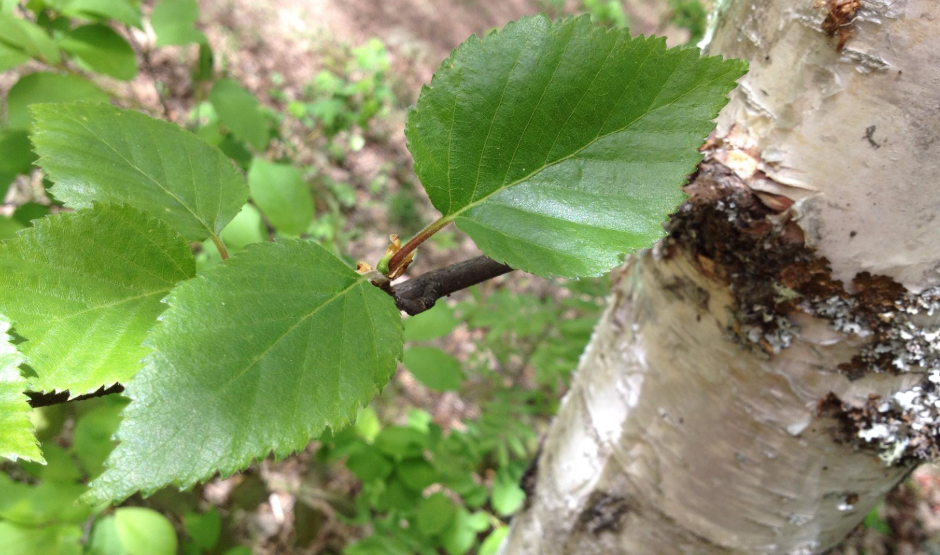
All three trees have simple, alternate leaves with doubly serrate edges, so the leaf shape and base are what help most. Paper birch leaves are egg-shaped, about 2 to 4 inches long, with a rounded base and a short pointed tip. They have fewer than ten pairs of veins and feel slightly thicker than the leaves of the other two.
European white birch leaves are smaller, about 1.25 to 3 inches long, and are roughly diamond-shaped or triangular with a long, tapering point. Some popular cultivars have deeply cut, lacy leaves that are unmistakable. These leaves also stay on the tree later in autumn than native birch leaves. Gray birch leaves are the most triangular of the three. They are widest at the base, almost flat across the top edge, and drawn out into a long slender tip, and they tremble in the breeze a little like aspen leaves.
Also Read: Types of Birch Trees For Landscaping
Catkins, Twigs, and Form
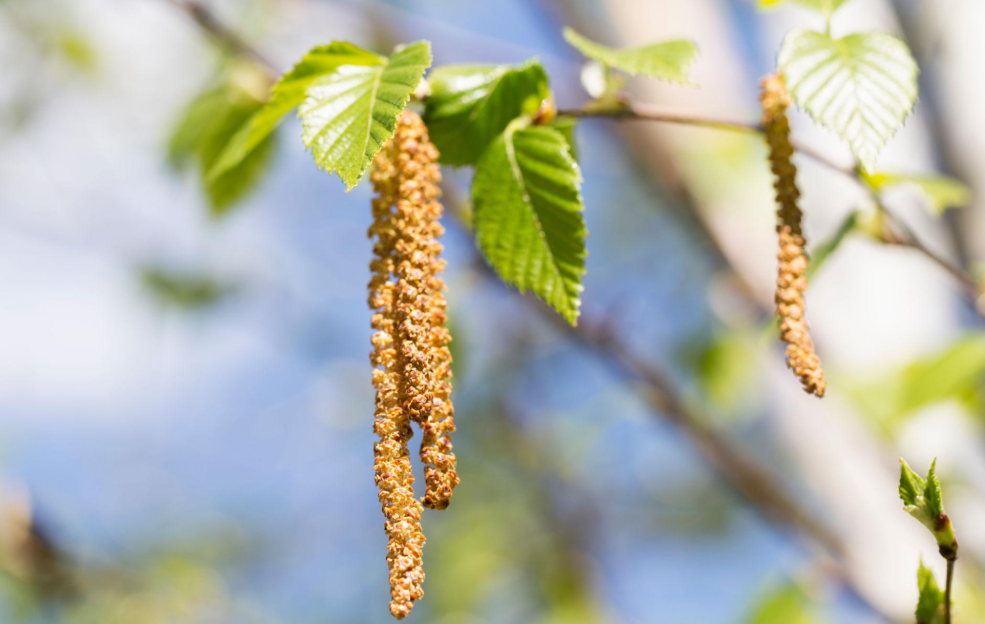
Male catkins form on all three trees in late summer or fall and stay through winter before lengthening in spring. On paper birch they usually hang in groups of two or three at the twig tips. In autumn, the seed catkins break apart and drop tiny winged seeds that often scatter visibly across snow.
The shape of the tree is often the quickest clue from a distance. European white birch is pyramidal when young and develops graceful weeping branchlets as it matures, with slender twigs draping toward the ground. Paper birch has a more upright, irregular crown with branches that angle outward, not downward. Gray birch is a small, slender, short-lived tree, usually under 30 feet, and it often grows in leaning clumps on poor, sandy, or disturbed soil in the Northeast.
White Birch Twigs and Buds
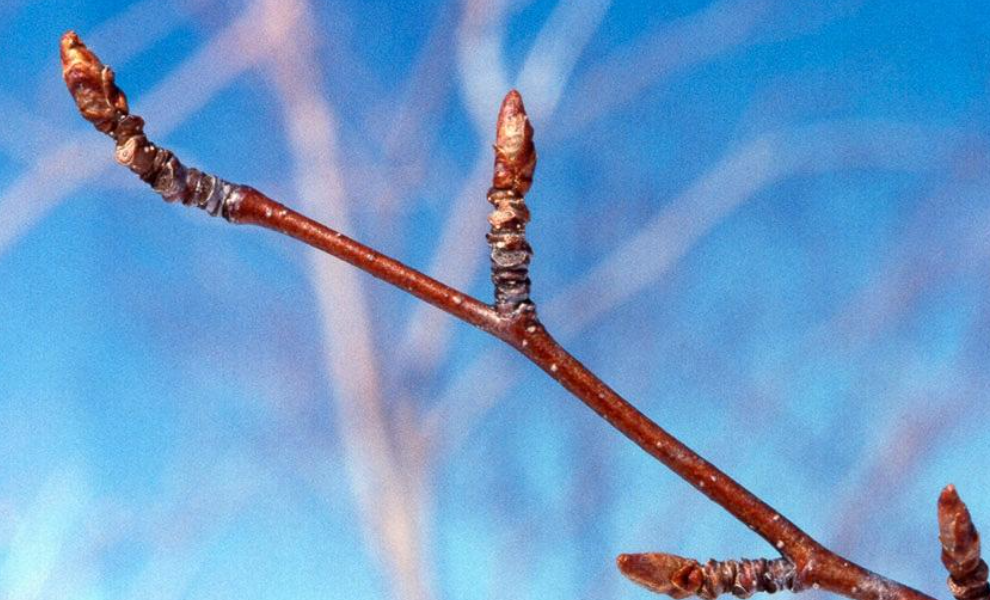
White Birch has slender twigs that are generally reddish-brown or dark brown. Its small, pointed buds are arranged alternately along the branches and become particularly noticeable during winter.
Young twigs are relatively smooth, while older branches gradually develop darker bark. Examining the arrangement of buds, twig color, and branch structure can help identify White Birch when its leaves are absent.
Look-Alikes
Quaking aspen is the tree most often mistaken for a white birch. Its bark can be smooth and pale white, but it never peels, and its rounded leaves on flattened stems flutter constantly. Sycamore also has white upper branches, but its bark flakes off in mottled patches and its leaves are large and lobed like a maple’s.
Pest problems can also help with identification in landscapes. European white birch is one of the birches most vulnerable to the bronze birch borer, so a pale-barked birch in a yard with a thinning, dying crown is often the European species and not native paper birch. If you combine the way the bark peels, the trunk markings, the leaf base, and the branch habit, you can name nearly any white birch you come across.
Common Places Where White Birch Is Found in North America
White Birch, particularly Paper Birch, is native to northern North America. It is widely distributed across Canada, including Ontario, Quebec, Manitoba, Saskatchewan, Alberta, and parts of British Columbia. In the United States, it commonly occurs in Minnesota, Wisconsin, Michigan, Maine, New Hampshire, Vermont, and other northern states.
In its natural habitat, White Birch grows in boreal forests, mixed woodlands, mountain slopes, forest edges, and recently disturbed areas. It generally prefers cool climates, adequate moisture, and well-drained soils.
White Birch Identification: Key Characteristics
The following features are useful when identifying White Birch:
- Bark: Bright white or cream-colored bark that peels in thin, papery layers.
- Leaves: Oval or egg-shaped leaves with pointed tips and serrated edges.
- Height: Commonly grows between 50 and 70 feet tall.
- Growth habit: Upright trunk with a rounded or irregular crown.
- Twigs: Slender, reddish-brown or dark brown branches.
- Catkins: Hanging male and female flower clusters that appear in spring.
- Seeds: Small, lightweight, winged seeds released from cylindrical fruiting structures.
White Birch is especially recognizable because of its distinctive white peeling bark and yellow autumn foliage. These features, combined with its leaf shape and growth habit, make it easier to distinguish from River Birch, Yellow Birch, Gray Birch, and other North American birch species.
Sources
- Michigan Technological University, “Paper Birch, Yellow Birch – Upper Peninsula Tree ID”
- NC State Extension, “North Carolina Extension Gardener Plant Toolbox: European White Birch”
- University of Alaska Fairbanks Cooperative Extension, “European White Birch (Weeping Birch)”
- Colorado State University, “European White Birch – Identification Characteristics”
- University of Vermont, “Paper Birch – Plant Identification”