Sweet Birch Tree Identification: How to Recognize the Wintergreen Birch
Sweet birch tree identification often surprises people, because this birch has no white or peeling bark. Its trunk is dark, smooth, and glossy, and it looks more like a cherry tree than the birches most people picture. Because of that dark bark, it is also called black birch and cherry birch. The name “sweet birch” comes from its strong wintergreen fragrance. For generations its twigs and inner bark were a source of wintergreen oil and the flavoring for traditional birch beer.
Sweet birch is native to eastern North America. Its range runs from southern Maine and New England through New York and Pennsylvania and south along the Appalachian Mountains into the Blue Ridge and northern Georgia. It grows best on moist, well-drained slopes, rocky hillsides, and ravines, often with oaks, maples, hemlock, and yellow birch. It is a medium-sized tree, usually 50 to 60 feet tall, and on good sites it can reach about 80 feet, with a single straight trunk and a rounded crown.
Bark
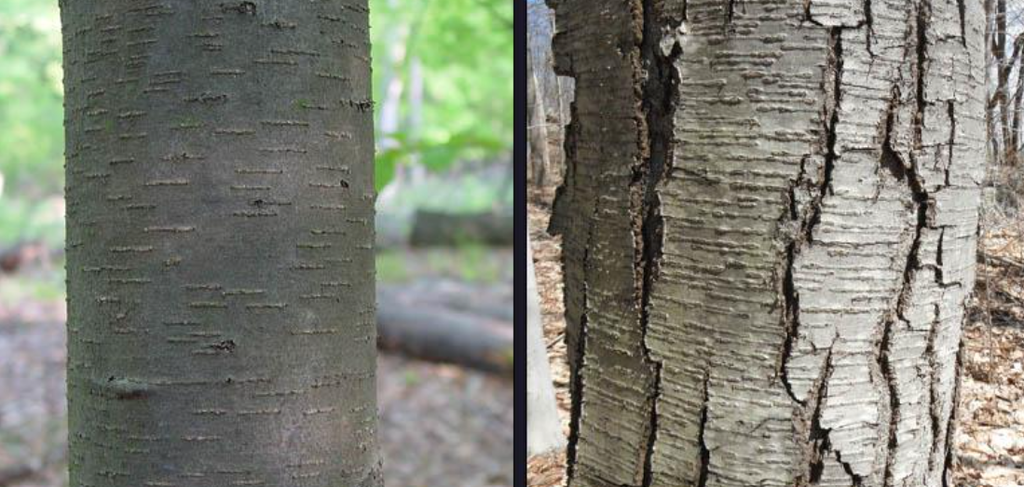
Young sweet birch bark is smooth, shiny, and dark reddish-brown to almost black, marked with long horizontal lenticels that look like pale dashes across the trunk. It doesn’t peel or curl the way the bark of paper, yellow, or river birch does. That glossy, tight, cherry-like bark is the most important field mark.
As the tree ages, the bark gets thicker and darker gray-black and breaks into irregular, scaly plates. Some people compare older trunks to burnt potato chips stuck to the tree, with thin flat plates lifting slightly at the edges. Even on very old trees, the bark never forms the golden curls of yellow birch, which is the easiest way to separate these two closely related trees.
Leaves
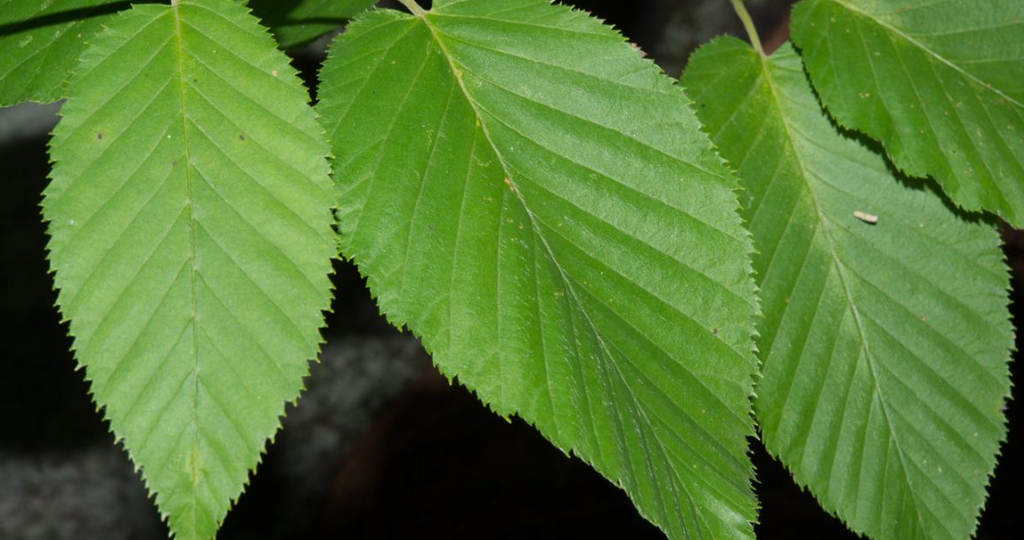
Sweet birch leaves are simple, alternate, and oval to egg-shaped, usually 2 to 4 inches long, with a pointed tip and a rounded or slightly heart-shaped base. The edges are finely and sharply toothed, with small teeth mixed among slightly larger ones. Straight, parallel veins run from the midrib to the edge, usually about 9 to 11 pairs per leaf.
On older branches the leaves often grow in pairs from short, stubby spur shoots, which gives the twigs a knobby look. The leaves are dark green and somewhat glossy above and paler underneath, with a few soft hairs along the veins. In autumn they turn a bright golden yellow. Sweet birch leaves look almost identical to yellow birch leaves, so bark and twigs are more useful for identification.
Twigs and Buds
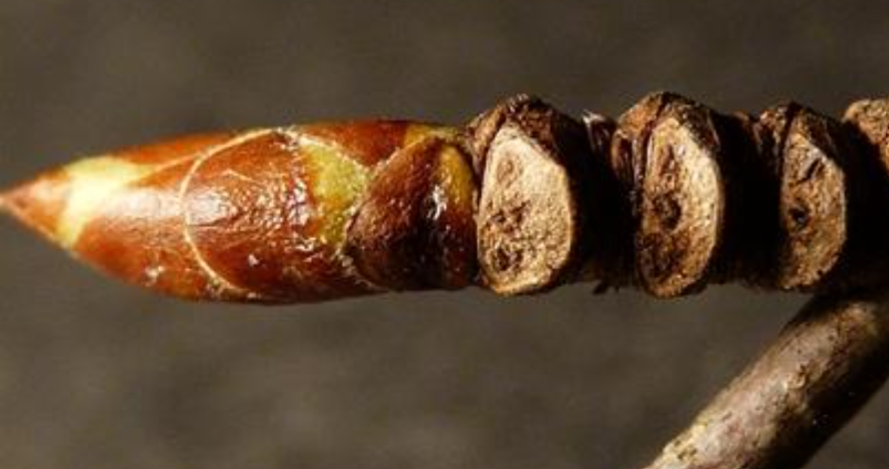
The twigs give the strongest identification test. They are slender, smooth, shiny, and reddish-brown, dotted with small pale lenticels. If you scratch or snap a young twig, it releases a strong, sweet wintergreen scent, and the twig has a minty taste. Yellow birch twigs smell faintly of wintergreen too, but sweet birch is much stronger and more immediate.
The winter buds are long, sharply pointed, and chestnut-brown, and they angle away from the twig. They are smooth and shiny, without the fine hairy fringe on the bud scales of yellow birch. Checking the buds with a hand lens is a reliable way to tell the two trees apart in winter, especially on young trees where the bark differences aren’t developed yet.
Catkins and Seeds
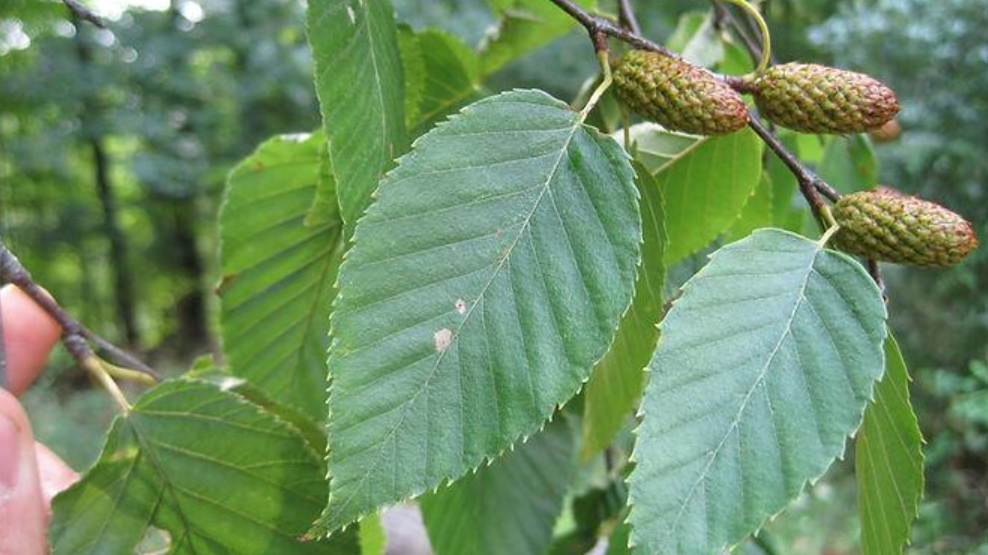
Sweet birch carries male and female flowers in separate catkins on the same tree. The male catkins form in late summer and stay at the branch tips through winter as tight, slender clusters. In spring they lengthen to about 3 to 4 inches, droop, and release pollen as the leaves come out.
The female catkins grow upright on short side shoots and ripen into oblong, cone-like seed clusters about 1 to 1.5 inches long. Their scales are smooth and hairless, while yellow birch fruits have hairy scales, so this detail can help when the clusters are within reach. The clusters ripen in autumn and break apart over the following months, scattering tiny winged seeds that grouse, finches, and small mammals eat.
Look-Alikes
Black cherry is the tree most often confused with sweet birch, because both have dark bark with horizontal lenticels that breaks into scaly plates with age. The scratch-and-sniff test settles it quickly. Sweet birch twigs smell pleasantly of wintergreen, while black cherry twigs give off a bitter, almond-like odor. Black cherry leaves are also narrower and finely toothed with tiny incurved teeth, and they often have a line of reddish-brown hairs along the midrib underneath.
Yellow birch shares the same leaves, catkins, and wintergreen-scented twigs, but its bronze or golden bark peels in thin curls, while sweet birch bark stays dark and tight. If you look for the glossy dark bark that doesn’t peel, the smooth pointed buds, and the strong minty twig scent, you can identify sweet birch in any season.
Where Sweet Birch Grows in North America
Sweet Birch is native to the eastern United States, particularly the Appalachian region and parts of the Northeast. Its natural range includes states such as Maine, New Hampshire, Vermont, New York, Pennsylvania, Maryland, Virginia, West Virginia, and North Carolina.
It grows in mixed hardwood forests, wooded hillsides, and well-drained upland soils. Sweet Birch is also found in parts of southeastern Canada, especially southern Ontario and Quebec, where suitable growing conditions occur.
Key Characteristics for Identifying Sweet Birch
- Bark: Dark reddish-brown to nearly black, becoming rough and irregular with age.
- Leaves: Oval-shaped, pointed, and finely double-serrated, turning yellow in autumn.
- Twigs: Reddish-brown with a distinctive wintergreen scent when scratched.
- Catkins: Separate male and female catkins growing on the same tree.
- Size: Usually 40–60 feet tall, with a straight trunk and rounded crown.
Sources
- University of Vermont, “Sweet Birch – Plant Identification”
- Cornell Cooperative Extension ForestConnect, “Doubly Serrate Margins: Identifying Birches”
- University of Connecticut Plant Database, “Sweet Birch, Black Birch”
- Bloomsburg University, “Black or Sweet Birch”
- National Park Service, Shenandoah National Park, “Sweet Birch”