Golden Trumpet Tree: Florida’s Late-Winter Burst of Gold
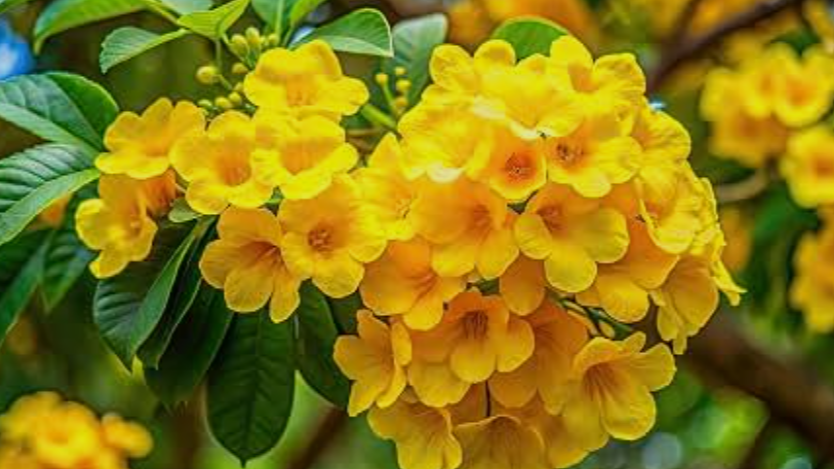
The golden trumpet tree is one of the most dazzling flowering trees in the warm South. For a few weeks in late winter or early spring, its branches erupt in dense clusters of bright yellow trumpet-shaped flowers, often before the new leaves appear. In Central and South Florida, a golden trumpet tree in full bloom can stop traffic, and fallen petals turn lawns and sidewalks yellow beneath it.
It is also one of the most practical trumpet trees for home gardeners. It stays small to medium in size, tolerates drought once established, and has proven more cold-tolerant than most of its tropical relatives. University of Florida horticulturists rate it an outstanding tree. It is common along Florida medians, in parking lots, and in backyards from the Keys to the Tampa Bay area and beyond.
Botanical Classification
The golden trumpet tree belongs to the bignonia family, which includes jacaranda, catalpa, trumpet creeper, and the other trumpet trees. For most of its history it was grouped with the pink, silver, and rosy trumpet trees in a single genus. A 2007 DNA study showed that genus actually contained several distinct lineages. The golden trumpet tree was moved to a separate genus along with many other yellow and pink trumpet trees. Botanists noted that this group has particularly hard wood. Many plant tags and books still use its older name.
In Brazil, the golden trumpet tree and its close yellow-flowered relatives are known as ipê amarelo, or yellow ipê. The yellow ipê flower is widely regarded as Brazil’s national flower. In English-speaking countries the tree is also called the yellow trumpet tree or golden tabebuia. Several other yellow-flowered species share those names.
Brief History
The golden trumpet tree is native to Brazil and northeastern Argentina. It grows in Atlantic coastal forests, woodland edges, and open areas. Its flowers are rich in nectar, and in its homeland it is valued as a honey plant, a shade tree, and an ornamental. Its hard, durable wood has also been used for construction and furniture.
It was introduced to Florida as an ornamental in the 20th century and has become one of the most widely planted flowering trees in the state. Its compact size made it a natural choice for street plantings and residential landscapes, and so did its spectacular bloom and toughness. Nurseries have made it more widely available in recent decades. It now appears in landscapes across Central and South Florida, in southern Texas, and in Southern California.
Identifying Characteristics
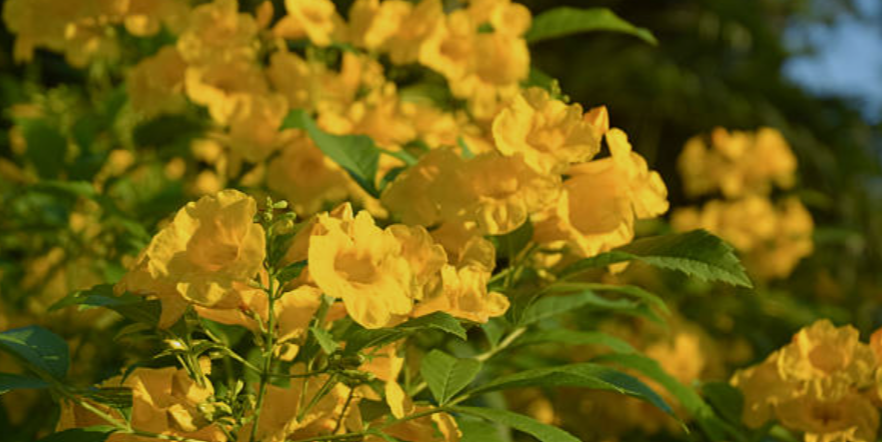
The golden trumpet tree usually grows 25 to 35 feet tall and about as wide in landscapes. In wind-protected sites it occasionally reaches 50 feet. It typically grows on a single trunk with a rounded, irregular, spreading crown and branches that often droop slightly. Young bark is tan and smooth with shallow vertical fissures, and it becomes rougher and more deeply furrowed with age.
The leaves are palmately compound, with several leaflets about 4 inches long spreading from the tip of a stalk. New leaves are covered in a soft, golden fuzz. As they mature, they turn silvery green on top and stay tan and fuzzy underneath. That golden fuzz gives the tree its name, and it is one of the best ways to identify it. The flowers are bright golden yellow, often with fine reddish lines in the throat. They grow in dense clusters 2½ to 8 inches long at the branch tips. The flowers are followed by brown, hairy seed pods about 8 inches long, which often hang on the tree through winter.
Bloom Season
The golden trumpet tree blooms in late winter to early spring, usually from February to April in Florida. In most years the tree drops its old leaves just before or during bloom. The flowers then open on nearly bare branches, and the whole crown turns gold. The heaviest flowering usually comes just as the new leaves begin to emerge.
The main bloom lasts a few weeks. Some trees also produce a few scattered flowers throughout the warm season. Bees and other pollinators visit the nectar-rich flowers heavily. In regions with occasional cold snaps, a hard freeze can damage the flower buds and reduce the following spring’s bloom.
Also Read: Different Types of Trumpet Trees
Golden Trumpet Tree Versus Silver Trumpet Tree
The golden trumpet tree is often confused with the silver trumpet tree, which also has bright yellow flowers and blooms at about the same time. The easiest way to tell them apart is the leaves. Golden trumpet tree leaves are covered with golden or tan fuzz, especially on new growth and the undersides. Silver trumpet tree leaves are smooth, leathery, and silvery gray-green.
The 2 trees also differ in form and hardiness. The golden trumpet tree has a rounder, more spreading crown and is generally more cold-tolerant. The silver trumpet tree is usually more upright and irregular, with thick, corky bark, and it is best suited to frost-free South Florida. The golden trumpet tree’s hairy seed pods are another clue. Silver trumpet tree pods are smooth.
Where It Grows in the United States
The golden trumpet tree is one of the most cold-tolerant trumpet trees, though sources differ on its exact range. The University of Florida’s main fact sheet rates it for USDA zones 10A through 11. Other University of Florida resources list zones 9B through 11, or even 8B through 11. Specimens have been grown as far north as Gainesville. In practice, it is reliable in Central and South Florida and grows well all the way south to Homestead.
It is less reliable farther north, especially in zones 8 and 9. There, frost can damage or kill young trees, and freezes can weaken older trees. University of Florida horticulturists recommend protecting the trees from frost. They note that trees that leaf out after a freeze often stay weakened and grow poorly. Gardeners in North Florida and other borderline areas should plant in warm, sheltered sites and check with their county extension office before planting.
Landscape Uses
The golden trumpet tree is one of the best flowering trees for medians and street plantings in warm climates. Its vivid flowers, asymmetrical form, and drought tolerance suit it to roadsides, highway medians, parking lot islands, and tree lawns as narrow as 3 to 4 feet. University of Florida horticulturists describe it as an ideal patio, specimen, or lawn tree.
Planted near a patio or deck, it casts light to medium shade under its canopy, a welcome relief in hot Florida summers. Its roots generally don’t cause problems, so it can be planted near paved areas. For a dramatic late-winter display, plant it alongside pink trumpet trees, which bloom at about the same time.
Growing Considerations
The golden trumpet tree grows best in full sun, which produces the heaviest flowering and the strongest growth. It tolerates a wide range of well-drained soils, including clay, sand, and loam, in both acidic and alkaline conditions. It needs good drainage and does poorly in wet, waterlogged sites.
Water newly planted trees regularly for the first several months to help their roots establish. Once established, the golden trumpet tree is moderately drought-tolerant. In much of Florida it can survive on rainfall alone and still flower well each year. It has moderate tolerance for salt spray, so it can be planted in coastal areas that are not directly exposed to the ocean. A light application of a slow-release fertilizer in spring supports healthy growth.
Pruning and Training
Pruning young golden trumpet trees is important for long-term strength. As the tree ages, its wood becomes brittle and can break in strong winds. That is one reason the tree is rarely seen larger than about 30 feet tall in Florida. Prune young trees to develop a single dominant trunk well up into the canopy, shortening or removing branches that compete with it. The canopy may look somewhat open after this structural pruning, but it fills in over time.
Mature trees need little pruning beyond removing dead, damaged, or weak branches. Do any pruning soon after flowering to avoid removing next year’s flower buds. In hurricane-prone areas, have an arborist check large trees periodically for weak branch attachments.
Pests and Problems
The golden trumpet tree is free of serious pests and diseases. Occasionally, scale insects, mites, or caterpillars feed on the leaves, but they rarely cause significant harm to established trees. Healthy, well-sited trees usually tolerate minor pest damage without treatment.
The main problems are cold damage in marginal areas and branch breakage in strong winds. Poor drainage can cause root problems. Too much shade reduces flowering and causes leggy growth.
Also Read: Red Trumpet Tree
Invasive Status
The University of Florida’s assessment of non-native plants rates the golden trumpet tree as not a problem species, and it may be recommended for planting in North, Central, and South Florida. It is considered a Florida-Friendly choice for landscapes. In some other warm regions, including parts of Australia, it has been flagged as a potential weed. Gardeners outside Florida should check local guidance before planting.
Sources
University of Florida IFAS Extension, “Golden Trumpet Tree”
University of Florida IFAS Gardening Solutions, “Golden Trumpet Tree”
University of Florida IFAS, “Trees and Power Lines: Golden Trumpet Tree”
University of Florida IFAS Gardening Solutions, “Trumpet Trees”