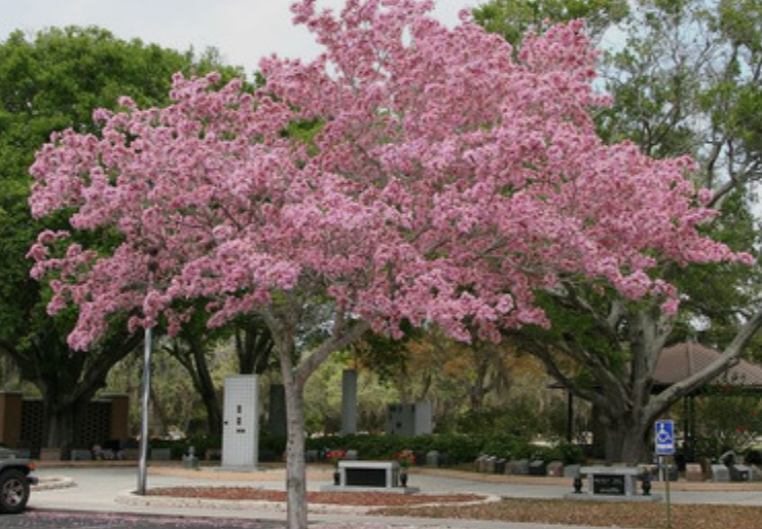
Pink Trumpet Tree: The Many Trees Behind One of Florida’s Most Spectacular Spring Bloomers
The pink trumpet tree is one of the most spectacular flowering trees grown in the United States. For a few weeks each year, its bare branches are covered in clusters of pink, rose, or lavender trumpet-shaped flowers. Fallen petals carpet the ground beneath it. In South Florida, the main bloom often peaks around Valentine’s Day, and the trees light up streets, parks, and front yards across the region.
One complication surprises many gardeners: “pink trumpet tree” is not a single tree. Nurseries, garden books, and extension services use the name for at least 4 different tropical species. They differ in size, cold tolerance, bloom time, and even whether they are welcome in Florida’s natural areas. Knowing which one you are buying matters as much as how to grow it.
Botanical Classification
Pink trumpet trees belong to the bignonia family, a group known for large, tubular flowers. Relatives include trumpet creeper, catalpa, jacaranda, desert willow, and crossvine. Like their cousins, pink trumpet trees bear showy, funnel-shaped blooms that attract bees, hummingbirds, and other pollinators.
For most of the 20th century, all trumpet trees were grouped together in a single genus. In the 2000s, botanists studied the group’s DNA and moved many of the most popular species into a separate genus, based on differences in their leaves, wood, and flower structure. Older plant tags and garden books still use the former names, which adds to the confusion. Common names, though, have stayed the same, so 1 tree may be sold as “pink trumpet tree,” “pink tabebuia,” “pink ipe,” or “purple trumpet tree.”
The Different Trees Called Pink Trumpet Tree
The most widely planted is the South American pink trumpet tree, also known as pink tabebuia, pink ipe, lapacho, or pau d’arco. It is native from Mexico through much of South America. In South Florida, it blooms in late winter, usually in February. Its flowers range from soft pink to magenta and lavender, often with yellow throats. University of Florida horticulturists have called it one of the most beautiful trees in flower in the world.
A second species, native to southeastern Brazil, Paraguay, and northern Argentina, is also sold as pink trumpet tree. The University of Florida rates it an outstanding tree for South Florida. It reaches about 20 to 30 feet tall and 15 to 25 feet wide. Its leaves have 5 leaflets, each about 2½ inches long, and in spring it bears pink to rose-purple flowers about 2 inches across.
The third is the Caribbean pink trumpet tree, native to Puerto Rico and the West Indies. It is also called white cedar or roble blanco. It grows at a moderate rate from a slim pyramid when young to a broad silhouette of 20 to 30 feet. Its pink or white bell-shaped flowers can appear throughout spring and summer. They are followed by slender seedpods 3 to 12 inches long.
The fourth is the Cuban pink trumpet tree, sometimes called white trumpet tree. It has delicate, very pale pink to white flowers and can reach 30 to 40 feet tall. It grows in Central and South Florida. A fifth relative, the rosy trumpet tree of Central America, is also planted in parts of Florida.
Identifying Characteristics
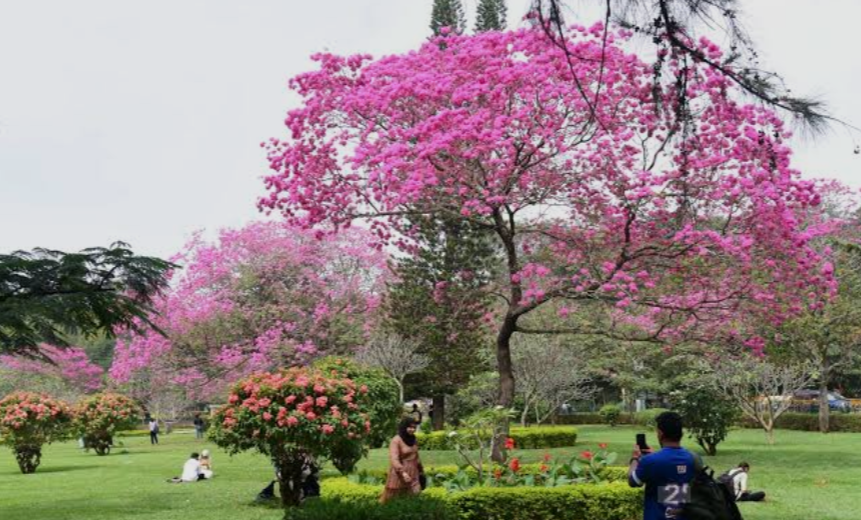
Despite their differences, pink trumpet trees share several features that make them easy to recognize as a group. Most have palmately compound leaves: 5 or more leaflets that spread from a single point at the end of a leaf stalk, like the fingers of a hand. The leaves are arranged in opposite pairs along the branches. Many species are deciduous or briefly deciduous, dropping their leaves just before or during bloom.
The flowers are the giveaway. They are trumpet- or bell-shaped, about 2 to 3 inches long, with 5 ruffled lobes at the mouth. They grow in dense clusters at the ends of the branches. In the South American species, the flowers burst open on bare branches, so the whole crown is solid color. The flowers are followed by long, slender, brown seedpods that split to release papery, winged seeds carried by the wind.
Where Pink Trumpet Trees Grow in the United States
Pink trumpet trees are tropical and subtropical trees with limited cold tolerance. In the continental United States, they are grown mainly in South and Central Florida, the southern tip of Texas, coastal Southern California, and Hawaii. The University of Florida rates the Brazilian species for USDA zones 9B through 11. The Caribbean species is generally limited to zones 10A through 11.
Cold snaps can damage flower buds even when they don’t kill the tree. A tree that goes through an unusually cold winter may skip or reduce its spring bloom, then flower normally the next year. Gardeners in North Florida and other borderline areas should contact their county extension office to find out which trumpet trees have proven reliable locally. Yellow-flowered trumpet trees are generally more cold-tolerant, and some survive as far north as zone 8B.
Landscape Uses
Pink trumpet trees are among the showiest flowering trees for warm-climate landscapes. They make outstanding specimen trees in front yards and lawns, where their seasonal flower display becomes a focal point. Their moderate size suits patios, courtyards, parking lot islands, and medians, and they are widely used as street trees in South Florida.
They also work well with other flowering trees to extend the season of color. A common pairing is pink trumpet trees with golden trumpet trees, which bloom in spring with bright yellow flowers. Some gardeners add royal poinciana or jacaranda for summer color. The South American pink trumpet tree is valued as an urban tree because it tolerates drought once established and generally has roots that don’t cause problems for sidewalks and foundations.
Also Read: Types of Tabebuia (Trumpet) Trees
Growing Considerations
Pink trumpet trees grow best in full sun. More sun means more flowers, and trees in shade bloom sparsely. They tolerate a range of well-drained soils, including sandy Florida soils and slightly alkaline conditions. They do not tolerate standing water or poorly drained sites, which can lead to root rot.
Water newly planted trees regularly through their first year or 2 so their roots can establish. After that, most pink trumpet trees are fairly drought-tolerant and need watering only during long dry spells. A light application of a balanced or palm-and-ornamental fertilizer in spring and summer supports healthy growth. Avoid overfeeding, which encourages leafy growth at the expense of flowers.
Plant the trees where they have room to spread, at least 10 to 15 feet from buildings and power lines, depending on the species. Keep in mind that flowers dropping in late winter can litter driveways, pools, and patios for a few weeks. Most gardeners consider that a small price for the bloom.
Pruning and Training
Young pink trumpet trees often grow several competing trunks or develop an irregular, open crown. Pruning in the first few years helps create a strong structure. Choose 1 central trunk, or a few well-spaced main branches, and remove or shorten branches that compete with it. For street trees and trees near walkways, gradually remove low branches as the tree grows to provide clearance.
Do major pruning right after flowering, so you don’t remove the branch tips that will carry next year’s blooms. Mature trees need little pruning beyond removing dead, damaged, or crossing branches. Trees with a strong central trunk and well-spaced branches hold up better in tropical storms and hurricanes.
Pests and Problems
Pink trumpet trees are generally tough and trouble-free. University of Florida fact sheets note that no pests are normally seen on the Brazilian species. Occasionally, scale insects, mites, or caterpillars feed on the leaves, but they rarely cause serious harm to established trees. Healthy, well-sited trees usually outgrow minor damage without treatment.
The most common problems come from the planting site, not from pests. Poor drainage leads to root rot. Cold snaps can damage flower buds or young branches. Too much shade or fertilizer reduces flowering. Some trees take several years to bloom after planting, especially if they were grown from seed.
A Note on Invasive Status
Before planting a pink trumpet tree in Florida, check which species you are buying and how it is rated. The University of Florida’s assessment of non-native plants lists the South American pink trumpet tree as “not a problem species,” making it a Florida-Friendly choice. The Brazilian species has also been rated as having little invasive potential.
The Caribbean pink trumpet tree is a different story. The Florida Invasive Species Council lists it as a Category II invasive species, meaning it has spread into natural areas in parts of South Florida. Some sources still describe it as non-invasive, so ratings can vary and change over time. Florida gardeners should check the current University of Florida assessment, or ask their county extension office, before planting it. The safest choice for most Florida landscapes is one of the South American species.
Sources
University of Florida IFAS Extension, “Pink Trumpet Tree” (ST-615)
University of Florida IFAS Extension, “Pink Trumpet Tree” (ST-616)
University of Florida IFAS Gardening Solutions, “Trumpet Trees”
University of Florida IFAS Extension Sarasota County, “Valentine Blossoms, Pink Trumpet Trees”