Clemson Spineless Okra: The Variety That Defined Southern Okra
Clemson Spineless okra is the most important okra variety ever grown in the United States. It is the variety behind the green, ribbed pods in Southern gumbo pots, fried okra platters, and pickle jars. It was developed in South Carolina in the 1930s and won an All-America Selections award in 1939. Nearly 9 decades later, it is still the standard every other okra is measured against, a remarkable run for a vegetable variety.
The name says what made it a breakthrough. Older okras were covered in tiny, prickly spines that left pickers’ hands and arms itching and stinging after every harvest. Clemson Spineless produced smooth, velvety pods that were far easier to pick, handle, and cook. It was also heavy-yielding, uniform, and dependable across the hot, humid Cotton Belt. Farmers, canners, and home gardeners adopted it almost immediately.
Botanical Classification
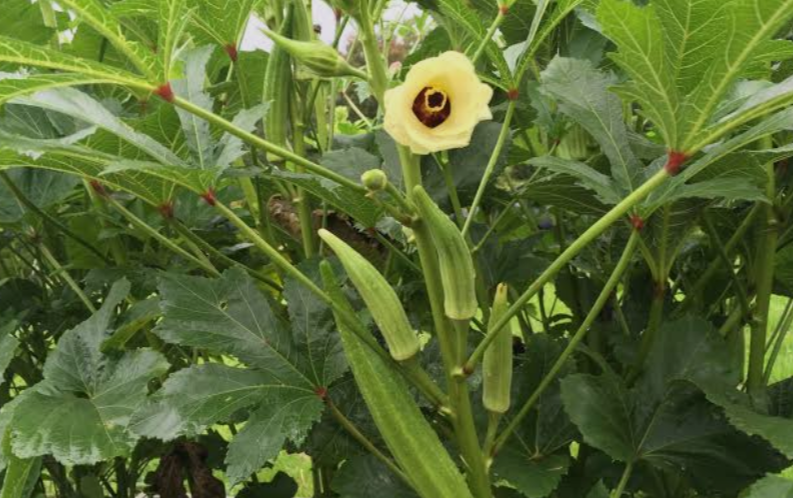
Okra belongs to the mallow family, the same plant family as hibiscus, hollyhocks, rose of Sharon, and cotton. The family resemblance shows in the flowers: large, 5-petaled, and creamy yellow, with a deep red or burgundy center. Okra is a warm-season annual in North America, though in tropical climates it can live for more than 1 season.
Clemson Spineless is an open-pollinated heirloom variety. That means seeds saved from the plants grow into plants that are true to type, the same as the parent. This sets it apart from modern hybrid okras, whose seeds do not reliably reproduce the parent plant. It is one reason Clemson Spineless has remained a favorite among seed savers and heritage gardeners.
Brief History
Clemson Spineless was developed at the South Carolina Agricultural Experiment Station at Clemson, now Clemson University. Breeders selected it from Perkins Mammoth Long Pod, a popular okra of the early 20th century, choosing plants that produced uniform, green, spineless pods. Clemson released the variety in the late 1930s, and in 1939 it won an All-America Selections award, one of the most prestigious honors for a new vegetable.
Its success was enormous. By 1988, agronomists estimated that about 99% of the commercial okra crop in the United States was Clemson Spineless. Food historian David Shields has called it the most important and iconic regional vegetable of the 20th-century South. Its influence reaches well beyond its own fields, too. It became the parent of later varieties, including Evergreen in 1945, Dixie Spineless in 1982, and Perkins Spineless in 1984, as well as the University of Arkansas variety Jade.
Identifying Characteristics
Clemson Spineless plants are upright, sturdy, and moderately tall, usually 4 to 5 feet in most gardens. In long, hot Southern summers they can reach 6 feet or more. The leaves are large, deeply lobed, and slightly hairy, and grow on thick green stems. The flowers open in the morning and close by afternoon. They are creamy yellow with dark red centers, and they are edible.
The pods are dark green, straight to slightly curved, and tapered at the tip, with 8 prominent ridges running along their length. They are smooth and velvety rather than spiny. Left on the plant, pods can grow 6 to 9 inches long, but by then they are tough and woody. Pods are tender and best for eating at about 2 to 4 inches. A pod cut crosswise shows a star-shaped outline that looks attractive when sliced.
Clemson Spineless 80 and Other Strains
Seed companies and universities have maintained several strains of Clemson Spineless over the years. The most widely recommended today is Clemson Spineless 80, an improved selection that Clemson Cooperative Extension recommends for South Carolina gardens. It produces dark green, spineless pods and is often described as having longer pods and a more open plant form than the original. A newer strain, Clemson Spineless 99, is shorter and more compact, about 4 feet tall in trials.
All of these strains share the same basic traits: spineless green pods, reliable yields, and good flavor. Many seed packets simply say “Clemson Spineless” without naming a strain. Gardeners growing in limited space may want to look specifically for the shorter strains.
Also Read: Types of Okra Plants
Growing Considerations
Clemson Spineless thrives in heat. It grows best when days are hot, above about 85 degrees Fahrenheit, and nights stay warm, around 70 to 75 degrees. It is ideally suited to the South, Southwest, and lower Midwest, but it can also be grown in northern gardens with a long, warm summer. The University of Arkansas notes that Clemson Spineless is less sensitive to day length than some other okra varieties. That helps it produce reliably across a range of latitudes.
Okra needs full sun and well-drained soil. Sandy or loamy soils are ideal, with a pH between about 6.0 and 7.5. Clemson Spineless also tolerates slightly alkaline soils. Work compost into the soil before planting. Avoid heavy nitrogen fertilizer early in the season, since it produces leafy plants with fewer pods.
Planting
Okra is extremely sensitive to cold, so do not plant until the danger of frost has passed and the soil has warmed to at least 65 to 70 degrees Fahrenheit. Across much of the South that means mid to late spring. In northern states, it often means early June. Seeds planted in cold soil rot or germinate slowly.
Soak the seeds in warm water overnight before planting to soften their hard seed coats and speed germination. Clemson Cooperative Extension recommends sowing seeds about ¾ inch deep, with rows 3 to 6 feet apart and plants spaced 9 to 12 inches apart in the row. Thin seedlings to the proper spacing once they have several leaves, since crowded plants produce fewer pods. Gardeners with short seasons can start seeds indoors in peat pots about 4 weeks before transplanting, but okra does not like having its roots disturbed.
Care
Once established, Clemson Spineless is fairly drought-tolerant, but it produces the most pods with regular watering. Water deeply about once a week, more often in sandy soils or during heat waves. A 2- to 3-inch layer of organic mulch helps conserve moisture and control weeds, and also keeps the soil warm.
Side-dress plants with a nitrogen fertilizer once they begin flowering and setting pods. Repeat about a month later to keep production going. In long Southern seasons, plants may slow down or stop flowering by midsummer. Gardeners can renew them by ratooning: cutting the plants back to about 1 to 2 feet tall in mid to late summer, then fertilizing and watering. The plants resprout and produce a second crop into fall.
Harvesting
Clemson Spineless begins producing about 55 to 70 days after planting, depending on the weather and the strain. Pods grow astonishingly fast, reaching harvest size just 4 to 7 days after the flower opens. Harvest when pods are 2 to 4 inches long, while they are still tender and snap easily. Larger pods quickly become tough, fibrous, and woody.
During peak season, harvest every 1 to 2 days to keep plants productive. Leaving mature pods on the plant signals it to slow down. Cut pods off with a knife or pruners rather than pulling, which can damage the stems. Even “spineless” okra plants have tiny hairs on the leaves and stems that can irritate the skin, so many gardeners wear gloves and long sleeves when picking. Fresh pods keep for up to about 7 days in the refrigerator.
Pests and Diseases
Clemson Spineless is generally a tough, productive plant, but it can face a few common problems. Root-knot nematodes, microscopic soil-dwelling worms, are the most serious pest in many Southern gardens. They cause swollen, knotted roots and stunted plants. Rotating crops and adding organic matter to the soil help reduce damage. Aphids, stink bugs, and corn earworms may feed on leaves and pods. Most are controlled with hand-picking, strong sprays of water, or insecticidal soap.
Fungal diseases such as Fusarium wilt and leaf spot can affect okra in hot, wet seasons. Plant in well-drained soil, avoid overhead watering, and give plants plenty of space for airflow. Removing plant debris at the end of the season and rotating okra to a new spot each year also helps prevent disease buildup.
In the Kitchen
Clemson Spineless pods have a mild, grassy flavor and the slightly slippery texture that okra is known for. That texture, called mucilage, is what thickens gumbos, stews, and soups. Sliced pods can be breaded and fried, roasted until crisp, grilled whole, sautéed with tomatoes and onions, or pickled whole in a vinegar brine.
To cut down on the slipperiness, cook okra quickly over high heat, or leave the pods whole rather than slicing them. Okra also freezes well. Blanch the pods for a few minutes in boiling water, cool them in ice water, then freeze them for use through winter. From backyard gardens to commercial fields, Clemson Spineless has supplied most of the okra eaten in America for close to a century.
Sources
Clemson Cooperative Extension, “Okra”
University of Arkansas Cooperative Extension Service, “Home Gardening Series: Okra”
University of Georgia Cooperative Extension, “Growing Okra in the Home Garden”
Texas A&M AgriLife Extension, “Okra”
NC State University, “Vegetable Cultivar Descriptions for North America: Okra”