Nugget Ninebark: The Golden Shrub Bred on the Northern Great Plains
Nugget ninebark is a golden-leaved shrub that brings bright yellow color to gardens from the Dakotas to New England. In spring its leaves emerge in a bright golden yellow, then mellow to soft chartreuse and lime green as summer goes on. It is dense, tidy, and easy to grow. It is also a rare example of a popular ninebark bred in America: it came out of a university program on the Northern Great Plains, where only the toughest shrubs survive.
Many of the colored ninebarks in garden centers today were bred in Europe. Diabolo came from Germany, and Coppertina was bred in France. Nugget was selected in South Dakota, where winters are long and bitter, summers are hot and windy, and soils are often alkaline. That background makes it a reliable choice for northern and Plains gardeners who need color without fuss.
Botanical Classification
Nugget is a cultivar of common ninebark, a deciduous shrub in the rose family native to central and eastern North America. Its cultivar name is simply ‘Nugget’, a reference to the gold color of its spring leaves. It is sometimes listed in catalogs as Golden Nugget, though the original name is just Nugget.
Nugget belongs to the group of gold-leaved ninebarks, alongside ‘Dart’s Gold’ and the older ‘Luteus’. All 3 share the same basic traits: lobed, maple-like leaves, white flower clusters, red seed pods, and peeling bark. What sets them apart is their size, branching, and the intensity and duration of their yellow color.
Brief History
Nugget was developed by South Dakota State University in Brookings, which has a long tradition of breeding and testing hardy plants for the northern Plains. Horticulturist Norman Evers of South Dakota State donated the cultivar to the USDA National Plant Germplasm System in May 1988. It is still maintained at the North Central Regional Plant Introduction Station in Ames, Iowa, as part of the national collection of plant varieties.
Nugget was selected to improve on ‘Dart’s Gold’, the most popular golden ninebark of the time. Dart’s Gold has bright leaves, but its growth is often loose and uneven. Nugget was chosen for its denser, more uniform branching, which gives it a fuller, rounder shape in the landscape. Cornell University describes it as superior to Dart’s Gold for its dense habit, and it became a staple of northern nurseries through the 1990s and 2000s.
Identifying Characteristics
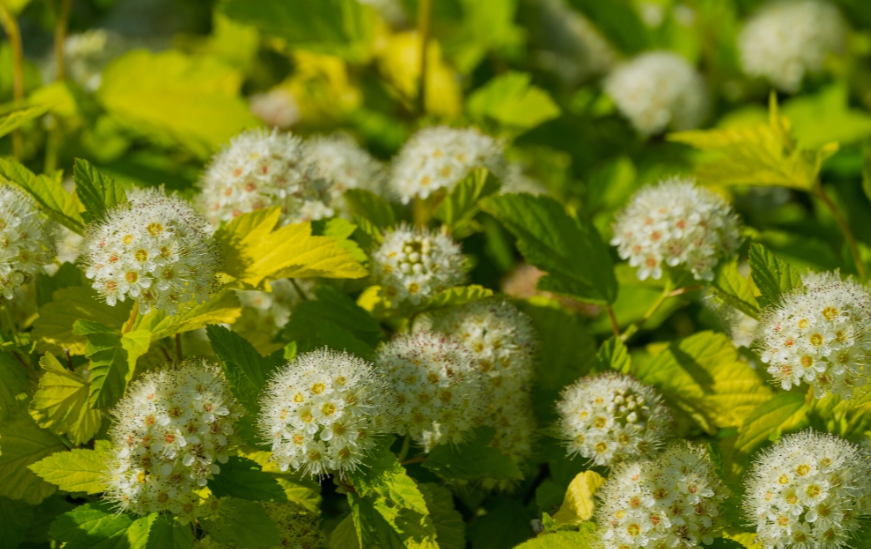
Nugget ninebark is a dense, rounded, multistemmed shrub with upright to slightly arching branches. Most plants mature at about 6 feet tall and wide, though they can reach 8 feet in rich soil with plenty of moisture. The leaves are alternate, 3-lobed, and toothed, roughly 2 to 3 inches long. They emerge a vivid golden yellow in spring, fade to chartreuse by early summer, and age to lime or medium green by midsummer.
In late spring to early summer, generally in June, Nugget produces rounded clusters of small white flowers at the tips of short side branches. They are followed by clusters of small, inflated, reddish seed pods that ripen in late summer. As the stems age, the bark peels away in thin, papery strips of tan and reddish-brown, giving the shrub interest in winter.
Nugget Versus Dart’s Gold
Nugget and Dart’s Gold are often sold side by side, and they look similar in spring. The main difference is size and structure. Dart’s Gold is the smaller of the 2, usually 4 to 5 feet tall and wide. However, it is less well-branched and less uniform than Nugget, and older plants can look leggy or open in the center. Nugget is larger, around 6 feet, with denser branching that gives it a fuller, more even shape.
Color is similar between the 2, though some gardeners find that Dart’s Gold holds its yellow color a little longer into summer. For small spaces, Dart’s Gold or one of the newer dwarf gold ninebarks may be a better fit. For a hedge, screen, or larger accent shrub, Nugget’s size and dense habit make it the stronger choice.
Also Read: Different Types of Ninebark Shrubs For Landscaping
Landscape Uses
Nugget’s bright spring color makes it a natural accent shrub. A single plant brightens a shady corner, a dark evergreen backdrop, or a dull section of a foundation planting. Planted in groups or rows, it makes a dense, colorful informal hedge or low screen. Its tolerance for wind, cold, and poor soil makes it well suited to windbreak plantings and exposed sites on the Plains.
Designers often pair gold ninebarks with purple and blue plants for strong contrast. Nugget looks especially striking next to purple ninebarks such as Diabolo, purple smokebush, blue spruce, and dark-leaved heucheras. It also pairs well with blue and violet flowers such as catmint, salvia, and Russian sage. In mixed borders, its chartreuse summer leaves blend easily with both bold and pastel colors.
Growing Considerations
Nugget ninebark is hardy in USDA zones 3 to 7, so it can survive winters as cold as minus 40 degrees Fahrenheit. It grows best in full sun, which brings out the brightest gold color. In partial shade, the leaves turn chartreuse to green more quickly, but the shrub still grows well. In hot southern climates, intense afternoon sun can occasionally scorch the gold leaves, so light afternoon shade helps in those regions.
Nugget tolerates a wide range of soils, including clay, sandy, rocky, and alkaline soils common on the Plains. It handles moderate drought, urban conditions, and wind once established. Water new plants regularly during their first growing season to help the roots establish. After that, occasional deep watering during long dry spells keeps the shrub looking its best. Fertilizer is rarely needed, and too much nitrogen can cause soft, floppy growth.
Pruning
Nugget ninebark blooms on wood from the previous year, so prune right after flowering in early summer. Every 2 to 3 years, remove about ⅓ of the oldest, thickest stems at ground level. This keeps the shrub dense and vigorous and encourages new shoots, which carry the brightest gold color.
For the most intense color, some gardeners cut Nugget back hard in late winter, to about 12 inches above the ground. The shrub responds with a flush of vibrant golden new growth. It will flower less that year, but many gardeners grow gold ninebarks more for their foliage than their flowers. Older, overgrown shrubs can be renewed the same way.
Pests and Diseases
Nugget ninebark is a tough, low-maintenance shrub with few serious problems. Powdery mildew is the most common issue, especially in humid summers and on shrubs in crowded, shaded sites. It shows up as a white, dusty coating on the leaves in mid to late summer. It is mostly cosmetic, and good air circulation, full sun, and watering at the base rather than overhead keep it in check.
Leaf spot can appear in wet seasons, and aphids or leaf beetles occasionally feed on new growth. Healthy, established shrubs usually tolerate this minor damage without treatment. Deer generally leave ninebark alone, which makes Nugget a practical choice for rural and suburban gardens where browsing is common.
Why Nugget Still Matters
Dozens of newer gold, orange, and copper ninebarks have come on the market since Nugget’s release, many of them more compact or more mildew-resistant. Even so, Nugget remains widely grown in northern nurseries and garden centers. Decades of trials in some of the harshest climates in the United States have proven its hardiness, adaptability, and dependable color.
For gardeners in the northern Plains, Upper Midwest, and Rocky Mountain foothills, Nugget is still one of the most reliable gold shrubs available. Its university origin and decades of performance give it a track record that many newer, heavily marketed varieties have yet to match.
Sources
South Dakota State University Extension, “Nugget Ninebark”
Cornell University Woody Plants Database, “Nugget”
Chicago Botanic Garden, “Nugget Eastern Ninebark”
USDA Agricultural Research Service, “Germplasm Resources Information Network: Ninebark ‘Nugget’”
University of Connecticut Plant Database, “Common Ninebark, Eastern Ninebark”