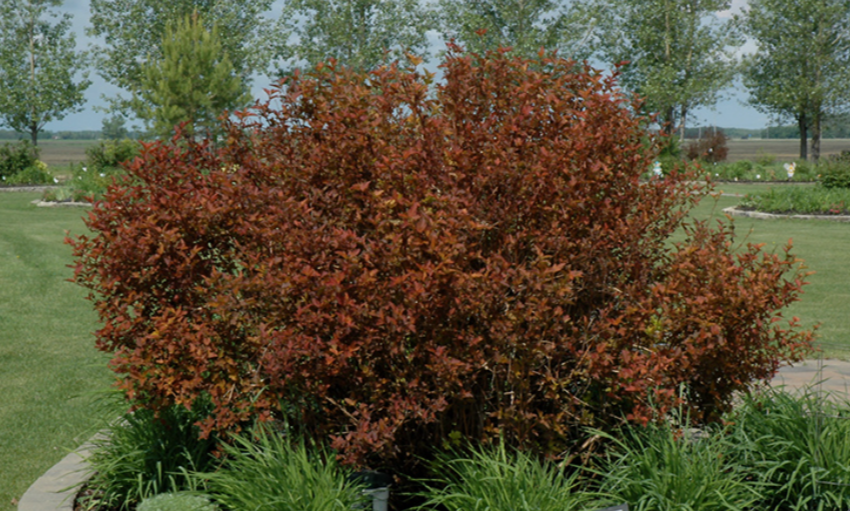
Coppertina Ninebark: The Copper-to-Red Ninebark Born From 2 Famous Parents
Coppertina ninebark is a shrub whose leaves change color over the season. In spring the new leaves come out a shiny, glowing copper-orange. By summer they have deepened to a rich red, and on older growth some turn nearly burgundy. That shift comes from its 2 parents: the gold-leaved ‘Dart’s Gold’ and the deep purple Diabolo. Coppertina falls between them, and it doesn’t look quite like either one.
The result is a ninebark with warmer tones than its purple and gold relatives. It gets all the toughness of common ninebark, a shrub native to central and eastern North America. Coppertina survives harsh northern winters and grows in poor, rocky soils. It also brings soft pink flowers in early summer, red seed pods later in the season, and peeling bark in winter.
Botanical Classification
Coppertina is a cultivar of common ninebark, a deciduous shrub in the rose family. Its official cultivar name is ‘Mindia’, and Coppertina is its trade name. In Europe the same plant is sold as Diable D’Or, French for “golden devil,” a nod to its Diabolo parent.
Coppertina is a hybrid of 2 earlier cultivars. Its seed parent, ‘Dart’s Gold’, is a compact shrub with bright yellow leaves. Its pollen parent, Diabolo, sold as ‘Monlo’, is the large purple-leaved ninebark that started the colored ninebark craze. The leaf color sits between the 2, with gold undertones showing through red and purple pigments.
Brief History
Coppertina was bred in Angers, in the Loire Valley of France, a region known for its nurseries. It came from an open-pollinated cross at Minier Nurseries. A ‘Dart’s Gold’ mother plant was pollinated naturally by a nearby Diabolo, and the seedlings were grown out and evaluated. ‘Mindia’ was selected in the summer of 2000 for its foliage color, compact habit, and branching. Minier released it in Europe in 2003.
Spring Meadow Nursery of Grand Haven, Michigan, brought it to North America under the Proven Winners ColorChoice brand. It received U.S. plant patent number 16,371 and Canadian plant breeders’ rights in 2007. Coppertina quickly became a popular landscape shrub. Floral designers also took notice, and the Association of Specialty Cut Flower Growers named it its 2011 Cut Flower of the Year, recognizing its colorful branches as long-lasting cut stems for arrangements.
Identifying Characteristics
Coppertina ninebark is an upright, spreading shrub with gracefully arching branches. At maturity it usually reaches 6 to 10 feet tall and 5 to 8 feet wide, depending on growing conditions and pruning. Trials submitted for Canadian plant breeders’ rights found it shorter, narrower, and less dense than Diabolo grown in the same conditions. The leaves are alternate, 3-lobed, and toothed, with a slightly glossy surface.
In early summer, Coppertina produces rounded, button-like clusters of small pinkish-white flowers along its arching stems. The pink tint is more noticeable than on most purple ninebarks, and the flowers look especially striking against the copper and red leaves. The flowers are followed by clusters of inflated, bright red seed pods. On older stems, the bark peels away in thin, papery strips of reddish-brown and tan.
The Color Shift Through the Seasons
The big selling point of Coppertina is how its leaf color changes. New leaves emerge in spring a bright copper-orange, sometimes with a metallic sheen in sunlight. As the season goes on, the leaves deepen to coppery red and then to a rich reddish-burgundy by midsummer. Because the shrub keeps producing new growth, plants often show a 2-tone effect in early summer: copper tips over darker red leaves below.
Fall brings another subtle shift as the leaves take on bronze and reddish-brown tones before dropping. In winter, the shaggy bark and arching stems give the shrub texture. Most other colored ninebarks hold a single color for most of the season. Coppertina keeps changing from spring through fall.
Also Read: Different Types of Ninebark Shrubs
Coppertina Versus Its Parents
Coppertina sits neatly between its parents in size and color. ‘Dart’s Gold’ is a small, dense shrub, usually about 4 to 5 feet tall, with bright yellow spring leaves that fade to lime green. Diabolo is a large shrub of 8 to 10 feet with nearly black-purple foliage. Coppertina grows larger than ‘Dart’s Gold’ but generally stays a bit smaller and more open than Diabolo.
Its color is warmer and brighter than Diabolo’s. Gardeners who find Diabolo too dark and heavy in a planting often prefer Coppertina’s copper and red tones, which read as warm and glowing rather than somber. It is less bright than ‘Dart’s Gold’ and blends more easily with flowering perennials and other shrubs.
Landscape Uses
Coppertina ninebark works in many of the same places as its parents. It makes an excellent informal hedge or privacy screen, a colorful backdrop for perennial borders, and a strong accent shrub in large beds. Planted in groups, it creates a bold sweep of warm color on slopes or along property lines. Its fibrous roots help hold soil on banks.
Its copper and red leaves pair beautifully with plants in blue, purple, silver, and chartreuse. Good companions include blue spruce, Russian sage, catmint, blue fescue, purple coneflowers, and gold-leaved shrubs such as golden spirea. It also looks striking with orange and yellow flowers, which pick up the copper tones of its spring leaves. Floral designers prize its arching stems for vases and arrangements.
Growing Considerations
Coppertina ninebark is easy to grow across most of the northern and central United States and southern Canada. Sources rate it hardy to zone 2 or 3 and north to zone 8, so it handles winters well below zero. It grows best in full sun, which brings out the brightest copper and red colors. In partial shade it still grows well, but the leaves turn more green-bronze and flowering is lighter.
Like other colored ninebarks, Coppertina tends to lose some of its color in hot southern climates, where summer heat dulls the leaves to a muddy bronze. Northern and high-elevation gardens see the best color. The shrub tolerates a wide range of soils, including clay, sand, and rocky ground, as long as drainage is reasonable. Water regularly during the first growing season. Once established, it is fairly drought-tolerant and needs only occasional deep watering during long dry spells.
Pruning
Coppertina blooms on wood from the previous year, so prune right after flowering in early summer to keep next year’s flowers. Every 2 to 3 years, remove about ⅓ of the oldest stems at the base. Thinning old wood encourages vigorous new shoots, and new growth carries the brightest copper color.
Overgrown shrubs can be cut back hard, to about 1 foot above the ground, in late winter or early spring. The shrub resprouts quickly with a flush of copper leaves, though it will flower less the following season. Gardeners who grow Coppertina for cut stems can harvest branches throughout the growing season without harming the plant.
Pests and Diseases
Powdery mildew is the most common problem with Coppertina, as with most colored ninebarks. It shows up in mid to late summer as a white, dusty coating on the leaves, especially in humid weather and on shrubs growing in shade or crowded sites. It is mostly cosmetic. Full sun, good air circulation, watering at the base rather than overhead, and thinning crowded stems all help keep it in check.
Leaf spot can appear in wet seasons, and aphids or leaf beetles occasionally feed on new growth. Healthy, established shrubs tolerate this minor damage without treatment. Deer usually leave ninebark alone, which makes Coppertina a dependable choice for suburban and rural gardens where browsing is a problem.
Availability Today
Coppertina has become harder to find in recent years. Proven Winners no longer offers it in its lineup, and some online retailers list it as discontinued, as newer copper and orange ninebarks have taken its place. Gardeners who want it can still find it at some independent garden centers and specialty nurseries.
Where it is still sold, it remains a reliable, proven performer. Its long track record across North American gardens, its unusual copper-to-red color change, and its value as a cut stem keep it one of the most distinctive ninebarks ever introduced.
Sources
Chicago Botanic Garden, “Coppertina Eastern Ninebark”
University of Minnesota, “Ninebark”
Cornell Botanic Gardens, “Common Ninebark: Coppertina”
Canadian Food Inspection Agency, “Plant Breeders’ Rights: Ninebark ‘Mindia’”