Sandankwa Viburnum: The Shade-Loving Evergreen Hedge of the Deep South
Sandankwa viburnum is one of the most dependable evergreen shrubs for warm-climate gardens. It is especially valued in Florida, along the Gulf Coast, and in coastal California and Arizona. Its dense, glossy, dark green foliage forms a solid wall of green year-round, which makes it a favorite for hedges, privacy screens, and foundation plantings. In late winter and early spring, pink buds open into clusters of small white flowers, and in some gardens bright red berries follow. It thrives in partial shade, a rare trait among dense hedging plants in hot climates.
Despite its popularity, sandankwa viburnum is often misunderstood. Many gardeners are surprised by its unusual floral scent. Others are puzzled to find it struggling in hot, sunny spots or in sandy soils. This guide covers its island origins, how to identify it, how it compares with other southern hedge viburnums, and how to grow it so it stays healthy and dense for years.
Botanical Classification
Sandankwa viburnum is an evergreen shrub in the viburnum genus, a group of roughly 150 to 175 species of shrubs and small trees found mostly in the Northern Hemisphere. Like other viburnums, it has moved between plant families over the years. Older references list the honeysuckle family, others the moschatel family, and current systems give viburnums their own family. Its botanical name refers to the gently drooping, “suspended” look of its flower clusters, and an older synonym preserves its common name.
It belongs to a group of subtropical and warm-temperate Asian evergreen viburnums that are widely used in southern landscapes. Among its close garden relatives are sweet viburnum, which is much larger, and the various glossy-leaved Japanese viburnums often sold for hedging. Sandankwa viburnum is the most compact of these commonly grown warm-climate evergreens, and the most shade tolerant.
Brief History and Origin of the Name
Sandankwa viburnum is native to the Ryukyu Islands, the chain of subtropical islands stretching southwest from Japan toward Taiwan, including Okinawa. Stanford University lists its origin as the Ryukyu Islands and describes it as an upright shrub with broadly elliptical leaves that are shiny above and paler beneath. In its native home it grows in warm, humid coastal forests and thickets, which helps explain its tolerance of shade, humidity, and heat.
The unusual name “sandankwa” comes from an Okinawan or Japanese common name for the plant, and early botanists also used it as a botanical name. The shrub was introduced to Western horticulture in the 19th century and later made its way to the warmest parts of the United States. By the mid-20th century it had become a standard landscape shrub in Florida and along the Gulf Coast. There it is still among the most commonly planted evergreen viburnums.
Identifying Characteristics
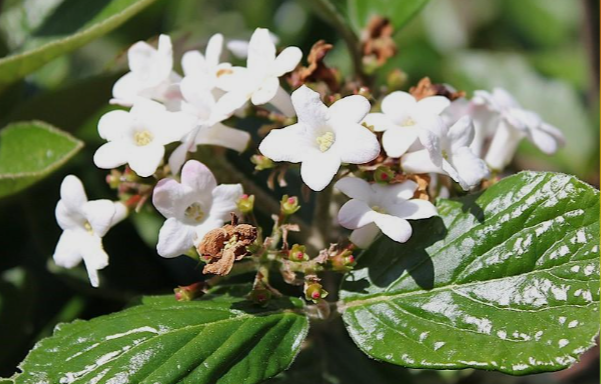
The leaves are the shrub’s main feature. They are opposite, broadly oval, and typically 2 to 4 inches long, with a thick, leathery texture. The upper surface is dark, glossy green and often slightly wrinkled or quilted between the veins, giving the foliage a coarse, rich texture. The undersides are paler, and the edges may have a few shallow teeth near the tip. The leaves stay on the plant year-round, so the shrub looks full and dense in every season.
The flowers appear in late winter to early spring. The University of Georgia Extension describes 2 to 4 inch clusters of small white flowers that follow pinkish-red buds, along with a musty fragrance. The clusters are dense and slightly rounded, and the pink-tinged buds add color for weeks before the flowers open. The flowers attract bees and other pollinators.
The fruit, when it forms, is a small, round berry that ripens to bright red and eventually darkens. Fruit set is often light in cultivated plants, and many hedges produce little or no fruit, especially when sheared regularly. Left unpruned, sandankwa viburnum usually grows 6 to 8 feet tall and wide, sometimes reaching 10 to 12 feet over time. It is often kept at 3 to 6 feet as a clipped hedge.
About That Fragrance
One of the most common questions about sandankwa viburnum concerns the smell of its flowers. Unlike the sweet, spicy fragrance of Koreanspice or Bodnant viburnum, its scent is often described as musty, earthy, or even unpleasant. People are most likely to notice it when many shrubs bloom together in a long hedge. Reactions vary widely. Some gardeners barely notice it, while others find it strong enough to keep the shrub away from doors and windows.
The scent lasts only a few weeks, from late winter into early spring, and is mostly noticeable up close or on warm, still days. If fragrance is a concern, avoid planting large numbers of sandankwa viburnum right beside patios, entrances, or open windows. Shearing the hedge before flowering also removes many of the flower buds and reduces the scent, though it also reduces the spring display and any later fruit.
Also Read: Different Types of Viburnum Shrubs
Sandankwa vs. Sweet Viburnum and Walter’s Viburnum
Sandankwa viburnum is often confused with sweet viburnum, another evergreen widely used for hedging in the South. Sweet viburnum is a much larger plant, easily reaching 15 to 20 feet tall. Its larger, smoother, very glossy leaves lack the wrinkled texture of sandankwa leaves, and its large, airy clusters of white spring flowers carry a sweet fragrance. Sweet viburnum is the better choice for tall screens. Sandankwa viburnum is better for medium hedges, shady sites, and foundation plantings where a smaller, denser plant is needed.
Gardeners who want a native alternative in Florida and the Southeast often consider Walter’s viburnum. It is a native evergreen with much smaller leaves and a finer texture. The University of Florida notes that it has the widest distribution of Florida’s native viburnums and is the one most commonly used in Florida landscapes. Walter’s viburnum supports more native wildlife and handles sun and wet soils well. Sandankwa remains the better option for deep shade and a bold-textured, glossy look.
Landscape Uses
Sandankwa viburnum is best known as a hedge and screen plant. Its dense branching and evergreen foliage create a solid barrier that blocks views and softens walls, fences, and property lines. It responds well to shearing and can be kept as a formal clipped hedge or allowed to grow into a looser informal screen. In foundation plantings, it fills space beneath windows and along the shady north and east sides of buildings, where many other shrubs struggle.
Its shade tolerance makes it valuable in woodland-style gardens, under large shade trees, and in shaded courtyards. It also works well in mixed shrub borders as an evergreen backdrop for flowering perennials and annuals. Because it can be clipped to almost any size, it suits both small urban yards and large commercial landscapes. It is commonly used in parking lot islands, office parks, and residential communities across the South.
Growing Considerations
Sandankwa viburnum is best suited to Zones 8 through 10, and in some protected sites it grows in Zone 11. It handles light frost but can be damaged when temperatures fall into the low 20s °F for long periods. In the colder parts of Zone 8, it may suffer leaf burn or dieback in harsh winters, and it may need a sheltered spot near a building or wall.
Light conditions strongly affect how the shrub looks. The University of Arizona recommends part shade to shade and warns that the foliage may sunburn in summer. In full sun, especially in hot, dry climates, the leaves often yellow, scorch, or bleach. In shade the foliage stays deep green and glossy. Morning sun with afternoon shade, or bright filtered light beneath trees, gives the best results.
The shrub prefers moist, fertile, well-drained soil rich in organic matter. It has limited salt tolerance, so avoid planting it directly on the beachfront or where it will receive salt spray. Water deeply during dry periods, especially in the first 2 years after planting, and spread 2 to 3 inches of mulch over the root zone. Sandankwa viburnum responds well to light fertilizing in spring and summer, which keeps its foliage dark green.
Pruning and Propagation
Sandankwa viburnum tolerates heavy pruning, which is part of what makes it such a useful hedge plant. For a formal hedge, shear it lightly 2 or 3 times during the growing season to keep it dense and tidy. For an informal screen, selectively thin a few of the oldest stems at the base each year to keep it full and vigorous. To enjoy the flowers, do the main pruning after flowering in spring, since the shrub sets next year’s flower buds on growth formed during the summer.
The shrub is easy to propagate. The University of Florida’s plant propagation database notes that it is mainly propagated by semi-hardwood cuttings. Take cuttings 4 to 6 inches long from firm, partly mature shoots in summer. Dip them in rooting hormone and keep them in a warm, humid, shaded spot until roots form. Because cuttings root readily, many gardeners propagate their own plants to extend or repair a hedge.
Pests and Problems
Sandankwa viburnum is generally a tough, low-maintenance shrub, but it has a few common problems in the South. Scale insects, including barnacle scale, can build up on stems and leaves. They weaken the plant and leave sticky honeydew, which leads to black sooty mold. Mites and thrips sometimes cause speckled, faded, or distorted leaves, especially in hot, dry weather. Regular inspections and good plant health go a long way toward preventing these problems.
In the sandy soils of Florida and the Gulf Coast, root-knot nematodes can be a serious issue. They cause stunted growth, yellowing leaves, and general decline. Adding organic matter to sandy soils, mulching well, and watering consistently help plants tolerate nematodes. Excessive sun, drought stress, and poor drainage also contribute to leaf yellowing and dieback. A shady, well-mulched site with steady moisture is the best defense, and there the shrub can remain healthy for decades.
Sources
Stanford University, “Viburnum suspensum: Sandankwa Viburnum”
University of Georgia Extension, Dougherty County, “Sandankwa Viburnum”
University of Florida IFAS, “Walter’s Viburnum”
University of Arizona, “Viburnum suspensum (Sandankwa Viburnum)”