Arrowwood viburnum is one of the toughest and most useful native shrubs in North America. It grows wild from the Atlantic coast to the Great Plains, and it does well in almost any soil a gardener can give it. Its name comes from the straight young stems that Native Americans once cut for arrow shafts. Today it is valued for different reasons: creamy-white flowers in late spring, blue-black fruit that birds strip from the branches each autumn, and fall foliage that turns from yellow to deep burgundy.
Many shrubs come and go with garden fashion. Arrowwood has lasted because it solves real landscape problems. It grows 6 to 10 feet tall and just as wide, takes clay and wet ground, survives winters down to Zone 3, and fills a hedge or screen quickly without constant care. It also has one serious modern weakness, which this guide covers in detail: an invasive beetle that favors it over almost every other viburnum.
Botanical Classification
Arrowwood viburnum is a deciduous, multi-stemmed shrub in the viburnum genus. That genus holds about 150 to 175 species of shrubs and small trees across the Northern Hemisphere and parts of South America. The genus has moved between families several times as botanists have revised its relationships. Older references put it in the honeysuckle family, later references in the moschatel family, and current systems give it its own family, the viburnum family. You will see all three in nursery catalogs and extension fact sheets, which often confuses gardeners comparing sources.
Arrowwood is less a single species than a loosely defined group of closely related plants. Their leaf hairiness, twig texture, and range vary across the continent. Some botanists split the northern, smooth-twigged plants from the southern, hairier ones as separate species. Others treat them as regional forms of one variable shrub. The USDA lists common names for these forms such as southern arrowwood, smooth arrowwood, and roughish arrowwood. For the home gardener, these differences rarely matter, since nursery plants are sold simply as arrowwood viburnum or under a cultivar name.
Brief History
The common name records one of the oldest known uses of the plant. Native peoples across the eastern woodlands valued the shrub’s young shoots, which grow remarkably straight and stiff from the base. They were cut, dried, and shaped into arrow shafts. Few native shrubs produce stems so uniform, which is why this plant got the name and nearby species did not. The same stems were reportedly used for pipe stems and light tools.
Arrowwood came into ornamental use more slowly than showier imported viburnums such as the European cranberrybush and Japanese snowball types. Interest grew in the late 20th century as native-plant landscaping and wildlife gardening became popular. Breeders in Illinois and the upper Midwest then began selecting compact, glossy-leaved forms with stronger fall color. Introductions from programs such as Chicagoland Grows and the Morton Arboretum helped turn a roadside thicket shrub into a standard nursery plant across the northern United States.
Identifying Characteristics
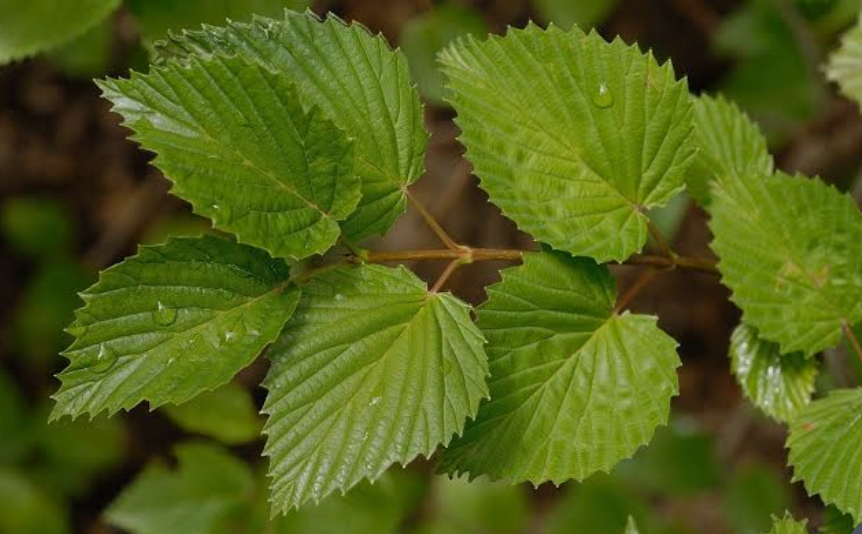
The leaves are the easiest way to identify arrowwood viburnum. They are opposite, oval to nearly round, and about 2 to 4 inches long. The edges have coarse, evenly spaced teeth, which is where the plant’s botanical name for “toothed” comes from. Each leaf has prominent straight veins running from the midrib to the teeth, giving the surface a pleated, ribbed look. In summer the leaves are dark green and often glossy. In autumn they turn yellow, orange, red, or reddish-purple depending on the plant and the season.
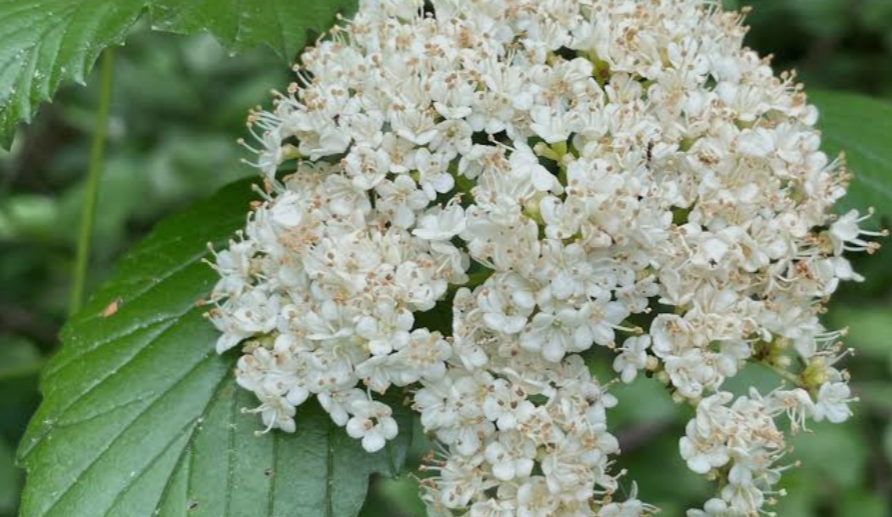
The flowers open in May and June in flat-topped clusters about 2 to 4 inches across, according to the Purdue Arboretum. Each cluster is made of dozens of small creamy-white blooms that give the shrub a frothy, lace-like look in late spring. Unlike some fragrant viburnums, arrowwood flowers have a mildly unpleasant smell that some gardeners notice up close. They are still heavily visited by bees, flies, and small butterflies.
The fruit ripens in late summer and early fall as clusters of round berries about ¼ inch wide. They turn from green to a deep blue-black, often with a slight bloom. Fruit set is much heavier when 2 genetically different plants grow near each other, because a single clone pollinates itself poorly. Older stems have smooth gray-brown bark, and the shrub spreads slowly by suckers from the base. Over many years this forms a dense, rounded clump.
Popular Cultivars
Nursery selections have made arrowwood much more predictable in the garden. The University of Minnesota lists several established cultivars and their traits. ‘Chicago Lustre’ has an upright, rounded shape about 8 to 10 feet tall, with glossy dark leaves that turn a soft red-purple in fall. ‘Northern Burgundy’ is taller at 10 to 12 feet, with burgundy-red autumn color. ‘Autumn Jazz’ has a vase shape and can spread 10 to 12 feet wide.
For smaller gardens, ‘Blue Muffin’ stays around 5 to 7 feet and is known for unusually bright blue fruit. ‘Little Joe’ is a dwarf that stays near 4 feet tall and wide and is often planted to pollinate ‘Blue Muffin’. ‘Red Feather’ produces two-toned maroon and green new growth that looks a bit like the fletching on an arrow, while ‘Cardinal’ and ‘Crimson Tide’ were selected for strong red fall color. Pairing 2 different cultivars is the simplest way to get a heavy fruit crop.
Landscape Uses
Arrowwood viburnum is one of the most versatile native shrubs for screening and hedging. Its dense, multi-stemmed growth fills gaps quickly, and it holds its shape with little pruning. Iowa State University Extension recommends it as an excellent hedge for both sunny and semi-shady sites. Planted 5 to 6 feet apart, a row forms a solid green wall within a few growing seasons.
Because it tolerates wet soil, the shrub also suits rain gardens, stream banks, pond edges, and the low spots where water collects after storms. Its spreading roots help hold soil on slopes and banks. In larger landscapes, it works well massed in naturalized borders, along woodland edges, or as the middle layer between tall trees and low perennials. Its moderate height also makes it useful along foundations, as long as it has room to spread.
Wildlife Value
Few native shrubs support as much wildlife as arrowwood viburnum. The fruit ripens in early fall, just as songbirds begin their southern migration. Bluebirds, catbirds, thrushes, cardinals, robins, cedar waxwings, and woodpeckers all eat it. Arrowwood fruit is relatively high in fat compared with many other fruits, which gives migrating birds the energy they need for long flights. A mature shrub in a yard often has its fruit stripped within days of ripening.
The flowers feed native bees and many beneficial insects in late spring. The foliage hosts the caterpillars of the spring azure butterfly and many native moths, and those caterpillars in turn feed nesting birds. The dense branching gives cover and nesting sites for small songbirds. Deer browse arrowwood less heavily than many ornamental shrubs, but hungry deer will still eat it in hard winters.
Also Read: Different Types of Viburnum Shrubs
Growing Considerations
Arrowwood viburnum is hardy from Zone 3 through Zone 8, which covers most of the continental United States. It grows at a moderate rate in full sun to partial shade. It flowers and fruits best with at least 6 hours of direct sun a day, and plants in deep shade grow looser and produce far fewer berries. The shrub tolerates clay, loam, sand, wet sites, and a fairly wide pH range. Very alkaline soils can cause some leaf yellowing.
Plant container shrubs in spring or early fall and water them regularly through the first full growing season while the roots establish. A 2 to 3 inch layer of mulch over the root zone helps keep soil moist and cool. Once established, arrowwood handles short droughts well and rarely needs fertilizer, except in poor soil. Prune right after flowering if needed by removing about one third of the oldest stems at ground level, which renews the shrub without losing next year’s blooms. Cut back unwanted root suckers to keep the clump from spreading where it is not wanted.
Pests and Problems
The biggest threat to arrowwood viburnum is the viburnum leaf beetle, an invasive insect from Europe first recorded in North America in 1947. According to UMass Amherst, the beetle feeds only on viburnums, and arrowwood is among the species it attacks most heavily. Larvae hatch in spring and skeletonize the young leaves. Adults then feed again in mid to late summer. Repeated heavy infestations can defoliate a shrub, cause dieback, and kill it within 2 or 3 years.
The most effective control starts in winter. Look along the undersides of the past season’s twigs for rows of small, capped egg sites, and prune out and destroy infested twigs before the eggs hatch in spring. In spring, check new leaves closely for small yellowish larvae, which are easiest to control while they are young. Gardeners in areas with established beetle populations sometimes choose more resistant viburnums instead. Outside the beetle’s range, arrowwood has few serious problems beyond occasional leaf spot, powdery mildew, and mites, which NC State Extension notes as a possible issue.
Sources
Purdue University Arboretum, “Arrowwood Viburnum”
University of Minnesota, “Arrowwood”
Iowa State University Extension and Outreach, “Viburnums for Iowa” (RG 705)
UMass Amherst Landscape, Nursery and Urban Forestry Program, “Viburnum Leaf Beetle”
NC State Extension Gardener Plant Toolbox, “Arrowwood Viburnum”