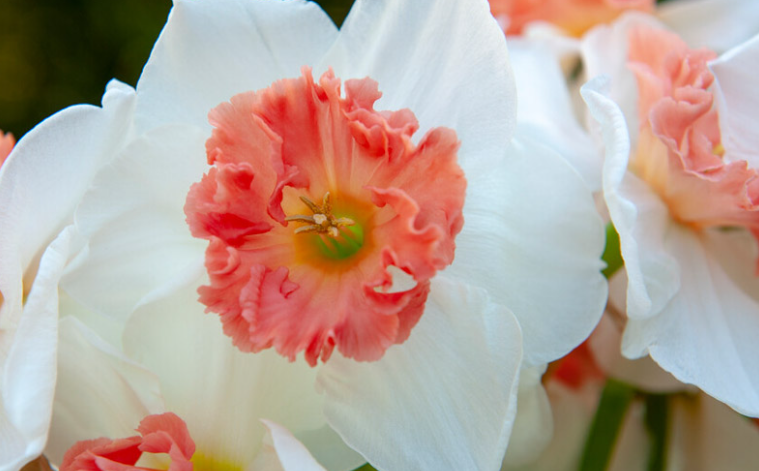
Large-cupped daffodils are some of the flowers I find easiest to appreciate in a spring garden. They have the familiar six-petaled daffodil shape, but the central cup is noticeably larger than you see on small-cupped varieties, giving each flower a more substantial and almost perfectly balanced appearance. When several are planted together, the flowers create a strong spring display without looking overly formal, which is one reason I keep coming back to this group when choosing bulbs.
The name comes from the official horticultural classification rather than simply the overall size of the flower. The Royal Horticultural Society places Large-Cupped Daffodils in Division 2. Each stem carries a single flower, and the corona, or cup, is more than one-third but shorter than the surrounding perianth segments. This creates the characteristic look: a prominent central cup that is substantial enough to catch your eye but still clearly shorter than the petals.
What I particularly enjoy about Division 2 daffodils is the range hidden within that simple definition. Some have bright yellow petals and matching cups, while others combine white petals with yellow, orange, pink or red cups. There are also varieties with softly fading colors and beautifully frilled cup edges. In this guide, I’ll look at 15 Large-Cupped Daffodils worth considering, along with practical ideas for using them in borders, lawns, containers and naturalized plantings.
What Are Large-Cupped Daffodils?
Large-Cupped Daffodils are Division 2 daffodils in the international horticultural classification system. They produce one flower per stem, with a corona that measures at least one-third of the length of the surrounding perianth segments but is shorter than them.
That proportion is what separates them from the two neighboring divisions. Trumpet Daffodils in Division 1 have a corona as long as or longer than the petals, while Small-Cupped Daffodils in Division 3 have a corona no more than one-third as long as the petals. Large-Cupped Daffodils sit neatly between the two.
For gardeners, however, the distinction is more than a technical classification. The large cup gives these daffodils a particularly recognizable appearance. The cup may be rounded, funnel-shaped, flared, frilled or gently ruffled, and its color can contrast strongly with the petals.
15 Large-Cupped Daffodils to Grow
1. Ice Follies
‘Ice Follies’ is one of the Large-Cupped Daffodils I would recommend when you want a flower that looks elegant without becoming fussy. It produces broad, overlapping creamy-white petals around a widely flared primrose-yellow cup. As the flower matures, that yellow cup fades toward white, giving the bloom a softer appearance. The RHS lists flowers around 9 cm wide and plants reaching approximately 40 cm tall.
I particularly like this kind of color transition because it means the flowers do not look exactly the same throughout their display. Early blooms have more contrast, while older flowers become much paler. ‘Ice Follies’ is also useful in mixed borders, containers and underplanting around shrubs, and the RHS lists it as an Award of Garden Merit cultivar.
2. Carlton
If you prefer the traditional golden appearance of daffodils, ‘Carlton’ is difficult to overlook. This reliable Large-Cupped Daffodil has bright yellow perianth segments surrounding a somewhat paler yellow trumpet-like cup. The difference between the two yellows is subtle, but it gives the flower more depth than a completely uniform bloom.
This is the sort of daffodil I would use when I want a planting to feel abundant rather than overly curated. Groups of ‘Carlton’ work well through borders, beneath deciduous shrubs and in grassy areas. The RHS also includes it among established cultivars suitable for naturalizing in taller grass.
3. Salome
‘Salome’ is one of the most beautiful examples of how sophisticated a Large-Cupped Daffodil can look. It produces broad cream-colored petals surrounding a cup that opens yellow and gradually fades toward peach-pink. The flowers can reach around 9 cm across, making them noticeable without feeling oversized.
This gradual color change is what makes ‘Salome’ particularly appealing to me. Rather than the strong yellow associated with traditional daffodils, it introduces warmer, softer tones that work beautifully with pastel spring planting. It is a good choice for cottage gardens, mixed borders and informal plantings where you want the daffodils to blend rather than dominate.
4. Pink Charm
‘Pink Charm’ is an excellent variety for gardeners who want to move beyond yellow daffodils. Its creamy-white flowers are around 7 cm across, with a cream-colored trumpet prominently edged in salmon-pink. It flowers in mid-spring and can reach approximately 50 cm tall.
I would use this variety where the garden already contains soft pink, white or peach tones. The pink edge around the cup is subtle enough to remain elegant, but noticeable enough to make the flower different from the usual yellow daffodil. It can also be particularly attractive when planted in groups rather than as isolated bulbs.
Also Read: Different Types of Daffodils
5. New World
‘New World’ is another Large-Cupped Daffodil with a softer color palette. The RHS International Daffodil Register describes its pale lemon-yellow petals surrounding a deep bowl-shaped primrose-yellow corona that becomes flushed with pink, particularly toward the rim. It is classified as a mid-season Division 2 cultivar.
The pink coloration gives this variety a more delicate personality than the standard yellow daffodil. I would place it somewhere where you can see the flowers up close, because details such as the changing cup color and frilled rim are easy to miss when the bulbs are planted too far away.
6. Adamant
‘Adamant’ is an older but particularly interesting Division 2 cultivar. Its flowers can reach around 10 cm across, with broadly shaped brilliant greenish-yellow perianth segments surrounding a darker yellow corona that becomes strongly flushed with orange toward the mouth. The cup itself has a slightly frilled and notched rim.
What appeals to me about ‘Adamant’ is the stronger contrast between the outer flower and the central cup. It has enough visual weight to hold its own in a spring border, particularly when planted in groups. For gardeners interested in historic or unusual daffodils, it is also a cultivar with a long recorded history and multiple horticultural awards.
7. Spring Dawn
‘Spring Dawn’ is a good example of the classic Large-Cupped form: one flower per stem with a central cup that is substantial but remains shorter than the surrounding petals. The RHS specifically describes Division 2 flowers in these terms and lists ‘Spring Dawn’ within the group.
I think varieties like this are particularly useful when you are designing a mixed daffodil planting. A Large-Cupped cultivar can sit comfortably between the dramatic presence of a trumpet daffodil and the more restrained appearance of a small-cupped variety, giving the planting some visual variation.
8. Camilla Duchess of Cornwall
‘Camilla Duchess of Cornwall’ belongs to Division 2 and demonstrates how varied Large-Cupped Daffodils can be even within the same classification. The RHS lists it as a solitary-flowered Large-Cupped Daffodil and notes that the defining cup proportion places it within the group.
I would consider this type when building a collection rather than simply filling a border with one cultivar. Mixing named varieties allows you to create differences in color, flower shape and flowering period while maintaining the consistent overall character of Division 2.
9. Interim
‘Interim’ is another Division 2 cultivar that fits well into the practical gardener’s collection. Like other Large-Cupped Daffodils, it produces a solitary flower with a cup at least one-third but less than the full length of the surrounding perianth segments.
One reason I like having several cultivars rather than relying on one is that spring weather is unpredictable. Different varieties can respond differently to the season, and a mixed planting tends to give you a longer and more varied display. ‘Interim’ can also be grown in borders, containers and informal garden settings.
10. Sacajawea
‘Sacajawea’ is a versatile Division 2 daffodil that the RHS lists for a wide range of garden situations, including borders, containers, banks, slopes and underplanting around roses and shrubs. It prefers moderately fertile, well-drained soil that remains moist during its growing season.
That range of possible uses is useful if you are not working with a large garden. I would particularly consider a variety such as this for planting around shrubs or in areas that need an early-season layer of color before the surrounding plants fully develop their foliage.
11. Johann Strauss
‘Johann Strauss’ is another Large-Cupped Daffodil that can be used in a surprisingly wide range of garden settings. The RHS recommends it for borders, containers, cottage and informal gardens, banks, slopes, cut-flower areas and underplanting around shrubs.
This versatility is one of the strengths of Division 2 daffodils generally. They are formal enough to look good in a carefully designed border but natural enough to disappear into a loose planting. If I were planning a spring display from scratch, I would take advantage of that flexibility rather than restricting them to one part of the garden.
12. Fortune
‘Fortune’ has the classic structure expected from a Large-Cupped Daffodil, with a solitary flower and a corona that falls between the proportions of trumpet and small-cupped forms. The RHS lists it as a Division 2 cultivar and recommends it for borders, containers, informal gardens, banks, slopes and cut-flower use.
For me, this is exactly where the Division 2 classification becomes useful to gardeners. Once you understand the basic flower shape, you can start choosing varieties based on color and garden purpose rather than simply buying whatever daffodil happens to be available at the local garden center.
13. Penkivel
‘Penkivel’ is a Division 2 cultivar suited to both formal and informal garden situations. The RHS recommends it for containers, city gardens, cottage gardens, banks, slopes, borders and cut flowers, and notes that it prefers moderately fertile, well-drained soil that stays moist during the growing season.
I particularly like using Large-Cupped Daffodils in containers because the flowers can be brought closer to eye level. In the ground, their central cups can sometimes disappear into a mass of flowers, whereas a container allows you to appreciate the individual shape of each bloom.
14. Kate Davies
‘Kate Davies’ is another recognized Large-Cupped Daffodil, suitable for borders, containers, city and courtyard gardens, banks, slopes and informal plantings. The RHS also lists it for cut flowers and underplanting around roses and shrubs.
Its versatility makes it a useful example of why daffodils should not be thought of as plants that belong only in traditional flower beds. A few carefully positioned containers, a drift beneath deciduous shrubs or a loose planting through a slope can all make good use of the same general flower form.
15. Broomhill
‘Broomhill’ is a Division 2 cultivar with the characteristic large cup that defines this group. The RHS recommends it for cottage and informal gardens, containers, coastal gardens, banks, slopes, borders and cut-flower use.
I would particularly consider it when creating a relaxed, natural-looking spring planting. Large-Cupped Daffodils can look surprisingly natural when planted in groups through grass or beneath deciduous trees, especially when the bulbs are allowed to establish and multiply over several seasons.
Large-Cupped vs. Trumpet Daffodils
The easiest way to tell these two groups apart is to look at the length of the central corona.
Trumpet Daffodils are Division 1, and their trumpet is as long as or longer than the surrounding petals. Large-Cupped Daffodils are Division 2, and their cup is more than one-third but shorter than the petals.
In the garden, the difference is quite noticeable. Trumpet varieties tend to have a more dramatic central structure, while Large-Cupped varieties usually have a better visual balance between petals and cup. If you want a classic daffodil silhouette without the trumpet dominating the flower, Division 2 is an excellent place to look.
Large-Cupped vs. Small-Cupped Daffodils
Small-Cupped Daffodils belong to Division 3, where the corona is no more than one-third the length of the surrounding perianth segments. Large-Cupped Daffodils have a much more prominent central cup.
The choice often comes down to the effect you want. Large cups create stronger focal points, while small cups tend to give the flower a more open, petal-dominated appearance. I like combining the two because the difference in flower proportions adds variety without making the planting feel disconnected.
How to Grow Large-Cupped Daffodils
Large-Cupped Daffodils are generally straightforward bulbs to grow. Choose a location with full sun or light shade and soil that drains well. The RHS notes that Division 2 cultivars tolerate a range of soils but generally prefer moderately fertile, well-drained soil that remains moist during the growing season.
Plant the bulbs in fall, following the depth recommended for the particular cultivar or bulb size. Good drainage is particularly important because bulbs sitting in consistently waterlogged soil are more likely to suffer problems.
Once the flowers fade, remove the spent flower heads if you want the planting to look tidy, but resist the temptation to cut down the green leaves. Allowing the foliage to die back naturally gives the bulb time to replenish its energy for the following season. The RHS specifically recommends deadheading faded flowers while allowing the leaves to die down naturally.
Where to Plant Large-Cupped Daffodils
Flower Borders
This is probably the most obvious use for Large-Cupped Daffodils. Plant them in groups toward the middle or front of a spring border, depending on the mature height of the cultivar.
Their relatively large flowers make them excellent companions for emerging perennials, early tulips and other spring bulbs.
Lawns and Grass
Large-Cupped Daffodils can also be naturalized in grass. The RHS specifically notes that many larger trumpet and Large-Cupped Daffodil hybrids naturalize well, with established cultivars including ‘Carlton’.
For a natural effect, avoid planting them in perfectly straight lines. Small groups scattered through grass can look much more convincing, particularly beneath deciduous trees.
Containers
Containers are an excellent way to enjoy the flowers close to the house. This is especially useful for varieties with interesting cup colors, such as ‘Salome’ or ‘Pink Charm’, where you may want to examine the flowers more closely.
Use a container with adequate drainage and combine the daffodils with other spring plants that will remain attractive after the daffodil foliage begins to fade.
Under Shrubs and Roses
Large-Cupped Daffodils can provide an early layer of color beneath shrubs before the shrubs develop their full summer foliage. The RHS lists several Division 2 cultivars for underplanting around roses and shrubs.
This is one of my favorite ways to use spring bulbs because the daffodils occupy space during a season when the rest of the planting can look surprisingly bare.
When Do Large-Cupped Daffodils Bloom?
Large-Cupped Daffodils generally flower during spring, but the exact timing depends on the cultivar and growing conditions. Some varieties flower earlier while others are mid- or late-season.
Rather than trying to make every bulb flower at exactly the same time, I prefer combining cultivars with different flowering periods. This gives the garden a more extended spring display and means you are less dependent on one particular week of good weather.
Do Large-Cupped Daffodils Come Back Every Year?
Yes. Daffodils are bulbous perennials, and established plants can return year after year when grown in suitable conditions. They are one of the reasons I consider daffodils such good long-term garden plants: once the bulbs are established, they can provide spring color without needing to be replanted every year.
With time, some bulbs produce offsets and form larger clumps. If a group becomes crowded and flowering declines, the offsets can be lifted and separated as the foliage dies back, then replanted.
Are Large-Cupped Daffodils Good for Naturalizing?
Many are. Large-Cupped Daffodils can be particularly effective when planted through grass, beneath deciduous trees or in informal areas where a natural appearance is desired. The RHS specifically identifies many larger trumpet and Large-Cupped hybrids as good candidates for naturalizing.
The trick is patience. A naturalized planting rarely looks impressive immediately after planting. Give the bulbs several seasons to establish, multiply and settle into the landscape, and the display can become much more convincing.
Final Thoughts
Large-Cupped Daffodils occupy a particularly useful place between the dramatic trumpet forms and the more understated small-cupped varieties. Their central cups are large enough to give the flowers character, but short enough to maintain a pleasing balance with the petals. That makes Division 2 one of the easiest groups to recommend when you want daffodils that are both noticeable and versatile.
What I like most is the sheer variety within the group. ‘Carlton’ provides the familiar golden spring look, ‘Ice Follies’ offers creamy white flowers with a fading yellow cup, ‘Salome’ introduces peach-pink tones, and ‘Pink Charm’ brings salmon-pink edging into the picture. These differences may seem small on paper, but when the flowers are growing together in a garden, they can completely change the character of the planting.
If you are choosing Large-Cupped Daffodils for your own garden, I would not plant just one variety unless you specifically want a uniform display. Try combining two or three cultivars with different colors or flowering periods. Plant them in generous groups, give the bulbs well-drained soil and plenty of light, and allow the foliage to fade naturally after flowering. With relatively little effort, you can create a spring display that becomes more impressive as the bulbs establish over the years.
Further References
- Iowa State University Extension — All About Daffodils
Useful for explaining the diversity of daffodils, flower structure, cultivar characteristics, and the 13-division classification system. It specifically describes Division II large-cupped daffodils and how their coronas differ from other divisions. - University of Missouri Extension — Spring Flowering Bulbs: Daffodils
A strong horticultural reference covering daffodil anatomy, classification, planting, growing conditions, and the defining characteristics of large-cupped narcissi. - Missouri Botanical Garden — Narcissus ‘American Lakes’
Particularly useful for an individual large-cupped cultivar. It provides details on flower color, height, bloom time, hardiness, soil, sunlight, watering, and landscape uses. - Missouri Botanical Garden — Narcissus ‘Premiere’
Useful for supporting descriptions of a Division II cultivar, including its greenish-yellow petals, orange cup, mature height, flowering period, growing requirements, and garden uses. - New York Botanical Garden — Identifying Daffodils
An excellent reference for identifying daffodil divisions based on flower structure. Its Division 2 description explains that the large cup is more than one-third but less than the full length of the perianth segments. - American Daffodil Society — Daffodil Divisions and Cultivars
Useful for verifying the official characteristics of Division 2 and for researching named large-cupped cultivars. It explains the relationship between the corona and petals used in the classification.