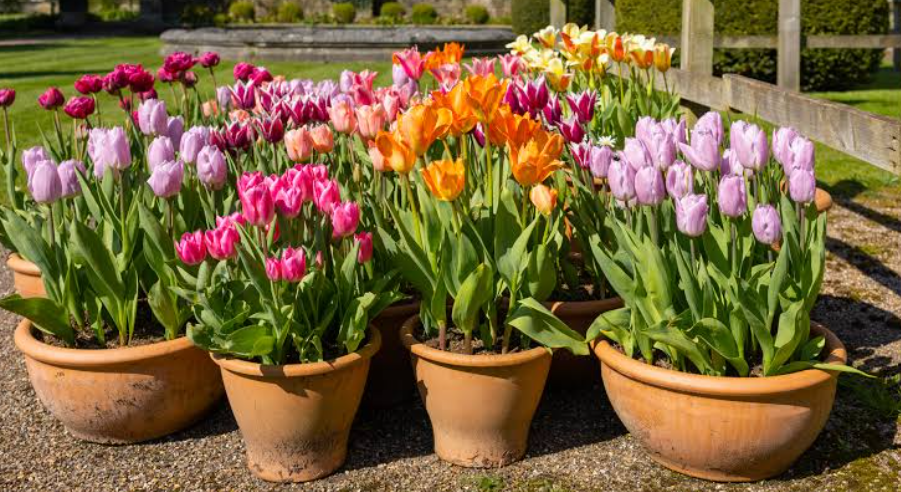
Tulips are often treated as short-term spring flowers, but some can do much more than produce a single season of color. Under suitable conditions, certain tulips can naturalize, meaning they remain in the ground, return in subsequent years, and may gradually produce offsets or increase into larger groups.
This is an important distinction because not every tulip naturalizes equally well. Many highly bred modern tulips are selected for enormous flowers and strong first-year displays rather than long-term persistence. Species tulips and several older hybrid groups tend to be better choices for gardeners who want bulbs that can remain undisturbed.
The American Hemerocallis Society notes that species tulips can be especially good candidates for naturalizing, while Iowa State University Extension recommends species tulips, Darwin Hybrids, Fosteriana types, and several other groups for longer-term performance.
Naturalizing also depends heavily on the site. Tulips generally perform best in sunny, well-drained locations where the bulbs can experience the appropriate seasonal conditions. If soil remains wet during dormancy or the foliage is removed too early, even a naturally persistent variety may gradually decline.
Here are 15 tulips worth considering for a naturalizing garden.
1. Tulipa tarda
Type: Species tulip
Flower color: Yellow and white
Height: About 4–6 inches
Tulipa tarda is one of the best-known naturalizing tulips. Unlike the large, solitary flowers of many modern hybrids, it produces clusters of small star-shaped flowers.
The petals are yellow toward the center and white toward their outer portions, creating a distinctive two-tone effect.
Its short stature makes it excellent for rock gardens, gravel beds, the front of borders, and areas beneath deciduous shrubs.
Given good drainage and plenty of sunlight, T. tarda can remain in the ground and gradually form attractive colonies.
2. Tulipa clusiana
Type: Species tulip
Flower color: White with pink or red exterior
Height: About 8–12 inches
Tulipa clusiana is sometimes called the Lady tulip. It has narrow, elegant flowers that look quite different from the rounded blooms of conventional garden tulips.
The outer petals often have pink, red, or purplish coloring, while the inside is much paler.
It is particularly attractive in informal plantings where the bulbs can spread naturally rather than being dug up after flowering.
3. Tulipa sylvestris
Type: Species tulip
Flower color: Yellow
Height: About 10–14 inches
Known as the woodland tulip, Tulipa sylvestris has a delicate appearance and is well suited to naturalistic plantings.
The yellow flowers are often fragrant and appear above relatively slender foliage.
Unlike highly formal tulip displays, this species can look at home among grasses, open woodland plantings, and informal perennial borders.
It can spread through underground offsets and is capable of forming colonies under suitable conditions.
4. Tulipa linifolia
Type: Species tulip
Flower color: Scarlet red
Height: About 4–8 inches
Tulipa linifolia is a small but intensely colored species tulip.
Its bright red flowers open widely in sunshine, revealing dark centers that contrast with the petals.
The plant’s short stature makes it useful in rock gardens and other locations where taller tulips would look out of place.
It is a good example of why species tulips can be so valuable for naturalizing: they often retain a relatively compact and less heavily modified growth habit.
5. Tulipa bakeri ‘Lilac Wonder’
Type: Species tulip
Flower color: Lilac-pink with yellow center
Height: About 4–6 inches
‘Lilac Wonder’ is a particularly charming low-growing tulip.
Its soft lilac-pink petals surround a contrasting yellow center, producing a surprisingly bright display despite the plant’s small size.
It is useful for rock gardens, gravel gardens, raised beds, and naturalized drifts.
Its compact habit also makes it easier to combine with other small spring bulbs.
6. Tulipa batalinii
Type: Species tulip
Flower color: Yellow, cream, or soft shades depending on cultivar
Height: About 6–10 inches
Tulipa batalinii is a lesser-known species that deserves attention from gardeners interested in long-term bulb displays.
It produces relatively delicate flowers and narrow foliage, giving it a more understated appearance than large hybrid tulips.
Several cultivars are available, with flowers ranging from pale yellow to cream and other subtle shades.
Its natural appearance makes it especially suitable for informal bulb plantings.
7. Tulipa humilis
Type: Species tulip
Flower color: Pink, purple, red, or related shades
Height: About 4–8 inches
Tulipa humilis is a small species tulip with considerable variation in flower color.
Its low-growing habit makes it particularly useful in rock gardens and at the front of borders.
The flowers can open widely in bright sunlight, creating a star-like appearance.
Because it remains relatively close to the ground, it can be planted among low-growing perennials without becoming visually dominant.
8. Tulipa kaufmanniana ‘Showwinner’
Type: Kaufmanniana hybrid
Flower color: Red
Height: About 8–12 inches
‘Showwinner’ is a Kaufmanniana tulip selected for its vivid red flowers.
Kaufmanniana tulips are sometimes called water-lily tulips because their flowers can open broadly in sunlight.
They are early flowering and generally shorter than Darwin Hybrids, making them useful in natural-looking spring plantings.
The RHS includes Kaufmanniana tulips among groups with good potential for returning in the garden.
9. Tulipa kaufmanniana ‘Giuseppe Verdi’
Type: Kaufmanniana
Flower color: Yellow and red
Height: About 8–12 inches
‘Giuseppe Verdi’ combines yellow flowers with red markings.
Its early flowering period makes it valuable for starting a naturalized tulip display before taller varieties begin flowering.
Planting it among other low-growing bulbs can create a layered early-spring scene rather than a formal row of tulips.
10. Tulipa fosteriana ‘Purissima’
Type: Fosteriana
Flower color: White
Height: About 16–20 inches
‘Purissima’ is a well-known Fosteriana tulip with large white flowers.
Although it is considerably larger than many species tulips, it is still regarded as one of the better choices for repeat performance.
Fosteriana tulips are among the groups commonly recommended for perennializing because their bulbs can remain productive for multiple seasons under favorable conditions.
The large white flowers make ‘Purissima’ particularly useful when naturalizing beneath deciduous trees or among early spring perennials.
11. Tulipa fosteriana ‘Juan’
Type: Fosteriana
Flower color: Orange-red and yellow
Height: About 10 inches
‘Juan’ provides a much warmer color combination than ‘Purissima’.
Its orange-red flowers have yellow coloring toward the base, while its foliage can provide additional interest before and after flowering.
The cultivar is relatively short, so it works particularly well in informal beds where large tulips would overwhelm the surrounding plants.
12. Tulip ‘Apeldoorn’
Type: Darwin Hybrid
Flower color: Red
Height: About 20–30 inches
Naturalizing tulips are not limited to tiny botanical species.
Darwin Hybrids are among the best large-flowered tulips for repeat performance. ‘Apeldoorn’ is a classic example.
Its tall stems and large red flowers make it useful for large drifts and broad garden beds.
Iowa State University Extension lists ‘Apeldoorn’ among Darwin Hybrid tulips suitable for perennial performance.
For gardeners who want the visual impact of traditional tulips without completely sacrificing long-term performance, Darwin Hybrids can be a useful compromise.
13. Tulip ‘Pink Impression’
Type: Darwin Hybrid
Flower color: Pink
Height: About 20–24 inches
‘Pink Impression’ produces large rose-pink flowers on sturdy stems.
Its height allows it to form a strong middle or back layer in a naturalized bulb planting.
It can be combined with white, purple, yellow, and other spring bulbs to create a succession of colors.
Like other Darwin Hybrids, it is generally a better candidate for repeat performance than many highly specialized tulip cultivars.
14. Tulip ‘Golden Parade’
Type: Darwin Hybrid
Flower color: Yellow
Height: About 20–24 inches
‘Golden Parade’ adds bright yellow to the naturalizing tulip palette.
Its large flowers stand out strongly against green foliage and are particularly attractive when planted in groups.
Yellow Darwin Hybrids can also provide a useful visual bridge between tulips and other late-spring flowers.
15. Tulip ‘Red Riding Hood’
Type: Greigii
Flower color: Red
Height: About 8–12 inches
‘Red Riding Hood’ is a compact Greigii tulip with bright red flowers and attractive foliage.
Greigii tulips are generally shorter than Darwin Hybrids, making them suitable for rock gardens, front borders, and containers.
Their foliage often features attractive markings, which means the plant can provide ornamental value even before the flowers open.
What Does It Mean When a Tulip Naturalizes?
Naturalization is more than simply leaving tulip bulbs in the ground.
A naturalizing bulb should be capable of surviving, flowering again, producing offsets, and gradually establishing itself in an appropriate location.
Some tulips may return for several years without noticeably multiplying. Others can gradually create larger clumps.
This means that “naturalizing” does not necessarily mean a tulip will spread rapidly across an entire garden.
The result depends on the variety, soil, climate, moisture, sunlight, competition from surrounding plants, and how the bulbs are managed after flowering.
Species Tulips vs. Hybrid Tulips
The distinction between species and hybrid tulips is important when selecting bulbs for naturalization.
Species Tulips
Species tulips are generally closer to wild tulip species. Many are relatively short and produce smaller flowers.
Examples include:
- Tulipa tarda
- Tulipa clusiana
- Tulipa sylvestris
- Tulipa linifolia
- Tulipa humilis
- Tulipa batalinii
They are often excellent choices for informal, natural-looking plantings.
Hybrid Tulips
Hybrid tulips are selected for particular characteristics such as large flowers, unusual colors, height, or flowering time.
Some groups, particularly Darwin Hybrids, Fosteriana, Greigii, and Kaufmanniana, can perform well over multiple years.
However, not every cultivar within these groups will naturalize equally well.
Why Some Tulips Naturalize Better Than Others
Tulip longevity is strongly influenced by genetics.
Many modern tulips have been bred primarily for dramatic flowers. Their bulbs may produce an exceptional first-year display but become weaker in subsequent years.
Species tulips often have a different growth strategy. Their smaller flowers require fewer resources, and some are naturally adapted to surviving and multiplying in conditions that resemble their native habitats.
This is one reason gardeners interested in naturalization frequently turn to botanical tulips.
The University of Maryland Extension lists species tulips among the most reliable choices for long-term performance, while Iowa State Extension identifies species tulips, Darwin Hybrids, and Fosteriana types as useful perennializing groups.
How to Naturalize Tulips Successfully
Choosing the right variety is only the first step. The planting site can determine whether your tulips naturalize or gradually disappear.
Plant in Full Sun
Most naturalizing tulips perform best with plenty of sunlight.
A sunny location allows the foliage to manufacture the energy needed to replenish the bulbs after flowering.
For woodland-style plantings, deciduous trees can work particularly well because they allow sunlight through in early spring before their leaves fully develop.
Give Them Well-Drained Soil
Good drainage is critical.
Tulip bulbs dislike sitting in saturated soil, particularly during dormancy.
If the soil is heavy clay, consider improving drainage or planting bulbs in raised areas rather than locations where water collects.
Plant at the Correct Depth
Planting too shallow can expose bulbs to temperature fluctuations and other problems.
As a general rule, bulbs are often planted at approximately two to three times their own height, although recommendations vary according to species, soil, and climate.
Always check the instructions supplied with the particular bulbs.
Leave the Bulbs Undisturbed
Naturalizing requires patience.
If bulbs are dug up every year, they cannot establish a permanent colony.
Choose a location where they can remain in place for several seasons.
Allow the Leaves to Mature
This is one of the most important rules.
After flowering, tulip foliage continues to photosynthesize and send energy back into the bulb.
Do not cut or braid the leaves immediately after flowering.
Wait until the foliage has turned yellow and naturally begun to die back.
Remove Spent Flowers
Deadheading can help prevent the plant from putting unnecessary energy into seed production.
Cut off the faded flower head while leaving the leaves intact.
Avoid Excess Summer Water
Many tulips prefer a relatively dry dormant period.
If irrigation is necessary for surrounding plants, avoid keeping the tulip planting constantly saturated.
Where to Naturalize Tulips
The best location depends on the type of tulip.
Beneath Deciduous Trees
This is particularly effective for species tulips.
They can receive sunlight early in spring before the tree canopy becomes dense.
Rock Gardens
Small species such as T. tarda, T. humilis, and T. linifolia are excellent candidates for rock gardens.
Meadow-Style Plantings
Species tulips can be mixed with other low-growing spring bulbs to create a more informal appearance.
Perennial Borders
Darwin Hybrid and Fosteriana tulips can be incorporated into perennial borders where their flowers rise above emerging foliage.
Gravel Gardens
Sharp drainage makes gravel gardens particularly suitable for many botanical tulips.
Naturalizing Tulips in Containers
Naturalizing in containers is more challenging than naturalizing in the ground.
Containers are exposed to greater temperature fluctuations, and the soil can become excessively wet or dry.
If attempting it, use a container with drainage holes and a well-draining growing medium.
Small species tulips are generally more practical than large hybrids.
Once the foliage has died back, allow the container to enter a relatively dry dormant period while ensuring the bulbs are not exposed to extreme conditions beyond their tolerance.
Do Naturalized Tulips Multiply Every Year?
Not necessarily.
Some bulbs produce offsets relatively readily, while others mainly replace themselves.
A successful naturalized planting may therefore look almost unchanged for several years before gradually becoming denser.
This is normal.
Environmental conditions can also affect multiplication. A tulip growing in poor soil, excessive shade, or wet conditions may survive without producing enough energy to form many offsets.
The Best Naturalizing Tulips for Different Situations
Best for Rock Gardens
Tulipa tarda, Tulipa humilis, and Tulipa linifolia are excellent choices because of their compact size.
Best for Woodland-Style Gardens
Tulipa sylvestris and Tulipa clusiana can create a more natural appearance.
Best for Large Flower Displays
‘Apeldoorn’, ‘Pink Impression’, and ‘Golden Parade’ provide the larger flowers associated with traditional tulip gardens.
Best for Early Color
Kaufmanniana and Fosteriana types are excellent choices.
Best for a Traditional Tulip Appearance
Darwin Hybrids offer large flowers, tall stems, and relatively good repeat performance.
Naturalizing Tulips vs. Perennializing Tulips
The terms are related but not always identical.
A perennializing tulip is one that has a reasonable ability to return and flower again in subsequent seasons.
A naturalizing tulip goes a step further by establishing itself in a location and potentially increasing in number.
A tulip can therefore return reliably without spreading significantly.
If your goal is to create expanding colonies, species tulips are generally among the best options to investigate.
A Simple Naturalizing Tulip Design
For a natural-looking spring display, consider combining different heights.
Plant Tulipa tarda and Tulipa humilis toward the front of a bed.
Behind them, add Kaufmanniana or Fosteriana tulips.
Further back, use Darwin Hybrids such as ‘Apeldoorn’ or ‘Pink Impression’.
The result is a layered planting in which small botanical tulips emerge first, followed by progressively taller varieties.
You can also mix tulips with other spring bulbs such as crocuses, daffodils, ornamental onions, and grape hyacinths.
How Long Can Naturalized Tulips Last?
There is no universal number of years.
A naturalizing tulip may perform for many seasons when it receives suitable conditions, while another planting may decline after only a few years.
The most important factors are:
- Genetics of the cultivar
- Quality of the bulbs
- Sunlight
- Soil drainage
- Climate
- Summer moisture
- Post-flowering care
- Competition from other plants
The goal should therefore be to create conditions that allow the bulbs to replenish themselves rather than expecting a particular number of years from every variety.
Choosing Tulips for a Permanent Spring Display
If your main objective is a spring garden that becomes more established over time, species tulips should be at the top of the list. Tulipa tarda, T. clusiana, T. sylvestris, T. linifolia, and T. humilis offer the natural appearance and relatively compact growth that make botanical tulips particularly valuable for this purpose.
For gardeners who want larger, more traditional tulip flowers, Darwin Hybrids and Fosteriana tulips provide a useful alternative. They may not spread as aggressively as some species, but several cultivars can return for multiple seasons when planted in suitable conditions.
The key is to think of naturalization as a long-term planting strategy rather than a guarantee. Choose varieties with a reputation for persistence, plant them where drainage and sunlight are favorable, leave the foliage intact after flowering, and give the bulbs several seasons to establish. Over time, the result can be a spring display that looks less like a freshly planted flower bed and more like a permanent part of the landscape.