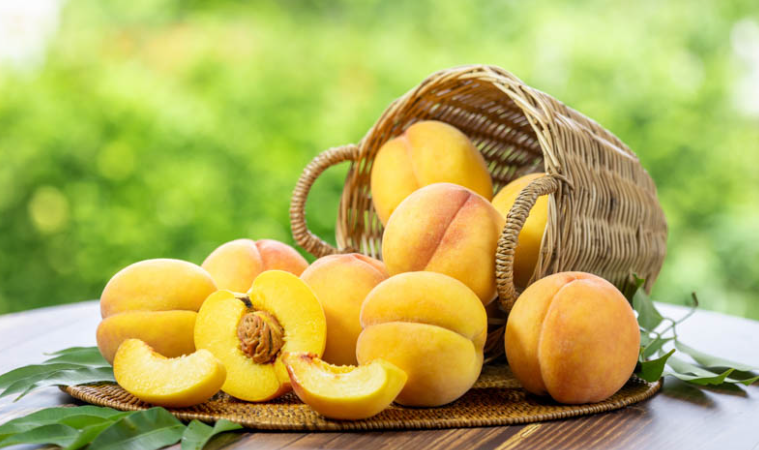
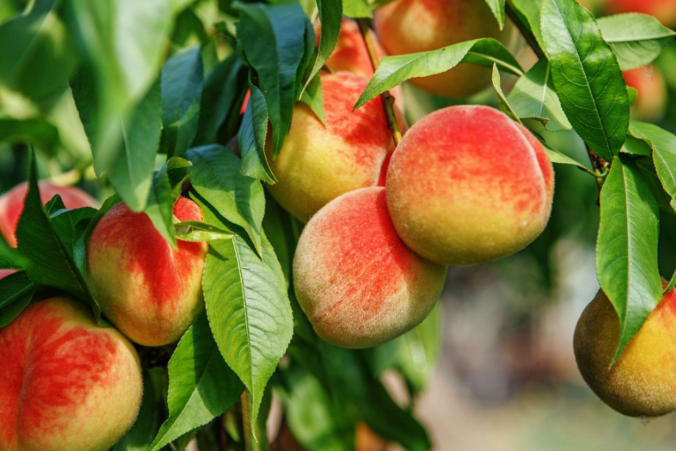
Peaches are a beloved summer fruit known for their round shape, soft fuzzy skin, and juicy, fragrant flesh. They grow on deciduous trees that thrive in temperate climates with warm summers and cool winters, producing fruit that ripens from a firm green stage to a soft, golden-orange color with red blushing. Inside, a peach holds a single large, deeply grooved pit at its center, surrounded by tender flesh.
Peach trees typically begin bearing fruit within a few years of planting and can produce a reliable harvest each summer once established. The fruit is often picked slightly underripe and allowed to soften over a few days at room temperature, since fully tree-ripened peaches bruise easily during transport. Different varieties range from freestone types, where the pit separates easily from the flesh, to clingstone types, where the flesh holds tightly to the pit.
Nutritionally, peaches offer a good amount of vitamin C and fiber, along with natural sugars that give them their characteristic sweetness. Their flavor balances sugary richness with a light tartness, especially near the skin, making them popular eaten fresh, baked into pies and cobblers, or preserved as jams. The soft fuzz on their skin is a defining trait, though many people choose to eat peaches unpeeled.
Because of their round shape, warm coloring, and single central pit, peaches are often compared to other stone fruits and round produce that share a similar look. Some of these lookalikes are extremely close botanical relatives, while others simply resemble peaches because of their color or shape.
Fruits that Look Like Peaches
Nectarines
Nectarines are essentially peaches without the fuzz, sharing the same round shape, warm orange-red coloring, and single central pit. The smooth skin is the main visual difference, since nectarines lack the soft fuzzy texture found on a peach’s exterior. Their flavor is slightly more intense and firmer in texture, though still closely related to a peach’s juicy sweetness.
Apricots
Apricots share a similar rounded shape and orange coloring with peaches, though they are considerably smaller in size. Their skin can have a light fuzz much like a peach, adding to the visual similarity, and both fruits contain a single pit at the center. Apricot flesh is firmer and less juicy than a peach, with a flavor that balances sweetness and tartness.
Plums
Plums come in a range of colors, including yellow, red, and orange varieties that can resemble a small peach at a glance, especially in smoother-skinned cultivars. Like peaches, plums contain a single pit at the center, though their flesh is typically firmer and their skin is smooth rather than fuzzy. Their flavor tends to be tarter, especially near the skin, compared to a ripe peach.
Donut Peaches
Donut peaches, also called Saturn peaches, share the same fuzzy skin and coloring as regular peaches but have a distinctly flattened, doughnut-like shape. Aside from their unusual form, they closely resemble standard peaches in both texture and flavor. Their taste is often described as slightly sweeter and less acidic than a traditional round peach.
Pluots
Pluots are a hybrid between plums and apricots, and their smooth to slightly fuzzy skin and rounded shape can bring peaches to mind, particularly in warmer color varieties. Like peaches, they contain a single central pit, though the flesh is generally firmer. Their flavor leans sweeter and more intense than a typical peach, with a plum-like tang.
Apriums
Apriums, another apricot-plum hybrid, closely resemble small peaches in their rounded shape and orange-toned, slightly fuzzy skin. They are similar in size to apricots but carry more of the smooth juiciness associated with peaches. Their flavor is notably sweet, often more so than a standard apricot, with only a mild tartness.
Persimmons
Persimmons share a rounded shape and warm orange coloring similar to peaches, particularly in the flatter, tomato-shaped varieties. Their skin is smooth and glossy rather than fuzzy, which is one of the easiest ways to distinguish them from a peach. Their flavor is honey-sweet with a mild spiced note, quite different from the tangy juiciness of a peach.
Mangoes
Certain smaller, rounder mango varieties display a similar blend of red, orange, and yellow coloring on smooth skin that can resemble a peach from a distance. Mango flesh is soft and fibrous, built around a large flat pit rather than the smaller round pit found in a peach. Their tropical sweetness and aroma set them apart quickly once tasted.
Quinces
Quinces share a rounded, slightly lumpy shape and golden-yellow coloring that can loosely resemble a large, firm peach, especially before ripening fully. Unlike peaches, quinces are hard and astringent when raw and must be cooked before eating. Their firm texture and tart flavor are a significant departure from the soft juiciness of a ripe peach.
Guavas
Guavas have a rounded shape and skin that can range from pale green to yellow with a pink blush, echoing some of the color variation seen in peaches. Their surface can carry a slight roughness reminiscent of a peach’s fuzz, though it is generally smoother overall. Inside, guava flesh is soft and filled with small seeds, offering a musky tropical sweetness quite different from a peach.