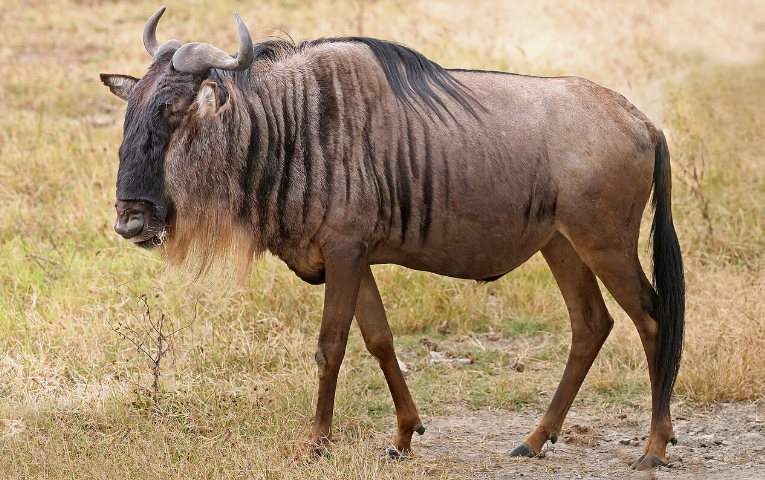
Wildebeests, also known as gnus, are large antelopes belonging to the genus Connochaetes within the family Bovidae. Native to the open plains, savannas, and woodlands of Africa, they are among the continent’s most iconic and ecologically significant megafauna. Their name comes from the Afrikaans word meaning “wild beast,” a fitting description for animals that combine a powerful, somewhat ungainly build with remarkable endurance and speed. Two main species are recognized — the blue wildebeest and the black wildebeest — along with several distinct subspecies spread across sub-Saharan Africa.
Wildebeests are perhaps best known for the Great Migration, one of the most spectacular wildlife events on Earth. Every year, approximately 1.5 million blue wildebeests travel in a circular route between Tanzania’s Serengeti and Kenya’s Maasai Mara in search of fresh grass and water, accompanied by hundreds of thousands of zebras and gazelles. The migration covers a distance of roughly 1,800 kilometres annually and results in the birth of around 500,000 calves — most within a three-week window in February — an overwhelming strategy that saturates predator populations and ensures calf survival rates remain relatively high.
As grazers, wildebeests play a vital role in shaping the ecosystems they inhabit. Their constant movement and grazing stimulate grass growth, their dung enriches soils, and their carcasses provide essential nutrition for scavengers including vultures, hyenas, and jackals. They are a keystone prey species, sustaining large predator populations of lions, cheetahs, leopards, wild dogs, and crocodiles. Adult wildebeests can weigh between 120 and 270 kilograms and reach speeds of up to 80 kilometres per hour when fleeing predators, making them formidable despite their somewhat comical appearance.
Wildebeest populations face ongoing threats from habitat loss, prolonged drought, disease, and the fragmentation of traditional migration routes by fences, roads, and expanding human settlements. The black wildebeest, once hunted nearly to extinction in the 19th century, now numbers around 18,000 individuals thanks to conservation and reintroduction efforts in South Africa and Eswatini. Blue wildebeest populations are more robust at approximately 1.5 million individuals, though localized populations outside protected areas have declined significantly. Climate change poses an emerging long-term threat by altering the rainfall patterns and vegetation cycles that the entire wildebeest life cycle depends on.
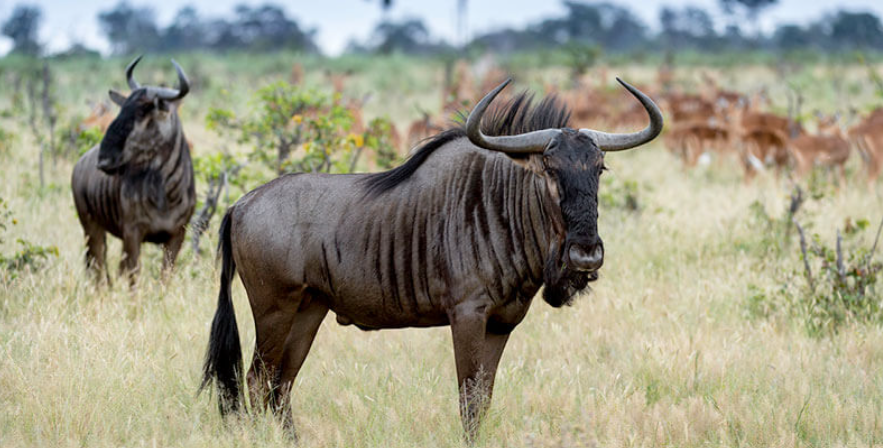
Types of Wildebeests
Blue Wildebeest (Connochaetes taurinus)
The blue wildebeest is the most numerous and widely distributed wildebeest species, found across eastern and southern Africa from Kenya and Tanzania down to South Africa and Namibia. It gets its name from the silvery-blue sheen of its coat, which contrasts with dark vertical stripes along its sides. Standing up to 1.5 metres at the shoulder and weighing as much as 270 kg, it is the larger of the two main species and the primary participant in the Great Migration.
Black Wildebeest (Connochaetes gnou)
The black wildebeest, or white-tailed gnu, is endemic to the open grasslands and Karoo shrublands of South Africa and Lesotho and is noticeably smaller and darker than its blue cousin. It is distinguished by its dark brown to black coat, a distinctive mane of stiff, cream-colored hair on the face and throat, and a long white tail that streams behind it when running. Hunted nearly to extinction by the early 20th century, its recovery through managed reserves and private game farms is considered one of southern Africa’s conservation success stories.
Eastern White-Bearded Wildebeest (Connochaetes taurinus albojubatus)
This subspecies of the blue wildebeest is found primarily in Tanzania and southern Kenya, including the Serengeti-Mara ecosystem that hosts the Great Migration. It is characterized by a pale, whitish beard hanging beneath the chin, which contrasts with the darker coat of other blue wildebeest subspecies. The eastern white-bearded wildebeest is the most numerically dominant migratory ungulate on Earth and forms the core of the famous million-strong herds that cross the Mara River each year.
Western White-Bearded Wildebeest (Connochaetes taurinus mearnsi)
Closely related to the eastern white-bearded subspecies and sometimes grouped with it, the western white-bearded wildebeest occupies overlapping range across the Serengeti and is distinguished by subtle differences in coat coloration and beard characteristics. It participates in the same annual migration cycle and faces similar ecological pressures including predation, drought, and the increasing impact of human activity along migration corridors. Taxonomists continue to debate the precise boundaries between this and related subspecies.
Nyassaland Wildebeest (Connochaetes taurinus johnstoni)
Found in the woodland-savanna transition zones of Malawi, Mozambique, and southern Tanzania, the Nyassaland wildebeest is a relatively little-studied subspecies distinguished by a slightly paler coat and subtle differences in horn curvature compared to the nominate blue wildebeest. Its range overlaps significantly with miombo woodland, a habitat type more heavily wooded than the open plains most wildebeest prefer. Habitat clearance for agriculture in this region has put increasing pressure on its populations.
Cookson’s Wildebeest (Connochaetes taurinus cooksoni)
Restricted almost entirely to the Luangwa Valley of Zambia, Cookson’s wildebeest is considered one of the most geographically isolated and range-restricted of the blue wildebeest subspecies. It tends to be somewhat paler and slightly smaller than other blue wildebeest subspecies and has adapted to the seasonal flood patterns of the Luangwa River system. The population is dependent on the health of the Luangwa Valley’s protected areas and is vulnerable to any deterioration in park management or anti-poaching efforts.
Serengeti Blue Wildebeest (Connochaetes taurinus taurinus — Serengeti population)
While belonging to the same nominal subspecies as other southern blue wildebeests, the Serengeti population is often treated as ecologically distinct due to its unique migratory behavior, population size, and the intensive research it has attracted over more than six decades. It has been the subject of landmark ecological studies that established foundational principles of predator-prey dynamics, carrying capacity, and savanna ecosystem function. The Serengeti wildebeest population effectively regulates the entire grassland ecosystem through its grazing, movement, and mortality.
Katanga Wildebeest (Connochaetes taurinus — Katanga population)
Populations of blue wildebeest found in the Katanga region of the Democratic Republic of Congo and surrounding areas represent a geographically peripheral and understudied group whose taxonomic status remains somewhat uncertain. These animals inhabit a transitional zone between classic open savanna and denser woodland, requiring broader dietary and habitat flexibility than their plains-dwelling relatives. Limited survey data makes precise population estimates difficult, and the region’s history of conflict has complicated conservation monitoring.
Southern Savanna Blue Wildebeest (Connochaetes taurinus — southern population)
The southern population of blue wildebeest found across Botswana, Zimbabwe, Namibia, and northern South Africa represents the nominate form of the species and inhabits classic open savanna and bushveld environments. Historically, these animals undertook large-scale seasonal movements across the Kalahari and Limpopo regions, but the erection of thousands of kilometres of veterinary fencing during the 20th century has severed most of these migration routes. Tens of thousands of wildebeest died along these fences during drought years, one of the most documented wildlife management disasters in African history.
Kruger Park Wildebeest (Connochaetes taurinus — Kruger population)
The wildebeest population within and around South Africa’s Kruger National Park forms a largely resident, non-migratory group that has adapted to the seasonal rhythms of the park’s mixed bushveld environment. Numbering around 14,000 to 16,000 individuals, this population is closely monitored and has been the subject of extensive research into disease transmission, particularly relating to malignant catarrhal fever and corridor disease. The Kruger population serves as an important genetic reservoir for wildebeest conservation efforts across southern Africa.
Etosha Wildebeest (Connochaetes taurinus — Etosha population)
The wildebeest of Etosha National Park in Namibia are adapted to one of the harshest semi-arid environments occupied by any blue wildebeest population, enduring extreme seasonal variation in rainfall and vegetation. They are partially migratory within the park, moving in response to rain and the greening of grasses around Etosha Pan. The population’s ability to thrive in this arid landscape has made it an important subject of study in understanding wildebeest resilience to drought and climate variability.
Hwange Wildebeest (Connochaetes taurinus — Hwange population)
Found in and around Zimbabwe’s Hwange National Park, this population of blue wildebeest inhabits a semi-arid mixed woodland and open grassland environment dependent on artificial waterholes for survival during the long dry season. The Hwange wildebeest population has fluctuated significantly due to drought cycles, lion predation, and historical hunting pressure. It forms an important part of the greater Kavango-Zambezi Transfrontier Conservation Area ecosystem, one of the largest cross-border conservation landscapes on Earth.
Lichwi Floodplain Wildebeest (Connochaetes taurinus — Kafue population)
Associated with the Kafue Flats and surrounding floodplain ecosystems of Zambia, this population is uniquely adapted to seasonal flooding and the highly productive grasses that emerge as floodwaters recede. Numbers on the Kafue Flats have declined dramatically from an estimated 250,000 in the 1970s to fewer than 10,000 today, largely as a result of the construction of hydroelectric dams that altered natural flood regimes. This collapse is considered one of the most severe ungulate population declines in African history.
Kalahari Wildebeest (Connochaetes taurinus — Kalahari population)
Wildebeest adapted to the semi-arid savanna and fossil river valleys of the Kalahari Basin form a distinctive ecological population that once ranged widely across Botswana and into Namibia and South Africa in enormous nomadic herds. The erection of veterinary cordon fences beginning in the 1950s caused catastrophic die-offs and fragmented what had been one of the great mammal migrations of southern Africa. Small, remnant populations persist in parts of the Central Kalahari Game Reserve and adjacent areas.
White-Tailed Gnu — Northern Population (Connochaetes gnou — northern range)
While the black wildebeest as a species is centered in South Africa, historical records and genetic studies suggest that its range once extended further into Lesotho and potentially into highland grassland areas of neighboring countries. Translocation programs have established small populations in protected reserves across a broader range than the species historically occupied in recent centuries. These northern populations are carefully managed to maintain genetic diversity and contribute to the overall resilience of the species.
Trophy-Line Wildebeest (Connochaetes gnou — game farm populations)
A significant portion of South Africa’s black wildebeest population now lives on private game farms and hunting reserves, where selective breeding has in some cases produced animals with exaggerated horn characteristics sought by trophy hunters. While these populations have contributed to the overall numerical recovery of the species, conservation geneticists have raised concerns about the long-term genetic consequences of selective breeding programs. Managing the relationship between commercially motivated breeding and the genetic integrity of wild populations remains an ongoing conservation challenge.
Golden Wildebeest (Connochaetes taurinus — melanistic color variant)
The golden wildebeest is not a separate species or subspecies but a rare color morph of the blue wildebeest characterized by a pale golden-tan coat caused by a recessive genetic mutation affecting pigmentation. First documented in the wild in South Africa, it has since been selectively bred on private game ranches where its striking and unusual appearance commands significant commercial value. Despite its exotic looks, it is biologically identical to the standard blue wildebeest in behavior, diet, and ecology.
Giant Wildebeest (Connochaetes taurinus — historical large-bodied form)
Fossil and subfossil records from sites across eastern and southern Africa indicate that wildebeest populations of the Pleistocene era included individuals significantly larger than any modern wildebeest, with some specimens suggesting body masses well above those of today’s largest blue wildebeests. These ancient forms lived alongside other now-extinct megafauna and occupied a more diverse range of habitats than present-day wildebeests. Their disappearance — likely linked to a combination of climate shifts and early human hunting pressure — left the two surviving species as the only representatives of what was once a more varied genus.