When most people think of ornamental grasses, they picture the airy, neutral tones of silver, cream, and buff — the characteristic flower and seed head colors that dominate the grass family. Yellow-flowered grasses are a genuine surprise to many gardeners, a reminder that the grass world contains far more chromatic diversity than its reputation for muted, naturalistic tones might suggest. From the vivid, saturated yellow spikes of golden oat grass to the delicate, lemon-hued anthers dusting the flower heads of certain native prairie species, yellow grasses occupy a unique and valuable niche in the ornamental plant palette.
It is important to clarify at the outset that grasses with genuinely yellow flowers represent a relatively small and specialized group within the broader grass family. Most grasses produce flowers that are technically colourless, greenish, or purplish — the yellow color in many cases being provided by the prominent anthers rather than the petals or bracts. However, the visual effect of yellow anther coloration, combined with the golden-yellow of ripening seed heads and the vivid chartreuse to gold of certain leaf blades, means that the experience of yellow in ornamental grasses is considerably richer and more varied than a strict botanical definition might suggest.
Yellow in grasses encompasses a wide spectrum of tones and origins. There is the vivid, saturated yellow of golden oat grass anthers in early summer — a color so intense that the plant looks, from a distance, as though it has been dusted in gold. There is the warm, honey-yellow of ripening pampas grass plumes. There is the luminous, chartreuse-yellow of golden foxtail grass and variegated golden grasses whose leaf blades provide a sustained yellow note through the entire growing season. And there is the clear, bright yellow of certain sedges and rushes whose flower structures are more openly colored than most true grasses.
Globally, yellow-flowered and yellow-foliaged grasses account for an estimated 8 to 12 percent of all ornamental grass varieties commercially available — a modest but significant proportion of the market that reflects a sustained and growing interest in color-expressive grass varieties. As naturalistic and prairie-style planting has become more mainstream, the demand for grasses that provide color beyond the conventional silver-buff palette has increased steadily, and yellow-expressed grasses have been among the principal beneficiaries of that demand.
Golden Oat Grass
Golden oat grass is the most vividly and obviously yellow-flowered of all ornamental grasses — a cool-season perennial whose showy, open panicles of large, oat-like flower spikelets are suffused with vivid golden-yellow anthers in late spring and early summer, creating a display of intense, saturated yellow color that glows brilliantly in early summer sunshine.
The anthers are particularly large and prominent, extending well beyond the spikelet bracts to create a fluffy, yellow-gold cloud of color above the narrow, arching leaves. From a distance, a well-established clump in full flower appears to be covered in a vivid yellow haze of remarkable intensity — an effect quite unlike the subtle, muted flower colors of most ornamental grasses.
It grows to two to three feet and performs best in cool, moist climates where the flowers are produced most generously. After the yellow-flowered display fades, the seed heads age to an attractive warm buff that provides further ornamental interest through summer.
Golden Foxtail Grass
Golden foxtail grass is grown primarily for its extraordinary leaf color rather than its flowers — the vivid, saturated, golden-yellow to chartreuse leaf blades providing a persistent, luminous yellow note throughout the growing season that outshines the modest, soft flower spikes produced in summer.
The leaf color is intense and sustained — particularly vivid in spring and early summer, fading slightly in the heat of midsummer before reviving in the cooler temperatures of autumn. In partial shade the yellow leaf color is at its most vivid and sustained, making golden foxtail one of the few genuinely bright-yellow plants for less sunny garden situations.
It grows to eighteen to twenty-four inches and is one of the most widely planted yellow-foliage ornamental grasses in European and North American gardens, where its consistent, long-season yellow color fills an important gap in the ornamental grass color palette.
Yellow Bristle Grass
Yellow bristle grass is a warm-season annual to short-lived perennial grass with compact, cylindrical, bristle-covered flower spikes in a warm yellow-green to golden-yellow color that are among the most texturally distinctive and ornamentally interesting of any yellow-expressed grass flower structure available in cultivation.
The bristly, fox-brush-shaped spikes provide an unusual textural element in the late-summer and autumn garden, and the warm yellow tones of the mature spikes catch the autumn light with a honeyed glow that complements the gold and copper tones of the broader autumn planting palette. It grows to one to two feet with a spreading, branching habit.
It is native to warm regions across Europe, Asia, and Africa and has naturalized widely across temperate landscapes globally — its weedy origins in disturbed habitats reflecting the resilience and adaptability that make it valuable as a naturalistic garden plant in appropriate settings.
Bowles’ Golden Sedge
Bowles’ golden sedge is one of the most celebrated and widely grown yellow ornamental grasses — technically a sedge rather than a true grass but universally grouped within the ornamental grass design category — whose vivid, luminous golden-yellow leaf blades are most intensely colored in spring and early summer, providing some of the most vivid yellow available from any shade-tolerant grass-like plant.
The small, brown flower spikes produced above the golden foliage in spring and early summer are modest in scale but the contrast of dark flower against vivid yellow leaf provides an attractive detail at close inspection. The plant reaches eighteen inches and performs best in partial shade where the brilliant yellow color is most sustained.
It has been in continuous cultivation in British gardens for over a century — named after the plantsman E.A. Bowles who popularized it — and remains one of the most consistently recommended yellow ornamental plants for damp, shaded situations.
Quaking Grass
Quaking grass is one of the most charming and distinctive of all yellow-expressed ornamental grasses — a cool-season annual and perennial whose extraordinary, flattened, heart-shaped spikelets hang from thread-like stalks and tremble and quiver in the slightest movement of air, the warm yellow to golden-buff coloration of the maturing seed heads creating a delicate, animated display of considerable ornamental beauty.
The spikelets are among the most structurally unusual of any grass — their oval, compressed form and the way they catch and reflect light as they move gives established plantings a shimmering, almost jewel-like quality in the right conditions. They are outstanding for cutting and drying, retaining their ornamental character indefinitely after harvest.
It is a native of European calcareous grasslands and meadows, and the decline of traditional hay meadow management has made it less common in its natural habitat — making garden cultivation an important contribution to the visibility of this beautiful grass.
Golden Hairgrass
Golden hairgrass is a compact, fine-leaved cool-season perennial whose vivid, gold-yellow leaf blades — at their most intense in spring and early summer — combined with the delicate, airy, yellow-tinged flower panicles produced in early summer create one of the most complete and sustained yellow expressions available from any small ornamental grass.
The combination of golden leaf color and delicate yellow flower heads in early summer is unique — a grass that is simultaneously yellow in leaf and yellow in flower for an extended period in late spring and early summer, after which the seed heads age to a warm, honey-buff that extends the season of yellow interest. It grows to eight to twelve inches.
It is among the most recommended ornamental grasses for small garden and container situations where consistent yellow color is the primary design requirement, and its compact, tidy habit makes it one of the most manageable and self-contained yellow ornamental grasses available.
Yellow-Eyed Grass
Yellow-eyed grass — technically a member of the iris family rather than a true grass but universally grouped with ornamental grasses in horticultural practice — produces tufts of narrow, flat, bright green, grass-like leaves and small, vivid, clear yellow flowers with a distinctive deeper yellow eye through spring and early summer.
The flowers are produced in succession over an extended period of several weeks, providing a consistent yellow flower display considerably longer than most true grass flowering seasons. The plant grows to twelve to eighteen inches and performs well in partially shaded, moist situations where its combination of grass-like foliage and genuine yellow flowers fills a unique and valuable niche.
It is a North American native with considerable ecological value, supporting specialist bee species that depend on iris-family flowers for early-season pollen, and its moisture tolerance makes it particularly valuable for wet, partially shaded garden situations.
Stipa Gigantea (Giant Feather Grass)
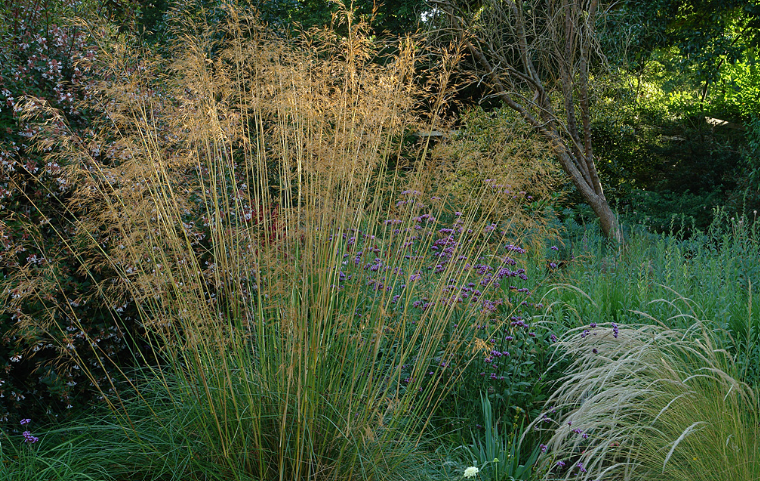
Giant feather grass is one of the most spectacularly beautiful of all yellow-expressed ornamental grasses — producing in early summer extraordinarily tall flower stems reaching five to six feet above a basal mound of narrow leaves, topped with large, open, oat-like panicles whose prominent golden-yellow anthers create a vivid, glowing display of warm yellow color that lights up the early summer garden.
The anthers extend prominently from each spikelet, giving the entire flower head a fluffy, gold-dusted appearance at peak flowering time. The display transitions from vivid anther-yellow to the warm, glinting silver-gold of the maturing awns — a color evolution that extends the period of yellow-gold interest over several weeks.
It is considered by many plantsmen to be one of the most beautiful of all ornamental grasses in flower — the combination of extraordinary height, golden anther color, and graceful, open flower structure creating an effect of luminous, backlit gold that is genuinely spectacular in the right garden position.
Golden Bamboo Grass
Golden bamboo grass — a grass-like plant with bamboo-like culms and broadly striped golden-yellow and green leaves — provides one of the most vivid and sustained yellow foliage displays of any grass family plant, the bold yellow-gold stripes on each broad leaf blade creating a powerfully tropical-looking effect in the summer garden.
The flowers produced in summer are slender and yellow-green, modest in scale compared to the dominant leaf display, but the combination of vivid leaf color and delicate flower structure creates a complete ornamental package. The plant grows to three to four feet in warm, sheltered positions.
It is valued in warm-climate gardens for providing the bold, tropical yellow-foliage effect of variegated bamboo in a considerably smaller and less invasive plant — an important practical advantage in situations where the spreading habit of true bamboo would be problematic.
Aurea Pendula Sedge
Aurea pendula is a strongly weeping, golden-yellow sedge of considerable ornamental elegance — its long, cascading, bright yellow-green to golden leaf blades falling in a graceful, waterfall-like curtain and the delicate, pendant, yellow-brown flower spikes hanging on thread-like stalks above the foliage in spring and early summer.
The combination of weeping, waterfall-like leaf habit and delicate pendant flowers gives this sedge a quality of gentle, animated movement and golden light-catching that is quite distinctive among yellow ornamental grasses. It grows to eighteen to twenty-four inches and performs well in partial shade with moist growing conditions.
It is one of the finest yellow weeping sedges available to the gardener and is particularly effective in containers, at raised bed edges, and in waterside plantings where the cascading golden leaves can be displayed to their best advantage.
Golden Wood Millet
Golden wood millet is a woodland grass perennial whose vivid, golden-yellow to chartreuse leaf blades provide one of the most intense and luminous yellow foliage displays available from any shade-tolerant ornamental grass — a plant of genuine brightness and impact that illuminates dark woodland and shaded garden spaces with warm yellow light throughout the growing season.
The modest flower spikes produced in early summer carry a soft yellow-green to pale straw coloration that complements the vivid leaf color without competing with it, and the seed heads that follow are attractive enough to provide further seasonal interest. It grows to eighteen to twenty-four inches and spreads slowly to form progressively larger colonies.
It is a European and Asian woodland native that brings the character of sunlit woodland glades into the domestic garden — particularly effective when combined with shade perennials whose flowers benefit from the bright yellow backdrop the golden foliage provides.
Yellow Indian Grass
Yellow indian grass — a color variant of the classic native prairie indiangrass — produces flower plumes of particularly rich, warm yellow-gold coloration that are among the most vivid and honey-hued of any native prairie grass flower display, catching the late summer and autumn light with a warmth and richness that perfectly captures the character of the prairie season.
The plumes are held above the foliage on stems reaching four to five feet, and their warm, golden-yellow color provides a perfect complement to the orange and copper autumn foliage that develops on the leaves simultaneously. The combination of golden plumes and rich autumn foliage makes this one of the most chromatically warm and complete of all yellow-expressed native perennial grasses.
Studies of native prairie grass plantings including indiangrass found that diverse native plantings absorb rainfall up to six times faster than conventional turfgrass — demonstrating the soil-health value that accompanies the ornamental beauty of this important native grass.
Golden Variegated Hakone Grass
The All Gold form of Japanese forest grass — also known as golden hakone grass — produces entirely golden-yellow leaf blades without the green striping of the standard Aureola variety, creating the most vivid and complete yellow expression available from any Japanese forest grass variety.
The entirely golden leaves create a mound of concentrated, luminous yellow in partial shade — the position that suits this grass best and in which the golden color performs most consistently without bleaching. Small, inconspicuous flower spikes appear above the golden foliage in summer, their modest scale allowing the vivid leaf display to remain the dominant ornamental feature.
It is slower-growing than the standard Aureola variety and commands a premium nursery price that reflects both its ornamental quality and the relative difficulty of its vegetative production, but the concentrated, all-gold luminosity it provides in shaded garden situations has made it one of the most sought-after yellow ornamental grass varieties currently available.
Golden Creeping Jenny
Golden creeping Jenny — while botanically a moneywort rather than a true grass — is universally included in the ornamental grass and ground cover category for its grass-like spreading habit and its vivid, golden-yellow to chartreuse leaf color that provides a continuous carpet of bright yellow through the growing season in moist, shaded positions.
The small, vivid yellow cup-shaped flowers produced in early summer add a further dimension of genuine yellow color to the already vivid leaf display, making golden creeping Jenny one of the few plants in the grass-like ground cover category that is yellow in both foliage and flower simultaneously. It spreads rapidly by surface runners.
It is one of the most widely used ground cover plants in European and North American gardens, consistently ranking in the top ten best-selling ground cover plants in both markets, and its combination of vivid color, spreading habit, and tolerance of shade and moisture makes it one of the most versatile yellow plants available for difficult garden situations.
Woodrush (Yellow Forms)
The yellow-flowered woodrushes — particularly the spring-flowering species that produce warm yellow-brown to golden flower clusters in March and April — are among the earliest yellow-flowered grass-like plants in the garden, their modest but cheerful flower clusters appearing at a time of year when yellow in the shaded garden is particularly welcome and particularly uncommon.
The flowers are small — clusters of tiny, star-shaped, yellow-brown spikelets — but they are produced reliably and are among the few genuine flowers that the woodrush family provides. The evergreen, dark green, softly hairy leaves provide year-round ground coverage in the shade situations where woodrushes perform best.
Woodrushes are among the most genuinely cold-hardy of all shade-tolerant grass-like plants — certain species surviving temperatures below -30°F (-34°C) — making the yellow-flowered forms among the most reliable year-round ground cover plants for extreme cold-climate garden situations.
Palm Sedge
Palm sedge is a distinctive, bold-textured sedge with wide, arching leaves and unusual, palm-like flower clusters that hang gracefully from arching stems in spring — the flowers combining yellow-green to golden-yellow coloration with a distinctive, shuttlecock-like form that makes them among the most structurally unusual and immediately recognizable flower structures in the sedge family.
The flower clusters are genuinely ornamental at close inspection, and the combination of bold, wide, bright green leaves and unusual pendant flower heads gives palm sedge a character quite distinct from the finer-leaved, more conventional sedge forms. It grows to two to three feet in moist, shaded positions.
It is native to the woodland streambanks of eastern North America and northern Europe and is increasingly used in naturalistic woodland garden planting where its bold texture and unusual flower structure add variety and interest to the typically fine-leaved sedge-dominated ground layer of the shade garden.
Golden Luzula
Golden luzula is a selected form of greater woodrush whose leaves are edged and banded with vivid golden-yellow margins — a variegation that provides a luminous, bright border to the otherwise dark green, hairy leaves and creates one of the most effective and unusual yellow-edged foliage displays available from any grass-like shade plant.
The small flower clusters produced in spring are yellow-brown to warm gold — modest in scale but providing a genuine yellow flower note above the attractively variegated foliage. The plant grows to twelve to eighteen inches and tolerates the dry shade beneath established trees with remarkable resilience.
Its tolerance of dry shade combined with the vivid yellow leaf variegation fills a specific and genuinely important design niche — providing yellow color in the most challenging garden situation — that very few other yellow ornamental plants can address with comparable reliability and effectiveness.
Common Reed (Yellow Variegated Form)
The golden-variegated common reed is a bold, tall, aquatic and semi-aquatic grass whose leaves are vividly striped with cream-yellow and green — creating a striking, large-scale yellow foliage display of considerable presence in water gardens, bog gardens, and moist landscape situations where its height of five to eight feet makes it one of the most imposing yellow-foliaged plants available.
The flower plumes produced in late summer are large, feathery, and initially purple-tinged before maturing to warm, honey-buff — a color that complements the yellow-variegated foliage beautifully. The combination of tall, bold, yellow-striped foliage and attractive late-season plumes makes this one of the most complete and multi-season yellow ornamental grasses for large-scale water garden and moist landscape situations.
It spreads vigorously by rhizomes and requires containment in most garden situations — a practical consideration that is an important planning element when incorporating this bold, vigorous grass into the landscape.