Nitrogen-fixing trees are woody plants capable of forming symbiotic relationships with soil bacteria — primarily Rhizobium, Bradyrhizobium, Mesorhizobium, and Frankia species — that colonize their roots and convert atmospheric nitrogen gas into ammonia, a biologically available form that plants can use directly for growth. This process, known as biological nitrogen fixation (BNF), bypasses the need for synthetic nitrogen fertilizers, which are derived from fossil fuels through the energy-intensive Haber-Bosch process and account for approximately 1–2% of global energy consumption annually.
Nitrogen-fixing trees are predominantly members of the legume family Fabaceae — the third largest flowering plant family with over 19,000 species — though significant nitrogen fixation also occurs in non-leguminous trees through symbiosis with the actinomycete bacterium Frankia, as seen in alders, casuarinas, and bayberries. Globally, biological nitrogen fixation by all plants and microorganisms contributes an estimated 100–140 million tonnes of nitrogen per year to terrestrial ecosystems, compared to approximately 120 million tonnes added through synthetic fertilizer manufacture.
The ecological and agronomic significance of nitrogen-fixing trees extends far beyond the immediate fertility boost they provide to surrounding soils. Their deep root systems physically access nitrogen-rich leaf litter and organic matter that has accumulated in subsoil layers, and their continuous leaf fall, root turnover, and decomposing nodules release nitrogen gradually and in organic forms that persist in the soil far longer than soluble synthetic fertilizers, which are prone to leaching and volatilization losses.
Individual nitrogen-fixing trees can contribute anywhere from 50 to 500 kg of nitrogen per hectare per year depending on species, climate, soil conditions, and management, with highly productive legume trees like Leucaena leucocephala documented at the upper end of this range under tropical conditions. This nitrogen contribution is not only valuable to adjacent crops and pastures but also drives broader soil biological activity — increasing earthworm populations, mycorrhizal fungal networks, and overall microbial biomass in soils managed under nitrogen-fixing tree cover.
Agricultural systems incorporating nitrogen-fixing trees have been shown to dramatically reduce or eliminate the need for synthetic nitrogen fertilizers, with corresponding economic benefits for smallholder farmers and environmental benefits in terms of reduced greenhouse gas emissions, nitrate leaching, and soil acidification. The CGIAR and World Agroforestry Centre have documented maize yield increases of 100–400% in sub-Saharan African farming systems managed under nitrogen-fixing trees such as Faidherbia albida and Gliricidia sepium, compared to unfertilized monoculture controls — improvements equivalent in agronomic terms to the application of 60–120 kg/ha of synthetic nitrogen fertilizer.
In the Sahel region of West Africa, farmer-managed natural regeneration of nitrogen-fixing trees on an estimated 5 million hectares has restored degraded farmland, increased cereal production, and improved household food security for millions of people without any external financial input beyond the protection and management of naturally regenerating trees. This represents one of the largest and most cost-effective agricultural transformations in recent history.
Beyond their agronomic value, nitrogen-fixing trees play irreplaceable roles in ecological restoration, carbon sequestration, watershed protection, and biodiversity conservation. As pioneer species capable of colonizing degraded, nutrient-depleted, and disturbed soils where few other trees can establish, they create the soil conditions necessary for the gradual succession towards more complex forest ecosystems. Alder species (Alnus spp.) are among the most important colonizers of glacial outwash, river gravel bars, landslide scars, and post-mining landscapes in temperate regions, rapidly building soil nitrogen and organic matter that allows other tree species to follow.
The carbon sequestration potential of nitrogen-fixing trees is enhanced by their typically rapid growth rates — a consequence of their unlimited access to nitrogen — and by their capacity to improve the productivity and carbon storage of the entire ecosystem around them. As interest in nature-based solutions to climate change intensifies, nitrogen-fixing trees are increasingly recognized as foundational components of reforestation, afforestation, and sustainable land management programs worldwide.
Black Alder (Alnus glutinosa)
Black alder is the most widely distributed alder species in Europe and one of the most ecologically important nitrogen-fixing trees of the temperate zone, forming dense riparian forests along riverbanks, lakesides, and wet valley floors from the British Isles across to Siberia. It fixes nitrogen through symbiosis with the actinomycete bacterium Frankia rather than through Rhizobium bacteria, and can fix 40–100 kg of nitrogen per hectare per year, substantially enriching the soils of the wetland ecosystems it colonizes.
Its waterlogged roots tolerate anaerobic conditions that would kill most other trees, and its leaf litter — rapidly decomposed by aquatic invertebrates — is a critical nutrient input to stream and river food webs. Black alder is widely planted for riverbank stabilization, wetland restoration, and as a pioneer tree on waterlogged, degraded, and post-industrial land where soil fertility is minimal.
Red Alder (Alnus rubra)
Red alder is the most commercially important hardwood tree of the Pacific Northwest coast of North America, growing in dense stands along stream corridors, logged areas, and disturbed sites from Alaska to California. It fixes nitrogen through Frankia symbiosis at rates of 50–100 kg per hectare per year, dramatically accelerating soil development on freshly disturbed substrates and creating the fertile conditions necessary for the establishment of the economically valuable conifers — Douglas fir, Sitka spruce, western hemlock — that eventually replace it in forest succession.
Its timber is pale, fine-grained, and highly workable, used for furniture, cabinets, and turned objects. Red alder stands have been deliberately integrated into conifer plantation management in the Pacific Northwest to improve soil nitrogen status and reduce fertilizer inputs in subsequent conifer rotations.
Italian Alder (Alnus cordata)
Italian alder is a medium to large deciduous tree native to southern Italy and Corsica, and one of the most versatile and widely planted alders for land restoration, urban forestry, and nitrogen enrichment outside its native range. It is notably more drought-tolerant than other alders and thrives on free-draining as well as moist soils, broadening its applicability to a wider range of restoration and agroforestry contexts than the moisture-demanding black alder.
It grows rapidly — often 1–2 metres per year when young — and fixes nitrogen actively through Frankia symbiosis. In the United Kingdom it is widely planted as a pioneer tree in upland land restoration schemes, urban greenways, and degraded former agricultural land where rapid canopy establishment and soil improvement are priorities.
Grey Alder (Alnus incana)
Grey alder is a hardy, cold-tolerant nitrogen-fixing tree native to the mountains and boreal zones of Europe and Asia, one of the first trees to colonize glacial moraines, avalanche tracks, landslides, and river gravel bars in alpine and subarctic environments where soil development is at the earliest stages. It fixes nitrogen at rates of 40–80 kg per hectare per year through Frankia bacteria in root nodules, building organic matter and fertility in soils that would otherwise remain biologically impoverished for decades.
It is valued in Scandinavian and northern European forestry for its role in soil amelioration before conifer establishment and is increasingly planted in upland restoration schemes in the British Isles and Central Europe. Its catkins are among the earliest sources of pollen for bees in late winter and early spring.
Leucaena (Leucaena leucocephala)
Leucaena is one of the most productive and extensively studied nitrogen-fixing trees in the tropics, capable of fixing up to 500 kg of nitrogen per hectare per year under optimal conditions — among the highest rates documented for any tree species. Native to Mexico and Central America, it is now cultivated across an estimated 5 million hectares in tropical Asia, Africa, and the Pacific for fodder, fuelwood, green manure, and timber.
In alley cropping systems its hedgerows are regularly pruned and the biomass incorporated into adjacent crop soils, supplying nitrogen equivalent to substantial doses of synthetic fertilizer. Its leaves contain 20–30% crude protein and are consumed by cattle, goats, and rabbits. The anti-nutritional compound mimosine in its leaves requires management through feed mixing or rumen inoculation with detoxifying bacteria in non-adapted livestock.
Gliricidia (Gliricidia sepium)
Gliricidia is a Central American legume tree that has become one of the most widely adopted nitrogen-fixing trees in tropical agroforestry worldwide, prized for its exceptional ease of propagation from large stem cuttings, rapid establishment, and versatility as a simultaneous provider of nitrogen, fodder, fuelwood, and live fence posts. Its leaf biomass contains 20–25% crude protein and decomposes relatively quickly when incorporated into soil, releasing nitrogen in a form readily available to subsequent crops.
Studies across West Africa, East Africa, and South and Southeast Asia have documented gliricidia prunings supplying 100–200 kg of nitrogen per hectare per year to adjacent food crops, substantially reducing fertilizer requirements. It tolerates a wide range of soils, is moderately drought-tolerant, and begins producing harvestable biomass within months of establishment from cuttings.
Faidherbia (Faidherbia albida)
Faidherbia albida is a nitrogen-fixing acacia of extraordinary strategic importance in African agroforestry, uniquely characterised by its reversed phenology — leafing and podding during the dry season and shedding its leaves when the rains bring crop growth, meaning crops in its vicinity receive nitrogen-rich leaf litter and improved soil without competing with the tree for light during the critical growing season.
It fixes nitrogen through Rhizobium symbiosis and contributes an estimated 30–60 kg of nitrogen per hectare per year to the soils of the parkland agroforestry systems where it is deliberately retained. The FAO has highlighted Faidherbia as a key species for climate-smart agriculture across the Sahel, and documented crop yield improvements of 100–200% under its canopy are among the most compelling evidence for the transformative potential of nitrogen-fixing trees in resource-poor farming systems.
Sesbania (Sesbania sesban)
Sesbania sesban is a fast-growing, short-lived nitrogen-fixing legume tree from tropical Africa and Asia that is one of the most widely used species for improved fallow fertility restoration — a practice where cropland is temporarily planted with nitrogen-fixing trees during an off-season to rapidly rebuild soil nitrogen and organic matter before the subsequent food crop.
It can grow 3–5 metres in a single rainy season while fixing 100–200 kg of nitrogen per hectare, and when its biomass is incorporated into the soil at the end of the fallow period it releases nutrients relatively rapidly, providing a substantial fertility boost for the following crop. Research from Zambia documented maize yields three to four times higher after a sesbania improved fallow compared to continuously cropped control plots. It also provides dry-season livestock fodder and fuelwood alongside its primary soil improvement function.
Acacia Senegal (Senegalia senegal)
Senegalia senegal, the gum arabic tree, is a small, thorny nitrogen-fixing acacia of the semi-arid Sahel, Sudan savannah, and Horn of Africa, fixing nitrogen through Rhizobium bacteria and contributing organic matter and fertility to the impoverished sandy soils it colonizes. It is one of the few trees capable of surviving and improving soil in areas with annual rainfall below 250 mm, and its nitrogen-fixing ability is a critical driver of the gradual soil rehabilitation that occurs as degraded Sahelian land is replanted with gum arabic trees in commercial and restoration programs.
Beyond nitrogen fixation, it produces gum arabic — the world’s most important natural plant gum, used in food, beverages, pharmaceuticals, and printing — generating income for millions of farming and pastoral households across Sudan, Chad, Nigeria, and Mali, where gum tapping is a significant dry-season livelihood activity.
Calliandra (Calliandra calothyrsus)
Calliandra calothyrsus is a nitrogen-fixing Central American legume shrub-tree that has become deeply embedded in smallholder agroforestry systems across East Africa and Southeast Asia, valued simultaneously as a high-protein fodder, fuelwood producer, soil improver, and erosion-controlling hedge on sloping farmland. It fixes nitrogen through Rhizobium bacteria at rates of 100–200 kg per hectare per year and produces dense, harvestable biomass on poor, acidic, degraded soils where many other legume trees struggle to establish.
Its relatively high condensed tannin content slows protein breakdown in the rumen — a quality that can improve nitrogen utilisation efficiency in ruminant livestock and provide an anti-parasitic effect against intestinal worms. In the highland dairy systems of Kenya and Uganda it is the most commonly planted fodder tree, with documented milk production improvements of 0.5–1.5 litres per cow per day when fed as a supplement.
Robinia (Robinia pseudoacacia)
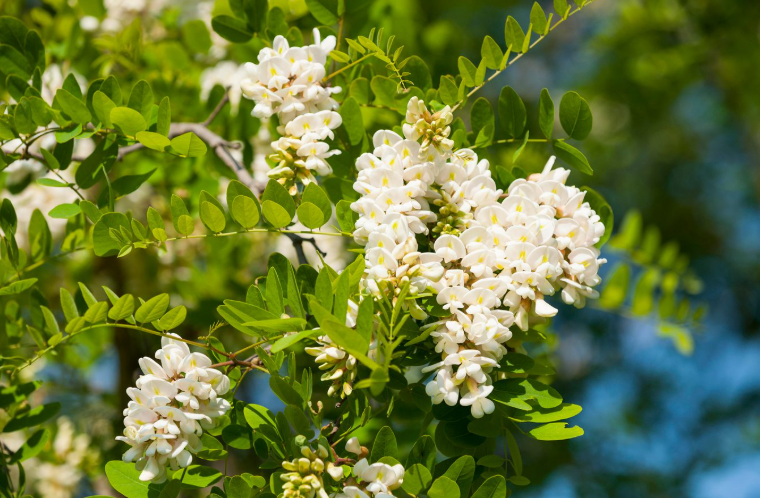
Robinia pseudoacacia, the black locust, is a fast-growing North American nitrogen-fixing legume tree now naturalized across Europe, Asia, and parts of Africa and South America, where it is cultivated for timber, fuelwood, honey production, and land reclamation on degraded soils. It fixes nitrogen at rates of 50–150 kg per hectare per year through Rhizobium bacteria and is one of the most effective pioneer trees for improving nutrient-depleted, acidic, and eroded soils in temperate climates.
Its timber is exceptionally durable — heartwood durability in ground contact rivals that of teak — and is used without preservative treatment for fence posts, outdoor furniture, and flooring in Hungary, where black locust plantation forestry covers over 400,000 hectares and produces some of Europe’s most productive short-rotation timber. Its fragrant blossom makes it the most important honey tree in Hungary and Romania, producing distinctive, pale, slow-crystallising honey widely exported across Europe.
Mimosa (Albizia julibrissin)
Albizia julibrissin, the silk tree or Persian mimosa, is a nitrogen-fixing legume tree native from Iran to Japan, widely planted as an ornamental and agroforestry species across warm temperate and subtropical regions for its feathery, bipinnate foliage and spectacular pink pompom flowers. It fixes nitrogen through Rhizobium symbiosis and produces abundant leaf litter that decomposes rapidly, enriching the soil beneath its spreading canopy.
In traditional agroforestry systems of China, Korea, and Japan it is integrated into farming landscapes on field margins and hillsides where it simultaneously improves soil fertility, provides fuelwood, and contributes medicinal bark and flowers used in traditional medicine. It grows rapidly to 5–10 metres and is notably drought-tolerant once established, though it can become invasive in parts of the eastern United States where it has naturalized extensively.
Casuarina (Casuarina equisetifolia)
Casuarina equisetifolia, the coastal she-oak, is one of the most important non-leguminous nitrogen-fixing trees in tropical and subtropical coastal zones, fixing nitrogen through symbiosis with the actinomycete Frankia at rates of 40–100 kg per hectare per year — a remarkable capacity that allows it to colonize and progressively improve the severely nutrient-depleted sandy soils of coastal dunes, beaches, and degraded littoral zones.
It is the dominant species in coastal agroforestry shelterbelts across South Asia, Southeast Asia, East Africa, and the Pacific, where its dense canopies protect agricultural land from salt-laden winds while simultaneously building soil fertility. Its dense, hard timber is valued for poles, fuelwood, and charcoal, and its rapid growth — reaching 15–20 metres in 5–7 years — makes it one of the most productive biomass-producing trees in difficult coastal environments.
Thorn Wattle (Acacia victoriae)
Acacia victoriae, the prickly wattle or elegant wattle, is an Australian nitrogen-fixing acacia native to the semi-arid interior of Australia, fixing nitrogen through Rhizobium root nodule bacteria and improving the nutrient status of the infertile red and sandy soils it colonizes in arid and semi-arid rangeland. It is an important pioneer species in degraded Australian dryland landscapes, providing the initial nitrogen input that enables more demanding native vegetation to follow in succession.
Beyond its ecological role, its seeds have attracted interest as a high-protein human food ingredient — they contain approximately 25% protein and 30% carbohydrate — and commercial development of Acacia victoriae seed as a bush food ingredient has generated interest in sustainable harvesting and domestication of this species for the emerging Australian native food industry.
Honey Locust (Gleditsia triacanthos)
Gleditsia triacanthos, the honey locust, is a large North American deciduous legume tree that fixes nitrogen through Rhizobium bacteria and produces abundantly sugary, protein-rich pods — consumed by cattle, sheep, goats, horses, and pigs — that have long been recognized as a valuable dual-purpose nitrogen-fixing and fodder tree for temperate agroforestry systems. It is extremely adaptable, tolerating a wide range of soils, pH levels, drought, and urban pollution, which has made it a popular street tree as well as a farm tree.
Thornless varieties developed through breeding programs are easier and safer to integrate into grazing systems. The honey locust’s pod production can reach 450–900 kg per hectare in mature plantings, providing a significant dry matter supplement for grazing livestock at precisely the time — autumn — when pasture quality is declining. Research in temperate silvopastoral systems in France and the United States has highlighted its potential as a combined nitrogen-fixer and forage tree.
Tree Lucerne (Chamaecytisus proliferus)
Chamaecytisus proliferus, tagasaste or tree lucerne, is a fast-growing nitrogen-fixing legume shrub-tree native to the Canary Islands, now widely cultivated in Australia, New Zealand, South Africa, Chile, and East Africa as one of the most nutritious and productive fodder trees available for ruminant livestock in Mediterranean and subtropical climates. It fixes nitrogen actively through Rhizobium symbiosis and produces leaves with 20–28% crude protein — among the highest of any tree forage — alongside high digestibility that makes it comparable in feed value to high-quality legume hay.
It is evergreen and deeply rooted, providing green feed throughout summer droughts when annual pastures are burned off. Studies in Western Australia have documented significant improvements in sheep and cattle liveweight gain and wool production in silvopastoral systems where tagasaste is grown as a browsable tree fodder component.
Siberian Pea Tree (Caragana arborescens)
Caragana arborescens is a cold-hardy, drought-tolerant nitrogen-fixing legume shrub-tree native to Siberia and Central Asia, one of the most important nitrogen-fixing trees for temperate and continental climates where tropical legume trees cannot survive. It tolerates extreme cold — to -40°C — poor sandy or rocky soils, and prolonged drought, making it invaluable for shelterbelts, windbreaks, and land restoration in the harsh continental climates of Central Asia, Russia, Mongolia, and the northern Great Plains of North America.
It fixes nitrogen through Rhizobium root nodule bacteria and produces seeds and leaves browsed by sheep, goats, and deer. In traditional Mongolian and Kazakh pastoral landscapes, Caragana shrublands are critical dry-season browse reserves for livestock, and their nitrogen-fixing capacity is a key driver of soil fertility in the semi-arid steppe ecosystems they inhabit.
Flemingia (Flemingia macrophylla)
Flemingia macrophylla is a robust nitrogen-fixing legume shrub-tree from South and Southeast Asia, widely integrated into agroforestry and conservation agriculture systems across tropical Africa and Asia as a soil-conserving hedge, green manure source, and dry-season fodder supplement. It fixes nitrogen through Rhizobium symbiosis and performs reliably on the acid, infertile, highly weathered soils of humid and sub-humid tropical highlands where many other legume trees struggle.
Its relatively high condensed tannin content slows the decomposition of its leaf litter, releasing nitrogen more gradually than fast-decomposing species like sesbania — a quality that can reduce leaching losses and provide a more sustained fertility effect in humid environments with high rainfall. It is notably shade-tolerant, making it useful in multistory agroforestry systems beneath taller timber or fruit trees.
Guanacaste (Enterolobium cyclocarpum)
Enterolobium cyclocarpum, the guanacaste or elephant ear tree, is a massive, fast-growing nitrogen-fixing legume tree native to Central America and northern South America, designated the national tree of Costa Rica and one of the most ecologically and culturally significant trees of the neotropical dry forest zone. It fixes nitrogen through Rhizobium bacteria and produces large, dark, ear-shaped pods that are consumed by horses, cattle, deer, and formerly by now-extinct Pleistocene megafauna whose ecological role in seed dispersal is now partially filled by domestic livestock.
Individual trees can reach 30 metres in height with a trunk circumference exceeding 6 metres, and their broad, spreading canopies provide shade for livestock in silvopastoral systems while their pods supply a high-energy, protein-rich feed supplement. In Central American silvopastoral systems, guanacaste is deliberately retained and planted as a shade and fodder tree in cattle pastures.
Pigeon Pea (Cajanus cajan)
Cajanus cajan, the pigeon pea, occupies a unique position as both a major food crop and a perennial nitrogen-fixing woody shrub that is one of the most widely planted legume trees in tropical smallholder agroforestry systems, grown across an estimated 7 million hectares globally. It fixes nitrogen through Bradyrhizobium root nodule bacteria at rates of 40–200 kg per hectare per year and improves soil physical structure through its robust root system that breaks up hardpan layers and improves water infiltration in degraded soils.
In Southern Africa — particularly Malawi, Mozambique, and Zimbabwe — pigeon pea intercropped with maize is a cornerstone of low-input smallholder farming, providing food, nitrogen, and an additional cash crop from the same area of land. Research has consistently shown that maize grown after pigeon pea without added fertilizer produces yields comparable to fertilized monoculture maize, demonstrating the potency of pigeon pea nitrogen contributions.
Indian Siris (Albizia lebbeck)
Albizia lebbeck, the Indian siris or woman’s tongue tree, is a large, fast-growing nitrogen-fixing legume tree native to tropical Asia and now widely naturalized and cultivated across tropical Africa, the Caribbean, and the Pacific for shade, timber, fodder, and soil improvement in agroforestry systems. It fixes nitrogen through Rhizobium bacteria and produces a dense, spreading canopy of bipinnate leaves that contributes abundant nitrogen-rich leaf litter to soils beneath it throughout the year.
Its pods — which rattle persistently in the wind, giving it the common name woman’s tongue — persist on the tree into the dry season and are eagerly consumed by cattle, goats, camels, and donkeys as a high-protein supplement. In India and Pakistan it is a traditional shade and avenue tree in agricultural landscapes, and its durable, attractive timber is used for furniture, boat building, and construction.
Wattles (Acacia mearnsii)
Acacia mearnsii, the black wattle, is an Australian nitrogen-fixing acacia now cultivated commercially across South Africa, Brazil, India, Kenya, and Tanzania for its tannin-rich bark — used in leather tanning — and for timber, fuelwood, charcoal, and paper pulp. It fixes nitrogen rapidly through Rhizobium symbiosis and grows with exceptional speed on poor, acid soils, reaching 10–15 metres in 8–12 years and fixing 50–150 kg of nitrogen per hectare per year in the process.
South Africa cultivates approximately 150,000 hectares of black wattle for the tanning extract industry, making it a significant commercial forestry crop. However, black wattle has become one of southern Africa’s most invasive alien trees outside managed plantations, spreading along riparian zones and displacing native vegetation, requiring integrated management approaches that balance its economic value with ecological risk.
Mimosa Tree (Leucaena diversifolia)
Leucaena diversifolia, highland leucaena, is a high-altitude adapted nitrogen-fixing legume tree from Central America that performs in cooler, highland tropical environments where the commonly cultivated Leucaena leucocephala does poorly. It fixes nitrogen through Rhizobium bacteria at rates comparable to its lowland relative and produces high-protein leaf biomass suitable for fodder, green manure, and mulch in highland agroforestry systems.
It is a key species in the improvement of East African highland farming systems — particularly in Kenya’s central highlands and in Rwanda and Uganda — where the elevation and cooler temperatures limit the use of most tropical nitrogen-fixing trees. Research from the World Agroforestry Centre has identified L. diversifolia as one of the most promising nitrogen-fixing species for smallholder agroforestry at altitudes between 1,500 and 2,500 metres, a zone home to millions of food-insecure farming households across the East African highlands.
Alder Buckthorn (Rhamnus frangula / Frangula alnus)
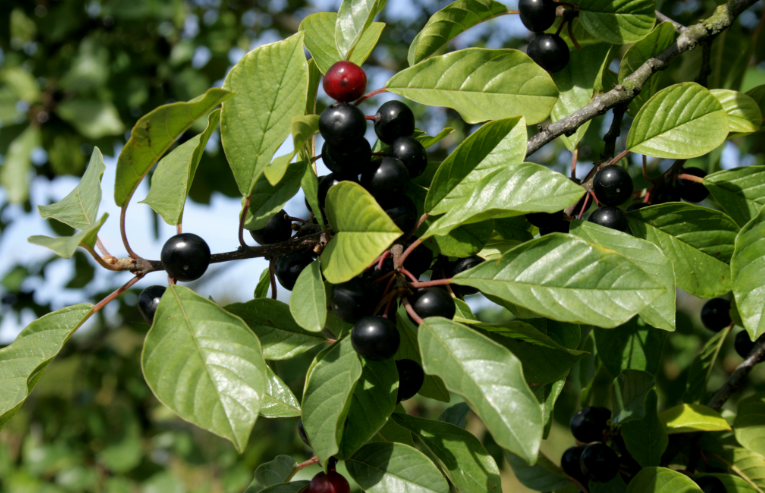
Frangula alnus, the alder buckthorn, is a small, moisture-loving shrub-tree of European and Western Asian woodlands and wetland margins notable for its association with Frankia-like nitrogen-fixing organisms and its important ecological role as a pioneer species on wet, nutrient-poor, peaty, and waterlogged soils where more demanding trees cannot establish. While its nitrogen-fixing capacity is modest compared to Alnus species, it contributes meaningfully to the gradual fertility building of the wetland and fen carr ecosystems it colonizes.
It is also ecologically significant as the sole larval food plant of the brimstone butterfly across most of its range and produces bark with medicinal properties historically used as a laxative. In wetland restoration planting schemes across temperate Europe it is used alongside black alder to restore the structure and function of native fen carr woodland communities on degraded peat and riparian landscapes.