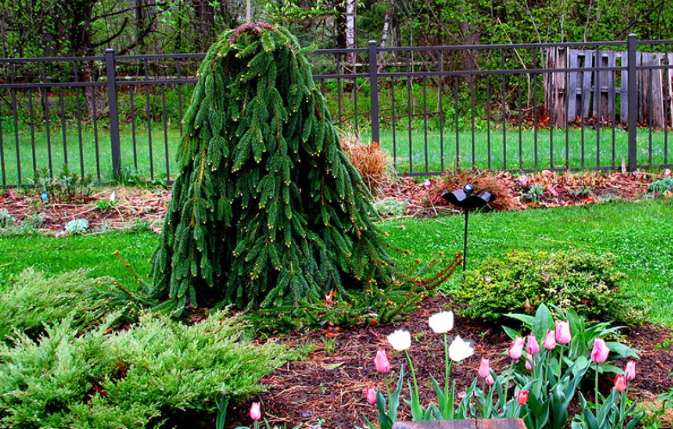
The first time you see a well-established weeping evergreen in a garden, it is hard not to stop and look at it. Instead of the familiar upright shape of most conifers, its branches spill downward, sweep toward the ground, or form a graceful curtain of foliage. Having seen how differently these trees develop as they mature, I have found that their beauty is often most impressive after several seasons of growth, when the branches begin to reveal the individual character of the plant. No two specimens always develop in exactly the same way, particularly among strongly weeping cultivars.
What makes Weeping Evergreen Trees especially interesting is that “weeping” does not describe just one shape. Some varieties naturally maintain an upright trunk with branches cascading downward, while others tend to spread horizontally when young and may need staking or training before they develop into a more tree-like specimen. I have found that this difference matters when choosing a tree because a young plant can look nothing like the mature specimen shown in a garden catalog. Extension horticulturists similarly note that some weeping conifers need early training to establish their eventual form.
Weeping evergreen trees combine two qualities that make a tree stand out in a landscape: year-round foliage and gracefully cascading branches.
Unlike ordinary upright evergreens, weeping varieties have branches that droop, cascade, or sweep toward the ground. Some develop a strong upright trunk with pendulous branches, while others naturally grow horizontally and need staking or training to develop into a tree form.
Most weeping evergreens used in American landscapes are conifers, including spruces, pines, cedars, cypresses, junipers, hemlocks, and related species. Their foliage can range from deep green to silvery blue, and their mature forms can vary from compact specimens to dramatic, tall landscape trees.
Below are 24 types of weeping evergreen trees and conifers worth considering for a US landscape.
1. Weeping Blue Atlas Cedar
Scientific name: Cedrus atlantica ‘Glauca Pendula’
Weeping Blue Atlas Cedar is one of the most dramatic weeping evergreens for a landscape. It has blue-green to silvery needles and long, pendulous branches that can create a highly individual shape.
One important characteristic is that young trees often need staking and training. If left unsupported, the branches may spread horizontally rather than form a conventional upright tree. With proper training, however, the plant can become an outstanding specimen tree.
Best use: Specimen tree, focal point, rock garden
Foliage: Blue-green to silvery blue
Growth habit: Weeping and irregular
US landscape appeal: Excellent
2. Weeping Deodar Cedar
Scientific name: Cedrus deodara ‘Pendula’
The weeping form of Deodar Cedar combines the soft, blue-green foliage associated with Deodar Cedar with strongly cascading branches.
It works particularly well where a gardener wants an evergreen specimen with a softer appearance than a typical upright conifer.
Because the exact shape depends heavily on how the young plant is trained, it is worth choosing a nursery-grown specimen whose structure already suits the intended location.
Best use: Specimen planting
Foliage: Blue-green
Growth habit: Cascading
Ideal for: Large landscapes and focal plantings
3. Weeping Nootka Cypress
Scientific name: Cupressus nootkatensis ‘Pendula’
Weeping Nootka Cypress is a distinctive evergreen with drooping branches and scale-like foliage. Depending on the selection and growing conditions, its foliage can appear green-gray or blue-gray.
It provides a more vertical, architectural appearance than many low-growing weeping conifers and can become an excellent focal point in a landscape.
A related selection, ‘Pendula Vera’, is also recognized as a weeping Nootka cypress form.
Best use: Specimen tree
Foliage: Gray-green to blue-green
Growth habit: Pendulous and upright
Feature: Architectural form
4. Weeping Mediterranean Cypress
Scientific name: Cupressus sempervirens ‘Pendula’
This weeping form of Mediterranean Cypress has a distinctive narrow, cascading appearance.
Mediterranean Cypress is naturally associated with warm, dry regions, so this is a better choice for gardeners in climates where the species is well adapted rather than for cold northern gardens.
Its unusual silhouette makes it especially useful when the goal is to create a strong vertical accent.
Best use: Formal or Mediterranean-style landscapes
Foliage: Evergreen, scale-like
Growth habit: Narrow and weeping
Feature: Strong architectural silhouette
5. Weeping Eastern Red Cedar
Scientific name: Juniperus virginiana ‘Pendula’
Eastern Red Cedar is a North American native evergreen, and its weeping form offers a very different appearance from the species’ familiar upright habit.
The pendulous branches create a softer outline while retaining the evergreen character of a juniper.
It can work particularly well as a specimen tree where year-round structure is desired.
Best use: Specimen planting, native-plant landscapes
Foliage: Evergreen, scale-like
Growth habit: Weeping
Feature: Native evergreen character
6. Tolleson’s Blue Weeping Juniper
Scientific name: Juniperus scopulorum ‘Tolleson’s Blue Weeping’
Tolleson’s Blue Weeping Juniper is one of the most distinctive weeping junipers available to gardeners. It is valued for its gracefully arching branches and attractive blue-gray to bluish foliage.
The University of Missouri notes that this cultivar makes an elegant landscape specimen and can provide year-round structure and color.
Best use: Specimen tree
Foliage: Blue-gray or soft green
Growth habit: Arching and weeping
Feature: Unusual blue foliage
7. Weeping Norway Spruce
Scientific name: Picea abies ‘Pendula’
Weeping Norway Spruce is one of the best-known weeping evergreen conifers.
It retains the dark green needles of Norway Spruce but develops strongly pendulous branches. Depending on training, it can become an upright specimen tree or form a low, spreading mound.
Oregon State University notes that staking can allow the plant to develop additional height, while an unstaked plant may remain much lower and spread outward.
Best use: Specimen tree, large rock garden
Foliage: Dark green needles
Growth habit: Strongly pendulous
Hardiness: Reported hardy to USDA Zone 3
8. Inversa Norway Spruce
Scientific name: Picea abies ‘Inversa’
‘Inversa’ is another unusual weeping form of Norway Spruce.
Its branches hang downward against the trunk, creating a narrow, dramatic shape. The final form depends greatly on training and the height at which the plant is grafted or supported.
Like other weeping spruces, it is particularly effective when planted where its unusual silhouette can be seen clearly.
Best use: Specimen planting
Foliage: Dark green
Growth habit: Narrow, strongly weeping
Feature: Dramatic vertical form
9. Brewer Spruce
Scientific name: Picea breweriana
Brewer Spruce, also called Brewer’s Weeping Spruce, is a naturally distinctive conifer with long branches that hang downward.
Unlike many ornamental weeping trees that are selected cultivars, Brewer Spruce itself naturally has a pendulous appearance.
Its graceful branching makes it particularly interesting as a specimen where there is enough room to appreciate its mature form.
Best use: Large landscape specimen
Foliage: Evergreen needles
Growth habit: Naturally pendulous
Feature: Naturally weeping form
10. Weeping White Spruce
Scientific name: Picea glauca ‘Pendula’
Weeping White Spruce combines the familiar evergreen foliage of White Spruce with a narrow, pendulous habit.
It can provide a strong vertical accent without having the broad silhouette of many conventional evergreen trees.
Because different nurseries may use somewhat different naming conventions for pendulous forms, check the plant’s mature dimensions and growth habit before purchasing.
Best use: Specimen tree
Foliage: Green needles
Growth habit: Upright and weeping
Feature: Narrow evergreen accent
11. Weeping Serbian Spruce
Scientific name: Picea omorika ‘Pendula’
Weeping Serbian Spruce has slender branches that cascade downward, producing a graceful, somewhat narrow silhouette.
The species is already valued for its elegant form, and the pendulous selection exaggerates that character.
It can make a particularly attractive specimen when surrounded by lower-growing plants that do not obscure its trunk and cascading branches.
Best use: Specimen planting
Foliage: Evergreen needles
Growth habit: Narrow and pendulous
Feature: Elegant silhouette
12. Weeping Blue Spruce
Scientific name: Picea pungens pendulous cultivars
Weeping forms of Colorado Blue Spruce combine blue or blue-green evergreen needles with a cascading growth habit.
They can be particularly attractive in gardens where foliage color is important. However, the eventual form can vary significantly depending on the cultivar and how the plant is trained.
When shopping, look for a named pendulous cultivar rather than assuming every Colorado Blue Spruce will develop a weeping habit.
Best use: Specimen tree
Foliage: Blue to blue-green
Growth habit: Weeping
Feature: Blue evergreen foliage
13. Weeping Eastern White Pine
Scientific name: Pinus strobus ‘Pendula’
Weeping Eastern White Pine is one of the most graceful weeping evergreen choices for suitable climates.
It has soft, relatively fine needles and flexible branches that can eventually cascade toward the ground. Young plants can look irregular before they develop their mature character.
The University of Arkansas notes that weeping white pine is among the particularly interesting weeping conifers and is best planted in sunny locations with well-drained soil.
Best use: Specimen tree
Foliage: Soft blue-green needles
Growth habit: Weeping
Feature: Fine-textured foliage
14. Mexican Weeping Pine
Scientific name: Pinus patula
Mexican Weeping Pine naturally develops long, drooping branches and is unusual among ornamental pines because of its distinctly pendulous appearance.
Its long needles give the tree a softer texture than many stiff-needled conifers.
This is primarily a choice for gardeners in warmer climates because Mexican Weeping Pine is not suited to the cold conditions tolerated by some northern conifers.
Best use: Specimen tree in warm climates
Foliage: Long green needles
Growth habit: Naturally weeping
Feature: Long, soft-looking needles
15. Weeping Giant Sequoia
Scientific name: Sequoiadendron giganteum ‘Pendulum’
The weeping form of Giant Sequoia is an unusual ornamental selection of a species better known for its enormous upright trees.
‘Pendulum’ develops tightly held, downward-hanging branches and can form a striking narrow specimen.
A Utah landscape reference lists a mature size of roughly 25 feet tall and 3–4 feet wide for a cultivated weeping form, although mature dimensions can vary by site and training.
Best use: Specimen tree
Foliage: Green to gray-green
Growth habit: Narrow and pendulous
Feature: Unusual sequoia form
16. Weeping Canadian Hemlock
Scientific name: Tsuga canadensis ‘Pendula’
Weeping Canadian Hemlock is a graceful evergreen with soft-looking needles and branches that sweep downward.
Unlike some weeping conifers that become tall trees, weeping hemlock can remain relatively broad and shrub-like unless it is trained upward.
The University of Missouri specifically notes that weeping hemlock can develop into a large shrub that is broader than it is tall.
Best use: Shady specimen planting
Foliage: Dark green
Growth habit: Broad and weeping
Feature: Fine-textured foliage
17. Weeping Western Hemlock
Scientific name: Tsuga heterophylla pendulous forms
Weeping Western Hemlock provides another option for gardeners interested in the soft texture and graceful branching of hemlocks.
Its pendulous branches give it a softer appearance than many rigid conifers.
As with other specialty weeping conifers, verify the exact cultivar and mature dimensions because nursery plants sold under similar common names can have substantially different growth habits.
Best use: Specimen planting
Foliage: Evergreen needles
Growth habit: Pendulous
Feature: Graceful, fine texture
18. Weeping White Fir
Scientific name: Abies concolor pendulous forms
White Fir is known for its attractive blue-green to gray-green needles, and pendulous forms add a dramatic cascading structure to that foliage.
A weeping White Fir can be particularly effective as a specimen because its foliage remains attractive throughout the year.
Look for a named, nursery-propagated pendulous selection when purchasing because the growth form of individual plants can differ considerably.
Best use: Large specimen planting
Foliage: Blue-green to gray-green
Growth habit: Pendulous
Feature: Attractive evergreen needles
19. Weeping Douglas Fir
Scientific name: Pseudotsuga menziesii pendulous forms
Douglas Fir is one of North America’s best-known conifers, but less commonly seen are its pendulous ornamental forms.
A weeping Douglas Fir can provide the familiar evergreen character of the species while producing a much more unusual silhouette.
Because Douglas Fir can become a very large tree, this is not a plant to choose without considering the eventual size of the particular selection.
Best use: Large properties and specimen landscapes
Foliage: Evergreen needles
Growth habit: Pendulous
Feature: Unusual form of a familiar native conifer
20. Weeping Japanese Cedar
Scientific name: Cryptomeria japonica pendulous forms
Japanese Cedar has evergreen foliage arranged along graceful branches, and pendulous selections can create a softer, cascading appearance.
It is particularly useful for gardeners who want something different from the more commonly planted weeping spruce and pine.
The exact mature form depends on the selection, so nursery identification is important when choosing one for a specific landscape position.
Best use: Specimen planting
Foliage: Evergreen
Growth habit: Weeping
Feature: Soft, distinctive texture
21. Weeping Lawson Cypress
Scientific name: Chamaecyparis lawsoniana pendulous forms
Lawson Cypress offers fine-textured evergreen foliage and a range of ornamental forms, including pendulous selections.
Its cascading branches can create an elegant specimen, especially when the tree is planted where it has enough space to display its outline.
This is another specialty conifer where the cultivar name matters: mature height, width, color, and degree of weeping can vary substantially.
Best use: Specimen and collector’s garden
Foliage: Scale-like evergreen foliage
Growth habit: Pendulous
Feature: Fine texture
22. Weeping Hinoki Cypress
Scientific name: Chamaecyparis obtusa pendulous forms
Weeping Hinoki Cypress brings the dense, refined foliage associated with Hinoki Cypress into a cascading form.
It can work well as an architectural specimen in gardens where its foliage can be appreciated up close.
Some forms are compact while others can become considerably larger, so always check the cultivar’s mature size before planting.
Best use: Japanese-style and specimen gardens
Foliage: Dense evergreen sprays
Growth habit: Weeping
Feature: Fine, layered foliage
23. Weeping Arborvitae
Scientific name: Thuja pendulous cultivars
Arborvitae are widely used in American landscapes for privacy screens and hedges, but pendulous selections offer a very different appearance.
Instead of forming a conventional upright screen, a weeping arborvitae can serve as a specimen or accent plant.
Because Thuja includes many cultivars with very different sizes and shapes, gardeners should identify the exact cultivar before deciding where to plant one.
Best use: Specimen, accent planting
Foliage: Evergreen scale-like foliage
Growth habit: Pendulous
Feature: Alternative to conventional arborvitae forms
24. Weeping Red Cedar / Juniper Forms
Scientific name: Juniperus pendulous cultivars
Several junipers have naturally cascading or pendulous forms, making the genus one of the most useful groups for gardeners searching for unusual evergreen specimens.
In addition to Eastern Red Cedar and Tolleson’s Blue Weeping Juniper, specialty nurseries may carry other pendulous juniper selections.
Their greatest advantage is variety: gardeners can find forms with green, blue-green, or blue-gray foliage and growth habits ranging from broadly cascading to more upright and narrow.
Best use: Rock gardens, specimen planting, slopes
Foliage: Green, blue-green, or blue-gray depending on cultivar
Growth habit: Cascading to strongly weeping
Feature: Wide range of forms
How to Choose the Right Weeping Evergreen Tree
Not every weeping evergreen is suitable for every yard. Before buying one, consider four things: mature size, climate, sunlight, and the way the tree naturally grows.
Consider the mature size
A small plant at the nursery can be misleading.
Some weeping evergreens remain compact and shrub-like, while others can become substantial landscape trees. Weeping hemlock, for example, can develop into a plant that is much wider than it is tall, while some weeping spruces can be trained into taller forms.
Check the expected mature height and width rather than choosing based on the size of the container plant.
Understand staking and training
This is one of the most important differences between weeping evergreens.
Some plants naturally develop an upright leader with branches that hang downward. Others naturally want to grow sideways.
Weeping Blue Atlas Cedar and some weeping spruce forms may require staking or pruning when young if you want them to develop into a particular tree shape.
In other words, “weeping” does not always mean “plant it and leave it alone.”
Match the tree to your climate
The United States contains dramatically different growing conditions, from cold northern winters to hot, humid Southeast summers and dry Western climates.
A tree that thrives in Oregon may not be a good choice for Florida or Arizona.
Check the USDA hardiness zone for the specific cultivar and consider local summer heat, humidity, soil drainage, and winter conditions.
Give the tree enough room to display its form
A weeping tree is usually most impressive when its cascading branches are visible from a distance.
Avoid squeezing it between several upright evergreens where its distinctive form will disappear.
The University of Arkansas recommends giving weeping conifers enough space to display their unusual shapes and notes that they can be particularly effective when positioned where their forms can be viewed clearly.
Are Weeping Evergreen Trees Difficult to Maintain?
They can be slightly more demanding than ordinary upright evergreens, particularly during their early years.
The main issue isn’t necessarily routine maintenance. It is establishing the desired structure.
Depending on the variety, you may need to:
- Stake the main leader
- Remove competing leaders
- Prune damaged or poorly positioned branches
- Check ties so they do not girdle the trunk
- Keep competing vegetation away from the young tree
- Provide appropriate water while the tree establishes
Once the desired structure is established, maintenance can become much simpler.
What Is the Best Weeping Evergreen Tree?
There isn’t one best weeping evergreen for every landscape.
For blue foliage, Weeping Blue Atlas Cedar and Tolleson’s Blue Weeping Juniper are excellent choices.
For a classic evergreen specimen, Weeping Norway Spruce and Weeping White Pine are strong candidates.
For a graceful, fine-textured tree, Weeping Hemlock is worth considering.
For something rare and dramatic, Weeping Giant Sequoia or Brewer Spruce can create a memorable focal point.
The best choice is the tree whose mature size, climate requirements, foliage color, and natural growth habit fit the location.
Final Thoughts
Weeping evergreen trees are among the most distinctive plants available for year-round landscape interest. Their combination of permanent foliage and cascading branches allows them to function almost like living garden sculpture.
The most important thing to remember is that not every weeping evergreen grows in the same way. Some form upright trees naturally, some need staking, and others are better treated as broad, cascading shrubs.
Before purchasing, identify the exact cultivar, check its mature dimensions and hardiness, and find out whether it needs training to achieve the form you want.
With the right placement, a weeping evergreen can become much more than another tree in the yard—it can become the feature that gives the landscape character in every season.
References
- University of Arkansas Extension — Conifers, Weeping
One of the best sources for this topic. It discusses weeping forms of blue Atlas cedar, white pine, Norway spruce, and other conifers, including their growth habits, staking requirements, pruning, and landscape uses. - University of Washington — Elisabeth C. Miller Library: Conifers
Useful for confirming that genera such as Cedrus, Chamaecyparis, Picea, Pinus, and Tsuga contain weeping forms, many of which use cultivar names such as ‘Pendula’ or ‘Pendulum’. - Washington State University Extension — Ornamental Trees for Narrow Spaces
Particularly helpful for weeping evergreen cultivars such as Weeping White Spruce and Strict Weeping Alaska Cedar, including mature size, hardiness zones, soil requirements, and landscape applications. - University of Missouri Extension — Uncommon Trees for Specimen Plantings
A useful source for Nootka falsecypress (Chamaecyparis nootkatensis), an evergreen with naturally pendulous twigs and an attractive graceful form. It also provides information about its mature size, hardiness, soil, light, and landscape use. - Penn State Extension — Pruning Needled Evergreens
Useful for the care section of the article. It explains the characteristics of needled evergreens and notes that some conifers have unusual growth forms, including weeping shapes. - Oklahoma State University Extension — Selecting Evergreen Trees
Helpful for discussing evergreen selection, mature size, growth rate, landscape characteristics, and weeping forms. It specifically notes weeping forms of Atlas cedar and Arizona cypress among ornamental evergreen choices.