Picture a palm that rises almost 100 feet into a Los Angeles sky on a trunk not much wider than a telephone pole. Now picture one small enough for a patio, its smooth gray stem no wider than a coffee mug. Both are among the palm trees with thin trunks that gardeners reach for when they want a tropical look without a massive, space-hungry tree. Slender palms look graceful and architectural, and they fit places where a wide-trunked palm never could.
Thin-trunked palms are especially useful in small yards, courtyards, entryways, and narrow side gardens. A palm with a trunk only 3 to 6 inches across can sit close to a wall or walkway without crowding it, and its light canopy casts gentle, filtered shade instead of deep shadow. Many of these palms also grow well in large containers, so they suit balconies, pool decks, and bright indoor spaces.
Not every slender palm grows the same way. Some have a single trunk that rises like a column, often topped by a smooth green crownshaft. Others grow in clumps of several thin, cane-like stems that look a bit like bamboo and make excellent screens or privacy hedges. A few have fan-shaped leaves, while most carry long, feathery fronds that arch from the top of the trunk.
Most thin-trunked palms come from tropical regions and are sensitive to frost. In the United States they grow outdoors mainly in South Florida, coastal Southern California, Hawaii, and the warmest parts of Texas and Arizona. Farther north, many of them do well as houseplants or as potted palms that spend summers outdoors and winters inside. A few, like the Mexican fan palm and pygmy date palm, handle brief cold snaps better than most.
1. Solitaire Palm
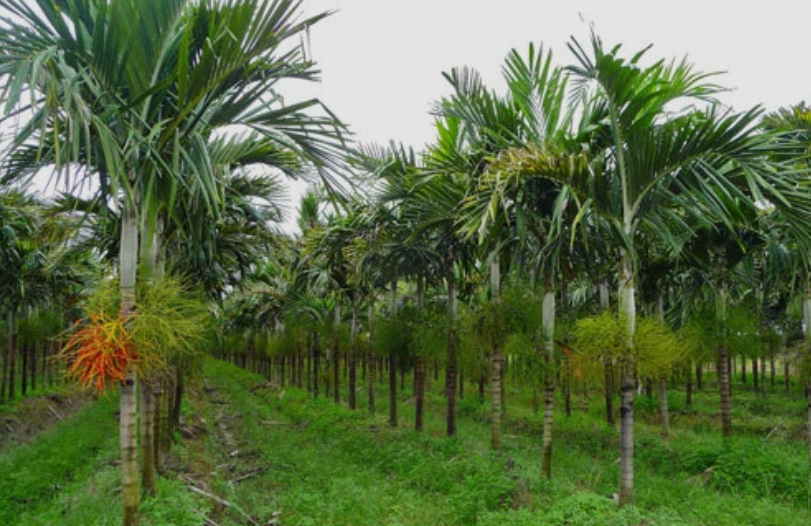
The solitaire palm is one of the slimmest landscape palms you can grow, with a single trunk that rarely grows wider than about 4 inches. The trunk is light gray to almost white and ringed with darker scars where old leaves have fallen. A smooth, bright green crownshaft sits at the top, and from it arches a small crown of feathery fronds with jagged, squared-off leaflet tips. Mature trees usually reach 20 to 25 feet, so the narrow trunk looks almost pencil-thin. Clusters of small, glossy red fruits hang below the crownshaft for much of the year and add a bright splash of color.
The solitaire palm is native to the rainforests of eastern Queensland in Australia, and it has become a favorite in warm parts of the United States. It grows outdoors mainly in South Florida, the Florida Keys, and Hawaii, where winter temperatures stay above about 35°F. Its small crown and slim profile let it fit narrow spaces near houses, along driveways, and in courtyards. Gardeners often plant it in groups of two or three for a fuller look. It also does well in large containers on patios and around pools.
2. Pygmy Date Palm
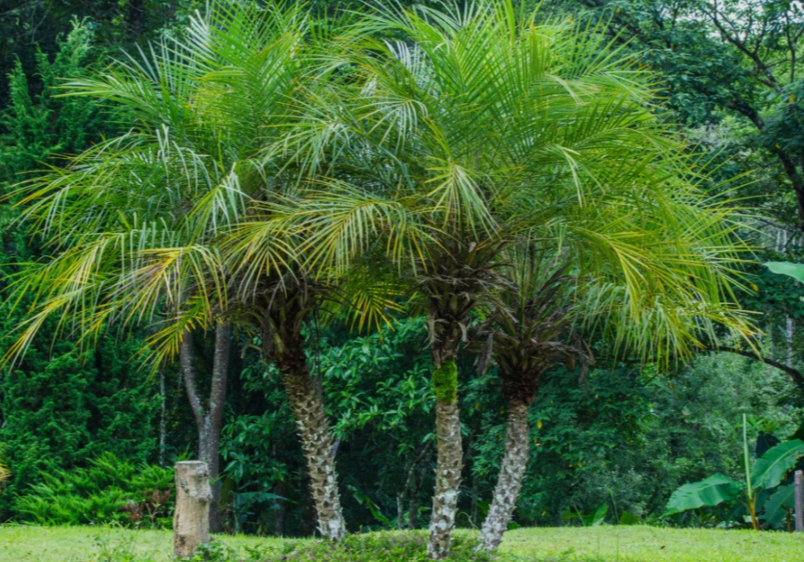
The pygmy date palm is a compact, finely textured palm with a slender trunk usually 3 to 6 inches across. The trunk is covered in knobby, peg-like leaf bases that give it a rough, textured look, and older trees sometimes develop a mass of aerial roots near the ground. It usually grows only 6 to 12 feet tall and carries a dense, rounded crown of soft, dark green fronds that arch gracefully outward. Be careful when you handle it, because long, sharp spines grow at the base of every frond. Female trees produce small dark purple to black dates, but they are mostly seed and skin.
The pygmy date palm is native to Southeast Asia, along the Mekong River region of Laos, Vietnam, and southern China. It is one of the most widely planted small palms in the United States, especially in Florida, Southern California, the Gulf Coast of Texas, and southern Arizona. It handles brief light frosts better than many tropical palms, though hard freezes can damage the fronds. Landscapers often plant it in clusters of three, with the trunks leaning outward, to create a multi-trunked effect. It is also a popular container palm for patios, entrances, and indoor spaces with bright light.
3. Florida Thatch Palm
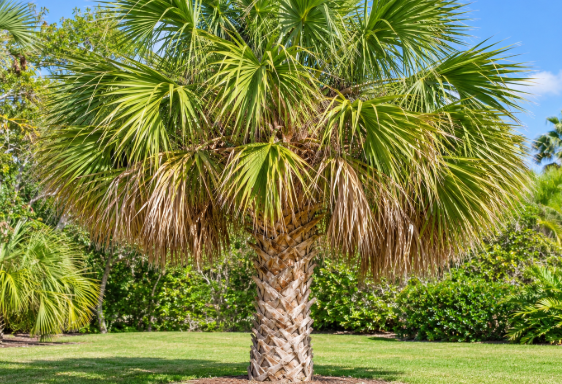
The Florida thatch palm is a native fan palm with a narrow, smooth gray trunk usually only 3.5 to 6 inches thick. It grows slowly to about 15 to 30 feet, carrying a rounded crown of glossy green, fan-shaped leaves on long, slender stalks. The leaf tips often droop softly, which gives the crown a relaxed, weeping look. The base of the trunk often shows a small mass of exposed roots, a common sight on palms that grow in thin coastal soils. In late summer and fall it produces small round white fruits that birds eat.
The Florida thatch palm grows naturally in the Florida Keys and the southern tip of mainland Florida. Its range continues into the Bahamas, the Caribbean, southeastern Mexico, and Central America. It is listed as endangered in Florida because of habitat loss and past overharvesting, so landscape trees should always come from nursery-grown stock. It tolerates salt spray, wind, sandy soils, and alkaline limestone very well. That makes it one of the best small palms for oceanfront yards in South Florida.
4. Key Thatch Palm
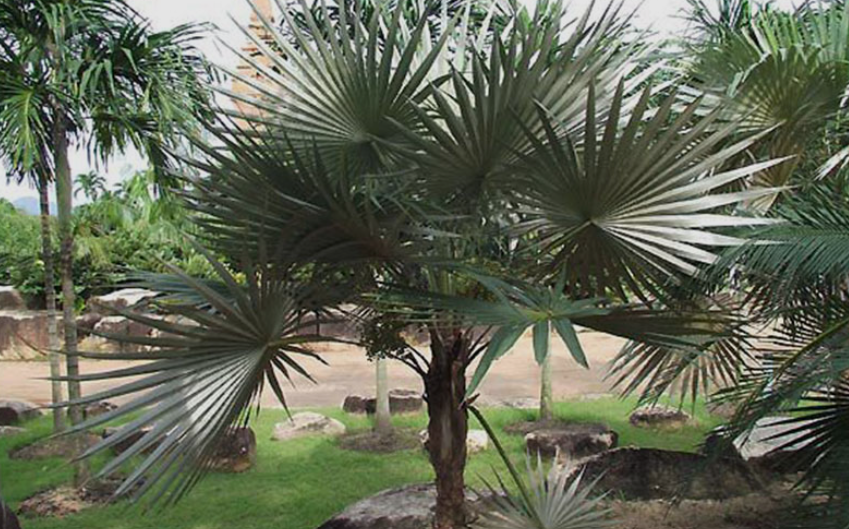
The key thatch palm is another slender native fan palm, with a smooth, narrow trunk and a crown of round fronds about 3.5 feet across. The underside of each frond is a shimmering silvery-white, so the whole crown flashes silver when the wind turns the leaves. It grows slowly to about 20 to 35 feet and usually has a single straight trunk. In spring and summer it produces long, drooping clusters of small white to yellow flowers. These are followed by tiny round fruits that turn from white to yellow when ripe.
The key thatch palm is native to the Florida Keys, extreme southern Florida, the Bahamas, and much of the Caribbean. It grows in USDA zones 10b and 11, so in the United States it is mostly limited to South Florida and the Keys. It is very tolerant of salt, drought, and poor rocky soils, and it has no major pest or disease problems. That makes it a low-maintenance choice for coastal landscapes, medians, and native plant gardens. Its narrow trunk and moderate size also make it work well in containers and on decks and patios.
5. Christmas Palm
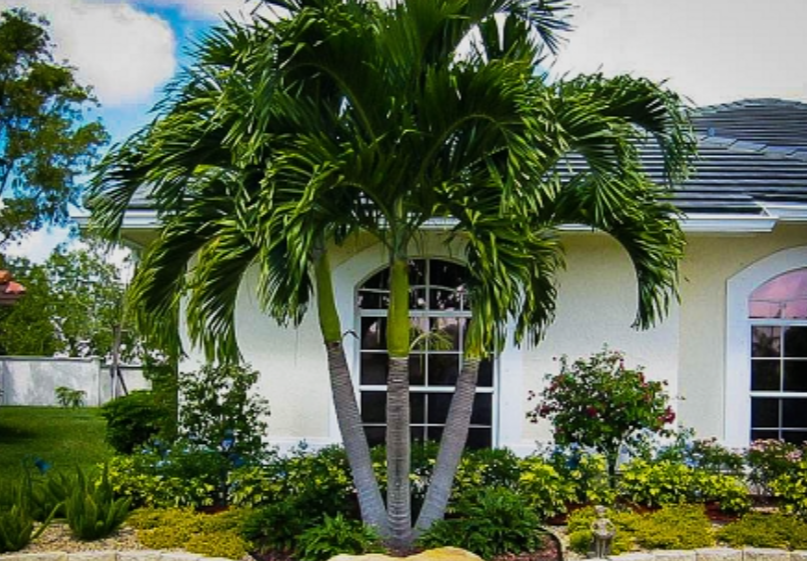
The Christmas palm, also called the Manila palm, is a neat, single-trunked palm with a slim, smooth gray trunk ringed with old leaf scars. It usually grows 15 to 25 feet tall, and its trunk stays well under a foot across, so it looks like a miniature royal palm. A short, bright green crownshaft supports a crown of stiff, upward-arching fronds. Its name comes from its clusters of glossy, bright red fruits, which ripen in early winter around the holidays. Those hanging bunches make it one of the most decorative small palms.
The Christmas palm is native to the Philippines, especially the island of Palawan. In the United States it is widely planted in South Florida and Hawaii, where it is a common sight in residential yards, shopping centers, and along streets. It is cold-sensitive and grows best in zones 10b and 11. It is also susceptible to lethal yellowing, a fatal disease, so gardeners in South Florida should watch for yellowing fronds and dropping fruit. Its small size and tidy habit make it ideal for narrow spaces and grouped plantings.
6. Mexican Fan Palm
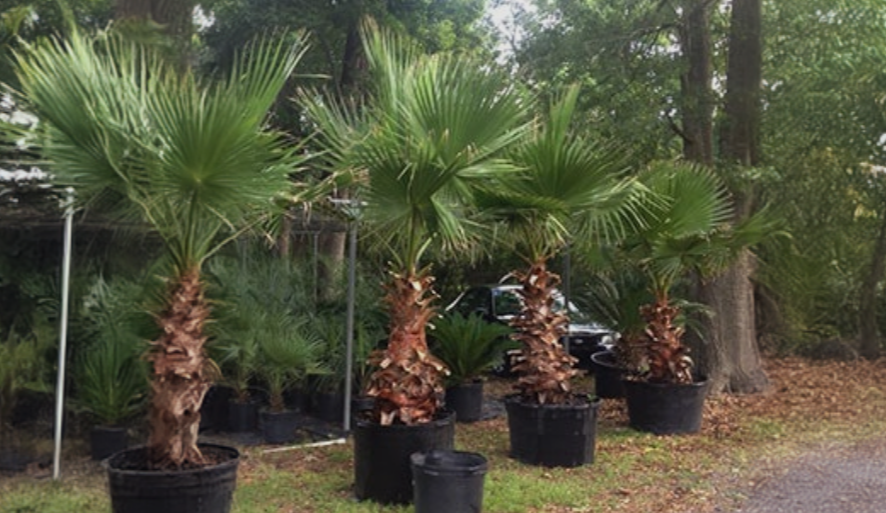
The Mexican fan palm is the tall, skinny palm that lines the boulevards of Los Angeles and many other Southwestern cities. It can reach 70 to 100 feet tall, yet above its slightly flared base its trunk is usually only about 1 foot across. That makes it look remarkably thin for its great height. At the top sits a small, compact crown of bright green, fan-shaped leaves on long stalks with sharp teeth along the edges. If the dead fronds aren’t trimmed, they hang down and form a thick brown skirt around the upper trunk.
The Mexican fan palm is native to the deserts of Baja California and Sonora in northwestern Mexico, where it grows around springs and canyon streams. It is one of the most widely planted palms in the United States. It is common throughout Southern California, Arizona, southern Nevada, Texas, and Florida. It grows very fast, tolerates heat, drought, and wind, and survives brief freezes into the low 20s°F. Its great height means it suits streets, large properties, and commercial landscapes better than small yards.
7. Kentia Palm
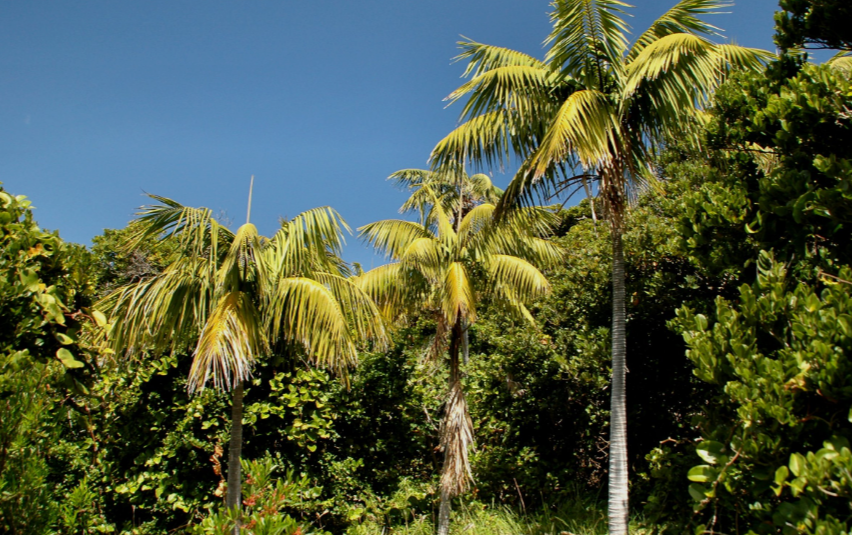
The kentia palm is famous as one of the most elegant indoor palms, but it is also a graceful slender-trunked palm outdoors. Its single trunk is smooth, ringed, and usually only about 4 to 6 inches across, even on mature trees. The crown is made of long, deep green, gently arching fronds that droop at the tips. Outdoors it slowly reaches 25 to 40 feet over many decades. Indoors it usually stays between 6 and 12 feet tall.
The kentia palm is native only to Lord Howe Island, a small island off the eastern coast of Australia. In the United States it grows outdoors mainly in coastal Southern California, the San Francisco Bay Area, and Hawaii, where mild, humid air suits it well. It tolerates shade better than almost any other palm and can grow under taller trees or along shaded walls. Across the rest of the country it is one of the most popular indoor palms for homes, offices, and hotel lobbies. It handles low light, dry indoor air, and occasional neglect well.
8. Areca Palm
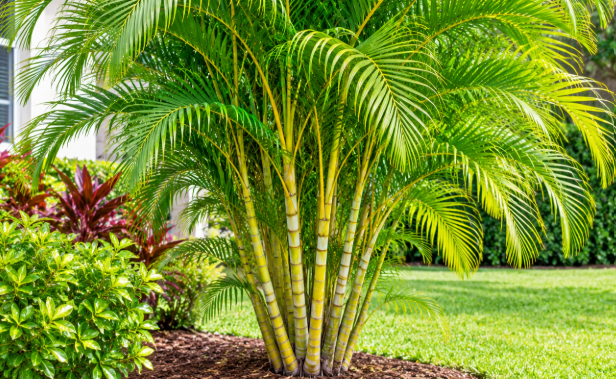
The areca palm, also called the butterfly palm or golden cane palm, grows as a clump of many thin, bamboo-like stems, each only a few inches across. The stems are yellowish-green to golden and ringed with leaf scars, and they grow close together to form a full, bushy cluster. Long, feathery fronds arch outward from the tops of the stems, and their yellowish stalks curve upward like butterfly wings. Outdoors it usually reaches 15 to 25 feet tall. New stems keep sprouting from the base, so the clump slowly gets wider.
The areca palm is native to Madagascar, and it is among the most widely grown palms in the world. In the United States it grows outdoors in South Florida, Hawaii, and the warmest parts of Southern California. There it is often planted as a dense privacy screen or tall hedge along property lines and pool enclosures. Everywhere else it is one of the most popular indoor palms, thanks to its feathery texture and tolerance of bright indirect light. Indoors, it needs steady moisture and good humidity to keep its fronds green.
9. MacArthur Palm
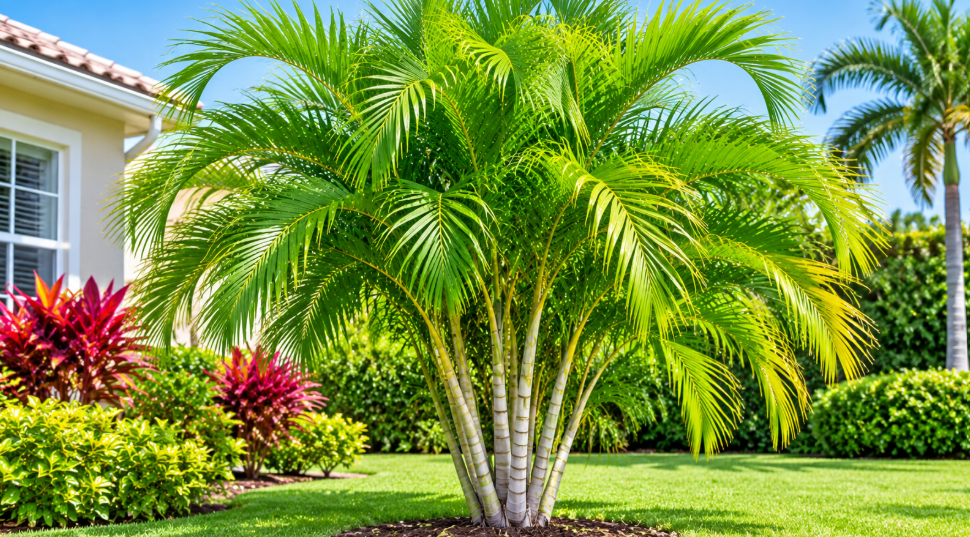
The MacArthur palm is a clustering palm with several thin stems, usually only 2 to 3 inches across. They are green to gray and neatly ringed with old leaf scars. Each stem ends in a short green crownshaft and a crown of feathery fronds with broad leaflets whose tips look jagged, as if they were cut with pinking shears. The clump usually reaches 10 to 25 feet tall and grows denser as new stems sprout from the base. Bright red fruits hang below the crowns in clusters, adding color for much of the year.
The MacArthur palm is native to New Guinea and the northern tip of Queensland in Australia. In the United States it is grown outdoors mainly in South Florida and Hawaii, where it handles partial shade, humidity, and regular rain. It is often used as a screen, an accent near buildings, or a backdrop for smaller tropical plants. Its slender stems and moderate size also make it a good container palm for patios, decks, and bright indoor spaces. Like the Christmas palm, it can be affected by lethal yellowing in parts of South Florida.
10. Paurotis Palm
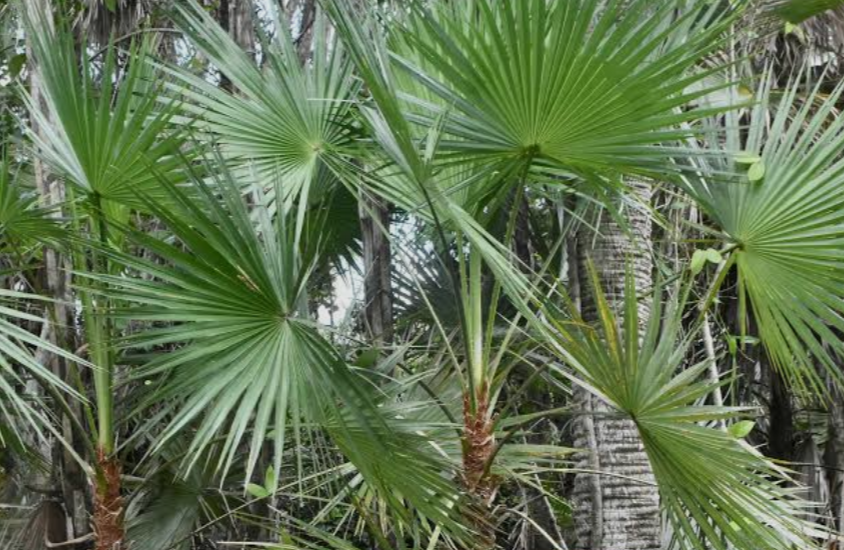
The paurotis palm, also called the Everglades palm, is a native clustering fan palm with many slender stems about 4 to 6 inches across. The stems are covered with brown fibers and old leaf bases, which gives them a shaggy, textured look. Each stem carries a rounded crown of bright green fan leaves on long stalks lined with sharp, curved teeth. Over time a single plant can form a dense, wide thicket of stems reaching 20 to 30 feet tall. In summer, long flower stalks rise above the leaves and are followed by small black fruits that birds eat.
The paurotis palm is native to the Everglades and other wetlands of South Florida, and it also grows in the Caribbean, southern Mexico, and Central America. In the wild it grows in swamps, sloughs, and the edges of hardwood hammocks, so it tolerates wet soils better than most palms. It is protected in Florida because wild plants were once heavily collected, so landscape palms should come from licensed nurseries. It grows outdoors in Central and South Florida in zones 9b through 11. It makes an excellent screen, a natural accent near ponds, or a feature palm in native landscapes.