Himalayan Birch Tree Identification: How to Recognize the Whitest Birch of All
Himalayan birch tree identification usually starts with one striking feature, bark so bright white that it can look painted. In the wild, though, this tree’s bark ranges from coppery-brown and pinkish-orange to creamy white, so color alone won’t always identify it. Himalayan birch is native to the high mountains of the Himalaya, from Afghanistan and northern India through Nepal and Bhutan into western China. It grows at elevations up to about 14,800 feet, where it often forms the last band of broadleaf forest below the alpine zone.
In North America, Himalayan birch is grown as an ornamental tree. It is most popular in the Pacific Northwest, the Northeast, and other cool regions, where it is prized for winter bark color. Landscape trees usually reach 30 to 40 feet tall and 18 to 25 feet wide, with an upright, open, pyramid-shaped crown on one trunk or several. The form with the brightest bark comes from the western Himalaya and is sold in nurseries as whitebarked Himalayan birch.
Bark
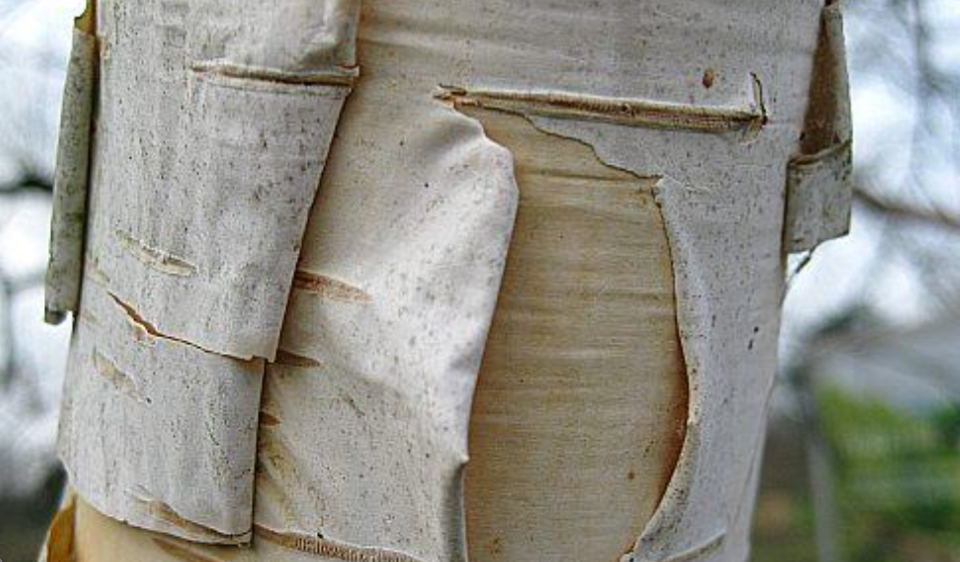
The bark is thin and smooth with scattered horizontal lenticels, and it peels in horizontal papery flakes and sheets. On the whitebarked form, the trunk and branches turn a clean, brilliant white at a young age, often within a few years of planting. It is widely considered the whitest bark of any birch, brighter even than paper birch or silver birch. The surface often has a faint chalky bloom that can rub off on your hand.
Wild trees and some cultivars have very different coloring. Their bark may be pink, orange-brown, or copper with a whitish bloom, and freshly peeled patches often show pale orange or cream underneath. The trunk doesn’t develop the black, deeply fissured base of older silver birch, and it lacks the dark triangular chevrons of gray birch, so the white stays clean all the way down the trunk.
Leaves
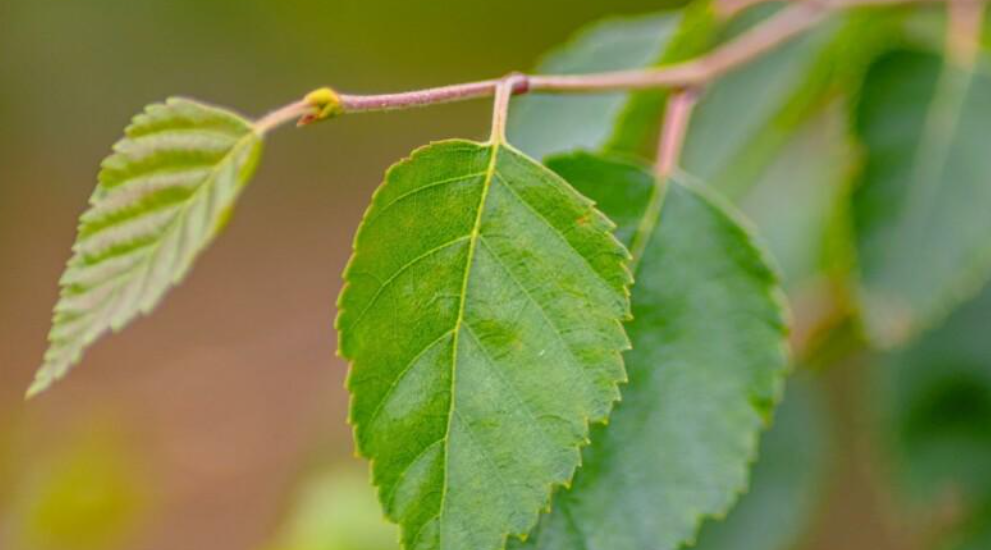
Himalayan birch leaves are simple, alternate, and oval to egg-shaped, with a tapering pointed tip and a rounded base. They are usually 2 to 4 inches long and can reach about 5 inches on vigorous shoots. That makes them noticeably larger than silver birch leaves and much less triangular than gray birch leaves. The edges are finely toothed, with the teeth ranging from mostly single to faintly doubled.
The leaves are dark green and slightly glossy above and paler underneath, with soft hairs along the veins. Each leaf has fairly closely spaced, straight veins, often 10 or more pairs, which gives it a neatly ribbed look. In autumn the foliage turns bright golden or buttery yellow, and against the white trunks it makes a strong fall display.
Also Read: Different Types of Birch Trees For Landscaping
Twigs and Branches
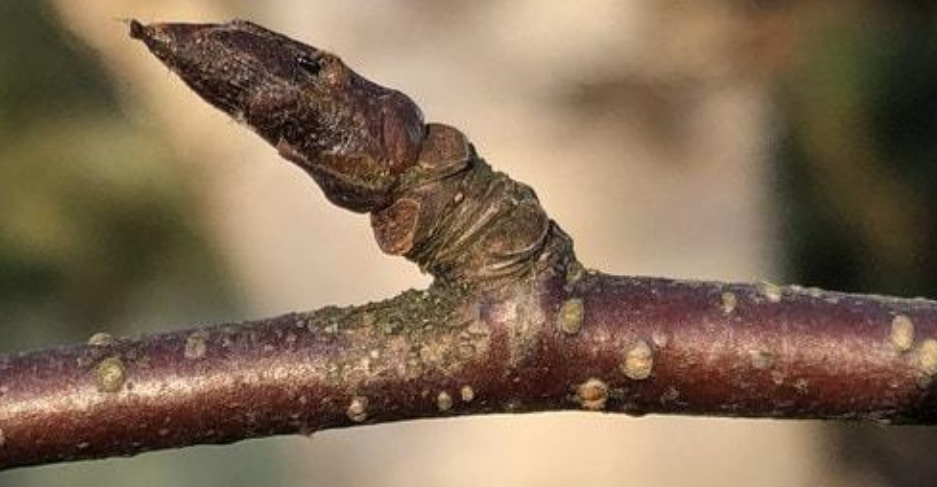
The twigs are slender and reddish-brown to dark brown, often slightly hairy when young and dotted with small resin glands. In autumn and winter the reddish color of the young twigs stands out against the pale trunk and limbs. Scraping a twig gives no wintergreen scent, which separates it from yellow birch and sweet birch.
The branches tend to grow upward and outward instead of drooping. That gives Himalayan birch a neat, open outline with no weeping branch tips. Many landscape trees are grown with three to five trunks, and on these the white bark often extends well up into the main limbs.
Catkins and Seeds
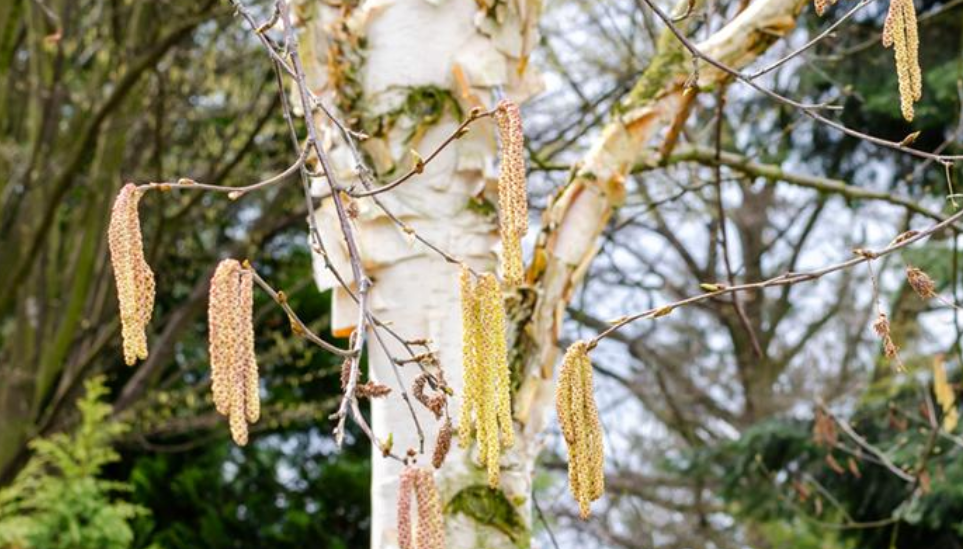
Himalayan birch has male and female flowers in separate catkins on the same tree. The male catkins form in late summer and stay on the twigs through winter. In spring they lengthen into drooping, yellowish-brown tassels usually 3 to 5 inches long, and some cultivars, such as ‘Jermyns’, have catkins close to 7 inches long. These long spring catkins are more conspicuous than those of most other birches.
The female catkins are much smaller, greenish, and upright, about 1.5 inches long. They appear with the new leaves and then mature into cylindrical, cone-like seed clusters that hang or angle outward from the twigs. In late summer and autumn these clusters break apart into tiny winged seeds and scales that scatter below the tree.
Look-Alikes
Paper birch and silver birch are the trees most often mistaken for Himalayan birch in North American landscapes. Silver birch has smaller, triangular leaves, warty twigs, weeping branch tips, and a black, fissured base on older trunks. Paper birch has bright white peeling bark too, but its leaves are more egg-shaped with fewer veins, and its bark is usually a slightly warmer, less chalky white.
Pest problems also help with identification in American landscapes. Himalayan birch is very susceptible to the bronze birch borer, especially in hot, dry summers, and that has limited how much it is planted in the Midwest and other warmer areas. If you look for very white, chalky peeling bark that is clean down to the base, larger oval leaves with closely spaced veins, upright branches, and long spring catkins, you can pick out Himalayan birch among the other white birches.
Where Himalayan Birch Grows
Himalayan Birch is native to the Himalayan mountain regions of India, Nepal, Bhutan, and Pakistan, as well as parts of southwestern China. It grows at high elevations, often in cool mountain forests and on rocky slopes. It is adapted to cold winters and relatively short growing seasons.
In North America, Himalayan Birch is mainly cultivated as an ornamental tree in cooler regions. It can be found in gardens, parks, and landscapes, particularly where winters are cold and summers are mild.
Key Characteristics for Identifying Himalayan Birch
- Bark: Bright white or creamy-white, peeling in thin papery layers.
- Leaves: Oval-shaped with pointed tips and toothed edges.
- Twigs: Slender, reddish-brown to dark brown, with small pointed buds.
- Catkins: Separate male and female catkins growing on the same tree.
- Size: Commonly 30–60 feet tall, with an upright crown.
- Natural habitat: Cool mountain forests and high-elevation slopes of the Himalayas.
Sources
- NC State Extension, “North Carolina Extension Gardener Plant Toolbox: Whitebarked Himalayan Birch”
- Oregon State University, “Whitebarked Himalayan Birch – Landscape Plants”
- Virginia Tech Dendrology, “Himalayan White Birch Fact Sheet”
- University of Alaska Fairbanks Cooperative Extension, “Himalayan Birch”
- The Morton Arboretum, “Himalayan Birch”