Gray Birch Tree Identification: How to Recognize the Old-Field Birch
Gray birch tree identification comes down to two features: the dark triangular patches on its chalky trunk and its sharply pointed triangular leaves. Gray birch is a small native tree of the northeastern United States and southeastern Canada. It is most common in New England, New York, New Jersey, and Pennsylvania, and scattered populations reach as far west as northern Indiana near Lake Michigan. Because it so often moves into abandoned farmland, it is also known as old-field birch.
Gray birch is a fast-growing, short-lived pioneer tree, sometimes adding 2 to 5 feet of height a year. It rarely grows taller than 40 feet and is more often 20 to 30 feet tall. It is usually one of the first trees to come back after fire, logging, or the abandonment of a field. It handles poor, sandy, rocky, wet, or dry soils that many other trees can’t, and in New England it often grows alongside pitch pine and scrub oak. Its soft, light wood decays quickly, and most trees live only a few decades.
Bark
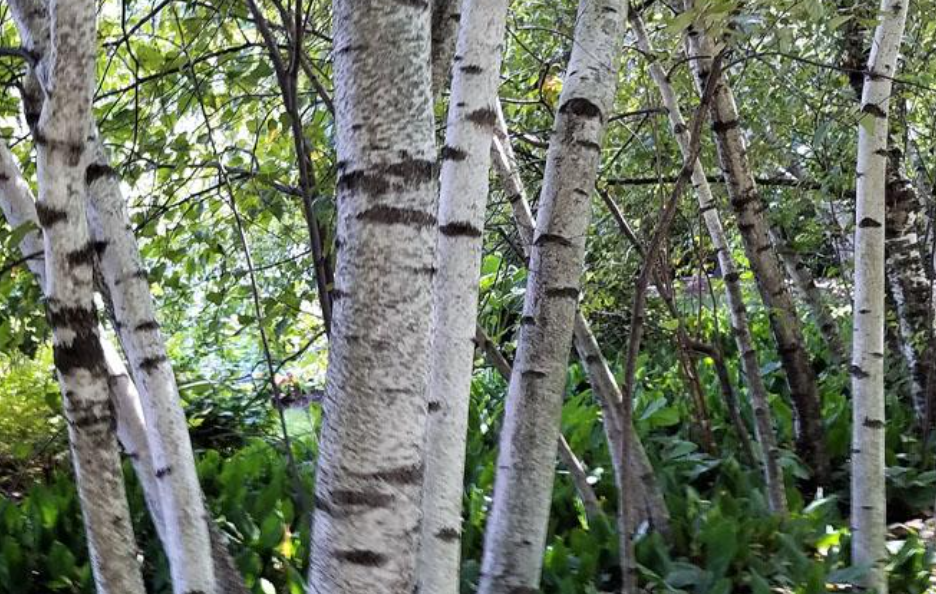
Gray birch bark is a dull, chalky grayish-white. It is noticeably duller than the bright white of paper birch and often looks a little dingy, with gray flecks and splotches. It stays tight to the trunk and does not peel in layers, which is the quickest way to tell it apart from paper birch. Very young stems and saplings have smooth reddish-brown to gray bark with pale horizontal lenticels before they turn white.
The black chevrons are the clearest bark clue. Below each branch, the trunk shows a dark, inverted V or triangular patch, as if someone had painted a mustache under the limb. These marks show up even on fairly young trees and stay on the trunk as it ages. On older trees the base becomes darker and rougher, and the bark there may break into shallow furrows.
Leaves
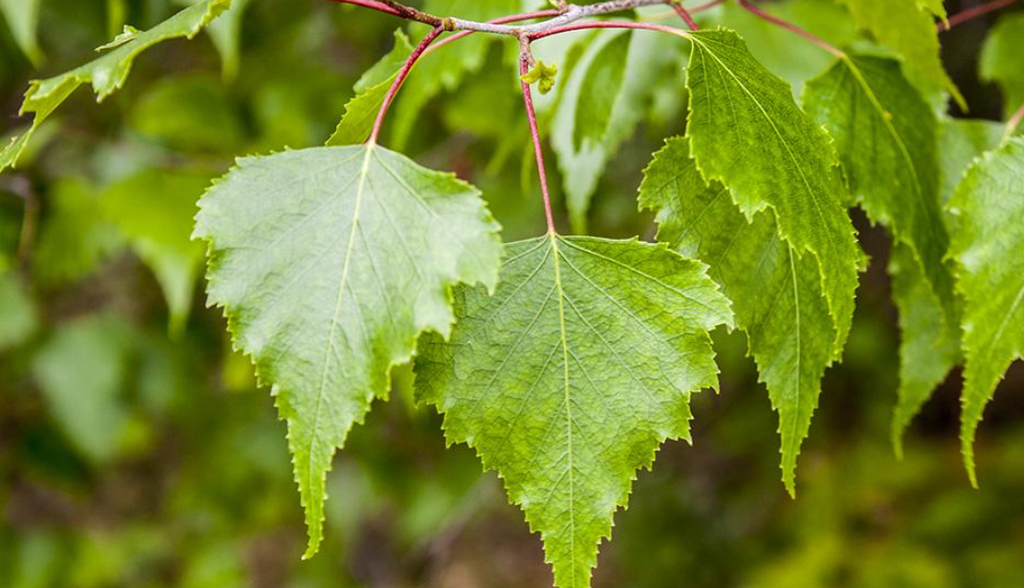
Gray birch leaves are the most distinctive of any native birch. They are simple, alternate, and triangular, usually 2 to 3.5 inches long. The base is wide and nearly straight across, and the tip narrows into a long, slender point. The edges are coarsely doubly serrate, with uneven larger and smaller teeth. The upper surface is glossy dark green and smooth, without the fuzz found on some other birches.
Each leaf hangs on a long, slender stalk, so the foliage trembles in the slightest breeze, much like a poplar or aspen. The tree’s name in other languages refers to this poplar-like leaf. Gray birch also leafs out early in spring, and in autumn the leaves turn a clear, often showy yellow before dropping.
Twigs and Branches
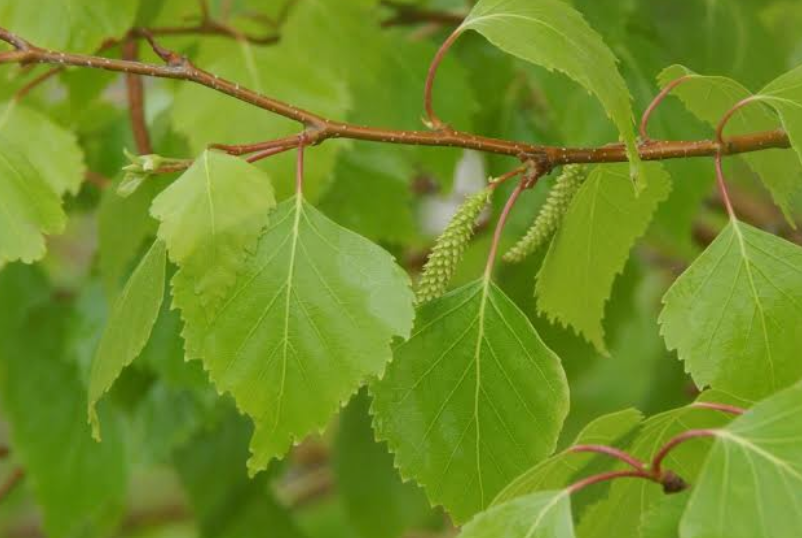
Gray birch twigs are thin, flexible, and brown to reddish-brown. They are often rough to the touch because of tiny raised resin glands. Scraping a twig gives no wintergreen scent, which quickly rules out yellow birch and black birch. The branches are slender and limber, and the tree usually grows in clusters of several trunks rising from one root system.
These clumps often lean or arch outward. The trunks are thin and flexible, and heavy ice or wet snow can bend them almost to the ground. Many recover partly, but they keep a permanent curve. A leaning cluster of slim, white, arching trunks at the edge of a field or along a roadside is one of the most recognizable sights of gray birch country.
Catkins and Seeds
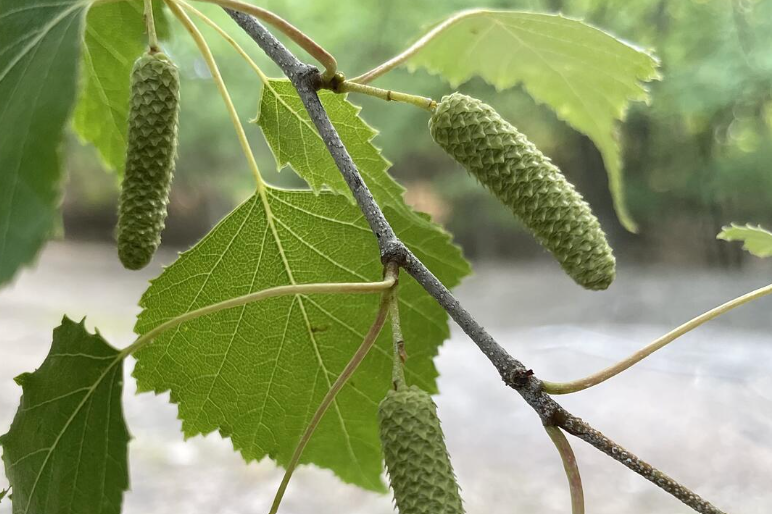
Gray birch carries male and female flowers in separate catkins on the same tree. The male catkins form in late summer and stay on the branch tips through winter. On gray birch they usually grow singly, one at each twig tip, while paper birch usually has them in groups of two or three. In spring they lengthen, droop, and release pollen as the leaves come out.
The female catkins ripen into small, cylindrical, cone-like seed clusters about 0.75 to 1.25 inches long, which point outward or slightly upward from the twigs. In autumn these clusters break apart into hundreds of tiny winged seeds and three-lobed scales that blow across open ground. These light seeds travel long distances on the wind, which is why gray birch so quickly fills in cleared land.
Look-Alikes
Paper birch is the tree most often confused with gray birch, and the two can grow side by side where their ranges overlap. Paper birch has bright white bark that peels in wide sheets, larger egg-shaped leaves with a rounded base and a shorter tip, and it grows into a larger, longer-lived tree. Gray birch extends farther south, while paper birch grows farther north and west.
Silver birch, the planted European species, also has triangular leaves and white bark that doesn’t peel much. It usually has weeping branch tips, scattered black diamonds instead of neat chevrons, and a much blacker, deeply fissured base on older trees. In landscapes, gray birch resists the bronze birch borer better than silver birch, but birch leafminer often turns its leaves brown in summer. If you look for the chalky non-peeling bark, the dark chevrons under the branches, and the long-tipped triangular leaves, you can identify gray birch with confidence.
Common Places Where Gray Birch Is Found in North America
Gray Birch is native to northeastern North America, particularly the northeastern United States and southeastern Canada. In the United States, it commonly occurs in Maine, New Hampshire, Vermont, Massachusetts, Connecticut, Rhode Island, New York, New Jersey, and Pennsylvania. In Canada, its natural range includes parts of Ontario, Quebec, and the Maritime provinces.
In its natural habitat, Gray Birch commonly grows in abandoned fields, woodland edges, rocky slopes, roadsides, and recently disturbed forests. It generally prefers well-drained soils and thrives in sunny locations where it can establish quickly.
Gray Birch Identification: Key Characteristics
The following features are useful when identifying Gray Birch:
- Bark: Smooth, chalky white or grayish-white bark with distinctive dark triangular markings near branch attachments.
- Leaves: Triangular leaves with long, pointed tips and double-serrated margins.
- Height: Commonly grows between 20 and 40 feet tall.
- Growth habit: Often develops multiple slender trunks and an irregular, open crown.
- Twigs: Thin, flexible, reddish-brown or grayish-brown branches.
- Catkins: Hanging male and female flower clusters that appear in spring.
- Seeds: Tiny, lightweight, winged seeds released from cylindrical fruiting structures.
Gray Birch is particularly recognizable because of its smooth, pale bark, dark triangular branch markings, and distinctly triangular leaves. These features help distinguish it from Paper Birch, River Birch, Yellow Birch, and other birch species found in North America.