Yellow Birch Tree Identification: How to Recognize the Golden Birch of the Northern Woods
Yellow birch tree identification is easiest when you look for its glowing bark. On a young or middle-aged tree, the trunk is shiny bronze, straw-gold, or silvery-yellow, and it peels in thin, curly strips that catch the light even on a gray winter day. Yellow birch is the largest native birch in North America. It usually grows 60 to 80 feet tall, and on the best sites it can reach about 100 feet with a trunk 1 to 3 feet across. Foresters also rank it as the most valuable native birch, because its hard, fine-grained wood is used for furniture, flooring, and cabinetry.
Yellow birch grows across the northeastern United States, the Great Lakes states, and southeastern Canada, and it extends south along the Appalachian Mountains. In the southern part of its range it grows only on cool, moist mountain slopes, generally above 3,000 feet. It is common in mixed forests with sugar maple, beech, and hemlock. It is also known for sprouting on rotting logs and stumps, so when the log underneath decays, the tree is left standing on stilt-like roots, which is a fun clue to spot in old woodlands.
Bark
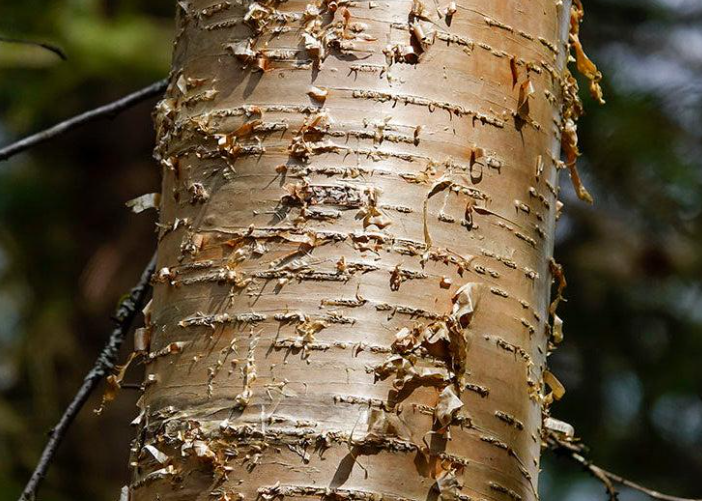
The bark changes a lot as the tree ages. Young trees have smooth, shiny bronze to golden bark with horizontal lenticels. As the trunk thickens, the outer bark peels into many narrow, papery curls that wrap around the trunk in ragged horizontal ribbons. Paper birch sheds broad sheets, but yellow birch bark looks shredded and frayed.
Once the trunk is about a foot in diameter, the bronze curls gradually weather away from the lower trunk. What’s left is thick, reddish-brown to gray bark broken into large, irregular plates. On these old trees, you will usually still see the golden curling bark higher up on the trunk and on the larger limbs, so look up if the base seems confusing.
Leaves
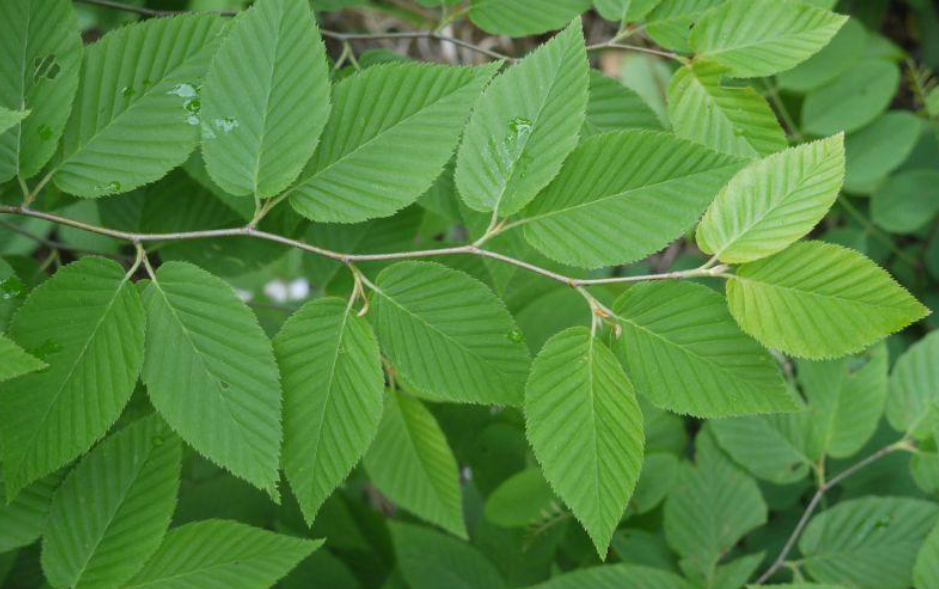
Yellow birch leaves are simple, alternate, and oval to oblong, usually 3 to 5 inches long, which is noticeably bigger than the leaves of paper birch or river birch. The edges are finely doubly serrate, with small teeth set along larger ones. The leaf base is often slightly uneven, with one side meeting the stem a little lower than the other. Straight, evenly spaced veins run from the midrib toward the edges, giving the leaf a neat, ribbed look.
In summer the leaves are dull dark green on top and paler underneath, with a few soft hairs along the veins. In autumn they turn bright golden yellow, so yellow birch is one of the most colorful trees in the northern hardwood forest at that time of year. Its fall color is another reason for the name, along with the bark.
Also Read: Different Types of Birch Trees for Landscaping
Catkins and Seeds
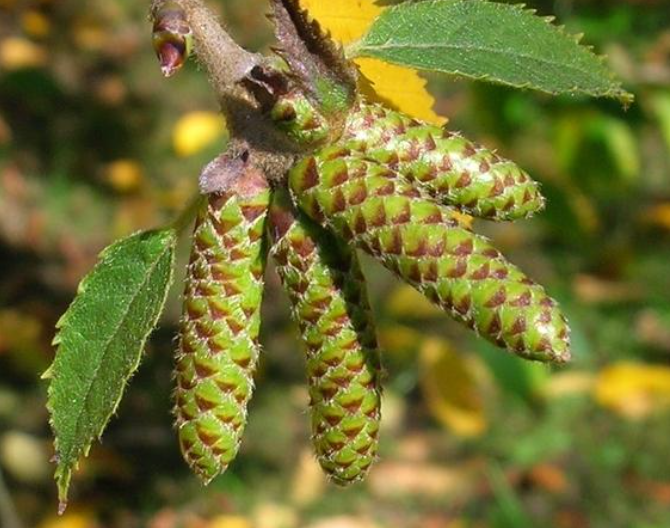
Like other birches, yellow birch carries male and female flowers in separate catkins on the same tree. The long, slender male catkins form in late summer, stay on the twigs through winter, and lengthen and release pollen in spring as the leaves open. The female catkins are shorter and grow upright on short side shoots along the branches.
The fruit is a good identification feature. It is an upright, egg-shaped cone-like cluster about 1 to 1.5 inches long and roughly three-quarters of an inch thick, made of hairy scales packed around tiny winged seeds. It ripens in autumn but breaks apart slowly, so many clusters stay on the tree well into winter. Paper birch and river birch fruits are slimmer and more cylindrical, while yellow birch fruits look plump and stubby, sitting upright on the twig.
Twigs and Buds
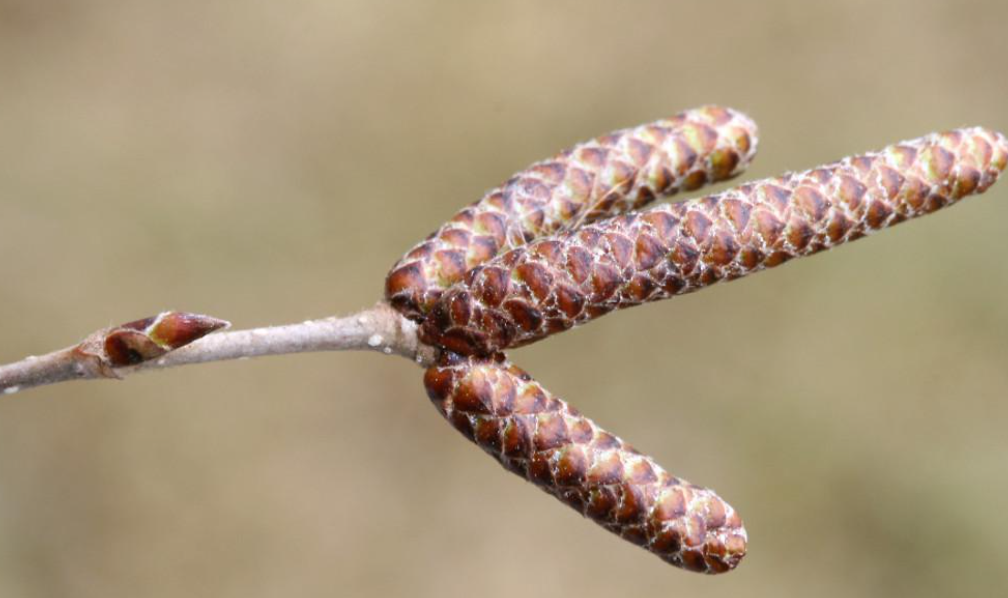
In winter, the twigs are one of the best ways to confirm a yellow birch. They are slender, light brown, and glossy, with scattered pale lenticels. If you scratch or snap a young twig, it gives off a wintergreen scent, and the inner bark has the same smell and taste. The aroma is milder than that of black birch, but it is enough to rule out paper birch, river birch, and the white-barked European birches, none of which smell of wintergreen.
The buds are small, pointed, and egg-shaped, with fine hairs along the edges of the bud scales. This detail matters when you are separating yellow birch from black birch, whose buds are smooth and shiny without the hairy fringe.
Look-Alikes
Black birch, also called sweet birch, is the tree most often confused with yellow birch. The two have similar leaves, grow in many of the same forests, and both have wintergreen-scented twigs. The bark is the easy difference. Black birch has dark, smooth, cherry-like bark that breaks into scaly plates with age and never forms golden peeling curls. Black birch also tends to grow at somewhat lower elevations than yellow birch in the mountains where both occur.
Paper birch is sometimes mixed up with yellow birch on young trees or in poor light, but paper birch bark is chalky white and peels in wide sheets, and its twigs have no wintergreen scent. If you check three things, the bronze shreddy bark, the plump upright fruit, and the wintergreen twig, you can identify yellow birch with confidence in any season.
Common Places Where Yellow Birch Is Found in North America
Yellow Birch is native to northeastern North America, particularly southeastern Canada and the northeastern United States. In Canada, it is commonly found in Quebec, Ontario, New Brunswick, Nova Scotia, and parts of Newfoundland and Labrador. In the United States, its natural range includes Maine, New Hampshire, Vermont, New York, Pennsylvania, Michigan, Wisconsin, and parts of the Appalachian region.
In the wild, Yellow Birch typically grows in cool, moist forests, mountain slopes, woodland valleys, and mixed hardwood forests. It often grows alongside sugar maple, American beech, eastern hemlock, and other northern forest trees.
Yellow Birch Identification: Key Characteristics
The following features are useful when identifying Yellow Birch:
- Bark: Golden-yellow, bronze, or silvery-yellow bark that peels in thin, curly strips.
- Leaves: Oval or elliptical leaves with pointed tips and double-serrated margins.
- Height: Commonly grows between 60 and 80 feet tall.
- Growth habit: Straight trunk with a rounded or irregular crown.
- Twigs: Slender, brownish twigs with a distinctive wintergreen-like fragrance.
- Catkins: Hanging male and female flower clusters that appear in spring.
- Seeds: Small, winged seeds released from cylindrical fruiting structures.
Yellow Birch is particularly recognizable because of its golden-bronze peeling bark and aromatic twigs. These features, combined with its oval leaves and large growth habit, make it easier to distinguish from Paper Birch, River Birch, Sweet Birch, and other North American birch species.
Sources
Purdue University Extension, “ID That Tree: Yellow Birch”
Michigan Technological University, “Paper Birch, Yellow Birch – Upper Peninsula Tree ID”
University of Vermont, “Yellow Birch – Plant Identification”
University of Vermont, “Yellow Birch Old Bark – Plant Identification”