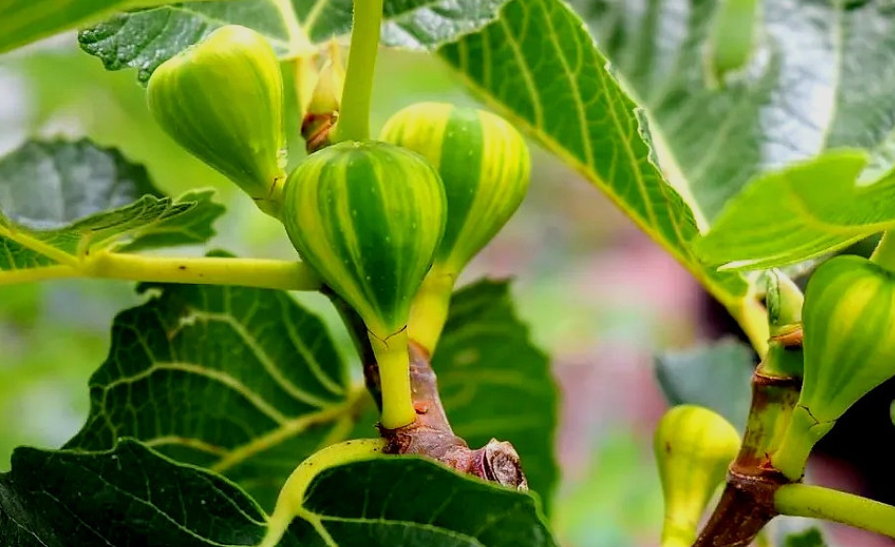
Panache Tiger Fig: The Striped Fig That Looks Like Candy
The Panache tiger fig, often called simply the tiger fig, is the most eye-catching fig you can grow. Its fruit is striped like a piece of candy. Bold bands of lime green and creamy yellow run from the stem to the eye, and inside is bright strawberry-red flesh. It is often described as tasting like raspberry jam. Even its admirers admit the stripes are half the appeal. Few fruits draw as many second looks in a garden, at a farmers market, or on a cheese board.
The Panache is also one of the oldest figs in cultivation. Its name comes from the French panachée, meaning “variegated” or “striped,” and it has been grown in Europe for centuries. It does come with a catch. It ripens very late in the season and needs a long, hot summer to bring its fruit to full sweetness. Gardeners in warm, sunny climates will find it one of the most rewarding figs they can grow. In cooler regions, growing it takes some planning.
Botanical Classification
The Panache is a cultivar of the common edible fig, a member of the mulberry family native to western Asia and the Mediterranean. It is known by many names, including Panachée, Tiger Stripe, Striped Tiger, Candy Stripe, Tiger Panache, and simply Tiger fig. Variegated figs like the Panache arise from natural mutations that affect the color of the fruit’s skin. Over time, these mutations have been selected and propagated by gardeners.
The Panache belongs to the “common” group of figs, which set fruit without pollination by the fig wasp. That means a single tree bears fruit on its own, and it can be grown almost anywhere figs can survive. Some growers report heavier crops when another fig variety grows nearby. The tree is fully self-fertile, though.
Brief History
The Panache is considered an ancient variety. British nursery records trace it back to at least 1668, and it was long grown in the gardens of France and southern Europe. Its striking fruit made it a favorite in aristocratic gardens and orangeries, where unusual and decorative fruits were prized as much for display as for eating.
The Panache eventually reached North America, where it has become a popular novelty fig for home gardeners and specialty growers. The University of California’s fig collection at the Wolfskill Experimental Orchard near Winters, California, is one of the largest living fig collections in the world. That collection has helped preserve striped figs like the Panache alongside hundreds of other varieties. Today the Panache is widely available from nurseries across the United States. It is also grown commercially in small quantities for specialty markets and restaurants.
Identifying Characteristics
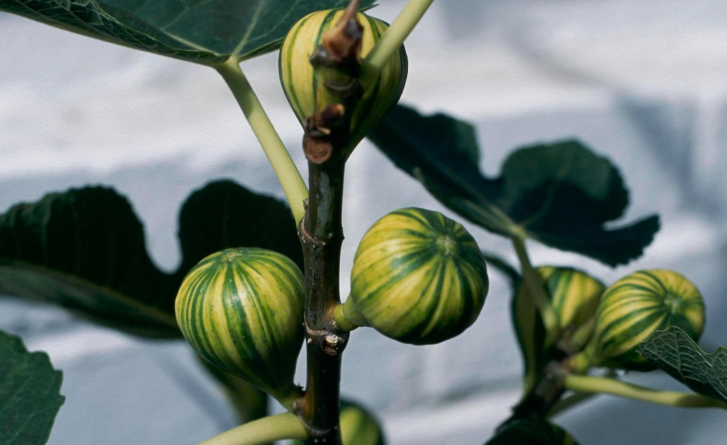
Panache fig trees are vigorous and spreading. They usually grow about 12 to 20 feet tall and wide if left unpruned, though they can easily be kept smaller. The bark is smooth and gray, and the large, lobed leaves are typical of figs. The trees are attractive in the landscape, especially when they are covered in ripening striped fruit.
The fruit is small to medium, usually about 1¼ to 2 inches across. It is teardrop-shaped, with a plump, rounded base that narrows to a short neck. The skin is boldly striped in alternating bands of green and pale yellow. The stripes often become more golden as the fruit ripens. Inside, the flesh is a vivid strawberry red to deep blood red. The texture is jammy and slightly dry, and the flavor is intensely sweet, with notes of berry and a hint of citrus. Like all figs, the tree produces a milky white sap that can irritate the skin.
A Main-Crop-Only Fig
Many figs produce 2 crops a year. A small early crop, called the breba crop, grows on the previous year’s wood, followed by a larger main crop on new growth. The Panache is different. It produces little or no breba crop and bears almost entirely on the current season’s new growth.
That has 2 important consequences. First, all of the Panache’s fruit ripens late, from late summer into fall. Second, the tree can be pruned fairly hard in winter without losing much of its crop, because the fruit forms on new shoots that grow after pruning. That makes the Panache easier to keep compact than many other figs.
Ripening Season and Climate
The Panache is a notably late fig. In warm climates, its fruit usually ripens from late August through September and October. That is often after Brown Turkey and Black Mission have finished. The figs need plenty of heat and sun to ripen properly. In regions with long, hot summers, such as California’s interior valleys, the desert Southwest, and much of Texas and the Gulf South, it ripens well and produces abundant crops.
In cooler regions, the Panache often struggles to ripen before fall frost. Gardeners in the Pacific Northwest, the Northeast, and high-elevation areas may find much of the crop still green when cold weather arrives. Nurseries generally rate the Panache for USDA zones 7 through 10, and some recommend it mainly for zones 8 and 9. It needs relatively little winter chilling, around 50 to 150 hours, so it also grows well in mild-winter areas.
Also Read: Different Types of Fig Trees
Tips for Ripening in Marginal Climates
Gardeners in areas with shorter or cooler summers can still succeed with the Panache by giving it extra heat. Plant it against a south- or west-facing wall, fence, or building, where reflected heat warms the tree and fruit. Paved areas and light-colored walls nearby add even more warmth. Growing the Panache in a container on a hot patio can also help.
Avoid heavy nitrogen fertilizer late in the season, which encourages leafy growth instead of ripening fruit. Keep the tree well watered through summer so it isn’t stressed, but don’t overwater as the fruit ripens. Pruning to open the canopy lets more sunlight reach the fruit. In especially cool areas, a greenhouse or hoop house can extend the season enough to ripen the crop.
Growing in Containers
The Panache is well suited to container growing, which lets gardeners in cold climates protect the tree and give it extra heat. Use a container of at least 15 to 20 gallons, with drainage holes and a well-drained potting mix. Place it in the sunniest, warmest spot available, ideally on a south-facing patio or against a heat-reflecting wall.
After the leaves drop in fall, move the container to an unheated garage, shed, or basement where temperatures stay above about 20 degrees Fahrenheit. Water lightly once a month during dormancy. Return it outdoors in spring after the danger of hard frost has passed. Because the Panache fruits on new growth, a container plant that is cut back in winter can still produce a good crop.
Planting and Care
Plant the Panache in full sun, in the warmest spot in your garden, with at least 8 hours of direct sun a day. Figs grow in many types of soil but need good drainage. They do poorly in soggy, waterlogged ground. In heavy clay, plant on a raised mound or bed.
Water young trees regularly during their first growing season. Established trees are fairly drought-tolerant, and growers value the Panache for its productivity in dry conditions. Even so, steady watering during summer helps the fruit size up. Mulch around the tree helps hold moisture. Fertilize lightly in spring if needed, and avoid feeding after midsummer.
Pruning
Because the Panache bears its fruit on new growth, it is one of the easiest figs to prune. Prune during the dormant season, in late winter before new growth begins. Remove dead, broken, and crossing branches, and thin crowded growth to let in light and air. To keep the tree compact, cut back the previous year’s shoots by about a third to a half.
Some gardeners prune the Panache hard each winter, keeping it at a manageable size of 6 to 10 feet. The tree responds with vigorous new shoots that carry the fall crop. Pruning also opens the canopy so more sun reaches the fruit, which helps late-season figs ripen.
Harvesting
Panache figs are ready to pick when the striped skin has softened and taken on a yellowish or golden tone. The fruit should feel soft when gently squeezed and droop on its stem. Small cracks in the skin and a drop of nectar at the eye are signs of full ripeness. Underripe Panache figs are dry and bland, so it pays to wait until they are fully soft.
Figs don’t ripen further after picking. Check the tree every day or 2 during the fall harvest, since ripe figs attract birds, squirrels, and wasps. Wear gloves and long sleeves to protect your skin from the milky sap. Fresh figs keep only a few days in the refrigerator.
Striped Fig Lookalikes
Several other striped figs are grown by collectors and are sometimes confused with the Panache. Col de Dame Mutante, also called Col de Dame Bicolor, is a striped mutation of a dark Spanish fig. Its fruit starts out looking much like the Panache, then ripens into a rainbow of red, yellow, and purple stripes before settling to deep purple. Col de Dame Rimada is a striped version of a green Spanish fig with sweet, late-ripening fruit.
Other striped figs include Jolly Tiger, an Italian variety, and Martinenca Rimada from the Balearic Islands. These figs vary in flavor, ripening time, and hardiness. Gardeners looking specifically for the classic green-and-yellow tiger fig with red flesh should buy a plant labeled Panache or Panachée from a reputable nursery.
Pests and Problems
The Panache is generally easy to grow in warm climates. Birds, squirrels, and raccoons are the biggest threats to the crop, and netting can help protect ripening figs. Fig souring, caused by yeasts and bacteria carried into the fruit by insects, can spoil figs on the tree, especially in humid weather. Late-season rain can cause fruit to split.
Root-knot nematodes can stunt fig trees in sandy soils, and fig rust can cause yellow-brown leaf spots and early leaf drop in humid climates. Fig mosaic virus may cause mottled leaves but usually doesn’t seriously affect production. The biggest challenge for most gardeners isn’t pests, though. It is getting this late fig fully ripe before fall cold arrives.
In the Kitchen
Panache figs are best eaten fresh, where their striking appearance can be enjoyed. Their sweet, jammy, berry-like flesh pairs beautifully with goat cheese, blue cheese, burrata, prosciutto, and honey. Halved and arranged on a platter, they make a stunning addition to cheese boards, salads, and desserts.
They can also be roasted, grilled, or baked into tarts. Cooking softens the stripes, so many cooks save the Panache for fresh dishes. Panache figs make jams and preserves with a deep red color. They can also be dried, though their relatively small size and late season make them more popular for fresh eating.
Sources
University of California, Davis, “Fig Varieties: A Monograph”
University of California, Davis, “Fig: Overview of an Ancient Fruit”
University of Florida IFAS Extension, “The Fig”