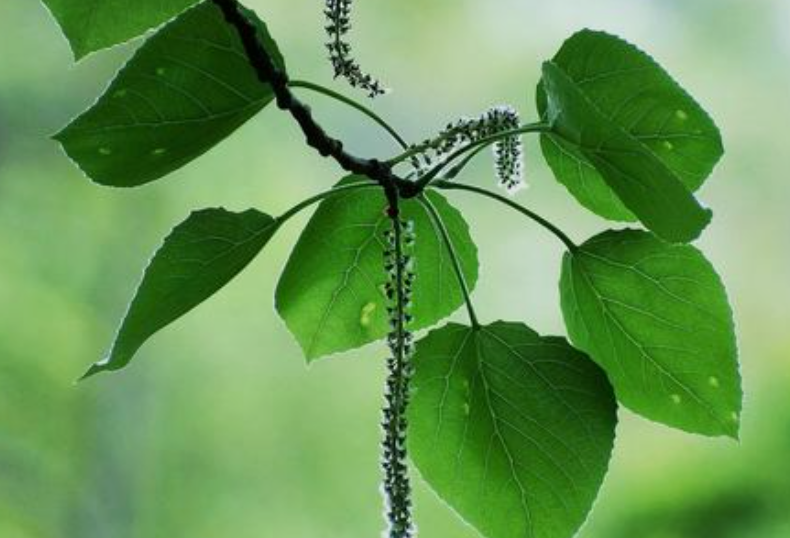
Japanese Aspen (Populus sieboldii): Japan’s “Mountain Rustler”
The Japanese aspen is the aspen of Japan’s mountains. It grows on sunny slopes, ridges, and forest clearings from Honshu south to Kyushu. Its round leaves hang on long, flattened stalks that send them trembling and clattering at the faintest breeze. In Japanese the tree is called yamanarashi, which roughly means “mountain rustler,” for the sound of its leaves filling the hillsides.
The tree has a second Japanese name, hakoyanagi, or “box willow,” because its light, pale wood was traditionally used to make boxes. Like other aspens, it is a pioneer tree. It is among the first to move into land opened by landslides, fires, and logging, and it is remarkably good at surviving disturbance. In North America it is a rarity, found mainly in a few botanical collections. It does share the familiar charm of aspens everywhere: pale bark, shimmering leaves, and golden fall color.
Botanical Classification
The Japanese aspen belongs to the willow family, alongside willows, cottonwoods, and other poplars. Within the poplars, it is one of the aspens. This small group also includes the quaking aspen and bigtooth aspen of North America, the European aspen, the Korean aspen, and the Chinese aspen. Botanists disagree on its rank. Many treat it as a separate species found only in Japan, while others consider it a Japanese variety of the European aspen.
Dutch botanist Friedrich Miquel described the tree scientifically in 1867. He named it in honor of Philipp Franz von Siebold, a German physician and naturalist who introduced many Japanese plants to Europe in the 19th century. In Japan’s northernmost island, Hokkaido, a related aspen grows that botanists usually group with the Korean aspen. The Japanese aspen proper is the aspen of Honshu, Shikoku, and Kyushu.
Brief History
The Japanese aspen has been part of Japan’s mountain forests for thousands of years. It thrives where fire, landslides, storms, and human activity have opened the forest canopy. In traditional rural Japan, people regularly cut woodlands for fuel and burned grasslands to maintain pasture and thatch meadows. That kind of land use created ideal conditions for pioneer trees like aspen and birch.
People made good use of its soft, light wood. It became a traditional material for boxes, which gave the tree its name hakoyanagi. In the 20th century it was widely used for matchsticks and paper pulp. Today it remains a common tree of Japan’s secondary forests, regrowing clearcuts, and mountain slopes. Japanese ecologists study it for its role in forest recovery after disturbance.
Also Read: Different Types of Aspen Trees
Identifying Characteristics
The Japanese aspen is a fast-growing deciduous tree, usually reaching about 50 to 80 feet tall. It has a straight trunk and a narrow, rounded to oval crown. Young bark is smooth and grayish white. On older trees, the lower trunk becomes dark brown, rough, and cracked, while the upper trunk and branches stay pale and smooth.
The leaves are broadly oval to nearly round, with slightly jagged, toothed edges and a short pointed tip. They are dark green and somewhat glossy above, and grayish white to silvery below, especially when young. That 2-tone effect makes the canopy flicker as the leaves move. Like other aspens, the leaves hang on long, flattened stalks that let them tremble and rustle in the wind. In fall they turn bright to pale yellow.
Flowers and Seeds
The Japanese aspen blooms in early spring, usually around March or April, before its leaves emerge. Male and female catkins grow on separate trees. The drooping catkins are about 2 to 4 inches long and are pollinated by the wind. Male catkins, with their reddish anthers, are the more ornamental of the 2.
Female catkins develop into strings of small capsules that split open in late spring, releasing tiny seeds covered in white, cottony hairs. The wind carries the seeds to bare ground, where they can sprout quickly on moist soil. In gardens, the drifting cotton from female trees can be messy.
How It Differs From Other Aspens
The Japanese aspen is very similar to the European aspen and the Korean aspen, and it can be difficult to tell them apart without knowing a tree’s origin. Its leaves are typically grayish white to silvery underneath and slightly jagged along the edges. The European and Korean aspens have coarser, wavier teeth. The Chinese aspen has much longer, tail-like leaf tips and 2 raised glands at the base of the leaf, which the Japanese aspen lacks.
The North American quaking aspen has smaller, finer-toothed leaves that are green on both sides, and its bark is creamier white. Geography is the most reliable way to identify the Japanese aspen. It is the native aspen of the main Japanese islands south of Hokkaido.
Native Range and Habitat
The Japanese aspen is found only in Japan, where it grows in mountains on Honshu, Shikoku, and Kyushu. It occurs from low hills to the mountains. It is most common on sunny slopes, ridges, forest edges, landslide scars, clearcuts, and burned areas. It usually grows on drier ground than the Japanese poplar, a related tree that prefers riverbanks and moist valleys.
It is a classic pioneer species, often growing alongside white birch, Japanese red pine, and other sun-loving trees in young forests. As the forest matures, slower-growing, shade-tolerant trees such as oaks, beeches, and evergreen broadleaf trees often grow up beneath the aspen and eventually replace it.
Surviving Fire and Disturbance
Like other aspens, the Japanese aspen is remarkably resilient. When its trunk is cut, burned, or damaged, its roots send up new shoots. A 2022 study at the foot of Mount Sanbe in Shimane Prefecture examined Japanese aspen growing in grassland that is burned every year. Despite the annual fires, the aspen survived by resprouting from its roots. It even expanded its range through new shoots from thin, spreading horizontal roots.
That ability makes the Japanese aspen valuable for stabilizing slopes and restoring damaged land. It can quickly cover bare ground after landslides, construction, or logging, protecting soil and creating conditions for other plants to grow. Over time, one tree can produce a small grove of genetically identical stems.
Ecological Importance
The Japanese aspen supports a wide range of wildlife in Japan’s mountain forests. Its leaves feed the caterpillars of many moths and butterflies, and its buds and catkins feed birds and insects in early spring. Deer, hares, and other mammals browse its young shoots and bark.
Older and dying aspens provide habitat for wood-boring insects and fungi, and nesting cavities for woodpeckers and other birds. Because it quickly colonizes disturbed ground, the Japanese aspen also plays an important part in forest succession. It helps cleared or damaged areas turn back into mature forest.
Wood and Other Uses
Japanese aspen wood is pale, soft, light, and easy to work. Its traditional use for boxes gave the tree its name hakoyanagi. It has also been used for matchsticks, paper pulp, chopsticks, and small wooden goods. Like other aspen wood, it doesn’t splinter easily and has little odor.
In rural Japan, the young leaves and shoots have sometimes been cooked and eaten as a wild vegetable. Like other poplars, the bark contains salicin, a natural compound related to aspirin, and has been used in traditional medicine. As with any wild plant, these uses should only be explored with expert guidance.
The Japanese Aspen in North America
The Japanese aspen is very rarely grown in North America. The US National Arboretum in Washington, DC, received budwood collected in Japan in 1986. Botanist Fred G. Meyer brought it back by hand from a plant-collecting trip. The tree is otherwise found mainly in specialized botanical gardens and arboreta, and it is almost never offered by nurseries.
Plant databases generally rate the Japanese aspen as hardy in USDA zones 4 through 8, tolerating winter temperatures to about minus 22 degrees Fahrenheit. In theory, that makes it suitable for much of the northern and central United States. Its performance in North American gardens has not been well documented, though. For most gardeners, the native quaking aspen and bigtooth aspen are easier to find and better adapted.
Growing Considerations
The Japanese aspen grows best in full sun and does not tolerate shade. It grows in a wide range of soils, including sandy, loamy, and clay soils, from mildly acidic to mildly alkaline. It prefers moist, well-drained conditions. It grows quickly and can reach a large size, so give it plenty of room.
Like other aspens and poplars, it has an aggressive, spreading root system and sends up suckers. Do not plant it close to buildings, foundations, driveways, septic systems, or water lines. Water young trees regularly during their first growing season. The Japanese aspen can be propagated from root cuttings, suckers, and fresh seed.
Pests and Diseases
Information on pests and diseases of the Japanese aspen in cultivation is limited. Like other poplars, it is likely affected by leaf rusts, leaf spots, cankers, wood decay fungi, leaf-feeding beetles and caterpillars, and wood-boring insects. Stressed trees are more likely to suffer serious problems.
In its native forests, these pests and diseases are part of the natural cycle that eventually replaces aspen stands with longer-lived trees. In gardens, the best defense is a sunny, open site with good soil, regular watering during drought, and care to avoid damaging the bark.
Sources
Royal Horticultural Society, “Japanese Aspen”
USDA Agricultural Research Service, “Germplasm Resources Information Network: Japanese Aspen”