Chinese Aspen (Populus adenopoda): The Rustling-Leaf Poplar of Southern China
The Chinese aspen is the southernmost of the world’s aspens. Most aspens are trees of cold northern forests and high mountains, from the quaking aspen of Canada and the Rockies to the European aspen of Scandinavia. The Chinese aspen grows instead on the warm, misty mountain slopes of subtropical China. Its range runs from the Yangtze River valley south to Guangxi and Yunnan, and it ranges from low hills to elevations of about 8,200 feet.
In Chinese it is called xiǎngyèyáng, usually translated as “sounding-leaf poplar” or “rustling-leaf poplar.” The name comes from the soft, constant whisper of its leaves, which tremble on long, flattened stalks like those of other aspens. The Chinese aspen is little known outside China and almost never grown in North America. It is still an important tree in its homeland, valued for timber and studied by scientists for what it reveals about how trees survived the Ice Age.
Botanical Classification
The Chinese aspen belongs to the willow family, alongside willows, cottonwoods, and other poplars. Within the poplars, it is one of the aspens. This small group also includes the quaking aspen and bigtooth aspen of North America, the European aspen, the Korean aspen, and the Japanese aspen. Of these, it grows the farthest south, in the warmest climate.
Russian botanist Carl Maximovich first described it scientifically in 1879. Its scientific name refers to the 2 small, raised glands at the base of each leaf blade, where it joins the leaf stalk. These glands are one of the tree’s best identifying features. Botanists recognize 2 varieties: the typical form and a broad-leaved variety with wider leaves.
Brief History
The Chinese aspen has a long and eventful history in the mountains of southern and central China. A 2018 genetic study published in the Annals of Botany examined 39 populations of the tree across its range. It found that the Chinese aspen survived the last Ice Age, roughly 21,000 to 18,000 years ago, in several separate refuges. It went through dramatic population declines, or bottlenecks, and then repeated expansions as the climate shifted.
The study found that populations in the southern part of the range carry the highest genetic diversity. However, they contributed little to the tree’s spread northward and eastward after the Ice Age. Instead, those regions were recolonized from other refuges. That makes the southern populations especially valuable for conserving the species’ genetic heritage. For centuries, people across southern China have also used the tree’s wood for building, furniture, and farm tools.
Identifying Characteristics
The Chinese aspen is a large deciduous tree. It can reach about 100 feet tall, with an egg-shaped to rounded crown. Its bark is smooth and grayish white on young trees, becoming dark gray and furrowed with age. Older branches are grayish brown and smooth. Young twigs are reddish brown and covered with fine hairs. Its winter buds are cone-shaped, smooth, and sticky.
The leaves set the Chinese aspen apart from other aspens. They are ovate to nearly round, about 2 to 6 inches long, with a long, tapering, tail-like tip. That tip is much longer and narrower than on the quaking or European aspen. The upper surface is dark green and shiny. The underside is grayish green and densely hairy when young. The base of the leaf is flat or heart-shaped, with 2 small, raised glands. The edges are curled slightly inward and lined with small, rounded, gland-tipped teeth. The leaf stalks are strongly flattened, usually about ¾ to 3 inches long and sometimes up to 5 inches. That shape lets the leaves rustle and tremble in the wind.
Also Read: Different Types of Aspen Trees
Flowers and Seeds
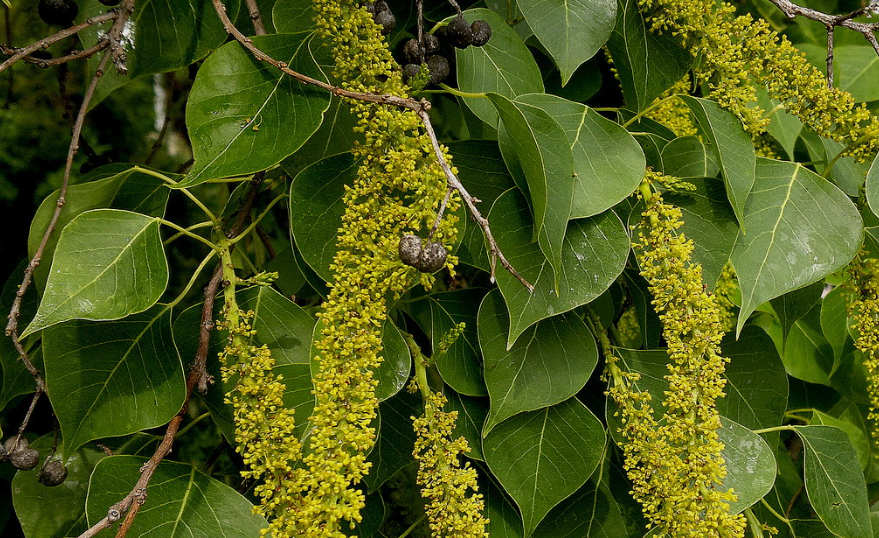
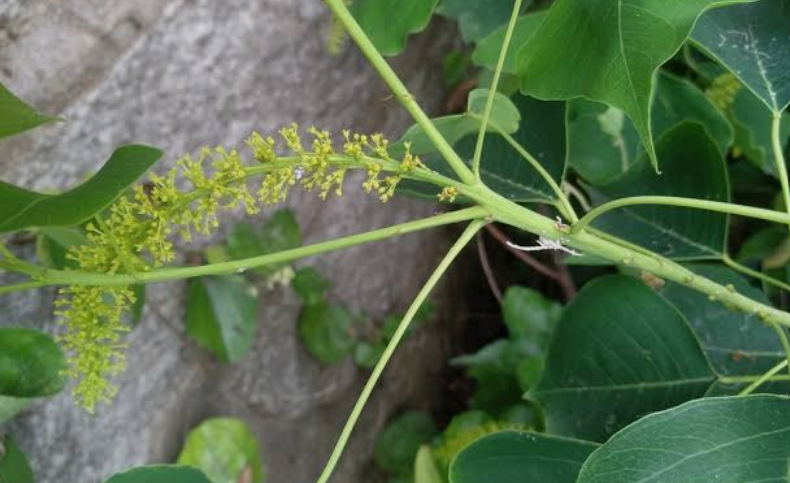
Like other aspens, the Chinese aspen produces drooping catkins in early spring before its leaves open. Male and female catkins grow on separate trees. Male catkins are about 2½ to 4 inches long, while female catkins lengthen as the seeds develop. In fruit they can reach about 5 to 8 inches, and occasionally up to 12 inches.
The female catkins produce small capsules that split open to release tiny seeds attached to fluffy white hairs. The wind carries the seeds long distances, letting the tree colonize open slopes, landslides, and clearings. Like other aspens, the Chinese aspen can also sprout from its roots, though it is less well known for forming large clonal groves than its northern relatives.
How It Differs From Other Aspens
The Chinese aspen is easy to distinguish from other aspens by its leaves and its habitat. Its long, tail-like leaf tips and the 2 raised glands at the base of each leaf are distinctive. The quaking, bigtooth, European, and Korean aspens all have shorter tips and lack prominent glands. Its leaves are also generally larger, and they are densely hairy beneath when young.
Its range is another clue. The Korean aspen grows in northern China, Korea, Japan, and the Russian Far East. The European aspen grows across Europe and northern Asia. The Chinese aspen grows farther south, in subtropical China, where winters are mild and summers are hot and humid. It is often described as growing “south of” the European aspen in China.
Native Range and Habitat
The Chinese aspen is native to central and southern China. Its range includes Anhui, Fujian, Guangxi, Guizhou, Henan, Hubei, Hunan, Jiangsu, Jiangxi, Shaanxi, Sichuan, Yunnan, and Zhejiang provinces, with some records farther north. Some sources extend its range into the eastern Himalayas, northeastern India, and Myanmar.
It grows on mountain slopes at elevations of about 1,000 to 8,200 feet. It is often found in mixed broadleaf forests, at forest edges, on sunny slopes, and in clearings and areas recovering from disturbance. Like other aspens, it loves light and is one of the first trees to colonize open ground. Over time, it is often replaced by slower-growing, shade-tolerant trees.
Ecological Importance
Like its northern relatives, the Chinese aspen is a pioneer tree that helps forests recover after landslides, fires, logging, and other disturbances. Its fast growth and wind-scattered seeds let it quickly cover bare ground. That helps stabilize soil on steep mountain slopes and creates shelter for other plants to grow.
Its leaves, buds, and catkins feed many insects, including the caterpillars of moths and butterflies. Its seeds and buds feed birds and small mammals. As the trees age, their soft wood provides habitat for fungi, wood-boring insects, and cavity-nesting birds. In the subtropical mountains of China, aspen stands add diversity to forests dominated by evergreen broadleaf trees and conifers.
Wood and Other Uses
Chinese aspen wood is light, soft, and easy to work. It has long been used for construction, furniture, farm tools, and general timber. It is also used for paper pulp, plywood, boxes, and other wood products. Because it grows quickly, it can provide timber in a relatively short time.
Chinese forestry researchers have studied the tree for its fast growth and adaptability to warm climates. Those traits could be useful for breeding poplars suited to subtropical regions. Most poplars and aspens are adapted to cool climates, so a warm-climate aspen is of special interest to tree breeders.
The Chinese Aspen in North America
The Chinese aspen is essentially unknown in North American gardens. It is not offered by ordinary nurseries. If it grows in North America at all, it would be found only in specialized botanical gardens, arboreta, or research collections with East Asian trees. Its hardiness and performance in North American climates have not been well documented.
It is a tree of subtropical, humid mountains. In theory, it might grow better than other aspens in warmer, more humid parts of the United States, such as the Southeast, where quaking aspen fails. That has not been tested, though. For most North American gardeners interested in aspens, the native quaking aspen and bigtooth aspen are far more practical choices.
Growing Considerations
Little is published about growing the Chinese aspen in cultivation outside China, but it likely shares the basic needs of other aspens. It probably grows best in full sun, in moist, well-drained soils, and in climates with ample rainfall. Like other aspens, it is intolerant of shade and does poorly in waterlogged soil.
Young trees should be watered regularly until established. Like other poplars, the Chinese aspen can likely be propagated from root cuttings, suckers, and fresh seed. Its seeds lose viability quickly, so they should be sown soon after they ripen.
Pests and Diseases
Information about pests and diseases of the Chinese aspen is limited in English-language sources. Like other poplars and aspens, it is likely affected by leaf rusts, leaf spots, cankers, wood decay fungi, leaf-feeding insects, and wood-boring beetles. In its native forests, these are part of the natural cycle, helping older aspen stands give way to longer-lived trees.
In cultivation, the best protection is planting in a suitable sunny site with good soil and avoiding damage to the bark. As with other aspens, healthy, vigorous trees are less likely to suffer serious problems.
Sources
Flora of China, “Chinese Aspen” (via Encyclopedia of Life)
Botany One, “Chinese Aspen With a Dynamic Quaternary Evolutionary History”