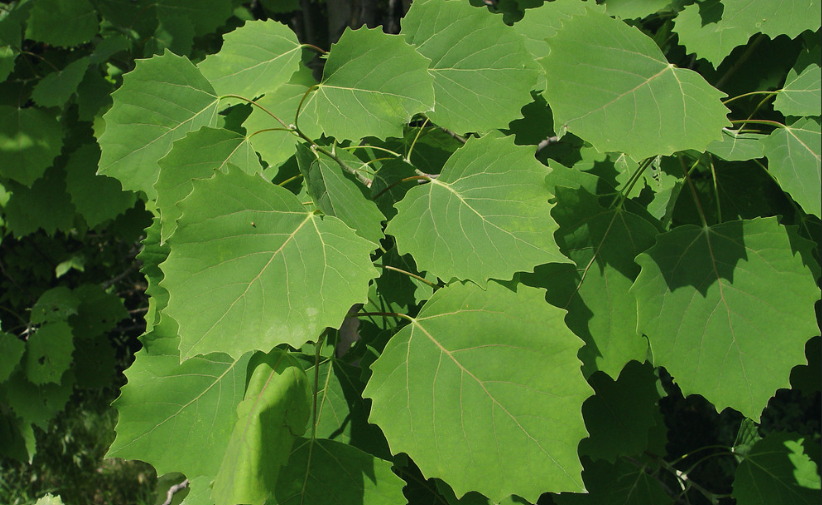
Bigtooth Aspen (Populus grandidentata): The Eastern Aspen With Coarse-Toothed Leaves
Bigtooth aspen is the aspen of eastern North America. It grows from Nova Scotia and Maine west through the Great Lakes to Minnesota and southeastern Manitoba, and south through the Appalachians. Its slender trunks and fluttering leaves are a familiar sight in young northern forests, old fields, and logged woodlands. In early spring its silvery, fuzzy young leaves give whole hillsides a soft gray-green glow.
At first glance it looks much like its better-known cousin, the quaking aspen, and the 2 often grow side by side. A closer look at the leaves reveals the difference that gives the tree its name: large, coarse, wavy teeth along the leaf edges. Bigtooth aspen is also generally larger and longer-lived than quaking aspen. It plays its own important role in eastern forests, where it is valued for pulpwood, wildlife habitat, and quick regrowth after disturbance.
Botanical Classification
Bigtooth aspen belongs to the willow family, alongside willows, cottonwoods, and other poplars. Within the poplars, it belongs to the aspen group, which also includes the quaking aspen, the European aspen, the Korean aspen, and the Japanese aspen. Its scientific name means “large-toothed,” a reference to its coarsely toothed leaves.
It goes by many common names, including largetooth aspen, large-toothed aspen, American aspen, popple, and poplar. In parts of New England it was once called white poplar, and in Tennessee large poplar. Bigtooth aspen and quaking aspen sometimes hybridize where they grow together, producing trees with features in between the 2 parents.
Brief History
Bigtooth aspen has long been part of the forests of eastern North America. It is a pioneer tree. Like quaking aspen, it quickly colonizes land opened by fire, windstorms, and logging, sprouting rapidly from its roots and shading out slower-growing competitors. Before European settlement, periodic fires helped maintain aspen stands across the northern Great Lakes region and New England.
In the late 1800s and early 1900s, the great logging era and the wildfires that followed swept across Michigan, Wisconsin, Minnesota, and the Northeast. Aspen spread widely across the cutover land as a result. Many of the aspen forests of the upper Great Lakes date from that period. In the 20th century, bigtooth aspen became an important commercial tree for the region’s pulp and paper industry. Foresters began managing aspen stands specifically for timber and wildlife.
Identifying Characteristics
Bigtooth aspen is a medium-sized deciduous tree. It usually grows 40 to 60 feet tall, with a straight, slender trunk and a narrow, rounded crown. Large trees occasionally exceed 70 feet. Young bark is smooth and pale greenish gray to yellowish tan. On older trees, the lower trunk becomes dark gray-brown with shallow furrows and flat ridges, and the dark bark often extends higher up the trunk than on quaking aspen.
The leaves are the key identifying feature. They are broadly oval to nearly round, about 2½ to 4 inches long, and larger than quaking aspen leaves. Their edges have large, coarse, wavy teeth up to about ¼ inch long. Like other aspens, the leaves hang on long, flattened leaf stalks that let them tremble in the wind. In spring, the young leaves are covered in a whitish, woolly fuzz, which gives them a silvery look. In fall they turn yellow to golden orange. The winter buds are dull gray and fuzzy. Quaking aspen buds are shiny and smooth.
Bigtooth Aspen Versus Quaking Aspen
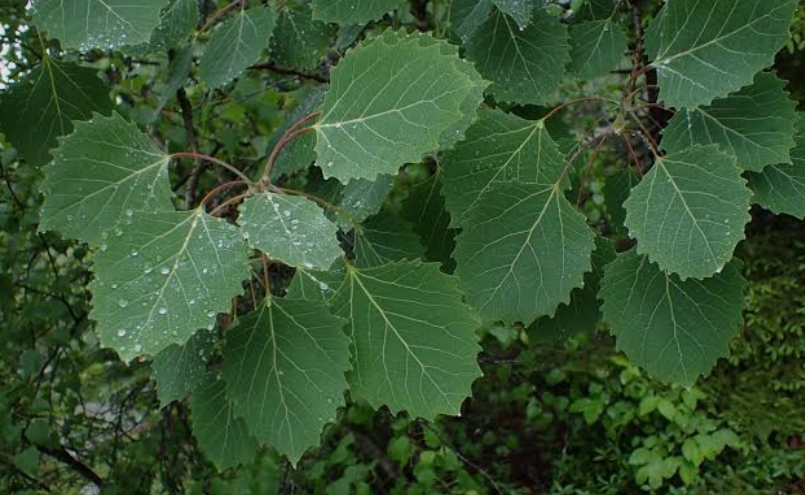
Bigtooth aspen and quaking aspen often grow together in the same forests, and many people find them hard to tell apart. The leaves give the clearest clue. Bigtooth aspen leaves are larger and have large, coarse teeth, while quaking aspen leaves are smaller and have fine, even teeth. In spring, bigtooth aspen leaves open later than quaking aspen leaves, often by a week or 2, and they emerge fuzzy and silvery.
The buds and bark also help. Bigtooth aspen buds are dull and fuzzy, while quaking aspen buds are shiny. Bigtooth aspen bark is often more yellowish or tan when young and turns dark and furrowed earlier. The 2 also prefer different sites. In the Great Lakes region, quaking aspen is the more common species overall. Bigtooth aspen dominates on drier, upland sites, often on sandy or loamy soils.
Range and Habitat
Bigtooth aspen grows across northeastern North America. Its range extends from Cape Breton Island in Nova Scotia and Maine south to Virginia, and west through southern Quebec and Ontario to southeastern Manitoba, Minnesota, and the eastern Dakotas. It extends south through Iowa to northeastern Missouri, and east through Illinois, Indiana, and Ohio. In the Appalachians it reaches western North Carolina and eastern Tennessee, where it is rare.
It grows in a variety of upland habitats, especially on well-drained sandy and loamy soils. It is common in young forests regrowing after logging or fire, in old fields, along woodland edges, and on dry ridges and slopes. It often grows with white pine, red pine, paper birch, red maple, northern red oak, and quaking aspen.
How Bigtooth Aspen Reproduces
Like other aspens, bigtooth aspen reproduces both by seed and by root suckering. Trees begin producing seed at about 10 years of age. They bear catkins in early spring before the leaves open, with male and female catkins on separate trees. The female catkins release tiny seeds attached to fluffy white hairs that float long distances on the wind. Seedlings need bare, moist soil and full sun to establish.
Most new bigtooth aspen stems come from root suckers. When a mature tree is cut, burned, or damaged, its roots send up many new shoots. Over time, this can create a grove of genetically identical stems called a clone. Bigtooth aspen clones are generally smaller than the huge quaking aspen clones of the West. Still, they can cover large areas, and in fall neighboring clones often change color at slightly different times.
Also Read: Different Types of Aspen Trees
Ecological Importance
Bigtooth aspen is an important tree for wildlife in eastern forests. Its buds, catkins, leaves, and twigs feed ruffed grouse, white-tailed deer, moose, snowshoe hares, and many other animals. Ruffed grouse rely heavily on aspen buds in winter. Young aspen stands provide excellent cover for grouse and woodcock. Beavers favor aspen for food and building material, and beaver activity often centers on aspen stands near water.
The leaves also feed the caterpillars of many butterflies and moths, including the viceroy, the red-spotted purple, and the eastern tiger swallowtail. Older and dying aspens provide nesting cavities for woodpeckers, chickadees, and other cavity-nesting birds. Because aspen grows quickly after disturbance, it helps protect soil, shades streams, and creates young forest habitat that many species depend on.
Timber and Other Uses
Bigtooth aspen is one of the most important commercial trees in the Great Lakes region. Its wood is light, soft, and fine-textured, and it is used mainly for paper pulp, particleboard, oriented strand board, and other engineered wood products. On good sites, large trees are sawn into lumber or peeled for veneer, which is used for crates, pallets, furniture parts, and paneling.
Aspen wood is also used for excelsior, matches, chopsticks, tongue depressors, and sauna benches. It doesn’t splinter easily and has little odor. Foresters often manage aspen stands by clearcutting, because it stimulates vigorous root suckering and produces a new, even-aged forest. Logging in fall and winter usually produces the most suckers.
Landscape Uses
Bigtooth aspen is not often planted in home landscapes, but it can be a valuable tree in naturalistic plantings, restoration projects, and wildlife habitat. Its fast growth, pale bark, silvery spring foliage, and golden fall color make it attractive in large, informal settings such as woodland edges, rural properties, and parks. It also works well for stabilizing eroding slopes and revegetating disturbed land.
Like other aspens, it has drawbacks in small yards. Its aggressive root suckering can fill lawns and garden beds with shoots. It is relatively short-lived, often declining after 50 to 70 years. Its soft wood can break in storms. It is best planted where it has room to spread and where its suckers won’t cause problems.
Growing Considerations
Bigtooth aspen grows best in full sun and does not tolerate shade. It prefers well-drained sandy or loamy soils, though it tolerates a range of soil types. It does poorly in heavy, poorly drained clay and in hot, dry climates outside its natural range. It is very cold-hardy, generally rated for USDA zones 3 through 5 or 6.
Water young trees during dry periods in their first growing season. Once established, bigtooth aspen tolerates moderate drought on well-drained soils. Avoid damaging the bark with mowers and string trimmers, since wounds let in canker diseases and decay. Bigtooth aspen is easy to propagate from root cuttings and suckers.
Pests and Diseases
Bigtooth aspen is affected by many of the same pests and diseases as quaking aspen. Insect pests include forest tent caterpillars, which can strip whole stands of leaves during outbreaks. Spongy moths and leaf-feeding beetles also feed on the leaves, and poplar borers and other wood-boring insects tunnel in the trunks.
Hypoxylon canker is one of the most serious diseases of aspen in the Great Lakes region. It causes yellowish-orange to black cankers that can girdle and kill trees. False tinder fungus causes heart rot in older trees. Armillaria root rot can weaken and kill stressed trees. Healthy, vigorous trees on good sites are less likely to have serious problems. In forests, these pests and diseases are part of the natural cycle that eventually replaces aspen with longer-lived trees.
Sources
Michigan State University Extension, “U.P. Tree Identification Key: The Aspens”
University of Wisconsin Extension, “How to Manage Aspen”
USDA Forest Service, “Fire Effects Information System: Bigtooth Aspen”
USDA Forest Service, “Silvics of North America: Bigtooth Aspen”
University of South Florida, “Tennessee-Kentucky Plant Atlas: Bigtooth Aspen”