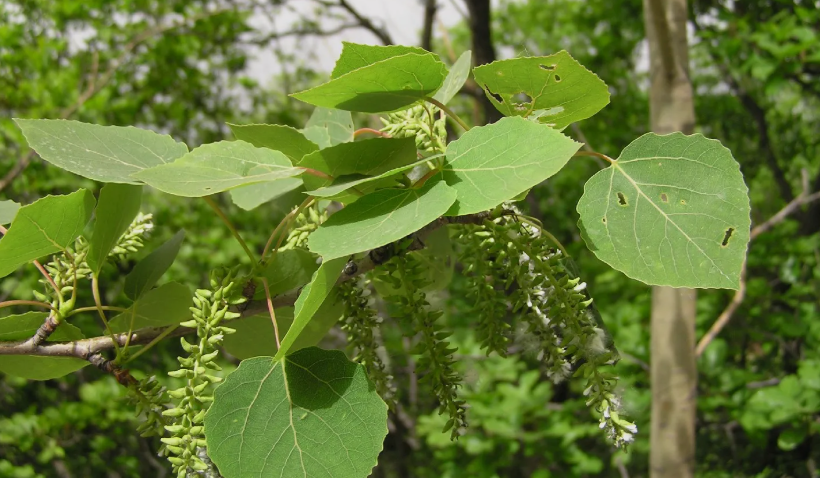
Korean Aspen (Populus davidiana): East Asia’s Trembling Tree
The Korean aspen is the aspen of East Asia. It grows across northern and central China, the Korean Peninsula, Japan, and the Russian Far East, where it fills burned hillsides, forest edges, and logged mountain slopes with pale gray trunks and fluttering green leaves. It is closely related to the quaking aspen of North America and the European aspen. Like them, it has round, restless leaves that shiver at the slightest breeze.
That trembling has given the tree a lasting place in Korean language and culture. In Korean it is called sasi-namu. An everyday Korean expression compares a person shaking with cold or fear to the leaves of the sasi-namu. Although it is rarely planted in North America, the Korean aspen plays an important role in the forests of Northeast Asia as a fast-growing pioneer tree, a home for wildlife, and a tool for restoring damaged land.
Botanical Classification
The Korean aspen belongs to the willow family, alongside willows, cottonwoods, and other poplars. Within the poplars, it belongs to the aspen group, which also includes the quaking aspen of North America, the bigtooth aspen of the eastern United States, the European aspen, and the Japanese aspen. It is the only aspen native to Korea.
Botanists disagree about whether the Korean aspen is a separate species or an eastern form of the European aspen. Some Korean botanical references treat it as a variety of the European aspen, while many Chinese and international sources list it as its own species. Genetic research published in 2020 found that the 2 aspens split from a common ancestor about 3.6 million years ago. The researchers linked that split to the rapid rise of the Tibetan Plateau, which reshaped the climate of Asia. The species was named in honor of Armand David, a 19th-century French missionary and naturalist who collected plants in China.
Brief History
The Korean aspen has a long history in the forests of East Asia. During the last Ice Age, when glaciers and cold steppe covered much of northern Asia, it survived in at least 2 refuges, one in northeastern Asia and one in southwestern China. As the climate warmed, it spread from those refuges to recolonize much of its present range. It traveled with other cool-temperate trees such as birch, oak, linden, and elm.
People across its range have long used the tree’s soft, light wood for matches, pulp, boxes, and carvings. In Korea, its trembling leaves inspired the familiar saying “to tremble like a sasi-namu.” In the 20th century, foresters began to value it for reforesting land cleared by logging, war, and fire. Its fast growth and vigorous sprouting make it a strong candidate for restoration projects in South Korea.
Identifying Characteristics
The Korean aspen is a medium to large deciduous tree. It usually reaches 30 to 80 feet tall, with a straight trunk and a rounded to oval crown. Its bark is smooth and pale grayish green to grayish white, marked with dark, diamond-shaped pores and scars. On old trees, the lower trunk becomes darker and rougher.
The leaves are nearly round, about 1½ to 3 inches across, with a short pointed tip. Their edges have dense, wavy, rounded teeth. They hang on long, flattened leaf stalks that let them flutter and rustle in the wind. New leaves often emerge reddish or bronze before turning green. In fall they turn yellow, sometimes with orange or reddish tones. In early spring, before the leaves open, the trees bear drooping catkins. Male and female catkins grow on separate trees. In Korea, the seeds ripen in mid to late May and drift away on tufts of white, cottony fluff.
Also Read: Different Types of Aspen Trees
How It Differs From Other Aspens
The Korean aspen is very similar to the European aspen and the North American quaking aspen, and it can be hard to tell them apart without knowing where a tree came from. Compared with the quaking aspen, its leaves have coarser, wavier teeth. In that respect it is closer to the European aspen. Its bark tends to be grayer than the creamy white bark of many western American quaking aspens.
Its geographic range is the most reliable clue. The Korean aspen grows in East Asia, the European aspen in Europe and western Asia, and the quaking aspen in North America. Within Asia, the Korean aspen can also be confused with the Japanese aspen and the Chinese aspen. The Japanese aspen has finer-toothed leaves, and the Chinese aspen grows farther south in warmer parts of China.
Native Range and Habitat
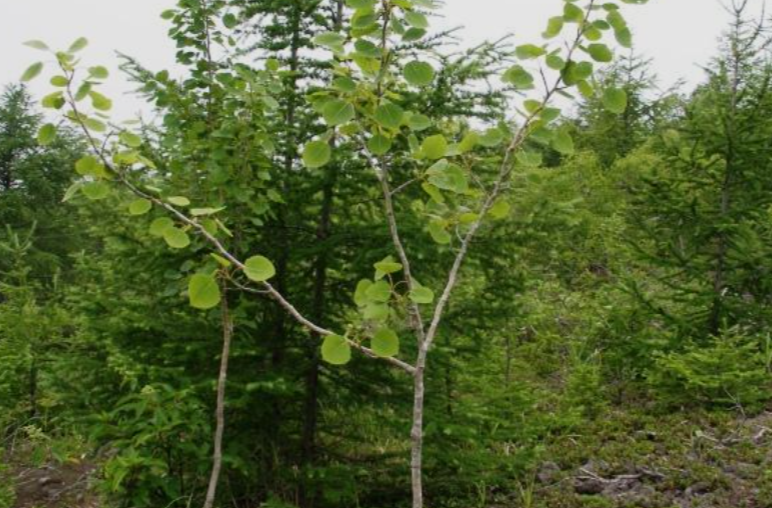
The Korean aspen grows across much of temperate East Asia. Its range includes northern and central China, Mongolia, the Russian Far East, the Korean Peninsula, and Japan, including the northern island of Hokkaido. In Korea it grows mainly in the north, from the Hamgyong and Pyongan regions south through the mountains of the Baekdudaegan range to northern Gangwon and Gyeonggi provinces.
It is a sun-loving pioneer tree that grows on sunny mountain slopes, forest edges, clearings, and riverbanks. After wildfires and logging, it often forms dense stands of trees that are all the same age, quickly covering bare ground. In parts of China, Russia, and Japan, it sometimes forms pure aspen forests. In South Korea, by contrast, it usually grows as scattered individual trees at forest edges.
Ecological Importance
Like its European and North American relatives, the Korean aspen is considered a keystone tree in the cool temperate and boreal forests where it grows. It is one of the first trees to colonize land after fire or disturbance, stabilizing soil and creating shelter for other plants. Over time, slower-growing conifers and broadleaf trees often grow up beneath it and eventually replace it.
Its leaves, buds, and bark feed many insects, as well as deer, moose, hares, and other wildlife. Its catkins provide early spring food for insects and birds. Old and dying aspens offer nesting cavities for woodpeckers and other birds, and their soft wood is home to many insects and fungi. In northern China and Russia, aspen stands are an important part of the forest mosaic. They add variety to landscapes otherwise dominated by conifers and birch.
Reforestation and Restoration
The Korean aspen grows quickly and reproduces vigorously. Like other aspens, it spreads by sprouting from its roots as well as by seed. These traits make it useful for restoring damaged forests and stabilizing eroding slopes. Researchers at Seoul National University and the Korea Forest Service have studied the genetic diversity of South Korea’s aspen populations to guide restoration projects.
Korean tree breeders have also used aspens and white poplars to create fast-growing hybrid poplars. One of the best known is the hybrid called hyun-sasi, developed by Korean forest geneticist Hyun Sin-kyu. It was widely planted in South Korea’s large reforestation programs after the Korean War, which helped turn bare mountainsides green again.
Wood and Other Uses
Korean aspen wood is pale, soft, light, and easy to work. In China, Korea, and Russia it has been used for matches, paper pulp, plywood, boxes, crates, chopsticks, and carvings. Like other aspen wood, it does not splinter easily, which makes it good for items that are handled often.
In northern China, the Korean aspen is planted for windbreaks, erosion control, and soil conservation, especially in cold, dry regions where few other trees grow quickly. Its bark has been used in traditional medicine in parts of East Asia. Researchers have also studied its fast growth and hardiness as possible traits for poplar breeding.
The Korean Aspen in North America
The Korean aspen is rarely grown in North America, and it is almost never available from ordinary nurseries. It appears mainly in botanical gardens, arboreta, and research collections. Because it comes from regions with cold winters and warm, humid summers, it is likely hardy in roughly the same parts of the northern United States and Canada as other aspens. However, its performance in North American gardens is not well documented.
For most North American gardeners, the native quaking aspen offers a similar look: pale bark, fluttering leaves, and golden fall color. It is far easier to find and better adapted to local conditions. Gardeners interested in Asian aspens can visit large arboreta with collections of East Asian trees. They can also check with specialty nurseries that offer rare species.
Growing Considerations
Like other aspens, the Korean aspen grows best in full sun and cool climates. It is intolerant of shade. It prefers moist, well-drained, slightly acidic to neutral soil, but it tolerates poor, rocky, and disturbed soils. It does poorly in hot, dry climates and waterlogged soils.
Water young trees regularly during their first growing season to help them establish. The Korean aspen grows quickly and spreads by root suckers, so plant it where new shoots won’t be a problem, away from lawns, patios, and foundations. It is easy to propagate from root cuttings and suckers, as well as from fresh seed.
Pests and Diseases
The Korean aspen is affected by many of the same problems as other poplars and aspens. Fungal diseases such as leaf rusts, leaf spots, cankers, and wood decay can weaken trees, especially those growing in stressful conditions. Leaf beetles, caterpillars, aphids, and wood-boring insects also feed on the tree.
In its native forests, these pests and diseases are part of the natural cycle, helping older aspen stands give way to other trees. In cultivation, the best defense is planting in a cool, sunny site with good soil and avoiding damage to the bark.
Sources
Flora of Korea, “Korean Aspen”