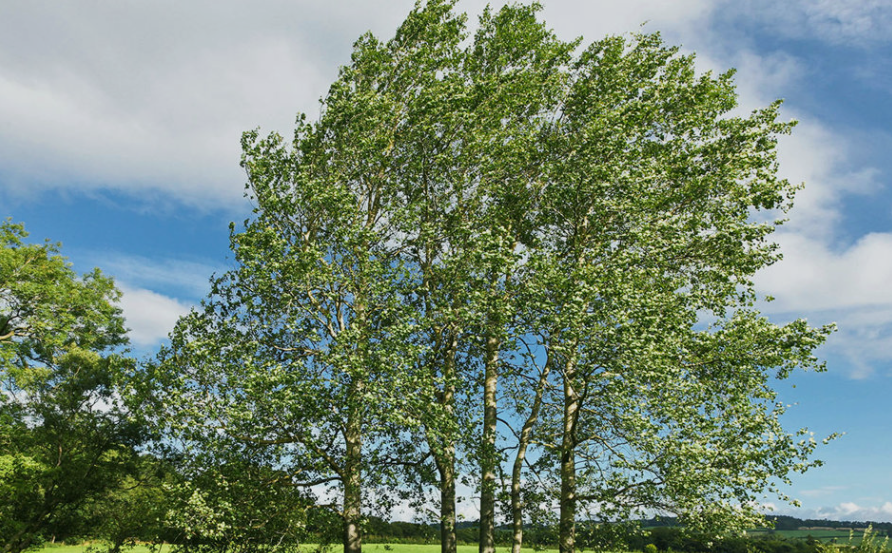
European Aspen (Populus tremula): The Whispering Tree of Europe and Asia
The European aspen is one of the most widely distributed trees on Earth. Its natural range runs from Iceland and the British Isles across Europe and northern Asia to China, Japan, and the Kamchatka Peninsula, and from above the Arctic Circle in Scandinavia south to North Africa. Like its North American cousin, the quaking aspen, it is known for its restless leaves, which flutter and shimmer at the faintest breath of wind and fill the air with a soft, constant whisper.
In much of Europe, the European aspen was long treated as a weed tree of little value. Ecologists now recognize it as a keystone species, one that supports an exceptional variety of insects, fungi, lichens, mosses, birds, and mammals. In North America, the European aspen is best known through one narrow, upright selection: the columnar Swedish aspen, a popular tree for screens and tight spaces in cold northern climates.
Botanical Classification
The European aspen belongs to the willow family, alongside willows, cottonwoods, and the other poplars. Its closest relative is the North American quaking aspen. Some botanists consider the 2 species, along with a few Asian aspens, a single worldwide group of closely related trees. The European and North American aspens can hybridize. Their hybrid, often called hybrid aspen, is widely grown in Scandinavia and the Baltic states for fast-growing timber plantations.
The tree has many common names. In Britain it is usually called simply aspen, and it is also known as common aspen, quaking aspen, Eurasian aspen, and European poplar. In Irish it is crann creathach, the “trembling tree.” It is one of only 2 poplars native to Britain. The other is the black poplar.
Brief History
The European aspen has been part of the landscape of Europe and Asia since the end of the last Ice Age. As a pioneer tree, it quickly colonized land left bare by the retreating glaciers. It still rapidly occupies ground opened by fire, storms, or clearing, often alongside birch.
Over centuries, though, it lost ground in many regions. Forests were cleared for farming and grazing, and foresters often removed aspen in favor of more valuable timber trees. In Scotland, aspen has probably suffered more from deforestation than any other native tree. Today it survives there mainly in small, scattered stands. Conservation groups such as the Scottish Wildlife Trust and Trees for Life are working to restore aspen to the Scottish Highlands, including the remnants of the ancient Caledonian Forest.
Also Read: Different Types of Aspen Trees
Identifying Characteristics
The European aspen is a medium to large deciduous tree. In good conditions it reaches about 50 to 100 feet tall, with a slender trunk and an open, rounded crown. The bark is smooth and pale greenish gray, marked with dark, diamond-shaped pores. On older trees the bark at the base of the trunk becomes darker, rougher, and furrowed.
The leaves are nearly round, about 1½ to 3 inches across, with coarse, wavy, rounded teeth along the edges. They grow on long, flattened leaf stalks that let them tremble in the wind. Young leaves often emerge with a coppery or bronze tint before turning dark green. In fall they turn butter yellow, sometimes with orange tones. In early spring, before the leaves appear, the tree produces drooping catkins. Male and female catkins grow on separate trees. Male trees bear woolly gray catkins, and female trees bear green ones. Female catkins release tiny seeds covered in fluffy white hairs that drift on the wind.
How It Differs From the North American Quaking Aspen
The European aspen and the North American quaking aspen look alike, but there are a few differences. The leaves are the easiest clue. European aspen leaves have larger, coarser, wavier teeth. Quaking aspen leaves have finer teeth and a more pointed tip. European aspen bark tends to be grayer, while quaking aspen bark is often whiter or creamier.
The 2 also differ in habitat and size. In the American West, quaking aspen is mainly a mountain tree. European aspen grows from sea level to the tree line across a wide range of forests. European aspen also tends to grow taller and broader in good conditions. Both spread by root suckers and form clonal groves, but the huge single-clone groves of the American West, such as Utah’s Pando, have no known equivalent in Europe.
Range and Habitat
The European aspen grows across a vast range. It occurs throughout Britain, Ireland, and continental Europe, east across Russia and Siberia to China, Korea, and Japan. In the far north it reaches beyond the Arctic Circle in Scandinavia. In the south of its range, in the Mediterranean region and North Africa, it grows mainly at higher elevations in the mountains.
It grows in a wide variety of habitats, from sea level up to the tree line. It occurs in most types of woodland, especially birch woods. It also grows in pine forests, on heaths, along rivers, in wet woodlands, and on rocky outcrops. It prefers full sun and does not tolerate deep shade, so it is most common at woodland edges, in clearings, and in young forests.
A Keystone Species
The European aspen is one of the most important trees for wildlife in Europe. It supports a remarkable variety of insects, beetles, flies, moths, fungi, lichens, mosses, and birds. In the United Kingdom, 5 species listed as conservation priorities depend on aspen. Among them is the rare aspen hoverfly, which breeds only in the rotting wood of dead and dying aspen trees.
Aspen’s smooth bark and relatively high bark pH make it an excellent host for rare lichens and mosses that grow on few other trees. Its leaves feed the caterpillars of many moths and butterflies, and gall midges and other small insects live on its shoots. Aspen is also a favorite food of beavers. As beavers are reintroduced to parts of Europe, healthy aspen stands are becoming even more valuable. Because so many species depend on it, restoring aspen is a priority in woodland conservation across northern Europe.
Wood and Other Uses
European aspen wood is pale, soft, lightweight, and very buoyant when dry. It has traditionally been used for oars, paddles, surgical splints, matches, and paper pulp. In Scandinavia it is a classic wood for sauna benches and interior paneling, because it doesn’t splinter easily, stays cool to the touch, and has little odor. It has also been used for carving, toys, and wooden shingles.
In the Nordic and Baltic countries, hybrid aspen is grown in large plantations for pulp and timber, because it grows very fast. Aspen and its hybrids are also planted to clean up polluted soils. Their extensive roots can absorb some contaminants, a process called phytoremediation. Aspen is also used in shelterbelts and windbreaks because of its wind resistance and fast growth.
Folklore and Culture
The trembling leaves of the aspen have inspired folklore across Europe. In ancient Greece, aspen was associated with the underworld. In Celtic tradition, it was linked to communication, protection, and the passage between worlds, and its wood was used to make shields. In parts of Scotland and Ireland, people once avoided cutting aspen, believing it to have special powers.
A Christian legend common in many parts of Europe holds that the aspen trembles in shame because its wood was used to make the cross of Jesus. In Scandinavia and Russia, aspen has long been part of both folklore and traditional building, and its whispering leaves feature in poetry and songs. Today the tree remains a powerful symbol of northern forests.
The Columnar Swedish Aspen in North America
Most North American gardeners know the European aspen through a single selection, the columnar Swedish aspen. Discovered in Sweden in the 1920s, this tree grows tall and very narrow, usually about 35 to 50 feet tall but only 5 to 15 feet wide. Its rigidly upright, spire-like form makes it a popular choice for privacy screens, windbreaks, vertical accents, and narrow spaces between buildings.
The columnar Swedish aspen is extremely cold-hardy, generally rated for USDA zones 2 through 5. It is a favorite in the northern United States and Canada. It tolerates road salt, urban pollution, and a range of soils, and it is considered far more disease-resistant than the Lombardy poplar, a narrow poplar once widely used for screens. It can still be affected by canker diseases and leaf problems, especially in hot, dry climates. Utah State University Extension notes that it seems to send up fewer root suckers than the native quaking aspen, but it can still decline fairly quickly in stressful sites.
Growing Considerations
The European aspen and its columnar form grow best in full sun and cool climates. They tolerate a wide range of soils, from sand to clay and from rocky ground to moist lowlands. They prefer moist, well-drained soil and dislike prolonged waterlogging. In hot, dry regions, they often struggle. Plant them on north- or east-facing sites, away from hot, reflective surfaces.
Water newly planted trees deeply and regularly during their first growing season to help them establish strong roots. A layer of mulch over the root zone helps keep the soil cool and moist. Like other aspens, European aspen spreads by root suckers. Plant it away from lawns, patios, and foundations, or be prepared to remove unwanted shoots. European aspen is easy to propagate from root cuttings and suckers.
Pests and Diseases
The European aspen is affected by several fungal diseases, including cankers, leaf rusts, leaf spots, poplar scab, and powdery mildew. These are most serious on young trees and in humid conditions. Nurseries often cut back young saplings to help them recover from mildew, rust, and leaf spot. Healthy, vigorous trees in sunny, airy sites are less likely to have serious problems.
Insect pests include leaf beetles, leaf-mining insects, aphids, and wood-boring beetles, which can weaken stressed trees. In landscapes, the best protection is planting the tree in a suitable cool, sunny site, watering during droughts, and avoiding damage to the bark from mowers and string trimmers.
Sources
Scottish Wildlife Trust, “Aspen”
European Commission, “European Atlas of Forest Tree Species: Eurasian Aspen”
Utah State University Extension, “Ask an Expert: How to Keep Your Aspen Trees Happy”