Quaking Aspen (Populus tremuloides): North America’s Most Widespread Tree and Its Hidden Underground Forests
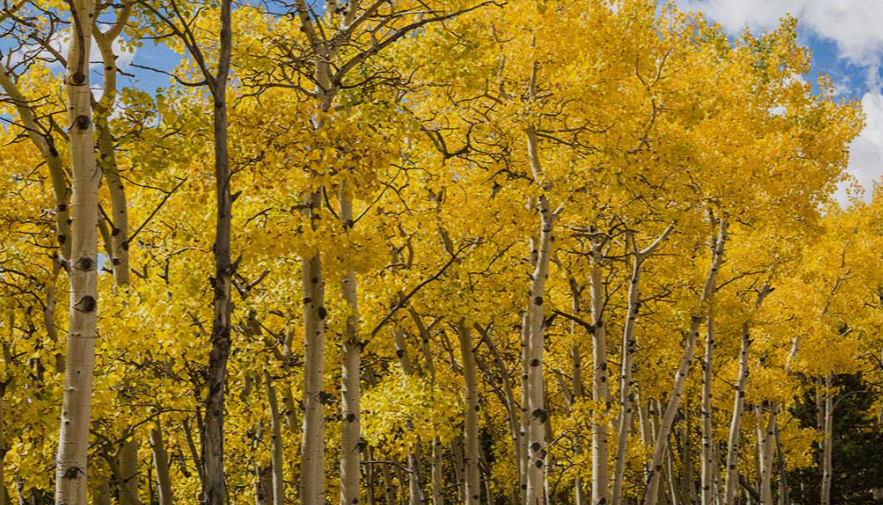
The quaking aspen is the most widely distributed tree in North America. It grows from Alaska and Newfoundland south through the Rocky Mountains to central Mexico, and it is native to all Canadian provinces and most US states. It is famous for 2 things. Its round leaves tremble and shimmer in the slightest breeze, giving the tree its name. And each fall, whole mountainsides of aspen turn a brilliant gold, one of the great natural spectacles of the American West.
The aspen’s most remarkable trait is hidden underground. What looks like a grove of separate trees is often a single organism: hundreds or thousands of trunks sprouting from one shared root system. The largest known aspen clone, nicknamed Pando, covers more than 100 acres of Utah’s Fishlake National Forest. It is considered one of the largest and heaviest living things on Earth.
Botanical Classification
The quaking aspen belongs to the willow family, alongside willows, cottonwoods, and other poplars. It is closely related to bigtooth aspen of the eastern United States and to the European aspen. Some botanists consider the aspens of North America, Europe, and Asia so closely related that they form a single worldwide group of species.
It goes by several common names. In Canada it is usually called trembling aspen. It is also known as quaking asp, golden aspen, mountain aspen, white poplar, and popple. The “quaking” refers to the leaf stalks, which are flattened from side to side rather than round. That shape lets the leaves flutter in even the gentlest wind, producing the tree’s characteristic soft rustling sound.
Brief History
Quaking aspen has been part of the North American landscape since long before people arrived. It is a pioneer tree, one of the first to colonize land opened up by fire, avalanches, landslides, or logging. After fire, aspen roots survive underground and quickly send up new shoots. This lets aspen spread across burned areas long before slower-growing conifers can return.
Indigenous peoples across North America used aspen for food, medicine, shelter, and tools. Its inner bark was eaten in times of scarcity, and its white bark contains a powdery coating historically used as a sunscreen. Today aspen is the state tree of Utah, adopted in 2014 to replace the blue spruce. At the signing ceremony, the governor sat at a desk and chair made of aspen and signed the bill with 13 aspen pens.
Identifying Characteristics
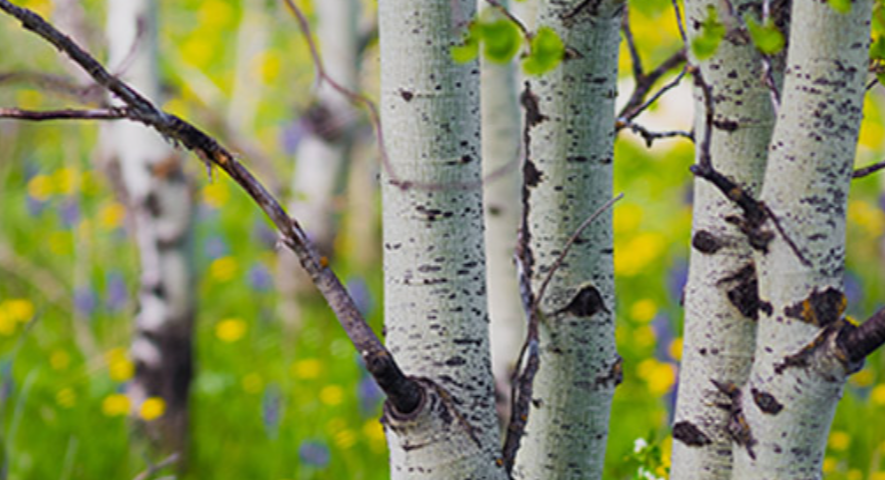
The quaking aspen is a medium-sized deciduous tree, commonly 20 to 80 feet tall and usually 3 to 18 inches in diameter. It has a slender, straight trunk and a narrow, rounded crown. Its bark is its most recognizable feature. It is smooth, pale greenish white to creamy white, often marked with black scars, knots, and eye-shaped markings where branches have fallen. On old trees the lower trunk becomes dark, rough, and furrowed.
The leaves are nearly round, about 1½ to 3 inches across, with a pointed tip and fine teeth along the edges. They are bright green above and paler below, and they hang on long, flattened leaf stalks that let them quake in the wind. In fall they turn brilliant gold, sometimes with shades of orange or red. In early spring, before the leaves appear, the trees produce long, drooping catkins. Male and female catkins grow on separate trees. Female trees usually flower and leaf out earlier than male trees.
Range and Habitat
Quaking aspen grows from Alaska across northern Canada to Quebec and Newfoundland. In the east it reaches south to Virginia and West Virginia, and it grows across the West in nearly every state except Oklahoma and Kansas. Its southernmost populations are in the mountains of central Mexico. It is absent only from the warm Southeast and parts of the southern Great Plains.
In the East and across Canada, it often grows at low elevations in mixed forests, old fields, and cutover land. In the West it is a mountain tree, most common between about 6,000 and 10,000 feet. About 75% of the aspen in the western United States grows in just 2 states: roughly half in Colorado and a quarter in Utah. There, aspen forms vast groves on mountain slopes, in meadows, and along streams.
Also Read: Types of Aspen Trees
How Aspen Clones Work
Quaking aspen can grow from seed. In Alaska, northern Canada, and the eastern United States, seedlings commonly establish on moist, bare soil. In the drier West, though, seedlings are rare. Most new aspen stems sprout from the roots of existing trees in a process called suckering. Each sucker is genetically identical to its parent, so over time one root system can produce a large grove of identical stems, called a clone.
Suckering is controlled by plant hormones. While a tree is healthy, hormones flowing down from the crown suppress new sprouts. When the tree is damaged, killed, or cut, that flow stops, and other hormones in the roots trigger a burst of new shoots. This is why aspen regenerates so quickly after fire or logging. Individual stems usually live less than 150 years, but the root system that produces them can survive for many centuries. In fall, neighboring clones often turn color at slightly different times, revealing the boundaries between them.
Pando, the Trembling Giant
The largest and best-known aspen clone is Pando, from a Latin word meaning “I spread.” It grows on Fishlake National Forest in south-central Utah. It contains roughly 47,000 stems, all genetically identical and connected by a single root system. It covers more than 100 acres and weighs an estimated 14 million pounds, making it one of the most massive living organisms known. In 2006, the US Postal Service honored Pando with a stamp as one of the “40 Wonders of America.”
Pando’s age is uncertain. Estimates range from several thousand years to far older, though none have been confirmed. What is clear is that Pando is in trouble. A 2018 study found that the clone has not been regenerating for the past 30 to 40 years. Mule deer, elk, and cattle eat nearly all the new sprouts before they can grow into trees, and old stems are dying without replacements. The Forest Service is fencing sections of the clone to keep browsing animals out and help new shoots survive.
Ecological Importance
Aspen groves are among the most biologically diverse forest types in the West. Their open canopies let sunlight reach the ground, supporting a rich understory of grasses, wildflowers, and shrubs. Aspen stands can produce as much as 2,900 pounds per acre of forage, far more than nearby conifer forests. This lush growth supports elk, deer, moose, black bears, beavers, and many species of birds, butterflies, and insects.
Aspen also helps protect watersheds. Aspen stands typically use less water than conifer forests and allow more snow to reach the ground, so more water flows into streams and reservoirs. Aspen also acts as a natural firebreak. Its moist leaves and lush understory burn less readily than dense conifer stands. These qualities make aspen a priority for land managers across the West.
Aspen Decline
In recent decades, aspen has declined in parts of the West. Scientists recognize 2 forms. The first is a gradual, long-term decline in which conifers slowly crowd out aspen where fires have become less frequent. Heavy browsing by elk, deer, and cattle also prevents new shoots from growing. The second is a faster process called sudden aspen decline, triggered by severe drought. During the 2000s it caused widespread branch dieback and death of aspen stems. By 2008 it affected about 19% of the aspen forests on national forests in southwestern Colorado.
During sudden aspen decline, drought-stressed trees become vulnerable to insects and diseases such as cytospora canker, bronze poplar borer, and aspen bark beetles. Land managers are working to restore aspen through prescribed fire, mechanical treatments that stimulate suckering, removal of competing conifers, and fencing to protect young shoots from browsing animals.
Timber and Other Uses
Across the Great Lakes region and Canada, aspen is an important commercial timber tree. Its soft, light-colored wood is used for paper pulp, particleboard, oriented strand board, pallets, crates, and matches. Large, high-quality trees are sawn into lumber or peeled for veneer. Aspen regrows quickly after harvest. Logging in fall and winter typically produces the most vigorous suckering the following spring.
Aspen wood is also prized for sauna benches and interior paneling because it stays cool to the touch, doesn’t splinter easily, and has little odor. Its light weight and fine texture make it good for carving, toys, and excelsior, the thin wood shavings once widely used as packing material.
Landscape Uses
Quaking aspen is a popular landscape tree, especially in the West, for its white bark, fluttering leaves, and golden fall color. It looks best planted in groups or clumps that mimic natural groves, and it works well in naturalistic landscapes, mountain gardens, and wildlife plantings. In cold northern regions and at high elevations, where it is well adapted, it can be a fast-growing, attractive shade tree.
It has drawbacks in home landscapes. Its aggressive suckering can fill lawns, flower beds, and nearby areas with shoots, so plant it in landscape beds well away from turf, patios, and foundations. Utah State University Extension notes that aspen planted outside its native mountain habitat, such as in hot, low valleys, often struggles. In those settings it may live only 5 to 15 years before declining. Gardeners in those areas may get better results from columnar Swedish aspen, a narrow relative that sends up fewer suckers.
Growing Considerations
Quaking aspen is extremely cold-hardy, growing in USDA zones 1 through 6 or 7. It grows best in full sun with cool summers. It prefers moist, well-drained, slightly acidic to neutral soils. In alkaline valley soils it may develop iron deficiency, which turns the leaves yellow. Water deeply to a depth of about 2 feet every 2 to 4 weeks during dry periods, especially for young trees and those in hot climates.
Avoid damaging the bark with lawn mowers and string trimmers, since wounds let in insects and diseases. Mulch around the base of the trees to keep soil cool and moist. Plan to replace declining trees over time. In landscapes, healthy suckers from established trees can often grow into replacements.
Pests and Diseases
Quaking aspen is affected by a long list of pests and diseases, especially when it is stressed by heat, drought, or poor soils. Insect pests include aspen borers and poplar borers, whose larvae tunnel in the trunk. Other pests are oystershell scale, aspen leafminers, gall-forming insects, forest tent caterpillars, and spongy moths. Leaf diseases such as marssonina leaf spot can cause brown spots and early leaf drop in wet years.
Canker diseases are among the most serious problems. Hypoxylon canker, common in the Great Lakes region, causes yellowish-orange to black cankers on the trunk and cannot be cured. Cytospora canker attacks stressed trees throughout the West. Wood decay fungi and Armillaria root rot can also weaken older trees. The best defense is keeping trees healthy with proper watering, avoiding wounds, and planting aspen only where it is well adapted. Extension specialists generally advise against heavy pesticide use on landscape aspens. Treatment can cost more than replacing the tree.
Sources
USDA Forest Service, “How Aspens Grow”
USDA Natural Resources Conservation Service, “Plant Guide: Quaking Aspen”
Utah State University Extension, “Important Pests of Ornamental Aspen”