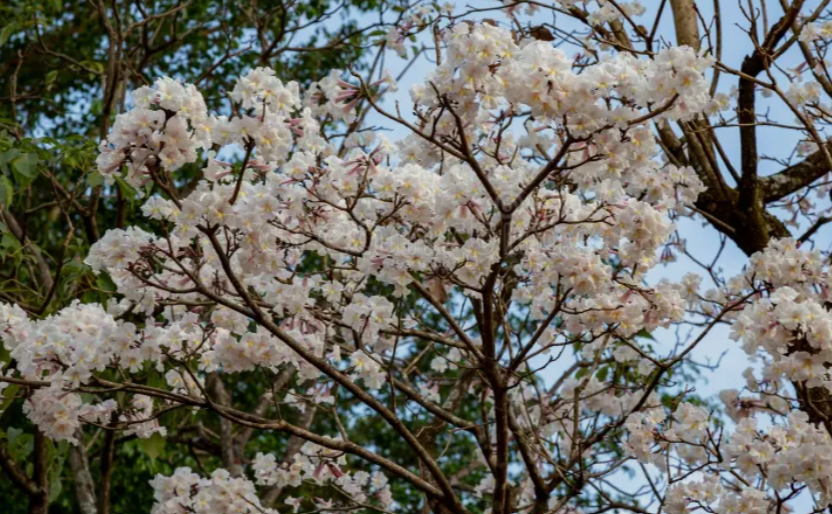
White Ipê: Brazil’s “Snow Tree” and Its Fleeting Winter Bloom
The white ipê is one of the most striking flowering trees of Brazil. For a few days in late winter, its bare branches disappear under masses of white to blush-pink trumpet flowers. The whole tree looks dusted with snow, and fallen petals carpet the ground in white. Brazilians call it ipê-branco, and its sudden, short-lived bloom draws admirers in parks and city streets across the country.
Most people know ipês for their yellow or purple-pink flowers, so the white ipê comes as a surprise. It blooms in the middle of the Brazilian dry season, when few other plants are flowering. The display rarely lasts more than a few days, which makes it all the more prized. Its small size, drought tolerance, and fast growth have also made it one of Brazil’s favorite trees for streets and urban landscapes.
Botanical Classification
The white ipê belongs to the bignonia family, alongside jacaranda, catalpa, trumpet creeper, and all the other trumpet trees. Its scientific name means “pinkish-white,” after its flower color. Despite being called an ipê, it is not one of the yellow or purple ipês that botanists moved into a separate genus in 2007. It stayed in the original trumpet tree genus, along with the rosy trumpet tree, the silver trumpet tree, and the Caribbean pink trumpet tree.
Its common names vary by region. In Brazil it is called ipê-branco, ipê-do-cerrado, pau-d’arco, taipoca, and itaipoca. In Argentina and Paraguay it is lapacho blanco. In English it is the white ipê or white trumpet tree. Gardeners should be careful with that last name, because “white trumpet tree” is also used in Florida for the Cuban pink trumpet tree, a different species. In Brazil, too, “ipê-branco” is occasionally applied to other white-flowered plants. The genus name comes from a Tupi word often translated as “wood that doesn’t float.” It refers to the heavy, dense wood of the trumpet trees.
Brief History
The white ipê is native to central South America. In Brazil it grows in the Cerrado savanna, the Atlantic Forest, the Pantanal wetlands, and sparsely in the dry Caatinga of the Northeast, from Pará in the north to São Paulo in the south. It also occurs in Bolivia, Peru, Paraguay, and northeastern Argentina, including the Iberá wetlands. The species was first described scientifically in 1890.
Indigenous peoples of Brazil traditionally used the bark and leaves of the white ipê in medicine. Modern laboratory studies have found that extracts from the tree have antimicrobial activity against some common bacteria. In the 20th century, Brazilian landscape designers began planting it widely in cities. Today it is one of the most common ornamental trees on Brazilian sidewalks, avenues, medians, and squares.
Identifying Characteristics
The white ipê is a small to medium deciduous tree. In cities and gardens it usually grows 16 to 33 feet tall, with a narrow, upright to pyramidal crown. In natural forests it occasionally reaches 50 feet or more. Young bark is smooth and light brown. As the tree ages, the bark becomes darker, thicker, and deeply fissured, which contrasts strikingly with the white flowers.
The leaves are one of its best identifying features. Most ipês and trumpet trees have 5 or more leaflets per leaf. The white ipê usually has just 3, arranged like a clover leaf. They are medium to bluish green and finely hairy on both sides, and they turn grayish before falling. The flowers are trumpet-shaped and pure white to soft pink, with a yellow throat or yellow streaks inside. They grow in dense clusters at the branch tips. The flowers are followed by long, thin, cylindrical seed pods that start green and turn dark brown to black as they ripen. When the pods split, they release thousands of light, papery, double-winged seeds that drift away on the wind.
Bloom Season
In Brazil, the white ipê usually blooms from about July to October, during the late winter and early spring of the Southern Hemisphere. That is the height of the dry season, and few other trees are in flower. Before blooming, the tree drops all of its leaves, so the flowers open on bare branches and cover the whole crown.
The bloom is explosive but short. Each flowering flush typically lasts only 2 to 3 days before the petals fall. Some trees bloom a second time a few weeks later, usually less heavily. Seed pods ripen soon after flowering, generally starting in October. New leaves emerge with the arrival of the rainy season.
How It Differs From Other Ipês
The white ipê is easy to distinguish from the yellow, purple, and pink ipês. The flower color is the most obvious clue. Its leaves are another: the 3-leaflet leaves of the white ipê set it apart from the 5- to 7-leaflet leaves of most other ipês and trumpet trees. Its bluish-green foliage and narrow, pyramidal crown also help identify it when it is not in bloom.
Its very brief bloom is a further difference. Yellow and pink ipês often flower for 1 to 3 weeks. The white ipê’s flowers usually last only a few days. Gardeners hoping to catch it in bloom need to watch closely.
Native Habitat
The white ipê grows naturally in seasonally dry forests, savannas, and wetland margins. It often occurs as single scattered trees rather than in groups. It is especially common on rocky outcrops, limestone soils, and gravelly ground along the banks of Pantanal rivers. It grows in both primary forests and secondary forests that have regrown after disturbance.
It is adapted to strong sun and long dry seasons. It sheds its leaves to conserve water during drought and grows quickly during the rainy season. These traits make it a hardy tree for hot, sunny climates with seasonal dry periods.
Also Read: Types of Tabebuia (Trumpet) Trees
Wildlife Value
The white ipê is an important nectar source in its native range. Bees visit the flowers heavily, and the tree is valued in Brazil and Argentina as a honey plant. Because it blooms during the dry season, when few other plants are flowering, it provides food for pollinators at a time when nectar is scarce.
Unlike many other trumpet trees, it is visited only occasionally by hummingbirds, which seem to prefer the flowers of other ipês. The dense branches provide shelter for birds. Its wind-dispersed seeds help it colonize open ground and recovering forests.
Growing the White Ipê in the United States
The white ipê is rarely grown in the United States. It is occasionally offered by specialty tropical nurseries and planted in botanical gardens. Like other tropical trumpet trees, it is suited to frost-free and nearly frost-free climates, roughly USDA zones 10 and 11. That includes South Florida, the Florida Keys, Puerto Rico, Hawaii, and possibly the warmest parts of Southern California.
Frost can damage or kill young trees, and cold snaps can reduce flowering on established trees. Gardeners at the edge of its range should plant it in a warm, sunny, sheltered site. Because it is relatively new to American landscapes, check with your county extension office before planting. Ask about local growing conditions and any concerns about its spread.
Landscape Uses
In Brazil, the white ipê is one of the most popular trees for urban landscaping. Its small size, narrow crown, and modest root system make it ideal for sidewalks, medians, squares, and small gardens. Rows of white ipês in bloom along city avenues are a beloved seasonal sight.
In warm-climate gardens, it makes an excellent specimen or accent tree, especially where its white flowers can be seen against a dark background or a blue sky. It pairs beautifully with yellow and pink trumpet trees, creating a striking mix of colors when they bloom together. Its bluish-green foliage and pyramidal shape also make it attractive when it is not in flower.
Growing Considerations
The white ipê grows best in full sun, which produces the heaviest flowering. It tolerates a wide range of well-drained soils, including sandy, rocky, gravelly, and limestone-based soils. It does not tolerate waterlogged or poorly drained conditions. Water newly planted trees regularly during their first year to help them establish. Once established, the white ipê is highly drought-tolerant and needs little supplemental water.
It grows quickly and has relatively few pest problems. Young trees benefit from structural pruning to develop a strong central trunk and well-spaced branches. A light application of a slow-release fertilizer in spring supports healthy growth. Heavy fertilizing is unnecessary and may reduce flowering.
Propagation
The white ipê is usually grown from seed. The seeds are tiny and light, with about 32,000 seeds in a single pound. They should be sown fresh, soon after the pods split, since they lose viability quickly. They germinate readily in warm, moist conditions, and seedlings grow fast. Trees grown from seed may take several years to bloom.
Because the species is cross-pollinated by insects, seed-grown trees vary in flower color. They can range from pure white to soft pink. Some nurseries propagate trees with especially attractive flowers by grafting.
Sources
Federal University of Minas Gerais, Natural History Museum and Botanical Garden, “Ipê-Branco”
Bahiana School of Medicine and Public Health, “Species Mapping: Ipê-Branco”
World Plants, “White Trumpet Tree, Ipê-Branco”
University of Florida IFAS Gardening Solutions, “Trumpet Trees”