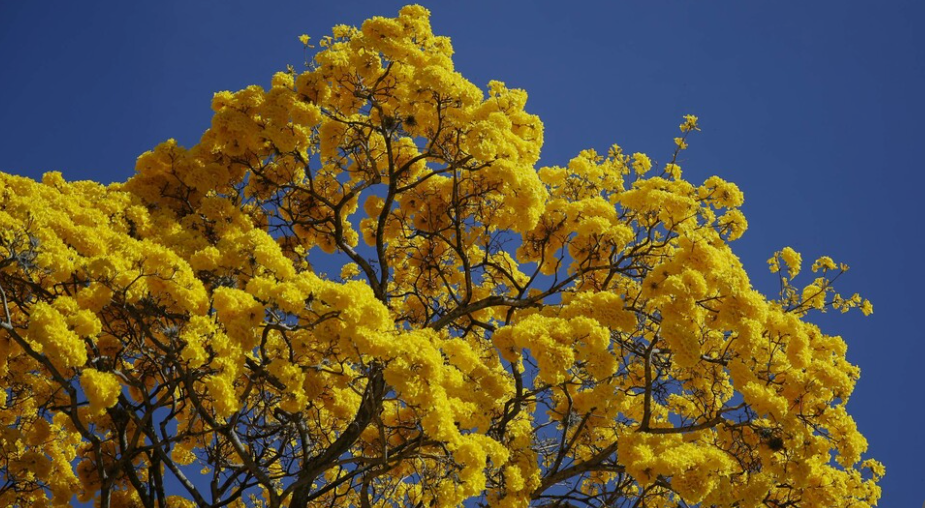
Araguaney: Venezuela’s National Tree and Its Burst of Golden Bloom
The araguaney is the national tree of Venezuela. Each year near the end of the dry season, it bursts into a blaze of golden-yellow flowers. For a few weeks in late winter and early spring, araguaneys across the Venezuelan countryside and in city streets lose their leaves and cover themselves in trumpet-shaped blooms, painting hillsides, plazas, and highways gold. Few trees are as closely tied to a nation’s identity.
Outside Venezuela the araguaney goes by many names. It is called guayacán in Colombia, Panama, and Ecuador, chonta quiru in Peru, tajibo in Bolivia, and ipê amarelo in Brazil. In English it is often called the yellow trumpet tree or golden trumpet tree. In Florida, where it is grown as an ornamental, it is often confused with its close Brazilian relative, which shares the same common name.
Botanical Classification
The araguaney belongs to the bignonia family, alongside jacaranda, catalpa, trumpet creeper, and all the other trumpet trees. Until 2007 it was grouped with the pink and silver trumpet trees in a single genus. A DNA study that year moved it into a separate genus with most of the other yellow and purple-pink trumpet trees. That group is known for its extremely hard, dense wood.
Its scientific name means “golden flower,” taken from the Greek words for gold and flower. Its closest relatives include the Brazilian golden trumpet tree and several other yellow trumpet trees. They are so similar that even experts and nurseries sometimes mix them up.
Brief History
The name araguaney comes from the Kalina people, also known as the Caribs, an Indigenous people of northern South America. They called the tree aravenei. For centuries, people across its native range have valued it for its hard, durable wood and its spectacular flowers. Its bloom marks the end of the dry season and the coming of the rains.
On May 29, 1948, the Venezuelan government declared the araguaney the national tree of Venezuela. Officials chose it as an emblematic native species of extraordinary beauty. Its deep yellow flowers also echo the yellow band of the Venezuelan flag. Since then the araguaney has become one of the country’s most beloved symbols, celebrated in songs, poems, paintings, and school lessons. Venezuelans mark the Day of the Araguaney each year in late May.
Identifying Characteristics
The araguaney is a medium-sized deciduous tree. It usually grows 20 to 40 feet tall, with a rounded to spreading crown. Its bark is gray to brown and becomes rough and furrowed with age. It is slow-growing but long-lived, and well-established trees can survive for many decades.
The leaves are palmately compound, with several leaflets spreading from the end of a long stalk like the fingers of a hand. They grow in opposite pairs along the branches. The flowers are large, tubular, and trumpet-shaped, about 2 inches long, with a broad, ruffled mouth. They are a deep, rich golden yellow, often with fine reddish lines in the throat. They grow in dense clusters at the branch tips. The flowers are followed by long, slender seed pods that split open to release papery, winged seeds carried by the wind.
Also Read: Types of Tabebuia (Trumpet) Trees
Bloom Season
In Venezuela, the araguaney flowers and sets seed during the dry season, generally from February to April. Before blooming, the tree drops its leaves, so the flowers open on bare branches and the whole crown turns gold. The display lasts only a few weeks, but it is one of the most spectacular natural events in the Venezuelan calendar.
The timing serves a purpose. The seeds ripen at the end of the dry season, just as the first rains arrive, so they can germinate in moist soil. If the rains are late, an araguaney may bloom and set seed a second, lighter time. The tree uses water efficiently, saving its most water-intensive activities for the dry season, much as mango trees do.
Native Habitat
The araguaney is native to tropical dry forests and savannas across northern and central South America, including Venezuela, Colombia, Brazil, Bolivia, Peru, and Ecuador. In Venezuela it grows in clearings of deciduous forests in the Guiana Shield region, on warm savannas, and even on dry, rocky hills. It grows at elevations of about 1,300 to 5,600 feet.
It is a rustic, adaptable tree that thrives in hard, dry, or poor soils, as long as they drain well. Its ability to survive long dry seasons, heat, and poor soils makes it common in open, sunny landscapes throughout its range. Those same qualities make it a good ornamental for warm, dry climates elsewhere.
Araguaney Versus the Brazilian Golden Trumpet Tree
The araguaney is often confused with the Brazilian golden trumpet tree, a close relative native to southeastern Brazil and northeastern Argentina. Both have bright yellow trumpet flowers that open on bare branches in late winter or early spring. In Florida both are sold as golden trumpet tree or yellow trumpet tree, and even some University of Florida resources use the names interchangeably.
The 2 differ mainly in their native ranges and their cold tolerance. The araguaney comes from tropical northern South America. It is generally more cold-tender than the Brazilian golden trumpet tree, which comes from cooler subtropical regions farther south. University of Florida extension agents in Charlotte County note that the araguaney is somewhat cold-sensitive and better adapted to the warmest parts of Southwest Florida. The Brazilian species and another yellow trumpet tree tolerate colder winters farther north. Gardeners who want a specific tree should buy from a nursery that can confirm the species.
Where It Grows in the United States
In the United States, the araguaney is grown mainly in the warmest parts of Florida, Puerto Rico, Hawaii, and other frost-free areas, roughly USDA zones 10 and 11. In Florida it does best from about Charlotte County and Palm Beach County south to the Keys. Some trees grow in protected spots farther north, such as a planting on the downtown tree walk in Tavares in Central Florida.
Frost can damage or kill young trees, and a hard freeze can reduce or eliminate the next spring’s bloom on older trees. In areas at the edge of its range, plant the araguaney in a warm, sheltered site, such as the south side of a building. Check with your county extension office about which yellow trumpet trees perform best in your area.
Landscape Uses
The araguaney is an excellent flowering tree for warm-climate landscapes. Its moderate size suits front yards, parks, courtyards, and public spaces, where it makes a striking specimen or focal point in late winter. In Venezuelan cities it is widely planted along streets, plazas, and highways, and rows of trees in bloom turn whole neighborhoods gold.
In home gardens, the araguaney looks especially beautiful with pink and lavender trumpet trees, which bloom at about the same time. Its yellow flowers also pair well with blue skies, white walls, and dark green palms and tropical shrubs. For gardeners with Venezuelan roots, planting an araguaney is also a way to celebrate their heritage.
Growing Considerations
The araguaney grows best in full sun, which produces the heaviest flowering and the strongest growth. It tolerates a wide range of soils, including poor, sandy, rocky, and clay soils, but it needs good drainage. It does not tolerate waterlogged or poorly drained conditions.
Water newly planted trees regularly during their first year to help them establish. Once established, the araguaney is very drought-tolerant and rarely needs supplemental watering, except during long droughts. A light application of a slow-release fertilizer in spring supports healthy growth. Heavy fertilizing can encourage leafy growth at the expense of flowers.
Propagation and Pruning
The araguaney is usually grown from seed. Seeds should be sown fresh, soon after the pods split, since they lose viability quickly. They germinate readily in warm, moist conditions, but seedlings grow slowly and may take several years to bloom. Some nurseries propagate the tree by grafting or air-layering to produce flowering plants sooner.
Young trees benefit from structural pruning to develop a strong central trunk and well-spaced branches. Remove competing leaders, crossing branches, and weak branches while the tree is young. Mature trees need little pruning beyond removing dead or damaged branches. Do this right after flowering so you don’t remove next year’s flower buds.
Wood and Cultural Importance
Like other yellow trumpet trees, the araguaney produces extremely hard, heavy, rot-resistant wood. In parts of South America it has been used for construction, flooring, furniture, tool handles, and fence posts. In Venezuela, though, its value goes far beyond timber. As the national tree, it is protected and celebrated, and it is planted in schoolyards, parks, and civic spaces across the country.
For Venezuelans at home and abroad, the yellow bloom of the araguaney is a symbol of national pride, hope, and renewal at the end of the dry season. It remains one of the best-loved national trees in the world.
Sources
University of Florida IFAS Extension Charlotte County, “The Golden Flowers of Cochran Blvd”
University of Florida IFAS Gardening Solutions, “Trumpet Trees”
University of Florida IFAS Gardening Solutions, “Golden Trumpet Tree”
University of Florida IFAS Extension, “Golden Trumpet Tree”
Petróleos de Venezuela, “El Araguaney: El Emblema Venezolano”