Sweet Viburnum: The Fast-Growing “Coral Tree” Evergreen That Built the Southern Privacy Hedge
Sweet viburnum is one of the most widely planted evergreen shrubs in the warm Southeast. In much of Florida and along the Gulf Coast, it is the default choice for a tall, dense, fast-growing privacy hedge. Its large, leathery, glossy leaves form a solid green wall year-round. In spring the shrub covers itself with fragrant clusters of small white flowers, and in summer it bears bunches of red berries that ripen to black. Left untrimmed, it grows into a handsome small evergreen tree, which few hedge plants can do.
For all its popularity, sweet viburnum is often treated as a background shrub. Its interesting history and its range of forms get little attention. Its common names in Asia call it a “coral tree,” for its bright red fruit clusters. A hardier relative, discovered on a Korean island in the 1980s, has made the look possible much farther north. This guide covers its origins, how to identify it, the main forms and cultivars, and how to grow and prune it.
Botanical Classification
Sweet viburnum is a broadleaf evergreen shrub or small tree in the viburnum genus, a group of roughly 150 to 175 species of shrubs and small trees found mostly in the Northern Hemisphere. Like other viburnums, it has been placed in several plant families over the years. Older references list the honeysuckle family, others the moschatel family, and current systems give viburnums their own family. Its botanical name means “most fragrant,” a reference to its sweetly scented spring flowers.
The species has a broad natural range across eastern and southern Asia and has several regional forms. The most important in gardens is a variety from Japan, Korea, and Taiwan, often sold as awabuki or mirror-leaf viburnum. It has even larger, glossier leaves and somewhat better cold hardiness than the typical form. Nurseries sell both forms as sweet viburnum, and they are closely related enough that many gardeners treat them as interchangeable.
Brief History and the “Coral Tree” Name
Sweet viburnum grows wild over a remarkable area. Its range stretches from southern Japan, Korea, and Taiwan across mainland China and into the Himalayan foothills, Myanmar, Thailand, Vietnam, and the Philippines. In the wild, it grows in forests, thickets, and along streams in warm-temperate and subtropical climates. That background explains its love of heat and humidity.
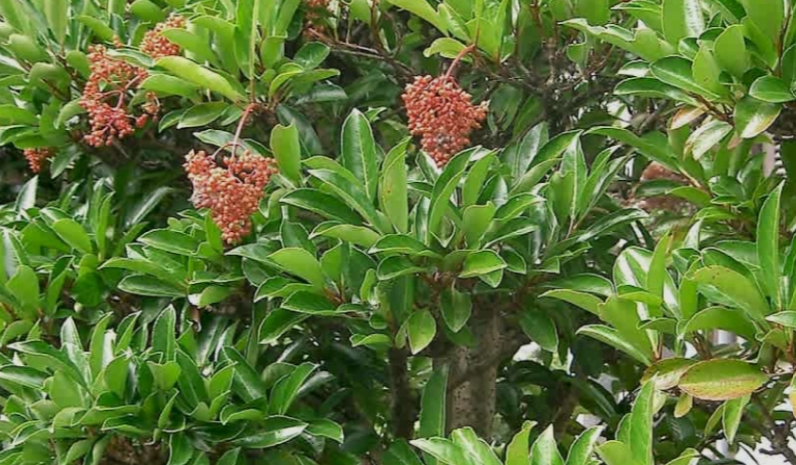
In Japan the shrub is called sango-ju, and in China shan hu shu. Both names mean “coral tree,” a reference to the bright red fruit clusters that ripen on the plant in summer. It has a long history in Japanese landscapes, where its thick, moisture-filled leaves made it a traditional choice for hedges around homes and temples. It reached Western horticulture in the early 19th century. By the 20th century it had become a mainstay of landscapes in Florida, the Gulf Coast, and other warm regions of the United States.
Identifying Characteristics
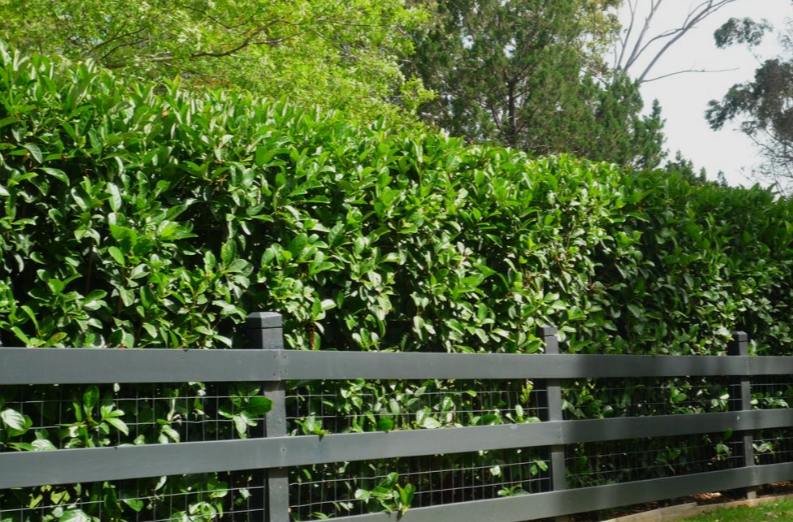
The leaves are the plant’s most distinctive feature. They are opposite, oval to elliptical, and large, typically 3 to 8 inches long. They have a thick, leathery texture and a highly glossy, bright to dark green upper surface. The edges may be smooth or shallowly toothed toward the tip. Because the leaves are large and shiny, a sweet viburnum hedge reflects light and looks lush even in the heat of summer. New growth is often a lighter, brighter green than the mature leaves.
The flowers appear in spring, usually from March to May depending on climate. They form large, rounded to cone-shaped clusters, often 3 to 6 inches long, of many small, white, funnel-shaped flowers. The University of Florida Extension notes that a well-grown plant becomes an ideal hedge and fills many Florida landscapes. In bloom, it can be covered with fragrant white clusters that attract bees and butterflies.
The fruit follows in summer. The small, round berries, less than ½ inch across, ripen first to bright red and then to black, often with both colors in the same cluster. Birds eat them readily. Left untrimmed, sweet viburnum grows into a large, multi-stemmed shrub or small tree. University of Florida Extension notes that, given the room, it will grow up to 25 feet tall with up to a 25-foot spread.
Sweet Viburnum Forms and Cultivars
The typical form of sweet viburnum is the plant most often sold in Florida and the Deep South. It is fast-growing, large-leaved, and heavy-flowering, and it is best suited to the warmest climates. The mirror-leaf or awabuki variety has even larger, glossier leaves and a slightly more upright habit. The University of Florida lists it for Zones 9A through 11 and describes plants growing 15 to 20 feet tall and wide.
The most famous named selection is ‘Chindo’. NC State Extension notes that it was collected by J.C. Raulston of the North Carolina State University Arboretum from Chindo Island, South Korea, in 1985. ‘Chindo’ grows into a dense, upright evergreen. It has proven hardier than the typical sweet viburnum, and it grows well in Zone 7 and the warmer parts of Zone 6. It has made the sweet viburnum look possible in North Carolina, Tennessee, and much of the mid-South, where the species would suffer winter damage.
Also Read: Types of Viburnum Shrubs
Landscape Uses
Sweet viburnum is primarily a hedge and screening plant, and it is one of the best for creating privacy quickly. Its rapid growth, large leaves, and dense branching form a solid screen within a few seasons. A University of Florida Extension volunteer in Leon County notes that plants spaced 5 feet apart can serve as well as a 6-foot privacy fence. It is widely used along property lines, around pools and patios, and to screen utility boxes, air conditioners, and neighboring buildings.
The shrub is also excellent as a small specimen tree. Remove the lower branches over time and train it to a single trunk or a few trunks, and it becomes a handsome evergreen tree with a rounded, dense crown. Gardeners use this form for small yards, courtyards, and street plantings. In larger landscapes, sweet viburnum serves as an evergreen backdrop for flowering shrubs, palms, and perennials. It is also a popular choice for commercial properties and roadside plantings.
Fragrance, Flowers, and Wildlife
The spring flowers give sweet viburnum its name, and their fragrance is a major attraction for many gardeners. The scent is sweet and noticeable, especially on warm spring evenings and when many shrubs bloom together in a hedge. Most people find it pleasant, though some find it heavy at close range. Gardeners sensitive to strong scents may want to keep large plantings a few yards from doors and windows.
The flowers attract bees, butterflies, and other pollinators, and the red-to-black fruit is eaten by mockingbirds, catbirds, cardinals, and other songbirds. The dense branches give birds valuable cover and nesting sites. Although sweet viburnum is not native to North America, University of Florida Extension notes that it is approved for Florida-Friendly Landscaping and is not considered a problem species in Florida’s natural areas. That makes it a responsible choice where native alternatives are not suitable.
Growing Considerations
The typical sweet viburnum grows best in Zones 9 through 11 and can be grown in the warmest parts of Zone 8 with some risk of winter damage. Gardeners farther north should choose ‘Chindo’ or other hardier forms of the awabuki variety. Sweet viburnum performs well in full sun to partial shade. Plants in full sun grow densest and flower most heavily, while those in shade grow more open.
The shrub adapts to a wide range of soils, including sand, loam, and clay, as long as drainage is reasonably good. It is moderately salt tolerant but should not be planted in direct salt spray on the beachfront. University of Florida Extension notes that, once established, it is highly drought-tolerant. Water regularly during the first growing season, then only during extended dry spells. Mulch spread 2 to 3 inches deep conserves moisture and protects the shallow roots from heat.
The LSU AgCenter notes that sweet viburnum is commonly planted in southern Louisiana. Like other marginally hardy plants, it should not be pruned or fertilized in late summer, because that encourages tender new growth that lacks cold hardiness. Fertilize lightly in spring and early summer instead. Avoid overfertilizing, which can produce soft, pest-prone growth.
Pruning Sweet Viburnum
Sweet viburnum grows quickly, so regular pruning is usually needed. For formal hedges, shear lightly several times during the growing season, keeping the base slightly wider than the top so lower branches get enough light. For the best spring flower display, do the heaviest pruning right after flowering, since flower buds form on growth made the previous year. Heavy late-season shearing removes many of next year’s flowers.
Overgrown hedges can be renewed by cutting them back hard in late winter or early spring. Sweet viburnum resprouts readily from older wood, though it may take a season or two to fill back in and flower heavily again. To grow it as a small tree, choose 1 to 3 strong trunks while the plant is young, and remove lower branches gradually over several years to raise the canopy.
Pests and Problems
Sweet viburnum is generally tough and adaptable, but its popularity means pests can spread quickly through large plantings. Scale insects, whiteflies, and aphids can build up on new growth and leaves, producing sticky honeydew and black sooty mold. Thrips, including chilli thrips in parts of Florida, can cause distorted, bronzed, or curled new leaves. Spider mites may appear in hot, dry conditions, causing speckled, faded foliage.
Leaf spots and downy or powdery mildew sometimes develop in wet, humid weather, especially in crowded, poorly ventilated hedges. Root rot can occur in poorly drained soils. Most of these problems are made worse by stress, so good spacing, proper watering, moderate fertilizing, and thoughtful pruning go a long way toward prevention. Gardeners planting long hedges may also want to mix in other shrubs, so that a single pest outbreak cannot damage the entire screen.
Sources
University of Florida IFAS Extension, Charlotte County, “One Sweet Shrub: The Sweet Viburnum”
University of Florida IFAS, “Viburnum odoratissimum var. awabuki: Awabuki Sweet Viburnum”
NC State Extension Gardener Plant Toolbox, “Chindo Sweet Viburnum”