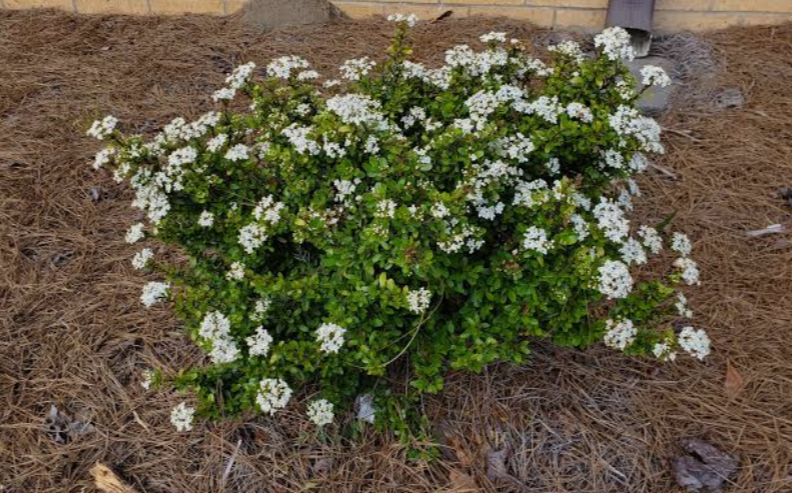
Walter’s Viburnum: The Native Southern Shrub That Can Replace Boxwood, Hedges, and Even Small Trees
Walter’s viburnum is one of the most adaptable native plants in the American Southeast. Few landscape plants can do as many jobs. Left alone, it grows into a large shrub or a graceful small tree with reddish-brown trunks. Sheared, its tiny evergreen leaves make it a tidy formal hedge or even topiary. In its newer dwarf forms, it stays a neat, mounded shrub just a few feet tall, and many southern horticulturists now recommend it in place of boxwood. In every form it puts on a striking late-winter display, covering itself with white flowers at a time when little else is in bloom.
Walter’s viburnum is also one of the toughest native shrubs available to southern gardeners. It grows in wet river floodplains and on dry sandy uplands, takes full sun or partial shade, and handles heat, humidity, and occasional flooding with ease. This guide covers its history and native range, how to identify it, the growing list of compact cultivars, and how to use and grow it in home and commercial landscapes.
Botanical Classification
Walter’s viburnum is an evergreen to semi-evergreen shrub or small tree in the viburnum genus, a group of roughly 150 to 175 species of shrubs and small trees found mostly in the Northern Hemisphere. Like other viburnums, it has been placed in several plant families over the years. Older references list the honeysuckle family, others the moschatel family, and current systems give viburnums their own family. Its botanical name means “obovate,” which describes leaves that are wider near the tip than at the base.
It is closely related to the native “black haw” viburnums of the eastern United States. Like them, it bears small clusters of white flowers followed by dark fruit. Its much smaller, evergreen leaves and preference for the warm coastal plain set it apart. It is also known by several other common names, including small-leaf viburnum, small viburnum, and, in some areas, black haw. Those names can cause confusion with related species.
Brief History
Walter’s viburnum takes its name from Thomas Walter, an 18th-century botanist and planter who lived along the Santee River in South Carolina. Walter studied the plants of the Carolina lowcountry and described this species in his landmark work, Flora Caroliniana, published in 1788. It was one of the first books to document the plants of the southeastern United States in detail. Many native southern plants still carry his name or bear names he gave them.
For most of its history, Walter’s viburnum grew mainly in the wild, along swamps, riverbanks, and woodland edges, and it was rarely planted in gardens. That began to change in the late 20th century, when Florida nurserymen started selecting compact, dense forms from wild populations. The University of Arkansas Cooperative Extension recounts that the popular ‘Mrs. Schiller’s Delight’ was named by Florida plantsman Steve Riefler. He saw in the dwarf plant a resemblance to the dwarf yaupon holly ‘Schilling’ and named it after his friend Mrs. Schiller. Selections like this helped turn a wild swamp shrub into a mainstream landscape plant.
Native Range and Habitat
Walter’s viburnum is native to the coastal plain of the southeastern United States. Its range stretches from South Carolina through Georgia and Alabama and across nearly all of Florida. It is the most widely distributed native viburnum in Florida and the one most commonly used in Florida landscapes. In the wild it grows along rivers and streams, in swamps and floodplain forests, in wet hammocks, and along the edges of lakes and ponds.
Its wetland background explains much of its toughness. Plants in floodplains must survive periodic flooding as well as long dry spells between rains. They also grow in a wide range of light conditions, from open riverbanks to shaded forest understory. That adaptability carries over to the garden, where Walter’s viburnum handles soggy soils, sandy soils, heat, and humidity better than most evergreen shrubs.
Identifying Characteristics
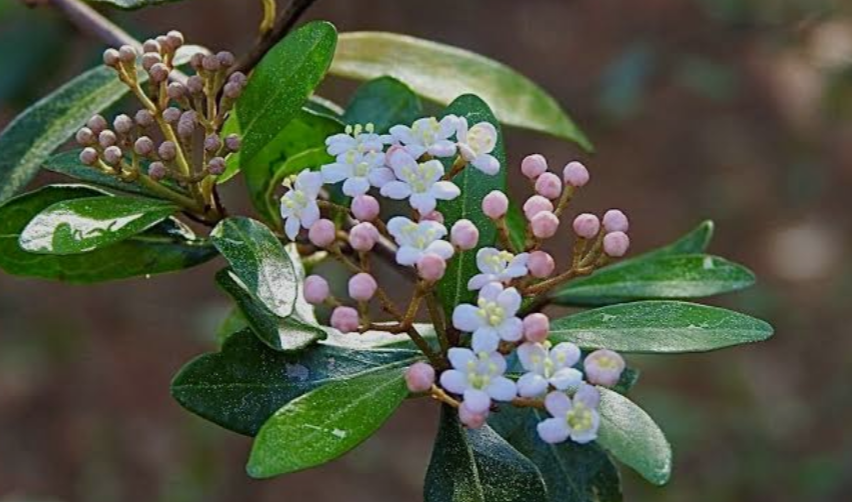
The leaves are one of the plant’s most recognizable features. They are small, opposite, and obovate, typically ¾ to 2 inches long, with a glossy dark green upper surface and a paler underside. The edges are usually smooth or have a few shallow teeth near the tip. On many dwarf cultivars the leaves appear in tight whorls along the stems, giving the plant a dense, fine-textured, almost boxwood-like look. The leaves stay green through winter in the warmer parts of its range and may drop partially in colder areas.
The flowers appear in late winter to early spring. They form flat-topped clusters about 2 to 3 inches across, made up of many small white flowers with yellowish centers. The University of Florida notes that in Florida the flowers appear in late January or early February, at a time when little else is in flower. A plant in full bloom can be almost completely covered in white for 2 to 3 weeks, and the flowers have a light, pleasant scent.
The fruit ripens in summer and early fall. The small, oval berries are about ¼ inch long and turn from red to black as they mature. Young stems are reddish-brown, and older trunks develop gray, slightly roughened bark. Wild-type plants usually reach 8 to 12 feet tall but can grow as large as 25 feet with age. Dwarf cultivars typically stay 3 to 5 feet tall and wide.
Also Read: Different Types of Viburnum
Popular Cultivars
The rise of compact cultivars is what made Walter’s viburnum a common sight in southern landscapes. ‘Mrs. Schiller’s Delight’ is among the best known. It grows into a dense, mounded shrub covered in white flowers in late winter. The University of Georgia describes it as tough and tolerant, growing to about 3 feet tall and slightly wider. ‘Whorled Class’ is another favorite, with leaves arranged in neat whorls along the stems, giving it an especially fine, formal texture.
‘Densa’ is an older dwarf selection that forms a tight, compact mound, while ‘Withlacoochee’ and ‘Reifler’s Dwarf’ are other small forms developed in Florida. For gardeners farther north, ‘Raulston Hardy’ is a larger selection associated with the JC Raulston Arboretum at North Carolina State University, valued for its improved cold hardiness. NC State Extension lists several other cultivars as well, including ‘Christmas Snow’ and ‘Seneca’. The University of Arkansas notes that dwarf forms are often said to grow 3 feet tall by 4 feet wide, but given time they may double that size.
A Native Alternative to Boxwood
One of the most important modern uses for dwarf Walter’s viburnum is as a replacement for boxwood. Boxwoods are among the most widely planted foundation shrubs in the South, but they often struggle in the region’s heat, humidity, and sandy soils. They also face growing disease threats, including boxwood blight and root rots. Dwarf Walter’s viburnum cultivars offer a similar dense, small-leaved, evergreen look with far fewer problems.
Compact selections such as ‘Whorled Class’, ‘Mrs. Schiller’s Delight’, and ‘Densa’ can be sheared into formal low hedges, edging plants, and geometric shapes, or left to grow into soft, natural mounds. Unlike boxwood, they also produce a heavy display of white flowers each spring and red-to-black fruit that feeds birds. Because they are native to the region, they are well adapted to southern climates and support local pollinators and wildlife.
Landscape Uses
Walter’s viburnum is remarkably versatile. Wild-type plants make excellent informal hedges, privacy screens, and buffers along property lines. They can also be trained into small multi-trunked trees. The University of Florida notes that it should make a good small street or parking lot tree for urban landscapes, a role few native evergreens can fill. Its tolerance of reflected heat, compacted soil, and irregular watering makes it suitable for difficult commercial sites.
Dwarf cultivars are ideal for foundation plantings, low hedges, mass plantings, and borders in residential and commercial landscapes. Because Walter’s viburnum tolerates both seasonal flooding and dry periods, it is also a strong choice for rain gardens, stormwater swales, retention pond edges, and other sites that alternate between wet and dry. Its small leaves make it one of the few native shrubs that can be clipped into formal topiary.
Wildlife Value
Walter’s viburnum provides valuable food and shelter for wildlife. Its late-winter flowers appear when few other plants are blooming, so they are an important early nectar and pollen source for native bees, honeybees, and other pollinators. In mild winters, the flowers may be busy with insects on warm, sunny days.
The fruit is eaten by many songbirds, including mockingbirds, catbirds, robins, and cardinals, along with small mammals. The dense, twiggy branches offer excellent nesting sites and cover from predators for small birds. As a native plant, it also hosts the caterpillars of various moths and butterflies, which form an important part of the food web for nesting birds.
Growing Considerations
Walter’s viburnum is hardy from about Zone 7 through Zone 10, with cold-hardy selections such as ‘Raulston Hardy’ extending its usefulness farther north. It grows in full sun to partial shade. Plants in full sun produce the densest growth and the heaviest flowering, while plants in shade grow more open and loose. It tolerates a wide range of soils, including sand, loam, and clay, and grows in acidic to slightly alkaline conditions.
Unlike many shrubs, Walter’s viburnum handles both wet and dry soils once established. Plant it in spring or fall, and water regularly during its first growing season while roots establish. Once established, it usually needs no supplemental watering except during prolonged droughts. Mulch spread 2 to 3 inches deep over the root zone helps conserve moisture and suppress weeds. Light fertilizing in spring is usually all it needs.
Prune right after flowering in spring, since next year’s flower buds form during summer. Dwarf cultivars rarely need more than occasional light shaping. Larger wild-type plants can be sheared into hedges or selectively thinned to form small trees. For tree forms, choose 1 to 3 strong main trunks and remove lower branches and suckers over time. The shrub tolerates hard pruning well and quickly regrows dense foliage.
Pests and Problems
Walter’s viburnum is widely regarded as one of the most trouble-free native shrubs for southern landscapes. It has no major pest or disease problems. Scale insects occasionally appear on stems and leaves, and spider mites may cause speckled leaves during hot, dry weather, but these rarely cause serious damage. Good plant health, regular watering during drought, and natural predators usually keep them in check.
Most problems come from extreme growing conditions, such as deep shade that makes plants thin and leggy, or extended drought in the first year after planting. Dwarf cultivars may also gradually outgrow their space over many years, so allow room for them to widen. The viburnum leaf beetle that troubles many northern viburnums is not a significant concern in the Deep South, which is one more reason Walter’s viburnum makes such a dependable choice for southern gardens.
Sources
University of Florida IFAS, “Viburnum obovatum (Walter’s Viburnum)”
NC State Extension Gardener Plant Toolbox, “Walter’s Viburnum”