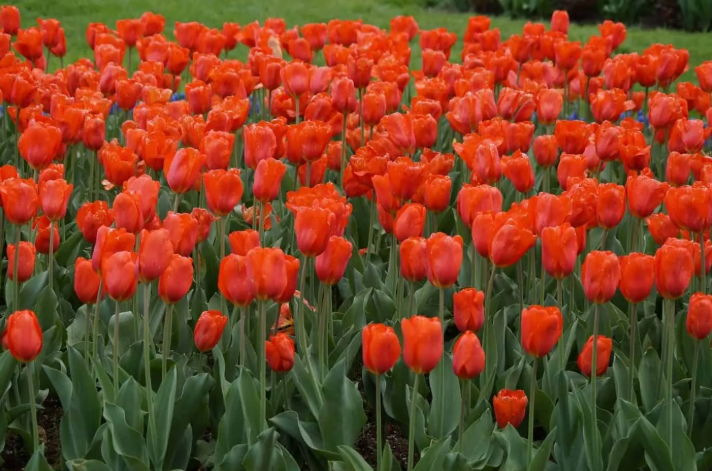
Tulips are often planted for one spectacular spring display and then treated as if their work is finished. But not all tulips behave that way. Some varieties can return for several years, while certain botanical tulips can gradually multiply and establish themselves in the garden when they are planted in suitable conditions.
This distinction matters because tulips are technically perennial bulbs, but many modern cultivars do not reliably behave like long-lived perennials in the garden. Iowa State University Extension notes that many modern tulip cultivars flower well for only about three or four years, while Darwin Hybrids and species tulips are among the better choices for long-term performance.
The good news is that gardeners who want tulips to return every spring have plenty of options. Darwin Hybrid, Fosteriana, Kaufmanniana, Greigii, and species tulips are particularly useful groups to explore. The RHS also specifically identifies Darwin Hybrids and Kaufmanniana cultivars as tulips that reflower with greater certainty than many border tulips.
Below are 15 tulips worth considering if your goal is a recurring spring display rather than planting new bulbs every autumn.
1. Tulip ‘Apeldoorn’
Type: Darwin Hybrid
Flower color: Red
Height: About 24–30 inches
‘Apeldoorn’ is one of the best-known perennializing tulips. Its large, bright-red flowers are held on strong stems, making it useful for mass plantings, borders, and natural-looking drifts.
One reason Darwin Hybrids perform well over multiple seasons is their strong growth and ability to produce replacement bulbs. Iowa State University Extension lists ‘Apeldoorn’ among its recommended Darwin Hybrid tulips for perennial performance.
Planting ‘Apeldoorn’ in groups rather than scattering a few bulbs throughout the garden can produce a much stronger visual effect when the flowers return.
2. Tulip ‘Golden Apeldoorn’
Type: Darwin Hybrid
Flower color: Yellow
Height: About 20–24 inches
‘Golden Apeldoorn’ combines the perennial tendencies of the Apeldoorn group with brilliant golden-yellow flowers.
The cup-shaped blooms are particularly effective against green foliage and can brighten a spring border before many summer perennials have begun growing.
Like other Darwin Hybrids, it is a good candidate for gardeners who want large flowers without completely sacrificing the possibility of future blooms.
3. Tulip ‘Pink Impression’
Type: Darwin Hybrid
Flower color: Rose-pink
Height: About 20–24 inches
‘Pink Impression’ is an excellent choice when you want perennializing tulips in a softer color.
Its large pink flowers have the classic broad, goblet-like shape associated with Darwin Hybrids. The stems are tall enough to stand out in mixed borders while remaining suitable for large containers.
Iowa State Extension specifically includes ‘Pink Impression’ among the Darwin Hybrid cultivars recommended for longer-term garden performance.
4. Tulip ‘Red Impression’
Type: Darwin Hybrid
Flower color: Bright red
Height: About 20–24 inches
‘Red Impression’ produces large, intensely colored red flowers.
It is particularly effective when planted in groups because the individual flowers combine to create a strong block of spring color.
As with other Darwin Hybrids, it performs best when the bulbs can build energy after flowering rather than being treated solely as short-term bedding plants.
5. Tulip ‘Parade’
Type: Darwin Hybrid
Flower color: Red
Height: About 20–30 inches
‘Parade’ is another classic red Darwin Hybrid. Its tall stems and large flowers make it useful for borders, formal beds, and mass plantings.
The flowers appear in mid-spring, extending the tulip display beyond the earliest species and Fosteriana types.
Its straightforward red coloring also makes it easy to combine with white, yellow, or pink tulips.
6. Tulip ‘Daydream’
Type: Darwin Hybrid
Flower color: Yellow changing toward apricot-orange
Height: About 20–24 inches
‘Daydream’ is particularly interesting because its flowers can change appearance as they mature.
The blooms open yellow and develop warmer apricot-orange tones, giving a planting of this cultivar a subtly changing appearance during its flowering period.
It is another Darwin Hybrid recognized for its potential to perform for several seasons.
7. Tulip ‘Purissima’
Type: Fosteriana
Flower color: White
Height: About 18–20 inches
‘Purissima’, sometimes called White Emperor, belongs to the Fosteriana group.
Fosteriana tulips are among the better perennializing tulips and are noted for large, elongated flowers that appear relatively early in spring.
‘Purissima’ is especially useful when you want a clean white display rather than the brighter colors often associated with traditional tulips.
The large flowers look particularly attractive when planted beneath spring-flowering trees or shrubs.
8. Tulip ‘Juan’
Type: Fosteriana
Flower color: Orange-red with a yellow base
Height: About 10 inches
‘Juan’ provides a more colorful alternative to ‘Purissima’.
The flowers combine orange-red petals with a contrasting yellow base, while the leaves may have attractive bronze markings.
The RHS classifies ‘Juan’ as a perennial bulb and notes that it reaches roughly 25 cm in height.
Its shorter stature makes it useful toward the front of borders or among low-growing spring plants.
9. Tulip ‘Sweetheart’
Type: Fosteriana
Flower color: Soft yellow with white edging
Height: About 16 inches
‘Sweetheart’ is a particularly distinctive Fosteriana tulip. Its soft-yellow flowers are edged in white, creating a gentle two-tone effect.
The RHS lists it as a perennial bulb and notes that it reaches approximately 40 cm in height. It is best grown in full sun and well-drained soil.
The combination of pale colors and strong flowers makes ‘Sweetheart’ useful in cottage-style and naturalistic plantings.
10. Tulip ‘Toronto’
Type: Greigii
Flower color: Pink and red
Height: Short
‘Toronto’ is a Greigii-type tulip suited to gardeners who prefer shorter plants.
Greigii tulips are known for attractive foliage as well as flowers. Many have leaves marked or mottled with darker patterns, giving the plants ornamental interest even before the flowers open.
Their compact growth makes them particularly useful in rock gardens, the front of borders, and containers.
11. Tulip ‘Red Riding Hood’
Type: Greigii
Flower color: Red
Height: Short
‘Red Riding Hood’ is a popular Greigii tulip recognized for its vivid red flowers and attractive marked foliage.
The plant stays considerably shorter than many Darwin Hybrids, so it creates a different visual effect in the garden.
Greigii tulips are among the groups worth considering when long-term return is more important than simply choosing the largest available flower.
12. Tulip ‘Heart’s Delight’
Type: Kaufmanniana
Flower color: Red and pink with lighter margins
Height: Short
‘Heart’s Delight’ belongs to the Kaufmanniana group, which the RHS identifies as one of the groups with better reflowering potential.
Kaufmanniana tulips are sometimes called water-lily tulips because their flowers can open widely in sunlight, creating a shape somewhat reminiscent of water lilies.
Their relatively short stems make them useful in rock gardens, containers, and the front of perennial borders.
13. Tulip ‘Giuseppe Verdi’
Type: Kaufmanniana
Flower color: Yellow and red
Height: Short
‘Giuseppe Verdi’ combines yellow flowers with red coloration, producing a lively early-spring display.
Kaufmanniana tulips tend to flower earlier than Darwin Hybrids, allowing them to start the tulip season before the taller mid-season varieties take over.
They are especially attractive when planted in informal groups.
14. Tulip ‘Tarda’
Botanical name: Tulipa tarda
Type: Species or botanical tulip
Flower color: Yellow with white tips
Height: About 4–6 inches
Tulipa tarda is one of the classic choices for naturalizing.
Instead of producing a single enormous flower, it creates several relatively small star-shaped flowers, each with yellow centers and white-tipped petals.
Its low growth makes it excellent for rock gardens, gravel gardens, the front of borders, and naturalized plantings.
University of Maryland Extension specifically lists species tulips such as T. tarda among the most reliable tulips for long-term perennial performance.
15. Tulip ‘Lady Jane’
Botanical name: Tulipa clusiana
Type: Species or botanical tulip
Flower color: White and pink-red
Height: About 8–12 inches
‘Lady Jane’ is a form of the species tulip Tulipa clusiana.
The slender flowers have a distinctive striped appearance, with white interiors and pink to reddish exterior coloring.
Species tulips are generally closer to wild tulips than many highly hybridized garden varieties. Cambridge University Botanic Garden recommends species such as T. clusiana as relatively easy tulips for gardeners interested in long-term, naturalizing displays.
Why Some Tulips Return Better Than Others
The fact that a tulip is technically a perennial does not guarantee that it will produce another impressive flower the following spring.
This is one of the biggest misconceptions surrounding tulips.
Many modern tulips have been selected for large flowers, unusual colors, dramatic forms, and strong first-year displays. After flowering, however, the bulb needs to rebuild its stored energy before the next growing season.
If the bulb fails to accumulate enough resources, it may survive but produce only leaves—or a much smaller flower.
Iowa State University Extension reports that many modern cultivars flower well for only around three or four years, with vigor gradually declining.
By contrast, species tulips tend to be longer lived and some can naturalize, meaning they establish themselves and gradually increase in number under suitable conditions.
The 4 Best Groups for Tulips That Return Every Year
If you are shopping specifically for perennializing tulips, the cultivar name is important, but the tulip group can provide an even better starting point.
Darwin Hybrid Tulips
Darwin Hybrids are among the best choices for gardeners who want large flowers on tall stems while still wanting reasonable repeat performance.
They generally flower in mid-spring and can reach around 30 inches in height. Popular examples include ‘Apeldoorn’, ‘Golden Apeldoorn’, ‘Pink Impression’, ‘Red Impression’, ‘Parade’, and ‘Daydream’.
Fosteriana Tulips
Fosteriana tulips, sometimes called Emperor tulips, combine large flowers with relatively early flowering.
They generally reach around 10–20 inches, according to Iowa State Extension, and are recognized for their ability to perennialize.
‘Purissima’, ‘Juan’, and ‘Sweetheart’ are examples worth considering.
Kaufmanniana Tulips
Kaufmanniana tulips are shorter and often have flowers that open widely in bright sunlight.
The RHS includes Kaufmanniana cultivars among tulips that reflower more reliably than many standard border tulips.
They are particularly useful for rock gardens, low borders, and naturalistic spring displays.
Species Tulips
If longevity is the highest priority, species tulips deserve special attention.
They are generally smaller than many modern hybrids, but their more natural growth habit can allow them to remain in the garden and gradually multiply.
Examples include Tulipa tarda, Tulipa clusiana, Tulipa linifolia, and Tulipa biflora. Cambridge University Botanic Garden recommends several species tulips as good starting points for gardeners interested in perennial displays.
How to Make Tulips Come Back Every Year
Choosing a perennializing variety is only half the equation. Growing conditions can determine whether a good perennial tulip performs well or disappears after a season or two.
Plant in Full Sun
Most tulips perform best when they receive plenty of sunlight.
A sunny location helps the foliage photosynthesize after flowering, allowing the bulb to rebuild its energy reserves for the next season.
Provide Excellent Drainage
Poor drainage is one of the biggest enemies of tulip bulbs.
The RHS recommends fertile, well-drained soil and warns against excessive winter wet. Species tulips can remain undisturbed for several years when grown in suitable conditions.
If water regularly stands around the bulbs, rot can become a serious problem.
Do Not Remove the Leaves Too Early
This is one of the most important steps.
After the flowers fade, the leaves continue producing energy that is transferred back into the bulb.
Allow the foliage to yellow naturally before removing it. The RHS recommends allowing approximately six weeks after flowering, or until the leaves become yellow, before lifting bulbs.
The fading leaves may look untidy, but they are performing an important job.
Deadhead the Flowers
Once the flowers fade, remove the spent flower heads.
This prevents the plant from putting unnecessary energy into seed production and redirects resources toward the bulb.
Leave the foliage in place.
Avoid Overwatering During Summer
Tulip bulbs naturally experience a relatively dry summer dormancy in many of their native environments.
The RHS notes that lifting, drying, and storing bulbs over summer can simulate the warm, dry summer rest experienced by tulips in the wild.
For tulips that remain in the ground, avoid locations that stay constantly wet during summer.
Feed Appropriately
A balanced bulb fertilizer or suitable garden fertilizer can support healthy growth, but excessive fertilizer is not necessarily beneficial.
Good soil preparation and adequate drainage are more important than trying to force bulbs with heavy feeding.
Which Tulips Are Most Likely to Naturalize?
Naturalizing goes one step beyond simply returning.
A tulip that naturalizes can survive from year to year and gradually produce offsets or new plants, eventually creating a larger colony.
Species tulips are generally the strongest candidates.
Some examples include:
- Tulipa tarda
- Tulipa clusiana
- Tulipa biflora
- Tulipa linifolia
- Tulipa saxatilis
These smaller tulips can look especially attractive when planted in groups beneath deciduous trees, along rock gardens, or toward the front of perennial borders.
The Cambridge Botanic Garden notes that species tulips can provide better long-term succession than many hybrids and recommends several species as relatively easy choices for gardeners beginning with botanical tulips.
Why Big Hybrid Tulips Sometimes Stop Flowering
A tulip bulb is essentially a storage organ. During the growing season, the leaves capture sunlight and convert that energy into reserves stored in the bulb.
Producing a large flower requires considerable resources.
Some highly bred tulips put so much energy into producing their spectacular first-year flowers that the replacement bulb may not be large enough to produce another equally impressive flower.
That is why a bulb can appear to “disappear” even though it has technically survived.
The result may be:
Year 1: Large, impressive flower.
Year 2: Smaller flower.
Year 3: Leaves with little or no flower.
Later years: The original bulb or offsets may eventually become too weak to provide a worthwhile display.
This does not happen equally with every cultivar. Genetics, climate, soil, drainage, sunlight, bulb quality, and post-flowering care all influence performance.
Best Long-Lived Tulips by Garden Style
For Large Flower Beds
Choose Darwin Hybrids such as ‘Apeldoorn’, ‘Pink Impression’, ‘Red Impression’, and ‘Golden Apeldoorn’.
For Early Spring Color
Choose Fosteriana and Kaufmanniana tulips.
For Rock Gardens
Choose species tulips, particularly Tulipa tarda and Tulipa clusiana.
For Naturalized Plantings
Choose botanical species tulips rather than highly specialized exhibition-style hybrids.
For Containers
Shorter Kaufmanniana, Greigii, and species tulips are particularly useful because their compact growth does not overwhelm the container.
A Simple Planting Strategy for Years of Tulips
For the best chance of having tulips return annually, consider combining several groups rather than planting one cultivar everywhere.
For example, a garden could begin with:
Early spring: Kaufmanniana or Fosteriana tulips.
Mid-spring: Darwin Hybrid tulips.
Later spring: Selected species tulips and other late-flowering varieties.
This creates succession rather than having every tulip bloom at exactly the same time.
Another approach is to plant groups of botanical tulips in areas where they can remain undisturbed for several years, while using less reliable hybrid tulips as seasonal displays.
That strategy recognizes an important horticultural reality: not every tulip needs to be perennial to be useful.
Tulips That Come Back Every Year at a Glance
| Tulip | Group | Main Color | Long-Term Potential |
|---|---|---|---|
| ‘Apeldoorn’ | Darwin Hybrid | Red | Excellent |
| ‘Golden Apeldoorn’ | Darwin Hybrid | Yellow | Excellent |
| ‘Pink Impression’ | Darwin Hybrid | Pink | Excellent |
| ‘Red Impression’ | Darwin Hybrid | Red | Excellent |
| ‘Parade’ | Darwin Hybrid | Red | Excellent |
| ‘Daydream’ | Darwin Hybrid | Yellow/Orange | Excellent |
| ‘Purissima’ | Fosteriana | White | Excellent |
| ‘Juan’ | Fosteriana | Orange-Red | Excellent |
| ‘Sweetheart’ | Fosteriana | Yellow/White | Excellent |
| ‘Toronto’ | Greigii | Pink/Red | Very good |
| ‘Red Riding Hood’ | Greigii | Red | Very good |
| ‘Heart’s Delight’ | Kaufmanniana | Pink/Red | Very good |
| ‘Giuseppe Verdi’ | Kaufmanniana | Yellow/Red | Very good |
| ‘Tarda’ | Species | Yellow/White | Excellent |
| ‘Lady Jane’ | Species | White/Pink | Excellent |
When to Plant Tulips for the Best Return
Tulip bulbs are normally planted in autumn so they can establish roots before winter or the cool season.
The exact planting window depends on climate. In colder regions, planting usually occurs before the ground freezes. In warmer regions, gardeners may need to plant later and provide the cool conditions required for proper flowering.
The important point is not simply the calendar date but the relationship between soil temperature, seasonal cooling, and the tulip’s need for a dormant period.
If growing tulips in containers, pay particular attention to moisture. Pots can become excessively wet during rainy periods and may also experience greater temperature fluctuations than bulbs planted in the ground.
The Most Reliable Choices for a Perennial Tulip Garden
If the goal is to plant bulbs once and enjoy returning flowers for as many seasons as possible, a useful starting combination is Darwin Hybrids for height, Fosterianas for early large flowers, Kaufmannianas for low-growing color, and species tulips for naturalizing.
The RHS, Iowa State University Extension, University of Maryland Extension, and Cambridge University Botanic Garden all point toward these groups as better long-term choices than many conventional bedding tulips.
The biggest lesson is that “perennial tulip” does not simply mean any tulip bulb left in the ground. The cultivar or species matters, but so do sunlight, drainage, post-flowering care, summer conditions, and climate.
For the most dependable long-term display, choose tulips bred or naturally adapted to perennialize, give them well-drained soil and plenty of sun, remove faded flowers, and allow the foliage to finish its work before cutting it back. With those conditions in place, spring does not have to mean starting your tulip garden from scratch every year.