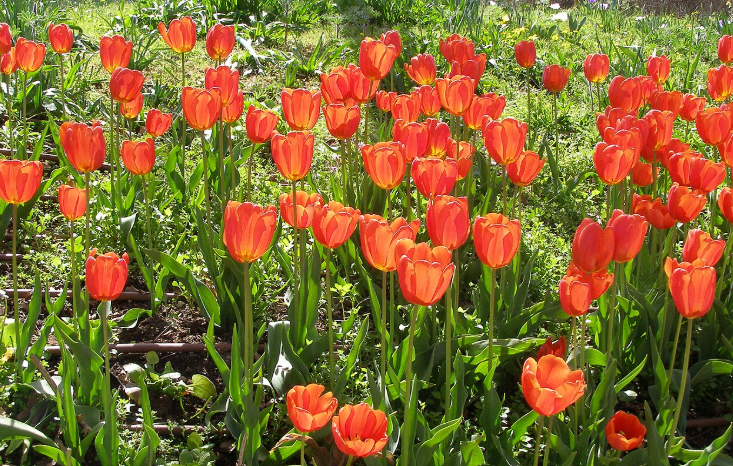
Tulips are among the most beloved and widely recognized flowering bulbs in the world, producing elegant, cup-shaped flowers in virtually every color of the spectrum across thousands of named varieties developed over centuries of intensive horticultural breeding. Native to the mountainous regions of Central Asia — particularly the Tian Shan and Pamir Alai ranges of Kazakhstan and Kyrgyzstan — they were first cultivated by the Ottoman Turks before arriving in Western Europe in the sixteenth century where they triggered the famous Dutch Tulipmania of the 1630s, the world’s first recorded speculative financial bubble. Global tulip production today is dominated by the Netherlands, which grows approximately 2.2 billion tulip bulbs annually and exports them to over 100 countries.
Tulip plants typically grow to 6 to 24 inches in height depending on the variety, with individual flowers measuring 2 to 4 inches across in standard types and up to 5 to 6 inches in large-flowering varieties. They are hardy perennial bulbs in USDA zones 3 to 8, requiring a cold winter period of at least 12 to 16 weeks below 45°F to break dormancy and flower reliably — a requirement that makes them outstanding spring garden plants in cool temperate climates. There are over 3,000 registered tulip varieties organized into 15 officially recognized divisions by the Royal General Bulb Growers Association.
Tulips have an extraordinary blooming season that spans from early March through late May depending on the variety group, with early, mid-season, and late-flowering types providing almost three months of continuous color when planted in combination. The flowers come in every color except true blue and black — though very dark purple varieties are marketed as near-black — and include single, double, fringed, parrot, lily-flowered, and many other distinctive flower forms. They are among the top five most purchased cut flowers globally, with the Netherlands exporting approximately 1.8 billion cut tulip stems annually.
Tulips have played an extraordinary role in art, culture, and economic history far beyond their significance as garden plants. They are the national flower of the Netherlands and Turkey, appear extensively in Ottoman art and architecture, and inspired some of the finest Dutch Golden Age flower paintings. In the garden they perform best in full sun with well-draining, slightly alkaline soil and benefit from being lifted and stored in summer in warmer climates where the summer heat prevents reliable perennialization. Their combination of elegant form, extraordinary color range, and reliable spring performance has made them one of the most universally planted and admired flowering bulbs in the world.
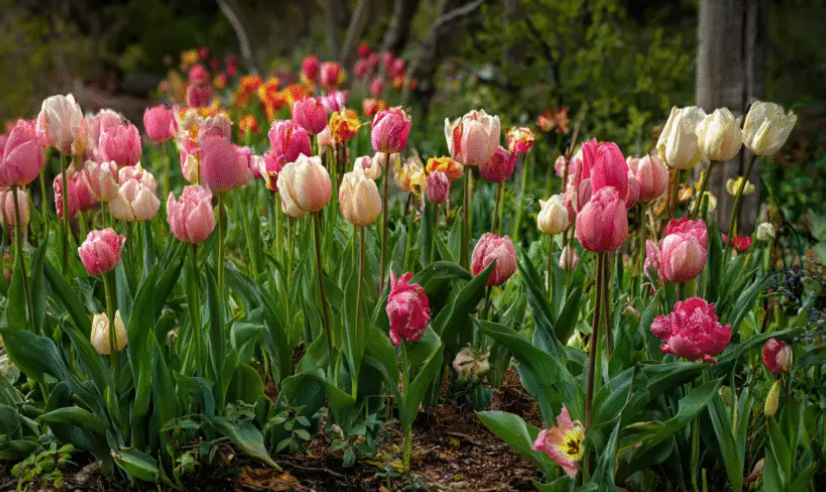
Types of Tulips
1. Darwin Hybrid Tulip
Darwin Hybrid is the most widely grown and commercially important tulip division in the world, producing very large, classic, oval to cup-shaped flowers up to 4 to 6 inches across on tall, strong stems reaching 20 to 28 inches in height. The flowers are produced in vivid shades of red, orange, yellow, pink, and bicolor in mid-spring and the large bulbs perennialize better than most other tulip types, returning reliably for several years in appropriate climates. Varieties like Apeldoorn, Golden Apeldoorn, and Parade are among the most widely planted tulip varieties in the world.
2. Triumph Tulip
Triumph is the largest single division of tulips by number of registered varieties, producing medium to large, classic, cup-shaped flowers on strong, medium-height stems of 16 to 22 inches that make them outstanding both in the garden and as cut flowers. They bloom in mid-spring between the early single types and the large Darwin Hybrids, filling a critical period in the spring tulip sequence, and are available in an extraordinary range of colors including many of the finest bicolor and multicolor varieties. The robust stems and good weather resistance make Triumph tulips among the most reliable for garden performance.
3. Single Early Tulip
Single Early tulips are among the first tulips to bloom in the garden, producing medium-sized, classic, cup-shaped flowers on short to medium stems of 10 to 16 inches in early spring — often flowering in late March to early April in temperate climates. The early season makes them invaluable for extending the tulip display as far back into spring as possible, and their compact, sturdy stems show good resistance to wind and rain damage. They are available in a wide range of colors and are among the most reliable and long-lived of all tulip types in the garden.
4. Double Early Tulip
Double Early tulips produce fully double, peony-like flowers with multiple layers of petals in early to mid-spring on compact, sturdy stems of 10 to 14 inches that are short enough to resist wind damage even when the doubled flower heads become heavy with rain. The lush, full, rounded blooms are extraordinarily showy and create a more opulent, extravagant effect than the simpler single-flowered types. They are particularly popular in containers and formal bedding schemes where the double, rose-like flowers create a more decorative and elaborate display than single varieties.
5. Parrot Tulip
Parrot tulips are among the most dramatically beautiful and distinctive of all tulip types, producing large, extravagantly ruffled, twisted, deeply fringed, and lacerated flowers in intense, often multicolored combinations that resemble the exotic plumage of tropical parrots. They grow to 16 to 22 inches in height and bloom in late spring, and the extraordinary flowers can reach 6 to 8 inches across when fully open, creating one of the most spectacular individual flower displays of any garden bulb. The heavy, large flowers may require staking in exposed positions but the ornamental impact fully justifies the extra attention.
6. Lily-Flowered Tulip
Lily-Flowered tulips produce distinctive, elegantly waisted flowers with pointed, reflexed petals that flare outward at the tips to create a graceful, lily-like outline quite unlike the rounded cup of standard tulip forms. They grow to 18 to 24 inches in height and bloom in mid to late spring, and the slender, elegant flower shape gives them an aesthetic refinement and sophistication that many gardeners consider the most beautiful of all tulip forms. They are excellent cut flowers and suit both formal and informal garden settings with equal elegance.
7. Fringed Tulip
Fringed tulips, also called Crispa tulips, produce classic cup-shaped flowers with a distinctive crystal-like fringe of fine, hair-like projections along the petal margins that catches light and gives the blooms an extraordinary, jewel-like decorative quality. They grow to 16 to 22 inches in height and bloom in mid to late spring, and the fringed petal margins are consistent and well-defined across all flowers on the plant. The fringed petal edge adds a layer of visual complexity and refined detail that makes them particularly popular for cut flower arrangements and close-up garden display.
8. Viridiflora Tulip
Viridiflora tulips are distinctive, unusual varieties with flowers that retain vivid green streaks or flames across the petals even at full maturity, creating striking bicolor effects of green combined with white, pink, red, yellow, or purple that give them a uniquely artistic, painterly quality. They grow to 14 to 20 inches in height and bloom in late spring, and the green coloring is most vivid in cool conditions and tends to fade in warm weather. They are highly popular with contemporary garden designers and flower arrangers who value the unusual green coloring as a sophisticated, unconventional alternative to the standard all-colored tulip palette.
9. Greigii Tulip
Greigii tulips are a species-derived division producing distinctive, broad, low-growing flowers on short stems of 8 to 14 inches, combined with attractively mottled and striped, wavy-edged leaves that are ornamental even before the flowers open. The flowers are large relative to the compact plant size and are produced in vivid shades of red, orange, yellow, and bicolor in early to mid-spring. They are among the best tulips for perennialization and naturalizing in appropriate climates and are an excellent choice for rock gardens, containers, and the front of borders where their low stature and attractive foliage are shown to best advantage.
10. Kaufmanniana Tulip
Kaufmanniana tulips, called Waterlily tulips for their wide-opening, star-shaped flower form that resembles a waterlily when fully open in sunshine, are among the earliest tulips to bloom and among the most reliably perennial, returning for many years in appropriate well-draining conditions. They grow to only 4 to 8 inches in height with broad, low flowers in white, yellow, red, and bicolor produced in very early spring, often in late February to early March in mild climates. The very early season, compact size, and reliable return make them outstanding for rock gardens, troughs, and naturalized plantings.
11. Fosteriana Tulip
Fosteriana tulips produce some of the largest flowers of any tulip division — enormous, brilliant, wide-opening blooms up to 6 inches across in vivid shades of red, orange, yellow, white, and pink on stems of 10 to 18 inches. They bloom in early to mid-spring and are among the most reliably perennial of all tulip types, naturalizing well in good drainage conditions and returning dependably for many years. The Emperor series — particularly Red Emperor and White Emperor — are the most famous Fosteriana varieties and among the most widely planted tulip bulbs in the world.
12. Single Late Tulip
Single Late tulips bloom at the very end of the tulip season in late spring, producing tall, classic, elegantly oval flowers on strong stems of 20 to 30 inches that are among the tallest of any tulip division. The flowers come in a very wide range of colors including many of the most subtly beautiful and complex color blends available in tulips, and the late season extends the total tulip display period as far into spring as possible. They are outstanding cut flowers and are widely used in commercial cut flower production for late spring market demand.
13. Double Late Tulip (Peony Tulip)
Double Late tulips, also called Peony tulips, produce enormous, fully double, peony-like blooms packed with multiple layers of petals in mid to late spring on strong stems of 16 to 22 inches. The massive, luxurious double flowers can reach 4 to 5 inches across and are among the most opulent and extravagant flowers of any spring bulb, creating a display of extraordinary richness and fullness. They are widely grown as cut flowers and are particularly popular for wedding and event floristry where the full, lush blooms provide maximum visual impact.
14. Apeldoorn
Apeldoorn is one of the most famous and widely planted tulip varieties in the world, a classic Darwin Hybrid producing very large, brilliant, vivid scarlet-red, classic cup-shaped flowers on tall, strong stems reaching 22 to 26 inches in mid-spring. It is one of the most commercially important tulip varieties in the Netherlands and is planted by the millions in public parks, gardens, and commercial landscaping across the world each year. The intense, saturated red color and exceptional flower size make it the definitive red tulip against which all others are measured.
15. Golden Apeldoorn
Golden Apeldoorn is the golden-yellow sport of the famous Apeldoorn variety, producing the same very large, classic cup-shaped flowers and tall, strong stems as the red parent but in a vivid, warm, clear golden-yellow that is among the finest and most saturated yellow tones of any Darwin Hybrid tulip. It is equally widely planted and commercially important as the red Apeldoorn and the two varieties are frequently planted together to create bold red and yellow spring color combinations in park and public landscape plantings. It is one of the most reliable and productive yellow Darwin Hybrid tulips available.
16. Parade
Parade is another enormously popular and widely planted Darwin Hybrid tulip producing very large, vivid, deep red flowers with a bright yellow base on tall, strong stems reaching 22 to 26 inches. The deep red color is slightly more vivid and saturated than Apeldoorn and the yellow basal blotch adds a two-tone detail visible when the flower opens in warm sunshine. It is one of the most commercially important Darwin Hybrid varieties and is planted in very large quantities in parks, municipal plantings, and formal gardens worldwide each spring.
17. Queen of Night
Queen of Night is the most famous and widely grown near-black tulip variety, producing large, elegant, deep, velvety, dark maroon to near-black, classic cup-shaped flowers on tall stems of 22 to 26 inches in late spring. The extraordinarily dark flower color is one of the most dramatic and sophisticated in the entire tulip range and makes it one of the most popular tulip varieties for contemporary garden designers who value its moody, mysterious, dramatic aesthetic. It is a Single Late variety of outstanding garden performance and excellent vase life.
18. Angelique
Angelique is the most popular and widely grown double late tulip variety in the world, producing large, very full, soft, delicate, pale pink, peony-like double flowers of extraordinary beauty on sturdy stems of 16 to 18 inches in late spring. The soft, blush-pink coloring of the layered petals is universally appealing and the lush, full flower form is among the most romantically beautiful of any spring bulb. It is enormously popular for wedding floristry, romantic garden schemes, and as a gift cut flower where the peony-like softness and gentle pink coloring create an effect of understated luxury.
19. Ballerina
Ballerina is one of the most celebrated and widely admired lily-flowered tulip varieties, producing beautifully waisted, pointed-petalled flowers in a warm, vivid, glowing orange with a slight tangerine-red flush that gives it one of the most striking and vibrant color expressions of any lily-flowered variety. It grows to 22 to 24 inches in height, blooms in mid to late spring, and has the additional rare quality among tulips of being genuinely fragrant — a sweet, gentle, pleasant scent that makes it even more exceptional as a cut flower. It has received the Royal Horticultural Society’s Award of Garden Merit.
20. Tulipa Sylvestris
Tulipa Sylvestris is a delicate, small-flowered wild tulip species native across southern Europe from Spain to Iran, producing nodding, pendant yellow flowers on slender stems of 10 to 16 inches that open to a graceful, star-shaped bloom in warm sunshine with a sweet, violet-like fragrance. It naturalizes readily by stolons in grass and light woodland conditions, spreading slowly over time to form attractive, informal drifts quite unlike the formal bedding associations of most garden tulips. It is one of the most reliably perennial of all tulip species under appropriate growing conditions.
21. Tulipa Tarda
Tulipa Tarda is a charming, multi-flowering wild tulip species from Central Asia, producing clusters of 4 to 6 small, star-shaped, white flowers with vivid yellow centers and pointed petals on short stems of only 4 to 6 inches in early spring. Each bulb produces multiple flower stems, creating a generous, spreading carpet of white and yellow stars that is particularly effective massed in rock gardens, gravel gardens, and the edges of paths. It is one of the most reliably perennial of all species tulips, naturalizing readily and returning for many years without lifting.
22. Tulipa Humilis (Dwarf Tulip)
Tulipa Humilis is a small, early-flowering wild tulip species from Turkey and Iran, producing charming, goblet-shaped flowers in shades of pink, purple, magenta, and white with yellow or dark centers on very short stems of only 4 to 8 inches. Several named cultivars have been developed including Violacea, Albocaerulea Oculata, and Eastern Star, each with slightly different color combinations of the characteristic vivid pink and yellow or dark center. It is among the most reliable and long-lived of all small tulip species for rock gardens, troughs, and naturalized planting in well-draining conditions.
23. Tulipa Clusiana (Lady Tulip)
Tulipa Clusiana, the Lady Tulip, is one of the most elegant and refined of all wild tulip species, producing slender, pointed, bicolored flowers with white inner petals and vivid crimson-red to pink outer petals on graceful, wiry stems of 10 to 14 inches. The flowers open to a wide, star-shaped bloom in warm sunshine, revealing the white interior dramatically contrasted against the colored exterior. It naturalizes reliably in warm, dry climates and is one of the most perennial of all tulips under appropriate Mediterranean-type growing conditions, persisting for many years in well-drained, sun-baked soil.
24. Rembrandt Tulip
Rembrandt tulips are historic, “broken” tulips displaying irregular, spontaneous streaks, flames, and feathering of contrasting colors on the petals caused historically by virus infection — a beautiful but plant-weakening phenomenon that created the most prized and expensive tulips of Dutch Tulipmania in the seventeenth century. Modern Rembrandt-type tulips sold today are virus-free varieties specifically bred to mimic the flame and feather patterns of historic broken tulips through genetics rather than disease, and they are among the most visually complex and historically evocative of all tulip varieties. They bloom in mid to late spring on stems of 18 to 24 inches.
25. Ice Cream Tulip
Ice Cream is one of the most distinctive and whimsical tulip varieties, producing double flowers in which the standard outer petals form a deep pink to magenta cup from which an inner cluster of white, tightly packed, cream-tipped inner petals emerges dramatically, creating an unmistakable resemblance to a scoop of vanilla ice cream in a pink cone. It grows to 16 to 20 inches in height and blooms in mid to late spring, and the extraordinary flower form makes it one of the most immediately recognizable and widely photographed tulip varieties in the world. It is particularly popular for social media garden content for its whimsical, photogenic appearance.
26. Black Parrot
Black Parrot is a dramatically beautiful parrot tulip variety producing very large, deeply fringed, ruffled, dark purple to near-black flowers with the characteristic lacerated petal margins of the parrot division but in one of the darkest, most intensely colored forms available. It grows to 18 to 22 inches in height and blooms in late spring, and the combination of the dramatic near-black color and the extravagantly fringed petal form creates one of the most visually arresting individual flowers of any spring bulb. It is a favorite of contemporary garden designers working with dark, moody color palettes.
27. Flaming Parrot
Flaming Parrot is a spectacular parrot tulip variety producing very large, heavily ruffled and fringed flowers in a vivid combination of deep red flames and streaks on a cream to yellow background that creates one of the most dramatically colorful and flamboyant flower displays of any tulip variety. The very large, heavily textured flowers reach 6 to 8 inches across when fully open and the combination of intense bicolor marking and exuberant petal fringing makes it one of the most extravagant and showy of all parrot tulips. It grows to 20 to 24 inches and blooms in late spring.
28. Rococo Parrot
Rococo is a classic parrot tulip variety producing heavily ruffled, deeply fringed, twisted flowers in vivid red to crimson with green feathering and edges that create an extravagantly decorative, baroque-inspired flower form perfectly suited to its name. It grows to 16 to 20 inches and blooms in late spring, and the richly colored, dramatically textured flowers are among the most ornamental of the parrot division. It has been grown and admired in gardens for several decades and remains one of the most popular and widely available parrot tulip varieties.
29. White Parrot
White Parrot is the pure white form of the parrot tulip division, producing large, heavily ruffled and fringed, pure white to cream flowers with occasional green feathering on the outer petals that creates an extraordinarily elegant, sophisticated flower form combining the drama of the parrot fringing with the purity and refinement of white. It grows to 18 to 22 inches and blooms in late spring, and the white parrot flowers suit both formal and contemporary garden and floristry styles with equal elegance. It is widely used in wedding floristry where the lush, dramatic white flower form provides maximum impact.
30. Tulipa Acuminata (Horned Tulip)
Tulipa Acuminata is one of the most bizarre and extraordinary of all tulip varieties, producing wildly elongated, needle-thin, twisted, spidery petals of red and yellow that extend to extraordinary lengths on a narrow, tapering flower quite unlike any standard tulip form. The petals can reach 4 to 6 inches in length but are extremely narrow and twisted, creating a spidery, alien flower form that has fascinated botanists and plant collectors for centuries. Its exact origin is uncertain — it may be an ancient Ottoman garden cultivar rather than a true wild species — and it represents one of the most remarkable extremes of tulip variation.
31. Spring Green
Spring Green is one of the most elegant and refined Viridiflora tulip varieties, producing beautifully shaped, creamy white flowers with a broad, vivid green central flame running the full length of each petal, creating a crisp, two-tone green and white effect of exceptional sophistication. It grows to 18 to 20 inches and blooms in late spring, and the green and white coloring suits contemporary, naturalistic, and mixed garden planting styles with particular elegance. It is one of the most widely recommended and Award of Garden Merit-holding Viridiflora tulips for garden use and cut flower production.
32. Artist
Artist is a Viridiflora tulip variety producing beautiful, salmon-pink and terracotta-orange flowers with green feathering on the outer petals that creates a warm, complex, multi-toned color effect unusual among tulips. It grows to 14 to 16 inches and blooms in late spring, and the warm, painterly color combination suits cottage garden and naturalistic planting styles particularly well. The green feathering gives the flowers an artistic, brushed quality that reinforces the aptness of its evocative name.
33. Exotic Emperor
Exotic Emperor is a Fosteriana-derived variety producing large, impressive, creamy-white, fully double flowers with subtle green feathering on the outer petals that gives the large, full blooms an unusual and sophisticated two-tone effect. It grows to 14 to 18 inches and blooms in early to mid-spring, and the combination of early season, large double flowers, and attractive white and green coloring makes it one of the most distinctive and ornamentally valuable varieties in this category. It is widely available and consistently popular in spring bulb displays.
34. Red Emperor (Madame Lefeber)
Red Emperor, sold under both the names Red Emperor and Madame Lefeber, is one of the most famous and widely planted Fosteriana tulip varieties, producing enormous, vivid, brilliant scarlet-red flowers up to 6 inches across on sturdy stems of 14 to 18 inches in very early spring. The sheer size and intensity of the vivid red flowers make it one of the most visually impactful early spring bulbs available, and it combines outstanding flower size with good perennialization qualities that give it long-term garden value. It is one of the most commercially important early-season tulip varieties globally.
35. White Emperor (Purissima)
White Emperor, also sold as Purissima, is the pure white counterpart to Red Emperor in the Fosteriana division, producing equally enormous, luminously pure white flowers on sturdy stems of 14 to 18 inches in early spring that are among the largest and most pristine white flowers of any spring bulb. The clean, brilliant white of the large flowers is particularly effective in mixed spring bulb combinations with blue muscari, yellow narcissus, and red tulips, and it is one of the finest large white tulips for both garden display and cut flower use. It is widely available and very reliably perennial.
36. Candy Club
Candy Club is a charming, Triumph-type tulip producing flowers in a delicate, soft combination of pale lavender-pink and cream-white with subtle color gradations across the petal surface that give the flowers a gently romantic, confectionery-inspired appearance. It grows to 16 to 20 inches and blooms in mid-spring, and the soft, blended, pastel coloring suits romantic cottage garden and mixed spring border planting schemes. It is a popular and widely available variety in the modern tulip market.
37. Orange Princess
Orange Princess is a popular Double Late tulip producing fully double, peony-like, warm orange flowers with subtle red and golden highlights across the layered petals that create a rich, glowing, multi-toned orange display. It grows to 14 to 18 inches and blooms in late spring, and the vivid warm orange coloring suits hot-colored garden schemes and provides a fiery, energetic alternative to the more commonly grown pink and red double tulips. It is widely available and consistently popular with gardeners who want bold, warm-colored double tulips.
38. Purple Prince
Purple Prince is an elegant Single Early tulip producing large, classic, pure, vivid purple to deep violet flowers on sturdy stems of 12 to 16 inches that represent one of the finest and most richly colored purple expressions in the early tulip season. The intense, saturated purple coloring is produced very early in spring and makes it one of the first genuinely vivid colored tulips to appear in the garden after winter. It is widely available and consistently recommended as one of the finest early-season purple tulip varieties.
39. Maureen
Maureen is a classic, elegant Single Late tulip producing large, pure white, classic oval flowers of exceptional form and quality on tall, strong stems of 24 to 28 inches — among the tallest of any tulip variety. The pure, brilliant white flowers have a clean, formal elegance that suits both contemporary and traditional garden styles and makes Maureen one of the most widely recommended white tulips for late spring flowering and commercial cut flower production. The outstanding stem length and flower quality make it particularly valued by florists.
40. Marilyn
Marilyn is a beautiful Lily-Flowered tulip producing elegantly waisted flowers in white with subtle pink feathering and streaking across the reflexed, pointed petals that creates a soft, romantic bicolor effect of considerable refinement. It grows to 18 to 22 inches and blooms in mid to late spring, and the delicate white and pink coloring combined with the graceful lily-flowered form makes it one of the most admired and widely grown lily-flowered varieties. It is particularly popular for wedding and event floristry.
41. Burgundy
Burgundy is a classic Lily-Flowered tulip producing tall, elegantly waisted flowers in deep, rich, wine-red to burgundy-purple on strong stems of 20 to 24 inches that bloom in mid to late spring. The deep, saturated wine-burgundy color is one of the most sophisticated and refined flower colors in the lily-flowered division and combines beautifully with white, pale pink, and lime-green companion planting in contemporary spring garden schemes. It is a widely available, reliable variety of consistently excellent garden and cut flower performance.
42. Purissima Design
Purissima Design is a multi-colored sport of the classic White Emperor (Purissima) Fosteriana tulip, producing the same large, early-season flowers but with creamy white petals delicately feathered and striped with soft pink and rose markings that give the large blooms a more ornamental, decorative quality than the plain white parent. It grows to 14 to 18 inches and blooms in early spring, and the soft pink and white coloring extends the ornamental range of the Fosteriana tulip division significantly beyond the bold, solid-colored standard varieties.
43. Flashback
Flashback is a Triumph tulip variety producing large, colorful flowers in a vivid bicolor combination of deep pink to magenta with creamy white edges and base that create a bold, high-contrast flower effect of considerable visual impact. It grows to 16 to 20 inches and blooms in mid-spring, and the vivid bicolor pattern makes it one of the more eye-catching and distinctive mid-season tulip varieties for garden display and mixed spring planting. It is widely available from mainstream bulb suppliers.
44. Exotic Parrot
Exotic Parrot is a striking parrot tulip variety producing large, heavily ruffled, deeply fringed flowers in a complex combination of purple, green, pink, and white that creates one of the most intricate and multi-toned flower color effects of any tulip variety. It grows to 18 to 22 inches and blooms in late spring, and the extraordinary complexity of the multi-colored, heavily textured flowers makes it one of the most immediately eye-catching and memorable of all parrot tulips. It is a popular choice for maximalist garden planting and dramatic cut flower arrangements.
45. Tulipa Batalinii (Bright Gem)
Bright Gem is a popular cultivar of Tulipa Batalinii, a small, delicate wild tulip species from Central Asia, producing soft, warm, apricot-yellow to salmon-orange flowers on very short stems of 4 to 6 inches in early spring. The soft, warm coloring and tiny scale make it perfect for rock gardens, troughs, and intimate garden spaces where smaller, more delicate plants are appreciated. It is one of the most reliably perennial of all small tulip species and naturalizes steadily in well-draining conditions to form gradually expanding clumps.
46. Tulipa Orphanidea (Whittallii)
Tulipa Orphanidea Whittallii is a charming wild tulip species from Greece and Turkey, producing small, pointed, warm orange to burnt-orange flowers with yellow and green basal markings on slender stems of 8 to 12 inches in mid-spring. The warm, earthy, autumnal-toned flowers are quite unlike the vivid, saturated colors of most garden tulips and suit naturalistic, meadow-inspired, and wild garden planting styles. It naturalizes gradually in warm, well-draining soils and is one of the more reliably perennial wild tulip species under appropriate conditions.
47. Tulipa Bakeri (Lilac Wonder)
Lilac Wonder is a popular cultivar of Tulipa Bakeri, a small, early-flowering wild species from Crete, producing delicate, soft lilac-pink to mauve flowers with a vivid yellow center on short stems of 4 to 6 inches in very early spring. The combination of soft lilac coloring and contrasting yellow center is charming and distinctive, and the early season makes it one of the first tulips to appear in the garden alongside Tulipa Kaufmanniana. It is one of the finest small tulip varieties for rock gardens, troughs, and naturalized bulb planting.
48. Tulipa Linifolia
Tulipa Linifolia is a striking small wild tulip species from Central Asia producing brilliant, vivid scarlet-red flowers with striking black centers on very short stems of 4 to 6 inches alongside narrow, wavy-edged, grey-green leaves. The intense, saturated red of the small flowers is remarkably vivid relative to the diminutive size of the plant and makes it one of the most eye-catching species tulips for rock gardens and close-up garden viewing. It is reliably perennial in well-draining, dry summer conditions.
49. Tulipa Sprengeri
Tulipa Sprengeri is the latest-flowering of all tulip species, blooming in late May to June when virtually all other tulips have finished, producing vivid, fiery, scarlet to orange-red flowers with yellow backs on slender stems of 12 to 18 inches. It is one of the most reliably naturalizing tulip species, self-seeding gently over time to form gradually expanding colonies, and is extraordinarily tolerant of partial shade and moist soils compared to most tulip species that require dry, sunny conditions. It is a treasured rarity in specialist bulb collections.
50. Tulipa Saxatilis
Tulipa Saxatilis is a beautiful, stoloniferous wild tulip species from Crete, spreading gradually by underground runners to form expanding colonies of soft, lilac-pink to pale pink flowers with vivid yellow centers on stems of 10 to 14 inches in early to mid-spring. It is one of the most naturally spreading of all tulip species, useful for naturalizing in warm, well-draining soils, and the soft pink and yellow coloring is gentle and appealing. It performs best in areas with warm, dry summers that replicate its native Mediterranean island conditions.
51. Gavota
Gavota is a popular Triumph tulip producing distinctive, bicolor flowers with deep, rich, dark maroon to burgundy-red petals edged with a clear, creamy-white to pale yellow margin that creates a crisp, high-contrast bicolor effect of considerable elegance. It grows to 16 to 20 inches and blooms in mid-spring, and the dark center with pale margins gives it an unusually sophisticated and formal appearance compared to solid-colored varieties. It is widely available and consistently recommended as one of the finest bicolor Triumph tulips.
52. Hemisphere
Hemisphere is a large-flowered Double Early tulip producing very full, rounded, peony-like blooms in soft, warm, blush-pink shading from deeper pink at the petal margins to pale pink at the center on sturdy, compact stems of 12 to 16 inches. The large, full, warmly colored double flowers are among the most beautiful of the Double Early division and are outstanding for early spring container displays and front-of-border garden planting where the full, rounded blooms create maximum impact at close range.
53. Foxtrot
Foxtrot is a popular Double Early tulip producing large, full, soft pink to pale rose double flowers of considerable elegance on sturdy, compact stems of 12 to 14 inches. The soft, warm pink coloring and full, rounded flower form suit romantic, cottage-garden, and pastel-palette spring planting schemes, and the early season combined with the double flower form makes it one of the most rewarding early-season double tulips for both garden display and cut flower use. It is widely available and consistently popular.
54. Drumline
Drumline is a Triumph tulip variety producing striking flowers in a deep, rich, raspberry-red to dark pink with vivid yellow-cream margins on each petal, creating one of the most clearly defined and attractive bicolor effects of any Triumph variety. It grows to 16 to 20 inches and blooms in mid-spring, and the raspberry-yellow bicolor combination provides a vivid, energetic color contrast that suits contemporary and formal garden planting schemes equally well. It is widely available from mainstream bulb suppliers.
55. Brown Sugar
Brown Sugar is an unusual and distinctive Triumph tulip producing flowers in warm, terracotta to apricot-brown tones with orange highlights — one of the most unusually and attractively colored of any modern tulip variety — that suits the contemporary trend for earthy, natural, muted garden color palettes. It grows to 18 to 22 inches and blooms in mid-spring, and the warm, unusual flower color pairs beautifully with complementary warm-toned companions in naturalistic and contemporary planting schemes. It is a popular choice among garden designers working with fashionable earth-tone color palettes.
56. Negrita
Negrita is a classic, widely grown Triumph tulip producing large, rich, deep purple to violet flowers of intense, saturated coloring on sturdy stems of 18 to 20 inches that bloom in mid-spring. The depth and richness of the purple coloring is among the finest of any Triumph variety and the large, well-formed flowers have excellent weather resistance and garden longevity. It is one of the most widely planted and commercially important purple Triumph tulip varieties and is used extensively in public park and formal garden plantings worldwide.
57. Shirley
Shirley is a classic, widely admired Triumph tulip producing creamy white to ivory flowers delicately edged and feathered with pale purple to violet that becomes more intensely colored as the flower ages, creating an ever-changing, subtly beautiful bicolor effect across the flowering period. It grows to 18 to 22 inches and blooms in mid-spring, and the subtle, refined coloring suits traditional, romantic, and contemporary garden styles with equal elegance. It has been one of the most popular and widely grown Triumph tulips for several decades.
58. Recreado
Recreado is a Single Late tulip producing large, rich, deep purple to dark violet, classic oval flowers on tall, strong stems of 22 to 26 inches that bloom in late spring. The depth and richness of the purple coloring combined with the tall, elegant stems make it one of the finest and most useful late-season purple tulips for both garden display and cut flower production. It pairs beautifully with white, pale yellow, and lime-green companions in sophisticated late spring planting combinations.
59. Raspberry Ripple
Raspberry Ripple is a distinctive fringed tulip variety producing white flowers with vivid raspberry-pink to magenta feathering and streaking across the petals combined with the characteristic crystalline fringe along the petal margins, creating a complex bicolor fringed flower of considerable ornamental interest. It grows to 16 to 20 inches and blooms in mid to late spring, and the raspberry and white bicolor fringed flower form makes it one of the most ornamentally detailed and visually interesting fringed tulip varieties available.
60. Cummins
Cummins is a Triumph tulip variety producing flowers in a warm, soft, salmon-pink to apricot tone with subtle orange highlights that give the flowers a gentle, warm, glowing quality quite unlike the cooler, cleaner pink of more standard pink tulip varieties. It grows to 16 to 20 inches and blooms in mid-spring, and the warm, apricot-salmon coloring suits both contemporary and traditional garden planting schemes where a softer, warmer alternative to standard pink is desired. It is moderately available from specialist bulb suppliers.
61. Purple Flag
Purple Flag is a Triumph tulip producing rich, clear, medium purple flowers of good, consistent coloring and well-formed, classic cup shape on sturdy stems of 18 to 20 inches. It is a reliable, widely available purple Triumph variety that provides good garden performance and decent cut flower quality at a typically moderate price point, making it one of the most practical and accessible purple tulip options for both garden planting and cut flower production. It is widely available from mainstream bulb suppliers.
62. Flaming Flag
Flaming Flag is a striking Triumph tulip producing white flowers with vivid, bold, deep purple to violet flames and streaking across the petals in an intense, high-contrast bicolor pattern reminiscent of historic “broken” Rembrandt tulips but produced through genetics rather than virus infection. It grows to 18 to 22 inches and blooms in mid-spring, and the vivid purple-on-white flamed pattern is one of the most dramatic and immediately eye-catching bicolor effects available in the Triumph tulip division.
63. Clearwater
Clearwater is an elegant Fringed tulip variety producing large, pure white flowers with a fine, crystalline fringe along the petal margins on strong stems of 18 to 22 inches that bloom in mid to late spring. The combination of pure white coloring and delicate petal fringing creates a flower of exceptional refinement and elegance that is particularly effective in white garden schemes and in cut flower arrangements where the fringed petal detail adds textural interest. It is widely available and consistently recommended as one of the finest white fringed tulip varieties.
64. Swan Wings
Swan Wings is a beautiful fringed tulip variety producing pure white, elegantly formed flowers with an exceptionally full, well-developed crystalline fringe along the petal margins — one of the most generously fringed of all white tulip varieties — on stems of 18 to 22 inches. The abundant white fringing gives the flowers an extraordinarily delicate, lacy quality that makes them particularly popular for wedding floristry and white garden displays. It blooms in mid to late spring and is a popular and widely available variety with excellent cut flower qualities.
65. Tulipa Praestans (Fusilier)
Fusilier is the most popular cultivar of Tulipa Praestans, a multi-flowering species tulip that produces multiple stems per bulb, each carrying clusters of 3 to 5 vivid, fiery, scarlet-orange flowers on stems of 10 to 14 inches in early spring. The multi-flowering habit is distinctive and valuable — a single bulb producing a generous cluster of vivid flowers rather than a single stem — and the intense orange-red coloring is among the most vivid of any early-season tulip. It is outstanding for rock gardens, borders, and naturalized plantings.
66. Tulipa Turkestanica
Tulipa Turkestanica is a multi-flowering wild tulip species from Central Asia producing clusters of 3 to 9 small, white, star-shaped flowers with yellow centers on branching stems of 10 to 14 inches in very early spring — one of the most prolific of all small tulip species in terms of flowers produced per bulb. The generous multi-flowering habit combined with the delicate, star-shaped white flowers creates an attractive, naturalistic display quite unlike the bold, solitary flowers of larger garden tulips. It naturalizes well in well-draining soil and returns reliably for many years.
67. Candela
Candela is a Fosteriana tulip variety producing large, brilliant, pure golden-yellow flowers of exceptional size and intensity on sturdy stems of 14 to 18 inches in early spring. The vivid, saturated golden-yellow color is among the finest of any early-season yellow tulip and the large Fosteriana flower form maximizes the visual impact of the color. It is one of the finest and most reliably early large yellow tulips for garden display and is excellent for forcing in containers for early indoor flowering.
68. Pinocchio
Pinocchio is a charming Greigii tulip variety producing distinctive, medium-sized flowers in white with vivid red flames and striping on each petal alongside the characteristic mottled, wavy-edged foliage of the Greigii division, on compact stems of only 8 to 12 inches. The red and white bicolor flowers combined with the attractive mottled foliage make it one of the most ornamentally complete of the small tulip varieties — providing interest from the decorative leaves as well as the bicolor flowers. It naturalizes reasonably well in appropriate growing conditions.
69. Cape Cod
Cape Cod is a Greigii tulip variety producing medium-sized, striking bicolor flowers of apricot-orange with red interior and the characteristic beautifully mottled, purple-striped foliage of the Greigii division on compact stems of 8 to 12 inches. The warm apricot-orange and red bicolor coloring combined with the ornamental foliage make it one of the most richly colored and ornamentally complete of the Greigii varieties. It is reliable, long-lived in appropriate conditions, and widely available from mainstream bulb suppliers.
70. American Dream
American Dream is a Greigii tulip variety producing large, vivid, red and yellow bicolor flowers with striking mottled foliage on compact stems of 10 to 14 inches in early to mid-spring. The bold red and yellow bicolor flower combined with the decorative mottled foliage creates an ornamentally generous plant that provides interest across a long period before, during, and after flowering. It is a popular and widely available Greigii variety with good perennialization qualities.
71. Tulipa Kolpakowskiana
Tulipa Kolpakowskiana is a delicate, early-flowering wild tulip species from the mountains of Central Asia, producing small, yellow flowers with red and green marking on the outer petals on slender stems of 6 to 10 inches in early spring. It is a collectors’ species of botanical interest and ornamental charm, valued in specialist rock gardens and alpine collections for the delicacy and beauty of its small, multi-toned flowers. It requires very well-draining, dry summer conditions to perennialize successfully in cultivation.
72. Tulipa Vvedenskyi (Tangerine Beauty)
Tangerine Beauty is a striking cultivar of Tulipa Vvedenskyi, a Central Asian species, producing large, vivid, flame-orange to tangerine flowers with yellow margins on broad, grey-green leaves on stems of 10 to 14 inches. The intense, glowing tangerine-orange color of the large flowers is exceptional and makes it one of the most vivid and eye-catching species-derived tulip varieties for early spring garden display. It perennializes well in dry, well-draining growing conditions.
73. Dordogne
Dordogne is an elegant Single Late tulip producing large, warm, apricot-salmon to rose flowers with soft, blended color transitions from deeper pink at the petal margins to warm apricot at the center on tall, strong stems of 22 to 26 inches. It blooms in late spring and the warm, complex, multi-toned coloring gives it a sophisticated, painterly quality that makes it particularly popular with garden designers who appreciate subtly colored alternatives to the bold, saturated colors of more standard tulip varieties. It is widely available and highly regarded.
74. Tulipa Micheliana
Tulipa Micheliana is a striking wild tulip species from the mountains of Tajikistan and Uzbekistan, producing large, brilliant, vivid scarlet-red flowers with dramatic black and white basal markings on relatively tall stems of 12 to 18 inches for a species tulip. The intense red coloring combined with the bold black and white center markings creates one of the most visually dramatic flower patterns of any wild tulip species. It requires excellent drainage and a warm, dry summer dormancy period to perform well in cultivation.
75. Flaming Spring Green
Flaming Spring Green is a Viridiflora tulip variety taking the classic Spring Green coloring — white with a central green flame — and adding vivid pink to magenta feathering and striping across the petals, creating a complex three-toned effect of green, white, and pink that is more dramatic and colorful than the simple two-tone Spring Green. It grows to 18 to 20 inches and blooms in late spring, and the multi-toned flower color suits contemporary and maximalist garden planting styles particularly well. It is increasingly available from specialist bulb suppliers.
76. Exotic Emperor
See entry 33 above — Exotic Emperor appears in some bulb catalogues under slightly different descriptions but refers to the same double Fosteriana-derived variety with creamy white flowers and green feathering described in that entry.
77. Blue Diamond
Blue Diamond is a Double Late tulip producing large, fully double, very richly colored, deep purple to violet flowers — marketed as blue in some catalogues, though true blue is not achievable in tulips — with a full, peony-like form on strong stems of 18 to 22 inches. The intense purple coloring of the fully double flowers is among the richest and most saturated of any double tulip variety and makes it one of the most dramatic and sophisticated double late options for both garden display and cut flower production. It blooms in late spring.
78. Bruine Wimpel
Bruine Wimpel is a Single Late tulip producing flowers in a distinctive, warm, bronze-brown to russet-orange tone that is among the most unusually and attractively colored of any single late variety, suited to the contemporary garden trend for earthy, warm-toned, naturalistic color palettes. It grows to 20 to 24 inches and blooms in late spring, and the warm, unusual bronze-brown coloring pairs beautifully with warm-toned companion plants in naturalistic spring border combinations. It is available from specialist bulb suppliers.
79. Menton
Menton is a classic, widely grown Single Late tulip producing large, soft, warm, apricot to rose-orange flowers with a slightly golden glow on tall, strong stems of 24 to 28 inches. The warm, gently glowing apricot-rose coloring is one of the most universally appealing and sophisticated color expressions in the late tulip season and makes Menton one of the most widely planted and consistently popular Single Late varieties for both garden display and commercial cut flower production. It blooms in late spring and has excellent vase life.
80. Tulipa Whittallii
Tulipa Whittallii is a charming wild tulip from Turkey, closely related to Tulipa Orphanidea, producing warm, orange-brown to burnt-orange flowers with olive-green outer petal markings on slender stems of 10 to 14 inches in mid-spring. The warm, earthy, naturally toned flowers are distinctly different from the vivid, saturated colors of garden tulip varieties and suit naturalistic, meadow-inspired, and wild garden planting styles with particular appropriateness. It is available from specialist bulb suppliers and naturalizes gradually in well-draining soils.
81. Tulipa Montana
Tulipa Montana is a small, brilliant wild tulip species from Iran and surrounding regions, producing intensely vivid scarlet-red to deep crimson flowers with striking black and yellow basal markings on compact stems of 6 to 10 inches in early to mid-spring. The small but intensely colored flowers are disproportionately vivid relative to the compact plant size and create outstanding impact in rock gardens and close-up planting situations. It requires very well-draining, dry summer conditions and is among the more demanding of the wild tulip species to grow successfully outside its native habitat.
82. Burgundy Lace
Burgundy Lace is a classic, widely admired fringed tulip variety producing rich, deep, wine-red to burgundy flowers with a fine, crystalline fringe along the petal margins on strong stems of 20 to 24 inches that bloom in mid to late spring. The combination of the deep, richly saturated burgundy coloring and the delicate petal fringing creates one of the most elegant and refined fringed tulip varieties available, and it is an outstanding cut flower with excellent vase life. It is widely available and consistently recommended.
83. Antraciet
Antraciet is a deeply, richly colored Double Late tulip producing very full, peony-like blooms in deep, dark, burgundy-red to near-maroon tones with occasional darker purple highlights across the layered petals on strong stems of 18 to 22 inches. The very dark, sumptuous coloring of the full, rounded double flowers creates one of the most dramatically rich and sophisticated flower displays of any late spring bulb, and the large, full blooms are outstanding for dramatic cut flower arrangements where maximum color depth is desired. It blooms in late spring.
84. National Velvet
National Velvet is a Single Late tulip producing large, rich, deep, velvety, pure crimson-red flowers of exceptional flower substance and color depth on tall, strong stems of 22 to 26 inches that bloom in late spring. The intense, vivid crimson-red of the large, well-formed flowers makes it one of the finest late-season red tulips available for both garden display and cut flower production, and the exceptional color depth and large flower size have made it one of the most consistently recommended red Single Late varieties for many years.
85. Tulipa Gesneriana
Tulipa Gesneriana is the collective botanical designation for the wild Anatolian tulip species that is considered the primary ancestor of the earliest cultivated garden tulips developed by Ottoman horticulturalists from the sixteenth century onward. It produces medium-sized, classic, cup to star-shaped flowers in vivid red with a black basal blotch on stems of 12 to 20 inches and is found naturally across Turkey and the surrounding region. Understanding its characteristics is fundamental to understanding the origins of the entire cultivated tulip tradition that followed from its domestication.
86. Estella Rijnveld
Estella Rijnveld is one of the most dramatically beautiful and extravagant of all parrot tulip varieties, producing enormous, very heavily ruffled and fringed flowers in a vivid, irregular combination of brilliant red and pure white that creates one of the most dramatically bicolored and exuberantly textured flowers of any spring bulb. The extraordinary flowers can reach 7 to 8 inches across when fully open and the combination of intense bicolor marking and lavish petal fringing makes it one of the most visually spectacular individual flowers in the entire tulip world. It grows to 18 to 22 inches and blooms in late spring.
87. Tulipa Humilis Alba Caerulea Oculata
This is a specific color form of the Tulipa Humilis species producing the most unusually colored flowers of the entire Humilis group — pure white petals surrounding a distinctively blue to violet-purple center eye that creates a striking, unusual color combination quite unlike any other tulip. The very small flowers are produced on compact 4 to 6 inch stems in early spring, and the white and blue-violet combination is considered by species tulip enthusiasts to be one of the most beautiful and refined color combinations in any small tulip variety. It is available from specialist bulb suppliers.
88. Funny Bunny
Funny Bunny is a charming, Triumph-type tulip producing distinctive flowers with soft white petals broadly feathered and edged with vivid, bright raspberry-pink to rose that creates a fresh, cheerful, high-energy bicolor effect with considerable popular appeal. It grows to 16 to 20 inches and blooms in mid-spring, and the pink and white bicolor coloring suits spring container displays, children’s garden schemes, and informal planting styles. It is widely available and popular in the contemporary spring bulb market.
89. Exotic Butterfly
Exotic Butterfly is a double fringed tulip variety combining the full, layered petal form of the double tulips with the crystalline petal fringe of the fringed division, producing flowers in a complex combination of warm yellow, orange, and red with prominent crystalline fringing along each petal margin. It grows to 16 to 20 inches and blooms in mid to late spring, and the combination of double form, petal fringing, and multicolor tones creates one of the most ornamentally elaborate and visually complex individual flower forms available in the tulip range. It is available from specialist bulb suppliers.
90. Princess Irene
Princess Irene is a classic, very popular Single Early tulip producing distinctive, medium-sized flowers in warm, vivid orange with subtle purple feathering and striping on the outer petals on sturdy stems of 12 to 16 inches. The warm orange with purple marking is one of the most distinctive and attractive color combinations of any early tulip variety and the early season combined with the unusual, appealing color has made Princess Irene one of the most consistently popular and widely grown Single Early tulip varieties for several decades. It is widely available from mainstream bulb suppliers.
91. Sunray
Sunray is a bright, cheerful Single Early tulip producing vivid, clear, pure golden-yellow flowers on compact, sturdy stems of 10 to 14 inches in early spring. The clean, pure yellow coloring and the reliable, very early season make it one of the most useful early yellow tulips for both garden display and forcing in containers for early indoor flowering. It is widely available and particularly popular for large-scale public park and municipal spring planting schemes where mass plantings of pure yellow are desired for maximum impact.
92. Ile de France
Ile de France is a robust, reliable Triumph tulip producing large, vivid, pure scarlet-red flowers of good, consistent coloring and excellent flower substance on strong stems of 18 to 22 inches that bloom in mid-spring. It is one of the most widely planted commercial red Triumph varieties, valued for consistent performance, good weather resistance, and reliable flower quality across variable spring weather conditions. It is widely used in commercial cut flower production and large-scale garden and public park planting schemes.
93. China Pink
China Pink is a classic, widely grown and widely admired Lily-Flowered tulip producing the most perfectly formed flowers of the lily-flowered type — beautifully waisted with elegantly reflexed, pointed petals in a pure, soft, clear, warm pink on sturdy, well-proportioned stems of 18 to 22 inches. It blooms in mid to late spring and is widely considered by horticulturalists to be the definitive pink lily-flowered tulip — the variety against which all other pink lily-flowered types are measured. It has received the Royal Horticultural Society’s Award of Garden Merit and is one of the most consistently recommended tulip varieties for garden planting.
94. West Point
West Point is a classic, long-established and very widely grown Lily-Flowered tulip producing pure, vivid, clear, golden-yellow flowers with the most elegantly pointed and reflexed petals of any yellow lily-flowered variety on sturdy, well-proportioned stems of 18 to 22 inches. It blooms in mid to late spring and is considered alongside China Pink as one of the two definitive lily-flowered tulip varieties — the benchmark yellow against which all other yellow lily-flowered types are measured. It has received the Royal Horticultural Society’s Award of Garden Merit.
95. White Triumphator
White Triumphator is the most widely grown and widely recommended white Lily-Flowered tulip variety, producing elegantly waisted, pure white flowers with beautifully pointed, reflexed petals of exceptional form and purity on tall, slender, graceful stems of 22 to 26 inches. It blooms in mid to late spring and is considered by many horticulturalists to be the most perfectly formed and most elegant of all white tulip varieties, combining the graceful lily-flowered form with the purity and luminosity of white in an outstanding variety of exceptional garden and cut flower quality. It holds the Royal Horticultural Society’s Award of Garden Merit.
96. Tulipa Saxatilis Lilac Wonder
Lilac Wonder is described earlier in entry 47 under Tulipa Bakeri — this entry acknowledges that Lilac Wonder is sometimes attributed to Tulipa Saxatilis in some bulb catalogues and botanical references rather than Tulipa Bakeri, reflecting taxonomic debate about the correct species designation of this popular small pink and yellow tulip variety. Both designations refer to the same beautiful, early-flowering small tulip producing soft lilac-pink flowers with vivid yellow centers on short stems in very early spring.
97. Carnaval de Nice
Carnaval de Nice is a spectacular Double Late tulip producing very full, peony-like double flowers in a vivid, irregular combination of pure white and vivid red flames, streaks, and markings across the layered petals that creates one of the most dramatic and exuberant bicolor double tulip flowers available. It grows to 16 to 20 inches and blooms in late spring, and the bold red and white bicolor double flower form suits both formal and maximalist garden planting schemes. It is widely available and consistently popular with gardeners who want the most dramatic double tulip effects.
98. Upstar
Upstar is a Double Late tulip producing large, very full, peony-like double flowers in soft, warm, blush-pink to pale rose with subtle cream and white highlights among the layered petals on strong stems of 16 to 20 inches. The soft, warm pink coloring and the full, generously doubled flower form create a gently opulent, romantic spring display that has made Upstar one of the most popular and widely available pink double late tulips in the mainstream bulb market. It is widely available and recommended for both garden planting and cut flower use.
99. Couleur Cardinal
Couleur Cardinal is one of the oldest and most historically significant tulip varieties still in commercial production, a Single Early type first registered in 1845 and producing medium-sized, distinctive, deep, vivid, plum-scarlet to cardinal-red flowers with a subtle glaucous, plum-purple sheen on the outer petals on compact, sturdy stems of 12 to 16 inches. The rich, unusual coloring — somewhere between red, purple, and plum — is quite unlike any standard red tulip and gives it a distinctive, slightly old-fashioned charm that has kept it in continuous cultivation for nearly 180 years. It is widely available from heritage and mainstream bulb suppliers.