Perennial ornamental grasses are among the most transformative and versatile plants available to the modern gardener and landscape designer. Unlike annuals that must be replanted each season, perennial grasses return year after year — often with increasing vigor, beauty, and ecological value — making them one of the most cost-effective and rewarding long-term investments in the garden. They bring movement, texture, sound, and a quality of living dynamism to planting schemes that static plants simply cannot replicate.
The rise of perennial ornamental grasses in mainstream garden design has been one of the most significant horticultural shifts of the past half century. In 1970, ornamental grasses were barely mentioned in garden design literature. By the turn of the millennium, they had become central to a new design philosophy — the New Perennial Movement — championed by designers including Piet Oudolf, Wolfgang Oehme, and James van Sweden, whose naturalistic, grass-driven planting schemes transformed public parks, private gardens, and corporate landscapes across North America and Europe. Today, perennial ornamental grasses feature in an estimated 60 percent of professionally designed residential landscapes in the United States.
The ecological contribution of perennial ornamental grasses is as significant as their aesthetic value. Many of the species in this guide — particularly the North American natives — support extraordinary numbers of insects, birds, and other wildlife. Research has shown that native prairie grasses collectively support over 400 insect species per acre in appropriate conditions, compared to fewer than 20 species per acre in conventional lawn plantings. The deep root systems of many perennial grasses sequester carbon, build soil organic matter, and improve water infiltration rates — making them genuine environmental assets as well as beautiful garden plants.
Perennial ornamental grasses are also among the most practical and low-maintenance plants available to the gardener. Once established — typically after two growing seasons — most require little more than an annual cutback in late winter to remain healthy, attractive, and productive. They are typically resistant to deer browsing, rarely suffer from significant pest or disease problems, and tolerate a wide range of growing conditions with a resilience that reflects their origins in some of the world’s most demanding natural habitats.
1. Maiden Grass
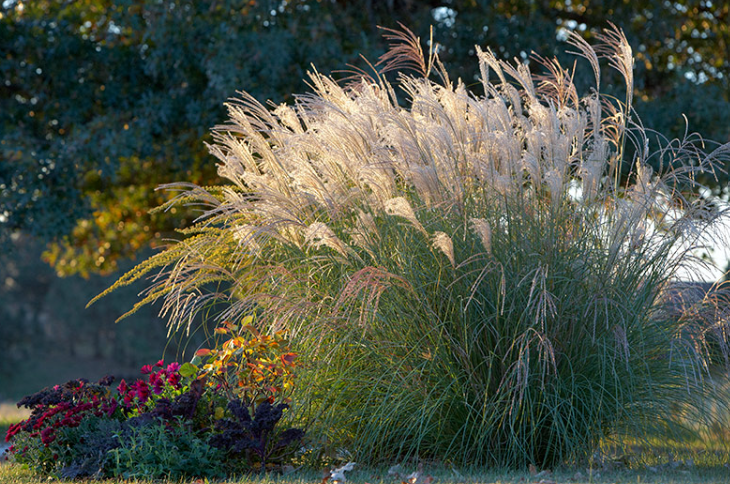
Maiden grass is the most widely planted perennial ornamental grass in American landscapes — a large, fountain-forming miscanthus whose arching, silver-green leaves reach five to seven feet and whose silky, copper to silver-pink flower plumes in late summer and autumn make it one of the most complete and seasonally rewarding perennial grasses available.
It returns reliably each spring with increasing vigor, and well-established clumps develop a commanding presence in the landscape that improves with each successive year. The warm, copper and gold autumn foliage and persistent silver-white winter plumes extend the ornamental contribution through all four seasons.
Over 40 named cultivars are commercially available, offering heights from three to eight feet, foliage colors from silver-green to variegated, and flowering times from midsummer to late autumn.
2. Karl Foerster Feather Reed Grass
Karl Foerster is the most important and widely specified perennial ornamental grass in contemporary landscape design — a narrow, upright, cool-season grass producing clean vertical columns of feathery, pink-tinged flower plumes in early June, maturing through golden wheat-buff to pale straw and persisting through winter.
Named the Perennial Plant of the Year in 2001 — the first grass ever to receive that honor — it combines strong vertical form, early summer flowering, exceptional cold hardiness to USDA Zone 4, and virtually year-round structural interest in a package requiring minimal annual maintenance.
It spreads very slowly and maintains its upright form without staking — qualities that make it particularly valuable in formal and semi-formal landscape settings where clean, precise structure is essential.
3. Switchgrass
Switchgrass is a North American native prairie grass of outstanding ornamental and ecological value — a warm-season perennial reaching four to six feet that supports over 200 native insect species, produces vivid red, burgundy, and gold autumn foliage colors, and contributes its airy, cloud-like flower heads to the landscape from midsummer through winter.
Research at the Land Institute in Kansas found that switchgrass roots store up to 2.7 tonnes of carbon per hectare per year in the soil — making it simultaneously one of the most ornamentally rewarding and ecologically important perennial grasses available.
The variety Shenandoah develops vivid early-season red coloration from midsummer, Northwind produces exceptionally stiff, upright, blue-green stems, and Heavy Metal delivers perfect, architectural uprightness — between them covering the full range of switchgrass landscape applications.
4. Big Bluestem
Big bluestem is the iconic grass of the North American tallgrass prairie, with roots documented at depths of eight to twelve feet and above-ground stems reaching four to eight feet. Its distinctive three-parted, turkeyfoot seed heads, vivid copper and burgundy autumn colors, and extraordinary ecological significance — it once covered 140 million acres of central North America — make it one of the most historically and ornamentally significant perennial grasses available.
The root-to-shoot biomass ratio of big bluestem typically exceeds three to four to one — meaning the underground root system outweighs the above-ground plant several times over. This deep root investment provides exceptional drought tolerance and soil carbon storage.
Varieties including Blackhawks (deep burgundy foliage) and Red October (vivid autumn red) have elevated its ornamental performance beyond the wild species while retaining all of its ecological value.
5. Pampas Grass
Pampas grass is one of the most immediately recognizable and dramatically impressive perennial ornamental grasses in the world — a large, clump-forming South American native whose towering, creamy-white to pink flower plumes can reach ten to thirteen feet in height on established plants, creating one of the most theatrical and imposing plant features available in the temperate landscape.
Established clumps can measure six to eight feet across and become permanent, commanding focal points that define the character of the surrounding landscape. The plumes persist through winter, providing months of dramatic interest in the dormant garden.
It is grown in over 80 countries worldwide and is one of the most commercially significant ornamental grasses in the global nursery trade — though its invasive tendencies in California, New Zealand, and parts of Australia require careful consideration before planting in those regions.
6. Little Bluestem
Little bluestem is one of the finest native perennial grasses for year-round landscape interest — modest in summer but transforming in autumn into one of the most brilliantly colored ornamental grasses available, with vivid shades of copper-red, burnt orange, and scarlet that persist through winter alongside fluffy white seed heads of considerable ornamental charm.
It reaches two to four feet — compact enough for smaller gardens and containers — and supports over 30 species of specialist native birds and insects. The root system extends five to eight feet into the soil despite the plant’s modest above-ground size, giving it exceptional drought tolerance.
Studies have shown that little bluestem-dominated plantings support significantly higher native bird populations than equivalent conventional lawn areas, reflecting the importance of its seed production and shelter value to wildlife through the winter months.
7. Japanese Forest Grass
Japanese forest grass is universally regarded as the finest perennial ornamental grass for shaded garden use — its cascading mounds of brilliantly variegated, gold-striped leaves creating a luminous, glowing effect in shaded positions that no other shade-tolerant grass can replicate.
The variety Aureola — with vivid yellow-gold and green-striped leaves — actually performs better in partial shade than in full sun, an unusual characteristic that makes it genuinely invaluable for the shaded garden where bold, bright color is so difficult to achieve. It reaches twelve to eighteen inches and develops warm copper and buff tones in autumn.
It is consistently rated among the top three perennial ornamental grasses in professional landscape designer surveys across both North America and the United Kingdom for its combination of ornamental excellence and shade-garden performance.
8. Blue Oat Grass
Blue oat grass is a cool-season perennial grown primarily for its striking metallic blue-grey foliage — one of the most intense and sustained blue colors available from any ornamental grass — that provides vivid color contrast in the landscape throughout spring and early summer, the cool blue-toned leaves combining beautifully with warm-toned and yellow flowering companions.
It grows to eighteen to twenty-four inches with strongly upright, narrow leaves and produces straw-colored, oat-like flower heads in early summer. The blue foliage is most intense in spring, fading somewhat in summer heat before reviving in the cooler conditions of autumn.
It is among the top five most popular blue-foliage ornamental plants in European garden center sales — a commercial position reflecting the consistent appeal of its intense, metallic blue color in mixed border and container planting.
9. Prairie Dropseed
Prairie dropseed is a fine-textured, graceful North American native perennial grass of exceptional ornamental quality — producing perfectly rounded, fountain-shaped mounds of extraordinarily fine, hair-like leaves and, in late summer, airy, branching flower heads of tiny spikelets releasing a distinctive, coriander-like fragrance that is unique among ornamental grasses.
It is one of the longest-lived and most self-sufficient of all perennial ornamental grasses — studies have documented established prairie dropseed plants that have been growing productively in the same location for over 30 years without division or significant management.
It requires two to three years to establish fully, during which time it invests heavily in root development, but once settled it becomes a virtually maintenance-free perennial of exceptional longevity and steadily improving beauty.
10. Blue Grama Grass
Blue grama is a native short-grass prairie perennial with one of the most distinctive and immediately recognizable seed head structures of any ornamental grass — the unique, comb-shaped, eyelash-like seed heads held horizontally on slender stems creating a curious, almost animated appearance that generates interest and comment wherever the grass is grown.
It reaches only eight to twelve inches in height with fine, curly, blue-green leaves — compact enough for rock gardens, containers, and the front of borders — but the root system extends four to six feet into the soil, giving it exceptional drought tolerance for its modest size.
Blue grama covers an estimated 130 million acres across the western United States, Canada, and Mexico — one of the most widespread native grass ecosystems in North America — and its compact garden forms bring the character of this vast landscape into the domestic garden.
11. Ribbon Grass
Ribbon grass — variegated reed canary grass — is a vigorous, spreading perennial with brightly variegated leaves striped in green and white that provides vivid, luminous foliage impact in moist, partially shaded landscape situations where its spreading habit can be managed within appropriate boundaries.
The clean, crisp white-and-green striped foliage is particularly bright in partial shade, and the plant tolerates the moist to wet conditions of stream margins and bog gardens better than most ornamental grasses. New foliage in spring has a particularly fresh and vivid appearance.
It spreads vigorously by rhizomes — a quality that makes it an effective and rapid ground cover for difficult moist sites but requires containment in more formal settings where its spreading habit could become problematic.
12. Tufted Hair Grass
Tufted hair grass is a cool-season perennial of considerable ornamental merit — producing some of the most delicate and translucent flower heads of any ornamental grass, with loose, open panicles of tiny, sparkling spikelets that shimmer and dance in the slightest movement of air with a crystalline, almost ethereal quality.
It is one of the few ornamental grasses with genuinely attractive flower heads that also performs well in partial shade — a combination of ornamental quality and shade tolerance that fills an important niche in the mixed border and woodland edge planting. It reaches two to three feet and produces its best display from June through autumn.
The influential German plantsman Karl Foerster was among the first to recognize and promote the garden value of tufted hair grass in the early 20th century, and his advocacy helped establish it as a cornerstone of European naturalistic garden design.
13. Giant Miscanthus
Giant miscanthus is one of the most dramatically scaled perennial ornamental grasses available — a vigorous species reaching ten to fourteen feet in a single growing season from an established root system and creating one of the most commanding large-scale landscape statements of any non-woody plant.
The broad, corn-like leaves with a distinctive white midrib create an immediately tropical-looking effect, and in warm climates the large, feathery flower plumes of late summer add a spectacular crowning display to the already impressive foliage. It is grown on a commercial scale as a biomass energy crop, with documented yields of fifteen to twenty tonnes of dry matter per hectare annually.
In the designed landscape it is used as a specimen, windbreak, or large-scale screen — its rapid height development providing effective privacy planting that established woody plants would take many years to achieve.
14. Indiangrass
Indiangrass is a tall, graceful North American native perennial prairie grass whose golden-yellow flower plumes — richly dusted with orange and red anthers when fully open in late summer — create one of the most beautiful and warm-toned flower displays of any ornamental grass, catching the autumn light with a richness and luminosity that is deeply evocative of the vast prairie landscape.
Research has shown that intact prairie grass plantings including indiangrass absorb rainfall up to six times faster than equivalent areas of conventional turfgrass — dramatically reducing surface runoff and demonstrating the extraordinary soil-health contribution of this deep-rooted native perennial.
It reaches four to six feet and the combination of golden flower plumes, vivid orange and copper autumn foliage, and persistent winter seed heads makes it one of the most seasonally complete native perennial grasses available to the landscape designer.
15. Pink Muhly Grass
Pink muhly grass is arguably the most spectacular-flowering perennial ornamental grass available in the American landscape — its extraordinary autumn display of vivid, pink-to-magenta, cloud-like flower plumes creating one of the most dramatic and celebrated seasonal events in the ornamental grass calendar.
The plumes appear in September and October, covering the entire plant in a shimmering cloud of vivid pink that seems almost fluorescent in the low autumn light. Highway plantings across Texas and the American South have become celebrated autumn landmarks, with visitors specifically seeking them out to witness the remarkable seasonal display.
It is drought-tolerant, pest-resistant, and essentially maintenance-free once established — growing to two to three feet in well-drained, sunny conditions.
16. Zebra Grass
Zebra grass is one of the most visually distinctive of all perennial miscanthus varieties — a large, arching grass with the unique characteristic of horizontal yellow-gold banding across each leaf blade, creating a pattern of warm-toned horizontal stripes quite unlike the vertical striping of most variegated grasses.
It reaches six to seven feet in height and produces reddish-copper flower plumes in late summer that age to silver-white through autumn. The horizontal banding creates a visual texture that is particularly effective when viewed from a distance, and the warm gold tones of the bands intensify as the season progresses.
It is one of the most photographed ornamental grasses in American gardens and botanical institutions, where its striking, unusual variegation pattern consistently generates attention and curiosity from garden visitors.
17. Mexican Feather Grass
Mexican feather grass is a cool-season perennial producing fine, hair-like, arching leaves and a near-continuous display of long, silky, silver-gold feathery awns from late spring through autumn — a plant of extraordinary grace and delicacy that provides a shimmering, animated quality in any breeze quite unlike any other perennial ornamental grass.
The fine, thread-like texture of Mexican feather grass makes it one of the most effective contrast plants in the landscape — its transparent, airy quality making neighboring bold-leaved plants appear stronger and more vivid. It is most beautiful when backlit by the low sun of morning or evening, when the individual awns glow with a warm, golden luminosity.
It should be noted that the species has naturalized and become invasive in parts of California and Australia, and gardeners in those regions should verify the availability of sterile non-invasive alternatives before planting.
18. Ravenna Grass
Ravenna grass is among the tallest and most dramatically impressive perennial ornamental grasses for temperate landscapes — its massive, silvery-white to pale pink plumes carried on stems reaching ten to fourteen feet above large, stout clumps of foliage that develop into permanent, commanding landscape features.
It is considerably more cold-hardy than pampas grass — tolerating temperatures down to -10°F (-23°C) — which makes it one of the best alternatives for gardeners in USDA Zones 6 and 7 who want a large-plumed, dramatic perennial grass of equivalent scale to pampas but with greater climatic tolerance.
Established clumps can measure five to eight feet across at the base and persist in the landscape for decades, becoming increasingly impressive landscape specimens with each passing year.
19. Calamagrostis ‘Karl Foerster’
While the standard Karl Foerster has already been discussed, the broader calamagrostis — feather reed grass — family offers several other outstanding perennial varieties including Overdam (cream-variegated foliage), Stricta (similar upright form, later-flowering), and Avalanche (bold white-striped leaves) that collectively represent one of the most important groups of perennial ornamental grasses for formal and structured landscape situations.
The family’s defining characteristic — the strongly upright habit that resists wind damage and maintains architectural structure through all seasons — makes it uniquely valuable for formal planting designs where precision and structural reliability are non-negotiable requirements. All are reliably hardy to USDA Zone 4 or lower.
Studies of ornamental grass landscape maintenance found that calamagrostis varieties require less intervention and repair than any other tall grass family — an important practical consideration in professional landscape management where ongoing maintenance costs are a significant factor.
20. Fountain Grass (Dwarf Hameln)
Dwarf Hameln fountain grass is the most compact and container-appropriate of the perennial fountain grasses — a well-behaved, tidy perennial producing dense, mounding plants with arching leaves and attractive, creamy-white to pinkish bottlebrush flower plumes from midsummer through autumn on a plant of ideal proportions for smaller borders, mass plantings, and container use.
It reaches eighteen to twenty-four inches — significantly more compact than standard fountain grass — and the combination of a dense, rounded mound with attractive arching leaves and generous flower plumes provides a self-contained ornamental display of considerable quality. The foliage turns warm gold in autumn.
Hameln is one of the top three best-selling perennial ornamental grasses in American and European garden centers, and its consistent availability and reliable performance across a wide range of growing conditions have made it a standard component of professional and amateur planting schemes alike.
21. Prairie Cord Grass
Prairie cord grass is a tall, robust North American native perennial of wetland and moist prairie habitats whose distinctive, comb-like flower spikes in late summer — the flat, one-sided arrangement of spikelets creating a precise, linear flower structure of striking character — make it one of the most architecturally interesting of all native wetland perennial grasses.
It reaches five to eight feet and its root system extends eight to ten feet into moist soils, making it one of the most effective stream bank and wet slope stabilization plants available in the native grass palette. Research from the Chicago Botanic Garden found prairie cord grass root systems fully established to maximum depth within two growing seasons.
It was one of the primary grasses used in the restoration of Chicago Botanic Garden’s native plant landscapes — one of the most extensive and influential native planting projects in North American horticultural history.
22. Lyme Grass
Lyme grass is a cool-season perennial with some of the most intense and vivid blue-grey foliage of any ornamental grass — the broad, stiff, ribbon-like leaves a vivid metallic blue that provides outstanding color contrast in sunny border and landscape situations and makes it one of the most striking foliage perennials in the cool-season grass palette.
It spreads aggressively by rhizomes — an important management consideration — but this spreading energy makes it one of the most effective and rapid perennial ground covers for large-scale sandy soil stabilization and coastal dune planting. It is one of the most important sand-binding grasses in its native coastal European habitat.
In contained situations — large borders with physical root barriers, or large containers — the vivid blue foliage makes it one of the most visually impactful perennial grasses available for providing bold, sustained color.
23. Eulalia Grass
Eulalia — a term applied to several miscanthus species — includes some of the finest and most ornamentally diverse perennial ornamental grasses available, with varieties covering a range of heights from compact three-foot forms to tall eight-foot specimens, and foliage colors from green through variegated white-striped and gold-banded forms.
The species as a whole represents the foundation of the modern ornamental grass landscape movement — miscanthus was among the primary grasses used by Wolfgang Oehme and James van Sweden in their groundbreaking naturalistic American landscapes of the 1980s and 1990s that introduced ornamental grasses to mainstream landscape design.
The collective commercial importance of eulalia grass varieties in the ornamental grass market is estimated to represent approximately 30 to 35 percent of all ornamental grass sales in the United States — making it by far the most commercially significant ornamental grass genus in the American nursery trade.
24. Tufted Fescue
Tufted fescue is a compact, fine-leaved, cool-season perennial forming neat, rounded tussocks of narrow, deep green to blue-green leaves — a grass of considerable practical usefulness and understated ornamental quality that provides reliable, low-maintenance ground coverage in rock gardens, border edges, and container plantings across a wide range of growing conditions.
It tolerates drought, poor soils, and exposed positions with remarkable resilience — a direct reflection of its origins in rocky, infertile mountain habitats across Europe and western Asia. The fine, dense tussocks provide effective weed suppression while the compact, self-contained habit requires minimal management.
It is one of the most widely used perennial grasses in European rock garden and alpine planting, where its tolerance of thin, well-drained soils and its neat, tussock-forming habit suit the aesthetic and growing conditions of rock garden situations.
25. Hairy Wood Brome
Hairy wood brome is a cool-season woodland perennial grass producing wide, flat, bright green, softly hairy leaves and graceful, nodding flower panicles of considerable ornamental charm in spring and early summer — one of the most elegant and naturally woodland-appropriate perennial grasses for shaded planting situations.
It grows to two to three feet and tolerates quite deep shade, performing well in the under-canopy of established deciduous trees where its broad, flat leaves and nodding flower heads create an authentically woodland-floor character that suits naturalistic woodland garden design.
The softly hairy texture of the leaves — unusual in the grass world — gives the plant a tactile quality that adds to the sensory experience of the garden, and the nodding flower heads catch whatever light is available in shaded positions with a delicate, trembling movement.
26. Northern Sea Oats
Northern sea oats is a shade-tolerant native perennial grass of eastern North American woodland streambanks — producing attractive, broad, flat leaves and distinctive, flattened, oat-like seed heads that hang from the arching stems in loose, elegant clusters and rattle pleasantly in the breeze through summer, autumn, and winter.
The seed heads are among the most ornamentally interesting and long-lasting of any native grass — turning from green through golden-bronze to warm tan as the season progresses, and persisting through winter to provide structural interest against snow. It tolerates shade, moisture, and the root competition of established trees remarkably well.
Northern sea oats self-seeds prolifically in appropriate conditions — a quality that allows it to naturalize in woodland settings but requires management in more formal situations where spontaneous seedlings might become excessive.
27. Autumn Moor Grass
Autumn moor grass is a semi-evergreen, fine-leaved perennial that produces arching, narrow mounds of bright green foliage and, in late summer and autumn, tall, airy, purple-tinged flower spikes that catch the low autumn light with a delicate, sparkling quality — one of the few grasses that genuinely improves its performance in partial shade compared to full sun.
It reaches two to three feet in flower and produces its best display in the late-season garden when many other plants are fading — extending the ornamental grass season with its late-season flower spikes and the warm golden tones of the autumn foliage. It is typically a relatively short-lived perennial of three to five years but self-seeds freely.
Its combination of fine texture, attractive late-season flower spikes, and good shade tolerance makes it one of the most complete and seasonally interesting of all the smaller shade-tolerant perennial ornamental grasses.
28. Sideoats Grama
Sideoats grama is the official state grass of Texas — a fine-leaved native perennial prairie grass whose unique, one-sided arrangement of small, dangling, oat-like spikelets along each flower stem creates one of the most distinctive and elegant seed head structures in the native grass world, with the seeds hanging uniformly on one side of each arching stem like a row of tiny flags.
It reaches two to three feet and is one of the most drought-tolerant of all native perennial grasses — its roots extending five to seven feet into the soil to access deep moisture. Studies from the Texas Department of Transportation have shown sideoats grama successfully establishing on over 90 percent of highway revegetation seedings in appropriate climates — one of the highest success rates of any native grass in roadside restoration programs.
The distinctive seed head structure, combined with the fine foliage texture, good autumn color, and exceptional ecological value, makes sideoats grama one of the most ornamentally interesting and practically valuable native perennial grasses for the sustainable, low-water landscape.