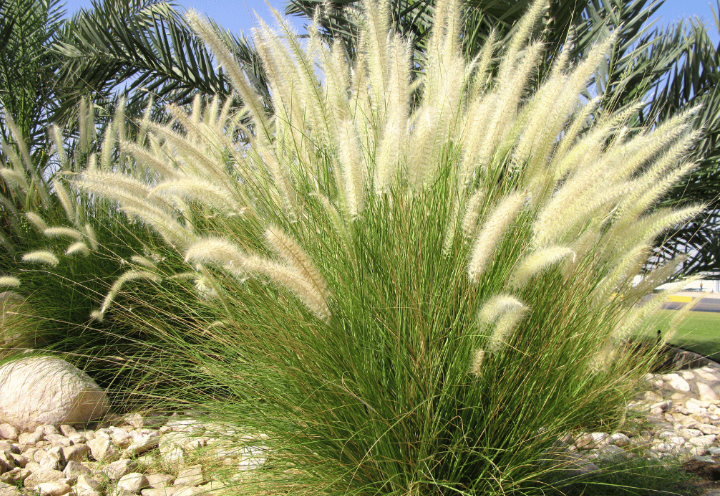
Few plant features in garden and landscape design are as universally captivating as the feathery, plumed tops of tall grasses catching the light on a late summer or autumn afternoon. That shimmering, translucent quality — the way a mass of feathery grass plumes seems to glow from within when backlit by low sun — is one of the most evocative and visually distinctive effects in all of horticulture. It is a quality that no flowering plant, no shrub, and no tree can replicate in quite the same way.
Feathery-topped tall grasses have their plumes produced as flower and seed head structures — the airy, branching panicles or dense, silky spikes that emerge above the foliage in summer and autumn and persist, often with remarkable staying power, through winter and into the following spring. These structures serve the grass’s reproductive purpose, but their secondary value as ornamental features has made them among the most important design elements in naturalistic and contemporary garden planting.
Globally, the popularity of naturalistic planting styles — the New Perennial Movement, prairie planting, meadow gardening — has placed feathery-topped grasses at the very center of garden design discourse. Designers such as Piet Oudolf, whose landscapes at the High Line in New York and Lurie Garden in Chicago have been seen by millions of visitors, have built entire planting philosophies around the combination of tall, feathery grasses with bold perennials. Studies suggest that landscapes incorporating tall ornamental grasses reduce maintenance costs by up to 50 percent compared to traditional planting schemes of equivalent scale.
The range of feathery-topped tall grasses available to the gardener and landscape designer is extensive, spanning cool-season and warm-season species, native and introduced plants, and heights ranging from a modest three feet to a genuinely towering fifteen feet or more. What they share is that defining quality of lightness — the way their feathery tops dissolve the boundary between grass and sky and bring the garden to life with every movement of the air.
Grass With Feather Like Tips
Pampas Grass
Pampas grass produces some of the largest and most spectacular feathery plumes of any grass in the world — dense, silky, creamy-white to pale pink flower heads that can reach two to three feet in length on established plants, carried on stems that rise to ten to thirteen feet in height.
The plumes appear in late summer and persist through winter, maintaining their ornamental value for five to six months. Each established clump can produce dozens of individual plumes simultaneously, creating a breathtaking display of soft, luminous white that is visible from great distances.
It is one of the most widely recognized ornamental grasses on earth — surveys suggest it is grown in over 80 countries worldwide — though its invasive tendencies in some regions require careful consideration before planting.
Maiden Grass
Maiden grass is the quintessential feathery-topped landscape grass — a large, fountain-forming miscanthus that produces silky, copper to silver-pink flower plumes in late summer and autumn, maturing to soft silver-white that persists attractively through winter.
The plumes are held three to four feet above the top of the foliage mound on slender, arching stems, creating an overall plant height of six to eight feet at flowering. The combination of graceful, arching foliage and shimmering feathery plumes makes it one of the most complete and visually satisfying of all ornamental grasses in the landscape.
Over 40 named cultivars of maiden grass are commercially available, each offering slightly different plume colors, flowering times, and foliage characteristics.
Karl Foerster Feather Reed Grass
Karl Foerster is unique among feathery-topped grasses for the particular combination of its early flowering time and narrow, upright form — the feathery, pink-tinged plumes emerging in June, considerably earlier than most large ornamental grasses, and held in clean, vertical columns rather than the arching, sprawling forms of miscanthus.
The plumes age from soft pink-purple in early summer through golden wheat-buff in autumn to pale straw in winter, providing a full season of changing color and texture from a single plant. The upright habit and early flower make it one of the most structurally useful feathery grasses for formal and semi-formal landscape situations.
It was named Perennial Plant of the Year in 2001 — the first grass ever to receive that honor — a recognition that reflects its outstanding all-round landscape performance.
Ravenna Grass
Ravenna grass is among the tallest hardy feathery-topped grasses available to landscape designers — its massive, silvery-white to pale pink plumes carried on stems reaching ten to fourteen feet, creating a scale of presence that very few other herbaceous plants can approach.
The plumes are large, dense, and feathery, appearing in late summer and persisting through autumn and much of winter, providing an extended period of dramatic display at extraordinary height. Established clumps can measure six to eight feet across at the base, developing into permanent, commanding landscape features.
It is considerably more cold-hardy than pampas grass — tolerating temperatures down to -10°F (-23°C) — which makes it one of the best alternatives for gardeners in colder climates who want a large-plumed feathery grass of equivalent drama.
Giant Feather Grass
Giant feather grass is perhaps the most purely beautiful of all the feathery-topped grasses — a cool-season species that produces in early summer extraordinarily long, silky awns extending from each seed in long, silvery, hair-like filaments that shimmer and ripple in the lightest breeze with a breathtaking, translucent beauty.
The individual awns can reach eighteen to twenty-four inches in length — longer than the leaf blades themselves — and a well-established clump in full display in June or July is one of the most extraordinary sights the garden produces all year. The plant reaches four to six feet in flower.
It requires a position where the low morning or evening light can backlight the silky plumes — the effect of the sun shining through hundreds of shimmering, golden-silver awns simultaneously is genuinely spectacular and unlike anything else in the plant world.
Switchgrass ‘Northwind’
Switchgrass produces airy, delicate, cloud-like flower and seed head displays of great subtlety and refinement — not the large, dense plumes of miscanthus or pampas grass, but an open, branching, mist-like flower structure of tiny spikelets that creates a translucent, hazy curtain of soft color above the strong, upright foliage.
Northwind in particular reaches five to six feet with exceptionally stiff, blue-green, wind-resistant stems that hold their structure through storms that would flatten less robust grasses. The airy seed heads turn warm gold through autumn, and the entire plant — foliage and feathery tops together — develops rich red and burgundy autumn colors.
Switchgrass supports over 200 native insect species in North America, making its feathery seed heads an important food source for birds and insects as well as a beautiful landscape feature.
Big Bluestem
Big bluestem produces one of the most distinctive and immediately recognizable seed head structures of any North American grass — the three-parted, turkeyfoot-shaped heads rising above the tall foliage in autumn, catching the light in warm tones of red, bronze, and gold that are deeply evocative of the vast prairie landscape from which this grass comes.
The plant reaches five to eight feet in height with the seed heads adding further height above the foliage, and the combination of rich autumn foliage coloring and warm-toned feathery tops creates one of the finest late-season ornamental displays available from any native grass.
Big bluestem once covered an estimated 140 million acres of central North America before the conversion of the tallgrass prairie to agricultural land — an area representing one of the greatest ecosystem losses in the continent’s history.
Purple Fountain Grass
Purple fountain grass produces distinctive, bottlebrush-shaped flower plumes in deep burgundy to rosy-pink — one of the most vivid and colorful feathery plume displays available from any tall ornamental grass — carried gracefully on arching stems above the rich, burgundy-purple foliage.
The plumes are dense and softly bristled rather than open and airy, giving them a tactile, velvety quality quite different from the looser plumes of miscanthus and switchgrass. They appear in summer and persist through autumn, providing months of vivid color from a plant that also contributes outstanding foliage color throughout the growing season.
It grows to three to five feet and is one of the most popular ornamental grasses worldwide for warm-climate landscaping, container growing, and use as a summer annual in cooler climates.
Tufted Hair Grass
Tufted hair grass produces some of the most delicate and translucent feathery flower heads of any shade-tolerant ornamental grass — loose, open panicles of tiny, sparkling spikelets arranged on thread-like branches that shimmer and tremble in the slightest movement of air with a crystalline, almost ethereal quality.
The flower heads appear in early to midsummer — earlier than most large ornamental grasses — and persist through autumn and into winter, fading from green through golden-straw to pale buff. They are particularly beautiful when backlit by low sun, when the individual spikelets catch the light and the entire flower head seems to dissolve into a shimmering, luminous cloud.
It reaches two to three feet in flower and is one of the few ornamental grasses with genuinely attractive flower heads that also performs well in partial shade.
Indiangrass
Indiangrass produces one of the most beautiful feathery flower displays of any native North American grass — the golden-yellow plumes, rich with orange and red anthers when fully open in late summer, catching the autumn light with a warm richness and luminosity that is among the finest seasonal sights in the naturalistic landscape.
The plumes are held above the foliage on stems reaching four to six feet, and their warm, golden-toned feathery structure provides a perfect complement to the deep orange and copper autumn foliage that develops on the leaves simultaneously. The combination is one of the most complete and visually rich of any native grass.
It is an important component of traditional tallgrass prairie plant communities, and prairie restoration plantings including indiangrass consistently record significantly higher biodiversity scores than monoculture grass plantings.
Silver Spike Grass
Silver spike grass is a cool-season ornamental grass with a distinctive, dense, cylindrical flower spike — not a loose, airy plume but a compact, bottlebrush-shaped structure of soft, silvery-white spikelets that creates an effect of dense, luminous silver above the narrow, blue-green foliage.
The spikes appear in early summer, are held on upright stems at two to three feet, and have an almost metallic, reflective quality in the right light — particularly effective against dark backgrounds such as evergreen hedges or dark stone walls where the silver color is shown to maximum advantage.
It is a compact grass well suited to smaller landscape situations and garden borders where a tall-plumed grass of restrained scale is needed alongside larger neighbors.
Giant Chinese Silver Grass
Giant Chinese silver grass is a particularly large and imposing miscanthus species — reaching eight to ten feet in height — that produces large, open, feathery flower plumes of soft silver-pink to creamy-white in early to mid-autumn, just as the foliage begins to take on its warm amber and orange autumn tints.
The plumes are looser and more open than those of standard maiden grass, with a more delicate, airy character that creates a feathery, cloud-like effect at great height — one of the most impressive large-scale ornamental displays available from any herbaceous plant in the late-season landscape.
It is a plant for large-scale landscape situations — gardens and parks where its considerable size and spreading habit can be accommodated without it overwhelming its surroundings.
Lyme Grass
Lyme grass is a bold, strongly upright, cool-season grass with some of the most intense blue-grey foliage of any ornamental grass — the broad, stiff, ribbon-like leaves a vivid metallic blue that provides outstanding color contrast in the landscape — and produces tall, upright, wheat-like feathery flower spikes in summer that add a vertical, architectural element above the remarkable foliage.
It reaches four to five feet in flower and spreads aggressively by rhizomes — a quality that makes it excellent for large-scale stabilization of sandy soils, coastal dunes, and difficult slopes but requires containment in more formal garden settings. It is one of the most important sand-binding grasses in its native coastal European habitat.
The combination of vivid blue foliage and upright feathery flower spikes makes it one of the most visually striking of all cool-season grasses in the summer landscape.
Mexican Feather Grass
Mexican feather grass is one of the most graceful and delicate of all tall feathery grasses — producing fine, hair-like, arching leaves and an almost continuous display of long, silky, silver-gold feathery awns from late spring through autumn that give the entire plant a shimmering, luminous, mist-like quality in any sunlight or breeze.
It grows to two to three feet — smaller than many grasses in this category — but the extraordinary fineness of its leaves and the persistent, glowing quality of its feathery seed heads give it a presence in the landscape disproportionate to its modest height. It is at its most beautiful when backlit by the low sun of morning or evening.
It has become naturalized and is considered invasive in parts of California and Australia, and locally appropriate non-invasive alternatives should be considered in those regions.
Prairie Cord Grass
Prairie cord grass is a tall, robust, warm-season native grass of North American wetlands and moist prairies that produces upright, corn-like foliage reaching five to eight feet and distinctive, comb-like feathery flower spikes in late summer — the flat, one-sided arrangement of spikelets creating a flower structure of striking and unusual character.
The feathery spike structure is more architectural and linear than the open plumes of miscanthus, with a precise, geometric regularity that is particularly effective in formal naturalistic planting schemes. The plant spreads by rhizomes and is one of the most effective native grasses for stabilizing wet soils, stream banks, and rain garden margins.
It was one of the primary grasses used in the natural restoration of the Chicago Botanic Garden’s native plant landscapes — one of the most extensive and influential native planting projects in North American horticultural history.